
Honed Versus Polished Stone: Which Finish Fits Your Countertops?
A finish can change the character of the same slab more than many homeowners expect. In the honed versus polished stone decision, the material may be identical, but the surface can look brighter, softer, busier, or more relaxed depending on how it reflects light. That difference also affects what you notice day to day, from water spots around a sink to fingerprints on a dark island.
For countertops, the right answer is rarely simply “polished for durability” or “honed for a modern look.” The stone type, slab colour, room lighting, intended use, and maintenance expectations all matter. It is also worth confirming that your selected material is available in the finish you want before finalizing a slab layout or fabrication plan.
Quick Answer: Polished stone has a glossy, reflective surface that typically enhances colour and veining. Honed stone has a smooth, low-sheen appearance that softens reflections and creates a more understated look. Neither finish is automatically more durable. The better choice depends on the stone, how the countertop will be used, and which everyday marks you are comfortable maintaining.
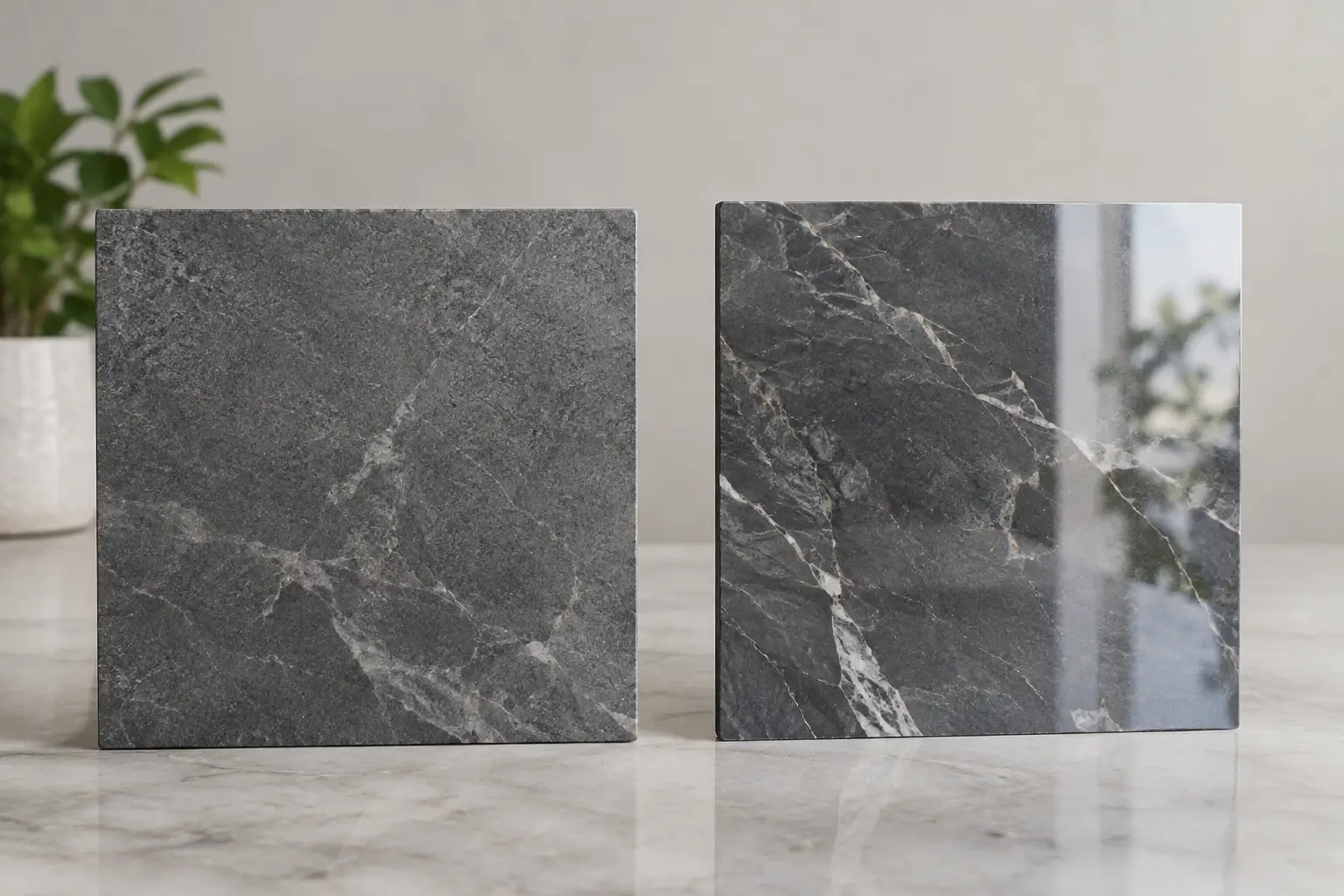
What Is the Difference Between Honed and Polished Stone?
A polished finish has a glossy, reflective surface. Light bounces off it, which can deepen colour, sharpen veining, and make a countertop feel more formal or dramatic. Polishing is common on granite, marble, quartzite, and many engineered surfaces, although the exact sheen varies by product and manufacturer.
A honed finish is ground to a smooth surface with little to no shine. It is not rough, unfinished, or necessarily textured. Instead, it has a low-sheen, satin-like appearance that diffuses light. On a highly veined marble or quartzite, honing can give the slab a quieter, more natural-looking presence.
Most countertop slabs arrive with a factory-applied finish before fabrication begins. Some natural stone can be professionally refinished, but changing the finish after installation is a separate restoration process, not a simple adjustment. Engineered products may have manufacturer restrictions that make refinishing unsuitable.
That is why viewing a full slab, or at least a large finish sample under realistic lighting, is more useful than choosing from a small colour chip alone.
Honed vs. Polished Stone: Side-by-Side Comparison
| Feature | Honed Stone | Polished Stone |
|---|---|---|
| Appearance | Matte, satin, or low-sheen | Glossy and reflective |
| Colour and veining | Often appears softer and more subdued | Often appears deeper and more pronounced |
| Light reflection | Diffuses light and reduces glare | Reflects windows and overhead lighting |
| Fingerprints and oils | Can show oils and handling marks, especially on dark surfaces | Can show smudges and fingerprints under reflected light |
| Scratches and etching | Some marks may blend into the lower sheen | Changes in gloss may be more noticeable |
| Cleaning | May require extra attention to oily residue or streaking | Generally easy to wipe, but water spots may be visible |
| Sealing | Depends on material and absorption | Depends on material and absorption |
| Design character | Understated and softly reflective | Bright, defined, and reflective |
The comparison describes common visual tendencies, not guaranteed performance. A dark honed granite, a light polished quartzite, and a matte engineered quartz can behave quite differently. Always evaluate the specific product and finish rather than relying on the finish name alone.
Honed Versus Polished Stone in Everyday Use
The visual difference is immediate, but daily use is where each finish has its trade-offs.
A polished surface reflects windows, pendant lights, and cabinet colours. This can make a kitchen feel brighter, especially where natural light is limited. It can also reveal smudges, fingerprints, and water droplets more readily on dark or solid-coloured materials.
A honed surface hides reflections, so it often feels calmer in a large kitchen, waterfall island, or full-height backsplash. It may be more forgiving of fingerprints and minor wipe marks, particularly in lighter colours or patterned stone.
However, honed dark stone can show hand oils, moisture marks, or residue from cleaning products. The idea that honed automatically hides everything is not always true.
Neither finish eliminates the need for routine care. Wiping spills, using a pH-neutral cleaner suitable for the material, and avoiding abrasive pads are sensible practices for both. The correct cleaning and sealing recommendations depend on the specific material, not the finish alone.
Does Honed Stone Stain More Easily?
Honed stone can sometimes be more absorbent than a polished version of the same natural stone, but this is not universal. The stone’s mineral composition, pore structure, finishing process, and any factory treatment all influence absorption.
A polished finish may reduce surface absorption on some stones, but polishing does not replace sealing where sealing is recommended. Similarly, a honed finish does not automatically mean a countertop will stain easily.
For natural stone, ask whether the selected slab needs sealing and how its absorption has been assessed. For engineered quartz, porcelain, and sintered surfaces, follow the manufacturer’s maintenance instructions rather than applying a natural stone sealer without confirmation.
Which Finish Shows Scratches More?
Scratches can appear differently depending on the finish. On a polished surface, a scratch may interrupt the reflection and become visible under direct light. On honed stone, a scratch may blend into the softer sheen, although some scratches can create a contrasting mark.
Neither finish changes the underlying mineral hardness of the stone. Granite and quartzite generally offer better scratch resistance than marble, but performance varies by the specific material.
Finish selection should not be treated as a substitute for choosing a material suitable for the way your kitchen is used.
How Different Countertop Materials Respond to Each Finish
Marble: Appearance and Etching
Marble is one of the clearest examples of how finish changes the experience of a countertop.
Because marble commonly contains calcite, acidic foods and drinks can cause marble to etch. Etching is a chemical change to the stone surface, not the same as an absorbed stain.
On polished marble, etching may appear as a dull spot against a glossy background. On honed marble, similar etching can be less visually obvious because the surface already has a softer sheen.
That does not mean honed marble cannot etch. It can. A honed finish may simply make the mark blend in more naturally.
Some homeowners prefer this because they expect a marble kitchen to develop character over time. Others prefer polished marble because they want the stone’s colour and movement to appear more pronounced.
For additional advice on preventing stains and managing everyday use, see our guide on how to protect marble counters.
Granite: Colour Depth and Surface Texture
Polished granite often brings out the depth of dark minerals, crystals, and natural movement. Black and dark grey granite can appear particularly rich under a polished finish.
Honed granite offers a softer appearance, but dark honed slabs may show fingerprints, oils, and moisture marks more readily than expected. Some materials sold with leathered or brushed finishes have a noticeable texture and should not be confused with smooth honed granite.
If you are considering granite countertops, compare the actual finish options available for your chosen slab. Not every granite colour is stocked in both honed and polished finishes.
Quartzite: Natural Movement and Finish Availability
Quartzite can display dramatic veining, crystalline movement, and subtle colour variations. A polished finish often emphasizes those features, while honing can soften the overall appearance.
Because natural stone sold as quartzite varies in composition and performance, the specific slab should be evaluated for absorption, acid sensitivity, and maintenance requirements.
Not every quartzite is available in a factory-honed finish. Refinishing a polished slab may be possible through specialized processing, but it can affect cost, scheduling, and material handling.
Explore our quartzite countertop options and review the quartzite countertop care guide for maintenance considerations.
Engineered Quartz: Matte and Polished Options
Engineered quartz is often available in polished, suede, matte, or other manufacturer-specific finishes. Not every colour is produced in every finish.
Matte or honed-look quartz can be appealing for contemporary kitchens, but darker matte options may show fingerprints, oil, or cleaning streaks more than expected.
Unlike natural stone, engineered quartz generally does not require routine sealing. Its resin-based composition and manufacturer-applied finish also mean that traditional stone polishing or refinishing methods may not be appropriate.
Ask to see a larger sample and handle it before making a final selection. You can also explore our quartz countertop collections to compare available colours and finishes.
Porcelain and Sintered Stone
Porcelain and sintered stone come in a range of finishes, including polished, matte, silk, and textured options.
The names are not standardized across manufacturers, so a “matte” finish from one collection may feel or look different from another.
For countertop applications, technical documentation and the intended location should guide the selection. Some polished products may have different stain-cleaning or surface-care requirements than their matte counterparts.
Special attention is also needed for exposed edges, cutouts, and fabrication methods. The finish does not eliminate the need for correct handling and installation.
Our porcelain slab countertops review explains the broader advantages, limitations, and fabrication considerations of this material.
How the Finish Changes Your Kitchen Design
A polished finish tends to intensify visual movement. White marble with grey veining can look crisp and luminous when polished, while dark granite may appear richer and more reflective.
In a kitchen with simple cabinetry, that shine can provide welcome contrast.
Honed stone softens reflected light. It works well when the goal is a more restrained surface, particularly beside matte cabinetry, brushed metal hardware, plaster-style walls, or warm wood tones.
It can also make a dramatic stone pattern feel less busy across a large island or full-height backsplash.
Lighting Makes a Difference
Consider the room as a whole. A polished countertop under bright recessed lighting can create noticeable glare, especially on a large island positioned beneath multiple fixtures.
A honed surface may reduce those reflections and produce a more consistent appearance throughout the day.
Before ordering, examine finish samples near a window and under artificial lighting. If possible, view them both horizontally and vertically. A slab may look different when used as a countertop compared with a backsplash.
Cabinet Colour and Veining
Finish selection should complement the surrounding materials rather than compete with them.
Polished stone can provide contrast against flat-panel matte cabinetry. Honed stone can create a more continuous, understated appearance beside natural wood or softly finished cabinet doors.
For heavily veined slabs, review the full pattern before choosing a finish. Our guide on how to match countertop veining explains why vein direction and slab positioning matter across adjoining surfaces.
Fabrication Details Still Matter
The surface finish is only one part of the finished countertop. Vein direction, seams, edge treatment, sink cutouts, and overhang support have just as much influence on the final result.
Matching the Edge Finish
A polished slab may have a polished edge profile to match its face. With honed material, fabricators need to consider how the chosen edge will be finished so it looks consistent with the top surface.
Simple eased countertop edges are often a natural fit for either finish, while more detailed profiles can change how light catches the edge.
Exposed edges should be reviewed before fabrication, especially when the project involves a thick-looking mitered edge, waterfall leg, or detailed profile.
Seams, Veining, and Waterfall Panels
For veined stone, the slab layout should be reviewed before fabrication.
A honed finish can make movement appear softer, but it does not remove the need to plan vein flow across an island, backsplash, waterfall leg, or seam.
If a project includes a mitered edge or waterfall countertop, the available slab size and vein orientation may affect both the layout and material yield.
Seam locations should also be planned around slab dimensions, access, structural support, and appearance. See our guide to countertop seam options for a closer look at those decisions.
Sink Cutouts and Overhangs
Sink selection deserves attention as well. Undermount sinks create a clean transition with either finish, but the cutout edge and sink reveal should be discussed during templating.
Larger sink openings, cooktop cutouts, narrow rails, and unsupported overhangs all require proper fabrication planning regardless of whether the stone is honed or polished.
The selected finish may influence appearance and cleaning, but it does not change the need for adequate structural support and suitable fabrication methods.
Which Finish Is Best for Your Project?
Choose polished stone if you want stronger colour, visible veining, and a reflective surface that contributes to a brighter look.
It can be especially effective for a statement island, bathroom vanity, or backsplash where the stone’s movement is the focal point. Be prepared to see water spots and fingerprints more readily on certain colours, particularly dark polished surfaces.
Choose honed stone if you prefer a low-sheen appearance and a softer relationship with light.
It often suits kitchens with matte finishes, natural materials, and a quieter overall palette. Before deciding, inspect the actual sample for fingerprints, water marks, and how it looks under your home’s lighting.
This is particularly useful with dark honed quartz, black granite, and honed marble.
If you are choosing natural stone, accept that it will have material-specific behaviour. A polished marble vanity may be a reasonable fit for a bathroom where acidic products are carefully managed, while a honed marble kitchen may appeal to someone comfortable with visible use over time.
A patterned granite or quartzite may be practical in either finish, but the specific slab should lead the decision.
What to Check Before Ordering
Before confirming a honed or polished countertop, review these five details with your fabricator:
- Finish availability: Confirm the selected slab or product is actually available in the desired finish.
- Realistic lighting: Compare large samples in natural and artificial light.
- Everyday maintenance: Check how the surface responds to water, fingerprints, and suitable cleaning products.
- Edge consistency: Confirm exposed edges and cutouts can be finished to match the main surface.
- Material requirements: Ask about sealing, care restrictions, and any manufacturer-specific instructions.
These checks can prevent an expensive finish decision from being made based on appearance alone.
Frequently Asked Questions About Honed and Polished Stone
Is honed stone better than polished stone for kitchen countertops?
Neither finish is universally better. Honed stone provides a softer, low-sheen appearance, while polished stone emphasizes colour and reflects more light. The best option depends on the countertop material, lighting, cleaning expectations, and how the kitchen is used.
Does honed stone need to be sealed more often?
Not necessarily. Some honed natural stones may absorb liquids more readily than polished versions, but sealing frequency depends on the specific slab, absorption, sealer, and use. Engineered quartz and many porcelain or sintered products generally do not require routine sealing.
Does polished stone scratch more easily?
Polishing does not automatically make stone softer or easier to scratch. However, scratches can be more noticeable when they interrupt a glossy reflection. The material’s hardness and composition are more important to scratch resistance than the finish alone.
Can polished stone be changed to honed after installation?
Some natural stone countertops can be professionally refinished from polished to honed, but the process requires specialized equipment and may be difficult around edges, sinks, and backsplashes. Engineered quartz, porcelain, and sintered stone may not be suitable for this treatment. It is usually better to choose the desired finish before fabrication.
Which finish is easier to keep clean?
Both can be straightforward to maintain with appropriate cleaning products. Polished surfaces may show water spots and fingerprints under reflected light, while certain honed or matte surfaces may retain visible oils or cleaning streaks. The easiest finish to maintain depends on the material, colour, surface texture, and household habits.
Compare Stone Finishes Before Your Countertop Is Fabricated
The best way to decide between honed and polished stone is to view the surface at a useful scale, compare finishes side by side, and discuss the intended application before templating.
Stone Valley Countertops helps homeowners across Mississauga, Toronto, Durham Region, Niagara Region, and surrounding Ontario communities evaluate slab movement, finish availability, edge details, and practical maintenance considerations.
Visit one of our showrooms in Mississauga, Bowmanville, Welland, or Orillia to explore available surfaces, or contact Stone Valley Countertops to discuss your project.