
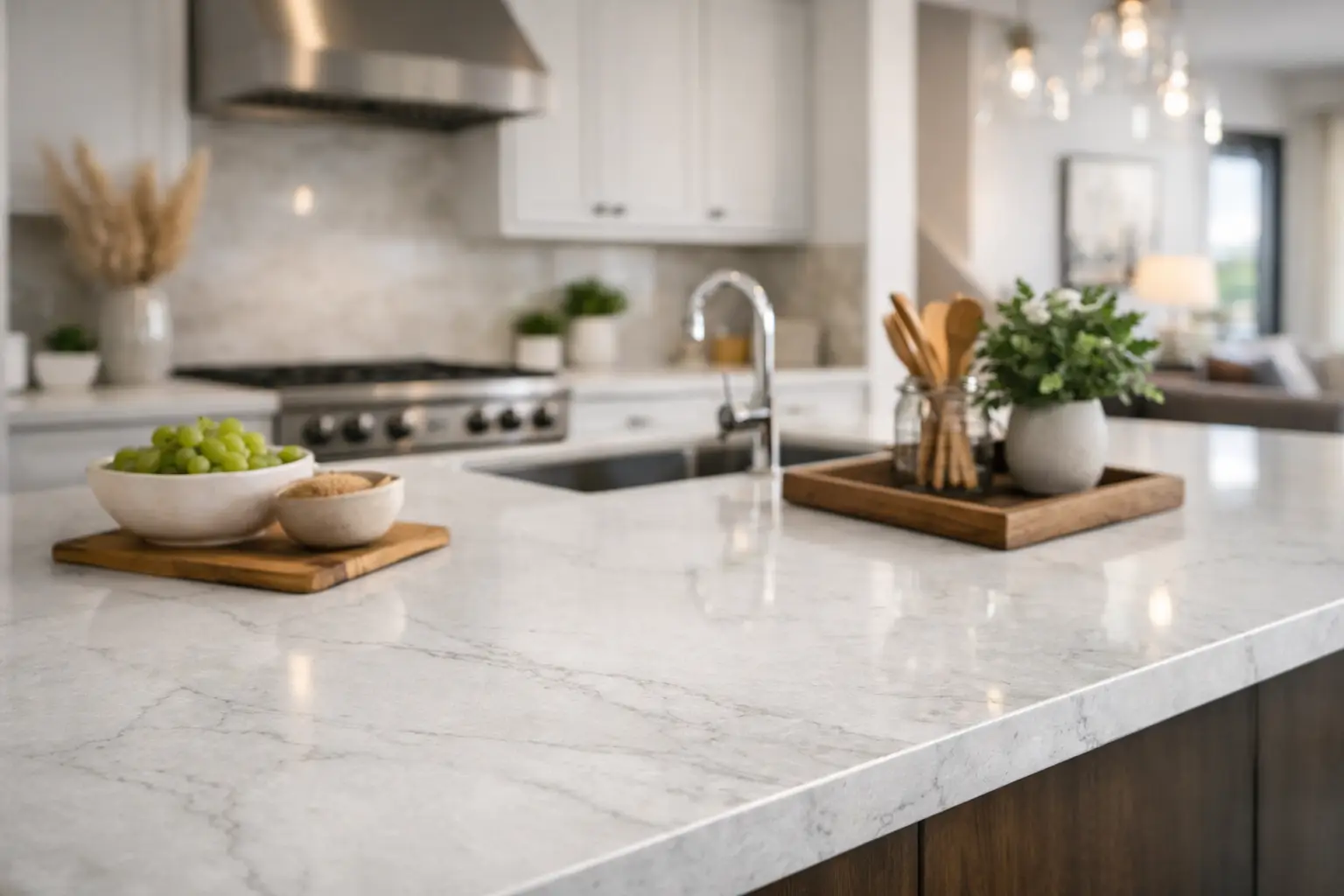
A quartz countertop can look remarkably similar to marble, concrete, or natural stone while asking far less of a busy household. That is one of the main reasons quartz remains a common choice for kitchens and bathrooms across Ontario.
However, a useful quartz countertops review needs to look beyond the showroom sample. Heat exposure, slab layout, edge details, seams, cabinet support, and installation quality all affect how the finished surface performs in daily life.
Quartz is an engineered surface made primarily from natural quartz minerals combined with resins and pigments. The result is a dense, nonporous slab with consistent colour options and relatively little day-to-day maintenance.
It is not the right answer for every project, particularly where extreme heat or uncovered outdoor exposure is involved. For many indoor kitchens, though, quartz provides a practical balance of appearance, durability, and easy care.
The biggest advantage of quartz is its nonporous surface. Unlike many natural stones, it does not require routine sealing. Coffee, cooking oil, juice, makeup, and common bathroom products are less likely to soak into the material when spills are cleaned within a reasonable amount of time.
That makes quartz especially appealing for family kitchens, rental properties, bathroom vanities, laundry rooms, and other areas where easy maintenance matters.
Routine cleaning is straightforward. A soft cloth, warm water, and mild dish soap are usually enough for everyday messes.
Avoid harsh oven cleaners, paint removers, highly alkaline products, and abrasive scouring pads. These products can dull the finish or affect the resin binder over time. A countertop that is easy to clean is not necessarily a countertop that can tolerate every chemical stored under the sink.
Quartz also provides greater design consistency than most natural stones. Every granite, marble, or quartzite slab has its own mineral variation, veining, and movement. That natural character is exactly why many homeowners choose those materials.
Quartz patterns are generally more controlled and predictable. This can make it easier to coordinate a large island, perimeter countertops, a full-height backsplash, or matching bathroom vanities.
Modern quartz designs have moved well beyond the uniform speckled appearance many people remember. Current options include marble-inspired patterns, warm off-whites, soft greiges, concrete looks, fine-grain neutrals, and dramatic veined slabs.
The best choice should be based on the full kitchen, not only a small sample. A bold vein may look subtle on a 4-inch sample but much more active across a long island or full-height backsplash.
No countertop material is indestructible. Understanding quartz’s limitations before installation can help prevent damage and unrealistic expectations.
Quartz is highly resistant to scratching during normal household use, but it is not scratch-proof. Knives, rough ceramic bases, dragged appliances, and abrasive materials can still mark the surface.
Cutting directly on the countertop is also hard on knife blades. A cutting board protects both the quartz and your kitchen tools.
Heat is the more important limitation. The resins used in quartz can react to sudden or sustained high heat, particularly near cooktops, coffee stations, air fryers, slow cookers, and areas where hot pans are regularly placed.
A hot pot, frying pan, or baking sheet can cause discolouration, leave a permanent mark, or contribute to thermal cracking in some situations. Trivets and hot pads provide simple protection, but they need to become part of the household routine.
Quartz is generally better suited to indoor countertops than uncovered outdoor kitchens. Direct sunlight, temperature changes, moisture, and Ontario freeze-thaw conditions can affect the colour and performance of some quartz products over time.
Materials for an outdoor BBQ countertop should be evaluated differently from materials used inside a temperature-controlled kitchen. Depending on the exposure and application, granite, porcelain, Dekton, or another sintered surface may be more suitable.
Small chips around an edge or sink cutout can often be professionally repaired and made less noticeable. Larger cracks, heat damage, or discolouration may be harder to disguise.
Prevention starts with proper cabinet support, careful fabrication, correct installation, and appropriate daily use.
Quartz countertop pricing is not determined by colour alone. The manufacturer, slab design, thickness, slab size, number of slabs, fabrication requirements, and installation conditions all affect the final quote.
A kitchen with a simple straight run and one sink cutout is very different from a kitchen with a large island, waterfall panels, full-height backsplashes, multiple cutouts, and detailed edge work.
Fabrication details that can affect quartz countertop pricing include:
A mitered edge that creates the appearance of a thicker countertop, for example, requires more fabrication than a standard eased edge. Waterfall panels also increase both material use and labour.
The most accurate way to compare estimates is to confirm exactly what each quote includes. Ask about material thickness, edge profile, countertop removal, sink cutout type, plumbing responsibilities, delivery, installation, backsplash pieces, and the expected number of seams.
A lower initial price may leave out details that are essential to completing the installation.
A beautiful quartz slab can still disappoint if the layout and fabrication are not planned carefully.
Before fabrication, a digital or physical template establishes the exact cabinet dimensions, wall conditions, overhangs, appliance clearances, and cutout locations. This is when small site conditions become visible, including walls that are not perfectly straight, uneven cabinets, and appliance openings that require adjustment.
Cabinets should be level, secure, and ready before templating. Correct preparation helps reduce installation problems and improves the fit of the finished countertops.
Many larger kitchens require at least one seam because quartz slabs have fixed dimensions. A properly completed seam should be narrow, clean, level, and placed where it is structurally practical and visually less noticeable.
A seam will not disappear completely, especially in a heavily veined quartz pattern. The realistic goal is thoughtful placement and careful pattern alignment, not the promise of a completely invisible seam.
Veined quartz deserves extra attention during slab layout. The fabricator needs to consider how the veins will run across an island, where they meet at a waterfall leg, and whether a seam will interrupt a dominant section of the pattern.
Viewing the full slab and discussing the layout before cutting can prevent surprises.
Common quartz countertop thicknesses include 2 cm and 3 cm. The final visual weight is also affected by the selected edge profile and cabinet design.
A standard eased edge works in almost any kitchen and is easy to clean. A mitered edge can make a thinner slab appear substantially thicker without using a solid extra-thick piece of quartz.
Mitered edges require accurate cutting, bonding, polishing, and pattern alignment. They can create a strong architectural appearance, but they also add fabrication time and cost.
Waterfall islands continue the countertop material down one or both cabinet ends. They can work well when the island is a main visual feature of the kitchen.
They also require additional material, precise miter joints, careful vein alignment, and a cabinet base that is prepared correctly. In a smaller kitchen where seating, storage, and aisle clearance are more important, a simpler island design may be the better investment.
A seating overhang needs adequate support based on its depth, material thickness, cabinet construction, and countertop configuration.
Support should be planned before fabrication. Poorly positioned brackets or corbels can reduce legroom, interfere with seating, or remain more visible than expected.
Long unsupported spans, dishwasher openings, raised bars, and wide seating areas may require steel support or another approved reinforcement system.
Sink and cooktop cutouts are higher-stress areas because there is less material surrounding the opening.
Undermount sinks provide a clean appearance and make it easier to wipe crumbs into the basin. The sink cutout must be finished accurately, and the sink should be supported mechanically rather than relying only on adhesive.
The selected sink reveal also affects the appearance and maintenance of the area. A positive, negative, or flush reveal should be discussed before fabrication so the finished opening matches the homeowner’s preference.
Quartz is often compared with natural stone and sintered surfaces. Each material has strengths and limitations, so the better choice depends on how the room will be used.
Granite countertops are made from natural stone, which means every slab has unique mineral movement and colour variation. Most granite varieties require occasional sealing, although the frequency depends on the density of the stone.
Granite generally handles direct heat better than quartz. Quartz offers more predictable patterning, does not require routine sealing, and may be easier for homeowners who want lower maintenance.
Marble has natural depth and movement that engineered products can imitate but do not fully reproduce. It can also etch, scratch, and stain more easily in an active kitchen.
Some homeowners appreciate the patina that develops as marble ages. Others prefer marble-look quartz because it provides a similar design direction with fewer maintenance concerns.
Quartzite is a natural stone known for hardness and strong visual movement. Maintenance and stain resistance vary from slab to slab, and many quartzites require sealing.
Quartzite may appeal to homeowners who want natural veining and greater heat resistance. Quartz is often more predictable in appearance and easier to maintain.
Porcelain countertops, Dekton, and other sintered surfaces can provide excellent heat resistance, UV stability, and thin-profile design options.
These materials require specialized fabrication and careful handling, particularly around edges and cutouts. They may be worth considering for outdoor kitchens, fireplace applications, full-height wall panels, or homeowners who prioritize heat resistance.
Quartz makes sense when you want a polished, low-maintenance indoor surface with consistent colour options and good resistance to everyday staining.
It works particularly well for:
Quartz may be less suitable if you want an uncovered outdoor countertop, frequently place hot cookware directly on the surface, or strongly prefer the natural variation found in granite, marble, or quartzite.
Before selecting a colour, view the full slab where possible. Bring cabinet, flooring, paint, and backsplash samples. Also consider the details that affect the final installation, including the edge profile, sink style, backsplash height, seating overhang, seam locations, and whether a waterfall panel is practical for the space.
A countertop is used in small moments every day. Choosing a material and fabrication plan that fits those moments is what makes quartz feel like the right decision long after installation.
Quartz countertops can be worth the cost for homeowners who value low maintenance, consistent patterns, stain resistance, and a wide range of colours. The value depends on the selected quartz brand, fabrication complexity, installation quality, and how well the material suits the household’s daily habits.
No. Quartz is nonporous and does not require routine sealing. Mild soap, warm water, and a soft cloth are normally sufficient for everyday cleaning.
Hot cookware should not be placed directly on quartz. The resin binder can be affected by sudden or sustained heat. Use a trivet or heat-resistant pad beneath hot pots, pans, baking sheets, air fryers, and slow cookers.
Quartz can chip, particularly around exposed corners, sink cutouts, and edges that receive a strong impact. Many small chips can be repaired professionally, although the repair may remain slightly visible depending on the colour and pattern.
Quartz seams are usually visible when viewed closely. A skilled fabricator can make the seam narrow, level, and colour-matched, but heavily veined patterns can make pattern interruptions easier to notice.
Quartz is generally not recommended for uncovered outdoor kitchens. UV exposure, moisture, and changing Ontario temperatures can affect some quartz products. Granite, porcelain, Dekton, or another outdoor-rated surface may be more appropriate.
Properly fabricated, installed, and maintained quartz countertops can remain functional for many years. Their lifespan depends on cabinet support, installation quality, heat protection, impact prevention, and normal household care.
Stone Valley Countertops supplies, fabricates, and installs quartz countertops for kitchens, bathrooms, laundry rooms, bars, and other interior applications across Toronto, the GTA, Durham Region, Niagara Region, Hamilton, and surrounding Ontario communities.
Before providing a final quote, the project should be reviewed for slab quantity, seam placement, edge details, sink type, backsplash requirements, overhang support, appliance clearances, and installation access.
To discuss your measurements, quartz colour, or fabrication requirements, contact Stone Valley Countertops.