
A kitchen island can look nearly identical in a showroom under bright lights, yet behave very differently after a month of coffee rings, pasta sauce, school lunches, and weekend baking. That is the real question behind a marble vs quartz kitchen decision. Both can be beautiful, but they ask different things of the homeowner and perform differently once the kitchen is in regular use.
Marble is a natural stone with movement, variation, and a softer, more traditional character. Quartz is an engineered surface made from natural quartz minerals, resins, and pigments, designed for consistent colour and low-maintenance daily use. The better choice depends less on which material is “best” and more on how you cook, clean, and want your kitchen to age.
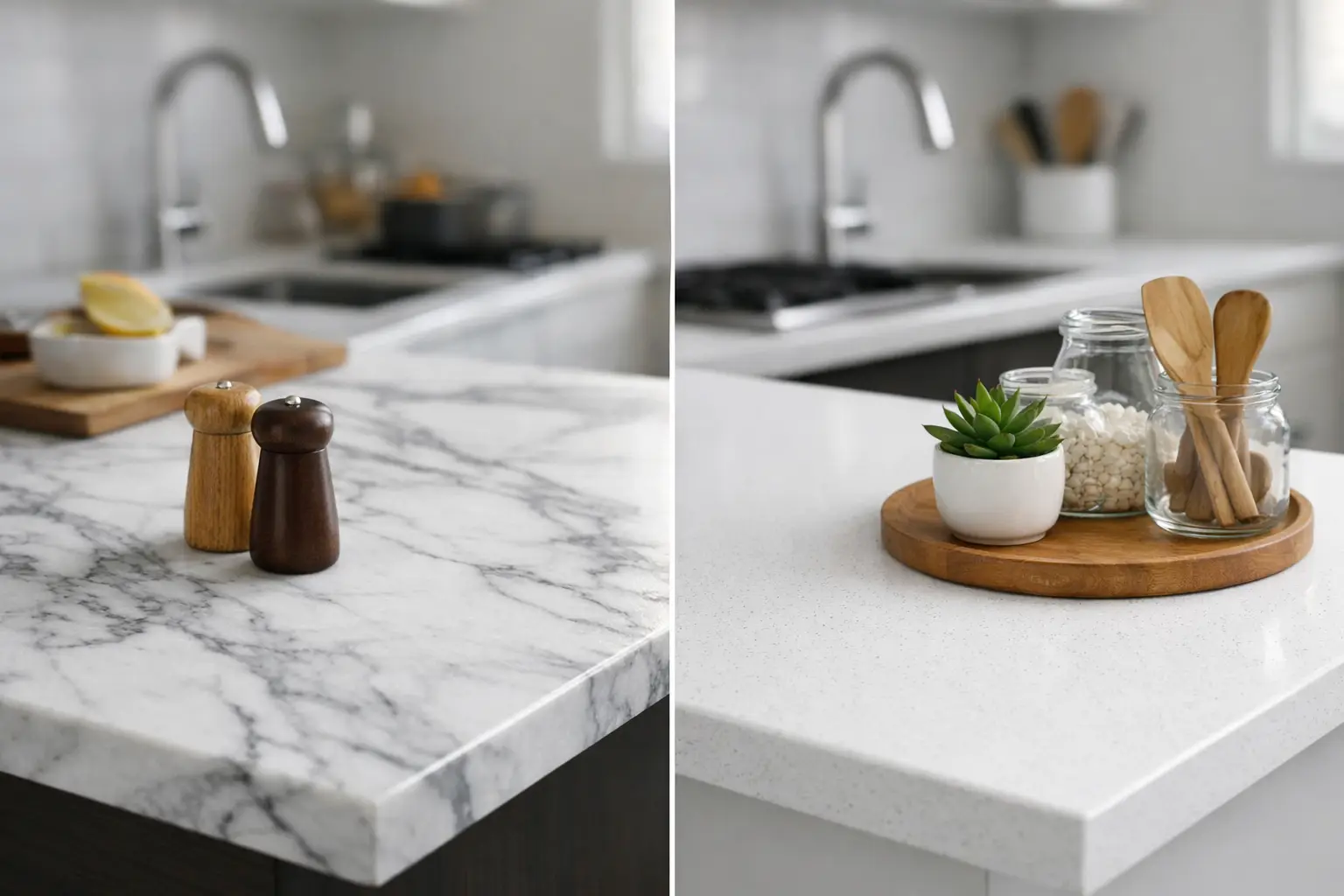
Quick Answer: For most busy kitchens, quartz is the more practical choice because it is non-porous, does not require sealing, and resists common stains better than marble. Marble provides distinctive natural veining, but it requires more care and can develop etching, scratches, and patina over time.
| Feature | Marble | Quartz |
|---|---|---|
| Material type | Natural stone | Engineered surface |
| Maintenance | Usually requires sealing and careful cleaning | No routine sealing required |
| Stain resistance | Moderate when properly sealed | High during normal household use |
| Etching | Can etch when exposed to acidic foods and cleaners | Does not etch like marble |
| Heat performance | Good, although trivets are still recommended | Heat resistant but not heatproof |
| Appearance | Unique natural veining and variation | More consistent colours and engineered patterns |
| Best suited for | Homeowners who value natural character and accept patina | Busy kitchens that prioritize easier maintenance |
Marble suits homeowners who value natural character and are comfortable with a surface that develops signs of use over time. Its veining is formed by nature, so every slab is different. A small sample can show the general colour direction, but the full slab is what determines the final look of your countertop.
Quartz is usually the more practical option for busy kitchens. It is non-porous, does not require sealing, and is less likely to stain from common foods and drinks. Quartz also offers a wide range of designs, from clean solid colours to soft veining that resembles natural stone.
Neither material is automatically right for every project. A careful cook who enjoys the patina of natural stone may be very happy with marble. A family kitchen used from morning to night may benefit from quartz’s easier upkeep.
Marble has been used for generations because it is distinctive, workable, and naturally beautiful. It can create a quiet, refined look that is difficult to reproduce exactly with any manufactured material. Honed finishes are especially popular because they can make minor scratches and etching less noticeable than a highly polished surface.
The trade-off is that marble is porous and relatively soft. It should usually be sealed, and spills should be wiped up promptly. Lemon juice, vinegar, wine, tomato sauce, and other acidic foods can cause etching. Etching is a dull mark created when acid reacts with the stone surface. It is different from a stain, and sealing does not prevent it.
That distinction matters. A sealed marble countertop may resist a coffee or oil stain, but it can still show etching from a sliced lemon left beside the sink. Some homeowners see those subtle marks as part of the material’s lived-in character. Others find them frustrating, particularly on a polished white marble surface where changes can be more noticeable.
Marble also needs thoughtful daily care and maintenance. Use a soft cloth, mild soap, and water or a stone-safe cleaner. Avoid abrasive powders, strong degreasers, and acidic cleaners. Trivets are recommended for hot cookware, and cutting boards protect both the countertop and your knives.
Homeowners comparing natural stone surfaces may also find it helpful to understand how countertop sealing works. Granite and marble are different materials, but both can vary in porosity, and sealing schedules should be based on the actual stone rather than a fixed calendar.
This does not mean marble cannot be used in a kitchen. It simply means expectations need to be realistic. It is often a good fit for a lower-use baking area, bar, butler’s pantry, or island where the owners understand its maintenance needs.
Marble can also work in an active kitchen when homeowners choose it intentionally rather than expecting it to perform like quartz. A honed finish, practical slab selection, and willingness to accept gradual patina can make the material easier to live with.
Quartz countertops are engineered for convenience. Their non-porous surface resists common kitchen stains without regular sealing, which makes them a practical choice around sinks, prep areas, and frequently used islands. For many households, this is the strongest reason to choose quartz.
Daily quartz cleaning is straightforward. A soft cloth, mild dish soap, and water will handle most messes. Because the surface is non-porous, it is also less likely to absorb spilled cooking oil, juice, or food colouring when cleaned within a reasonable timeframe.
Quartz is more resistant to scratching and staining than marble, but it is not indestructible. It can chip at a hard impact point, especially near an exposed edge or sink cutout. It should not be used as a cutting surface, and hot pots should not be placed directly on it.
Sudden or concentrated heat can damage the resin that binds the material. Homeowners can learn more about how quartz handles heat, but the practical rule is simple: use a trivet or hot pad for cookware coming directly from a burner, oven, or grill.
Colour consistency is another advantage. A quartz slab can provide a controlled, predictable look across a large kitchen, which is helpful for homeowners who want matching islands, perimeter counters, full-height backsplashes, or several rooms with the same surface.
Still, quartz patterns vary by collection and slab. Looking at the actual slabs before fabrication remains worthwhile, especially for designs with bold veining. Engineered patterns may be more consistent than marble, but seam placement and vein direction still need to be considered.
Material selection affects price, but it is not the only factor. Marble and quartz both come in a wide range of price levels based on the specific slab, colour, pattern, thickness, availability, and fabrication requirements.
A simple quartz design may cost less than a premium marble, while a highly detailed quartz with dramatic veining may be priced similarly to some natural stone options. Brand, slab size, finish, and regional availability can also affect the final price.
The countertop layout makes a meaningful difference. An L-shaped kitchen with a basic eased edge and one sink cutout requires less fabrication than a large island with a waterfall panel, mitered edges, a full-height backsplash, multiple cutouts, or a thick built-up profile.
Seams deserve attention during planning, particularly with marble. Natural veining can be aligned across a seam where possible, but slab size, layout, vein direction, and structural requirements affect the result.
A precise layout before fabrication helps place seams thoughtfully and ensures the best areas of the slab are used where they will be most visible.
Quartz offers more pattern consistency, but seams do not disappear completely. Good fabrication and installation minimize their visibility. They do not make them invisible. The same is true for sink cutouts, inside corners, and long overhangs. These details are where accurate templating and careful fabrication matter most.
Marble brings depth that comes from mineral movement rather than a manufactured or repeated design. Depending on the selection, it can range from soft grey veining to dramatic, high-contrast lines.
Its natural variation can be especially effective on a large island or full-height backsplash, where the stone can be treated as a continuous visual feature. However, the same variation means homeowners need to be involved in slab selection and layout decisions.
Quartz gives homeowners more control. If you want a clean white, a warm neutral, a concrete-inspired finish, or soft veining without the maintenance demands of marble, quartz provides many options.
It works well in modern kitchens, transitional spaces, and projects where the countertop needs to coordinate closely with cabinet colour, flooring, hardware, and backsplash selections.
Thickness and edge profile influence the final result as much as material choice. Standard 2 cm and 3 cm slabs each create a different visual weight. A simple eased edge suits many kitchens and is easy to clean, while a mitered edge can create the appearance of a thicker slab.
On waterfall islands, precise mitering helps the pattern turn from the horizontal countertop to the vertical panel with a clean, intentional look. Bold quartz patterns and strongly veined marble both require careful slab positioning to make this transition look natural.
For either material, avoid making a final decision from a small sample alone. Ask to view the slab or detailed slab images when available. This is particularly important for marble, where veining and background tone can shift significantly from one area to another.
Choose marble if you genuinely prefer its natural variation and accept that it can etch, scratch, and develop a patina. It is a choice for homeowners who see a countertop as a natural material that will change with use, rather than remain factory-perfect forever.
Choose quartz if low maintenance, stain resistance, and day-to-day predictability are priorities. It is often the more comfortable choice for households with young children, frequent cooking, or anyone who does not want to monitor every spill around an island or sink.
There is also room for a mixed approach. Some homeowners use durable quartz for the main kitchen work surfaces and reserve marble for a bar, baking station, butler’s pantry, or vanity where its character can take centre stage with less exposure to acids and heavy use.
A surface should fit your real habits, not the routine you imagine having after the renovation. Think about how often you cook, whether children use the island, how quickly spills are usually cleaned, and whether signs of wear will bother you.
Quartz generally asks less of the homeowner. Marble can be very rewarding, but only when its natural characteristics are understood before installation.
Before a slab is fabricated, decisions about overhangs, edge profiles, sink style, seams, backsplash height, faucet holes, appliance openings, and waterfall panels should be settled.
An undermount sink creates a clean countertop-to-sink transition, but the cutout must be accurately finished and properly supported. Larger seating overhangs may need concealed supports depending on the material, thickness, cabinet construction, and unsupported span.
Veined materials also require layout planning before cutting begins. The fabricator needs to determine how the pattern will flow across seams, corners, backsplash pieces, and waterfall panels. A small change in part orientation can noticeably affect the finished appearance.
At Stone Valley Countertops, consultation, slab selection, templating, fabrication, and installation are coordinated in-house so the final details remain connected from the first measurement through installation. That coordination is especially helpful when a project includes veined material, a large island, full-height backsplash pieces, or miters that need close attention.
Neither material is better in every kitchen. Quartz is usually more practical for busy households because it requires less maintenance and resists staining better. Marble may be the better choice for homeowners who prioritize natural variation and are comfortable with etching and patina.
Yes. Marble is porous and can absorb liquids when it is unsealed or when spills are left on the surface. Quartz is non-porous and generally more resistant to common household stains, although spills should still be cleaned promptly.
No. Sealing can help slow the absorption of liquids, but it does not prevent acidic foods or cleaners from reacting with marble. Lemon juice, vinegar, wine, and tomato-based foods can still leave dull etched areas.
Trivets should be used on both materials. Marble generally tolerates heat well, but rapid temperature changes can still create risk. Quartz contains resin, which can be damaged or discoloured by concentrated heat from hot cookware.
Quartz is easier to maintain because it does not require routine sealing and can usually be cleaned with mild dish soap and water. Marble needs stone-safe cleaners, periodic sealing when required, and faster attention to acidic spills.
Yes. Some homeowners use quartz on the main work surfaces and marble in a lower-use area such as a baking station, bar, or butler’s pantry. The materials should still coordinate in colour, thickness, edge profile, and overall design.
Both materials can support resale value when they suit the kitchen design and are fabricated properly. Quartz may appeal to buyers who prioritize low maintenance, while marble may appeal to buyers who value natural stone and distinctive veining.
Compare marble and quartz before choosing a slab.
Choosing between marble and quartz is easier when you can compare full slabs and discuss how each material fits the way your kitchen is used. Stone Valley Countertops supplies, fabricates, and installs kitchen countertops throughout Toronto, the GTA, Durham Region, Niagara Region, Hamilton, and surrounding Ontario communities.
Contact Stone Valley Countertops to discuss material options, slab layouts, edge profiles, seams, and installation details for your project.