
Countertop seams are a normal part of many kitchen installations, especially in larger layouts, long countertop runs, L-shaped kitchens, and oversized islands. A visible seam does not automatically mean the countertop was poorly fabricated or installed.
The practical goal is not always to eliminate seams entirely. It is to place them where they are structurally sound, visually balanced, and less disruptive to the way the kitchen is used. This kitchen countertop seams guide explains when seams are necessary, where they are commonly placed, why some are more noticeable than others, and what homeowners should expect after installation.
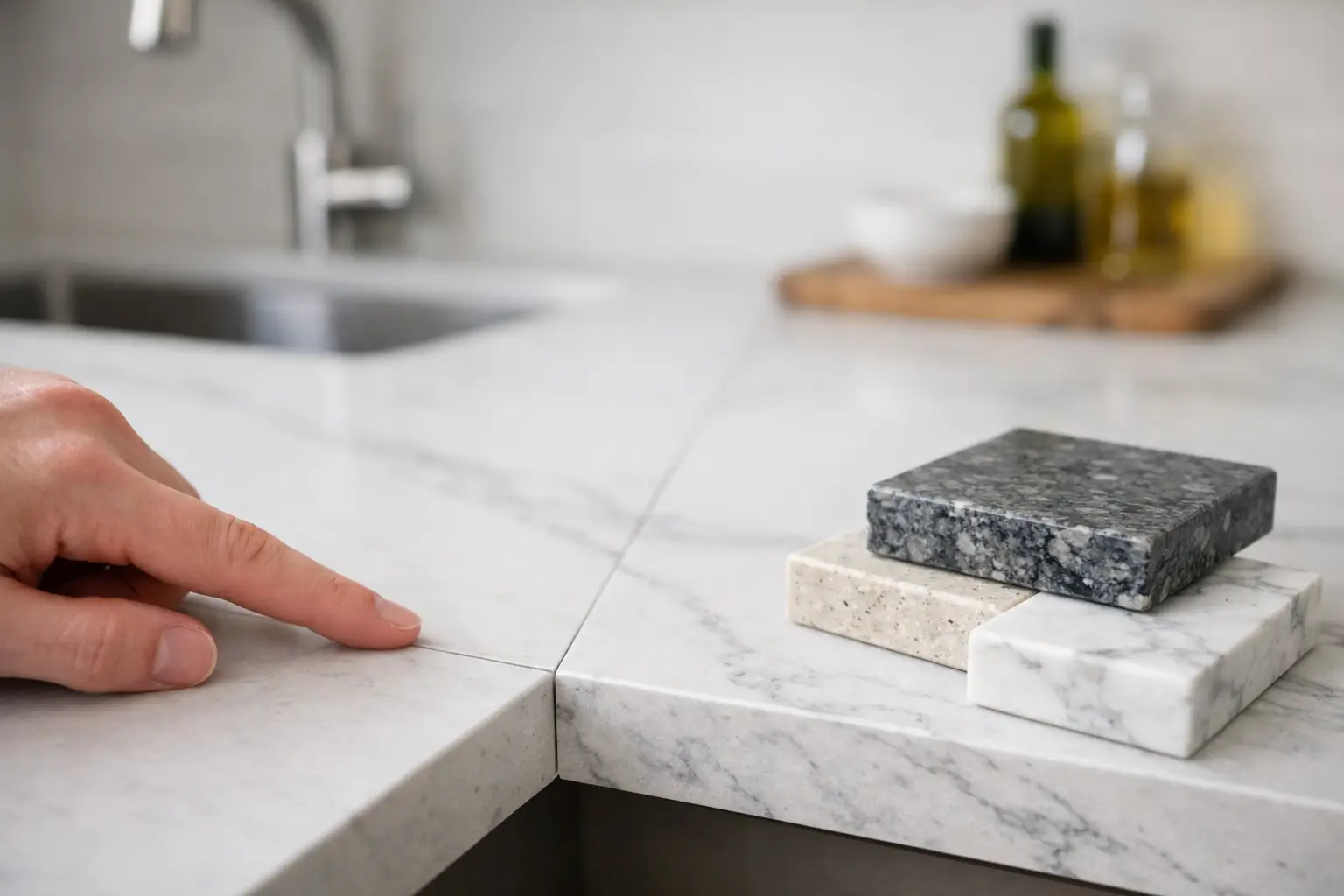
A countertop seam is the joint where two separately fabricated pieces of countertop material meet. During installation, the fabricators carefully align the pieces and bond them using a colour-matched adhesive. Once the adhesive cures, the joint becomes a solid part of the installed countertop.
Even a carefully fabricated seam will usually remain visible at close range. Quartz, granite, marble, quartzite, porcelain, and other surfaces have different colours, patterns, textures, and reflective qualities. These characteristics can make the seam more or less noticeable depending on the material and the surrounding lighting.
The realistic goal is not to promise an invisible seam. It is to create a narrow, properly supported joint that fits the layout and does not unnecessarily distract from the finished kitchen.
A simple straight countertop may fit within one slab or fabricated piece if its dimensions allow. Seams become more likely when the countertop is longer or deeper than the slab, wraps around a corner, includes an oversized island, or must be divided into manageable pieces for transportation and installation.
| Common Question | Practical Answer |
|---|---|
| Are countertop seams normal? | Yes. They are common in larger kitchens, islands, and layouts that exceed available slab dimensions. |
| Can a seam be completely invisible? | Usually not. A skilled seam can be subtle, but the joint may still be visible under certain lighting or from certain angles. |
| Do seams weaken the countertop? | A properly positioned, supported, and bonded seam should perform well during normal household use. |
| Where should a seam be placed? | In a structurally sound location that also considers visibility, pattern direction, cutouts, and daily work areas. |
| Can a damaged seam be repaired? | Many seam issues can be assessed and repaired, although the correct solution depends on what caused the problem. |
Countertop seam placement is normally decided during slab layout planning, before fabrication begins. The fabricator considers the slab dimensions, countertop shape, cabinet support, pattern direction, sink and cooktop cutouts, transportation requirements, and the safest installation sequence.
Whenever practical, a seam may be positioned away from the main focal point or busiest preparation area. On a long straight run, it might be placed closer to one end rather than directly in the centre of the primary work surface.
In an L-shaped kitchen, the inside corner is often a logical seam location because the change in direction creates a natural visual break. However, every kitchen must be evaluated individually. Wall conditions, cabinet construction, slab dimensions, and pattern direction may make another placement more appropriate.
A seam should not be forced too close to a sink, cooktop, or another large cutout if doing so would leave a narrow and vulnerable strip of material. These areas already have less material surrounding the opening and may experience additional stress during transportation and installation.
A slightly more visible seam in a properly supported location is often better than a hidden seam that creates unnecessary structural risk.
Sink and cooktop cutouts remove a substantial amount of material from a countertop section. This can make the surrounding stone more delicate while it is being transported and installed.
Some kitchen designs may allow a seam to be incorporated near a sink, but the placement must be evaluated carefully. The fabricator will consider the width of the material around the cutout, the location of cabinet rails, the sink type, and the support available underneath.
Homeowners should not assume that placing the seam directly through a sink is always the best way to conceal it. Depending on the material and layout, another location may provide a stronger and cleaner result.
Waterfall islands require additional planning because the horizontal countertop and vertical waterfall panel must be cut, aligned, and joined precisely. This becomes especially important when the surface has strong veining or directional movement.
Depending on the island dimensions and available slab size, a seam may be needed on the island top, on the waterfall panel, or in both areas. The best option depends on the slab layout, installation access, structural requirements, and the homeowner’s visual priorities.
A fabricator may be able to align the pattern so the movement appears to continue from the top onto the waterfall leg. However, a natural or printed vein cannot always continue perfectly through every joint. Slab size, kerf loss, material variation, and the direction of the pattern all affect the final appearance.
The selected material has a major effect on seam visibility. A quiet, light-coloured quartz with a consistent pattern often allows for a subtle joint. However, the adhesive line may still become noticeable under direct sunlight, pendant lighting, or when viewed from the side.
Solid dark colours can also reveal seams. Dark polished surfaces reflect light strongly, and even a small change in surface angle or adhesive colour may stand out.
Bold veining adds another layer of complexity. Marble, quartzite, granite, and veined quartz can create a dramatic finished surface, but the veins must be positioned deliberately during layout planning. A fabricator can often align the general movement, but a natural vein does not stop and restart with machine-like precision.
With natural stone, variation is part of the material. Two neighbouring pieces can come from the same slab and still have differences in colour, crystal structure, or vein direction near the joint.
Polished, honed, leathered, and textured finishes also reflect light differently. A polished finish may make a slight change in plane more visible, while some textured surfaces can make it harder to create an adhesive texture that exactly matches the surrounding material.
One finish is not automatically better than another. The finish simply needs to be considered during seam planning and when setting expectations.
Materials with directional veining require thoughtful slab layout. The fabricator must decide how the pattern will flow through corners, around cutouts, and across separate countertop sections.
Sometimes the best layout for vein movement creates more material waste. In other cases, rotating a piece may improve slab usage but cause the pattern to change direction. These trade-offs should be discussed before fabrication begins, especially for large islands and highly active natural stone.
Reviewing the actual slab is particularly useful when selecting granite, marble, or quartzite. Photographs and small samples may not show the full movement, colour variation, fissures, or areas that will affect seam placement.
Thickness and countertop edge details can also affect how a seam looks. A standard-thickness countertop may show a narrow joint primarily across the top surface and front edge.
A built-up edge, laminated edge, or mitered profile creates additional surfaces that must align. On a thick-edge island or mitered waterfall, the seam can be visible across the top, the front face, or both. Accurate cutting and alignment are especially important because these edges are viewed and touched frequently.
The adhesive used at the joint plays an important role in the finished appearance. Fabricators typically tint or select an adhesive colour that blends as closely as practical with the countertop.
A white quartz may require a light adhesive, while a black granite may require a darker mixture. Multicoloured granite, heavily veined quartz, and patterned quartzite can be more challenging because a single seam may cross several colours at once.
The adhesive cannot copy every crystal, vein, or pigment in the slab. The fabricator usually selects a colour that blends with the dominant background or creates the least noticeable transition across the joint.
Lighting also affects how the adhesive appears. A seam that looks subtle under general room lighting may become more noticeable under a bright pendant light or strong daylight. Polished surfaces can reflect light differently across the joint, even when the colour match is close.
Adhesive and stone may also age differently. Exposure to ultraviolet light, household products, heat, and normal wear can gradually affect their appearance. This is one reason homeowners should use material-appropriate cleaners and avoid aggressive chemicals around the seam.
Sometimes a kitchen can be fabricated without seams. A compact countertop run, modest island, or small vanity may fit within a single slab or fabricated piece.
However, avoiding seams should not be the only goal. Large pieces are heavier, more difficult to carry, and more challenging to manoeuvre through doorways, hallways, staircases, and tight corners. The material must reach the kitchen safely and be lowered onto the cabinets without excessive stress.
Natural stone can contain fissures, veins, and mineral structures that affect how large a piece can safely be transported. Porcelain and sintered surfaces can also require careful handling because large, thin panels may be vulnerable during movement and installation.
Choosing a jumbo slab may reduce the number of seams, but jumbo formats are not available in every colour, brand, thickness, or material. A larger slab may also increase material waste if the kitchen pieces do not fit efficiently within its dimensions.
For some projects, two carefully planned countertop pieces are more practical than selecting a slab solely to eliminate one joint.
Slab dimensions vary by manufacturer and material. Standard quartz slabs are often large enough for many residential layouts, while jumbo slab options may accommodate wider islands or longer countertop runs.
Natural stone dimensions are less standardized because slabs are cut from individual blocks. One bundle of quartzite or granite may contain slabs that are slightly different in length, width, thickness, colour, or pattern.
If a project requires two natural stone slabs, companion slabs should be selected to work together as closely as possible. They may come from the same block or bundle, but some variation is still expected.
A clean seam begins before installation day. Accurate templating records the real dimensions of the cabinets, walls, overhangs, appliances, and cutouts. Countertop measurements should normally be finalized after the base cabinets are installed, levelled, secured, and ready for stone.
Walls are rarely perfectly straight, and cabinet runs may not be perfectly square. A detailed template allows the fabrication team to account for these conditions before cutting begins.
During countertop fabrication, the pieces are cut and polished according to the approved layout. The edges that meet at the seam must be straight, smooth, and properly prepared.
During installation, the sections are positioned on the cabinets, brought together, aligned, and bonded with colour-matched adhesive. The installers check the joint from above and across the countertop to minimize lippage.
Lippage is a small height difference between the two sides of a seam. Cabinets, slab thickness variation, adhesive, and the flatness of the material can all affect how the pieces meet. A skilled installation team works to make the transition as smooth as reasonably possible.
You can learn more about the full process in our guide to how countertops are installed.
A well-executed seam should feel reasonably smooth when you run your hand across it. The adhesive should fill the joint cleanly, and the countertop sections should sit securely on the supporting cabinets.
You may still see the seam, especially in direct sunlight, beneath pendant lights, or when viewing a polished surface from the side. That alone does not indicate a defect.
What should be inspected is a large open gap, noticeably chipped seam edges, a rough or sharply raised joint, obvious adhesive smears, movement between the pieces, or a seam that begins to separate after installation.
At Stone Valley Countertops, seam planning is coordinated through material selection, templating, fabrication, and installation. Keeping these stages connected helps the team maintain the agreed slab direction, seam location, edge profile, cutout details, and installation plan.
Warranty coverage depends on the fabricator, installation agreement, material manufacturer, and the cause of the concern. A visible seam by itself is generally not considered a defect because seams are a normal part of many countertop installations.
A seam that separates, shifts significantly, or develops excessive movement should be inspected. The cause may be related to the adhesive, installation, inadequate cabinet support, cabinet movement, house settlement, or impact near the joint.
Countertops rely on the cabinets beneath them. If cabinets settle, twist, or move after installation, the seam can be placed under stress. This is why base cabinets should be properly secured, level, and structurally ready before templating and installation.
Homeowners should report a new seam concern promptly and avoid attempting to fill, sand, or glue the joint themselves. A repair made with the wrong product can make professional correction more difficult and may affect applicable warranty coverage.
Homeowners do not need to understand every technical detail, but a few practical questions can help prevent surprises.
Ask the fabricator to explain the likely seam locations and whether another placement is possible. There may be several potential options, but each can affect material strength, slab usage, pattern flow, transportation, and installation.
If the material has strong veining or significant natural movement, ask whether you can review the proposed slab layout before cutting. This is particularly useful for quartzite, marble, granite, and boldly veined quartz.
Slab layout review helps clarify where the pattern will change direction, which areas will appear on the island, and how adjoining pieces may meet.
Tell the fabricator how you use the kitchen. If you regularly roll pastry on one section, prepare food beside the sink, or use a particular part of the island for serving, mention it during planning.
The seam may be moved away from that area if slab dimensions, cutouts, support, and installation requirements permit. However, structural considerations must take priority over convenience alone.
For waterfall designs, ask whether the pattern will be wrapped, bookmatched, or aligned using another layout method.
These terms describe the intended visual treatment. They do not guarantee that every vein will continue perfectly through the cut and joint. Natural variation, slab limitations, and cutting loss all affect the final result.
A properly bonded countertop seam does not require special daily maintenance. Clean it using the same material-appropriate method recommended for the rest of the countertop.
For most surfaces, a soft cloth, warm water, and a mild non-abrasive cleaner are suitable for routine cleaning. Avoid harsh scouring pads, strong chemicals, and products that are not approved for the selected material.
Do not use the seam as a chopping surface or repeatedly strike it with heavy cookware. Direct impact should also be avoided around countertop edges, corners, sink cutouts, and cooktop openings.
For natural stone, follow the recommended sealing schedule for the specific material. Sealing does not strengthen the seam, but it can help reduce absorption in porous stone around the joint.
If the seam begins to separate, catches noticeably when touched, moves under pressure, or develops a nearby crack, arrange for a countertop professional to inspect it. Avoid trying to repair it using household glue, caulking, grout, or filler.
Yes. Quartz countertops may require seams when the kitchen run or island is larger than the slab, when the layout changes direction, or when a large piece cannot be transported and installed safely. Quartz seams are normally bonded using a colour-matched adhesive.
A properly installed seam should remain stable during normal use, but problems can occur if cabinets move, the countertop lacks proper support, the home settles, or the area experiences a strong impact. A new crack or separation should be inspected by a countertop professional.
Many seam concerns can be repaired, depending on their cause and severity. A professional may be able to remove failed adhesive, realign the pieces, re-bond the joint, or correct minor surface issues. Cabinet movement or inadequate support must also be addressed or the problem may return.
Materials with consistent colours and subtle patterns often make seams less noticeable. Quiet quartz designs may blend more easily than heavily veined marble, quartzite, granite, or dramatic printed quartz. Fabrication quality, adhesive colour, lighting, and seam placement also have a major effect.
A properly finished seam should feel reasonably smooth, although a slight transition may still be detectable. A sharp edge, large height difference, rough adhesive, or noticeable movement should be inspected.
It may be possible in some layouts, but it is not automatically the best location. The fabricator must consider the sink cutout, cabinet support, remaining material width, transportation, and structural strength before selecting the seam position.
The joint should be kept as narrow and consistent as the material, fabrication method, slab condition, and installation environment reasonably allow. The finished appearance matters more than judging the seam by one universal measurement because different materials and layouts behave differently.
No fabricator should guarantee a completely invisible seam. A skilled seam can be narrow, smooth, and well matched, but differences in pattern, adhesive, texture, reflection, and lighting may still reveal the joint.
The right seam plan balances appearance, structural strength, slab dimensions, material movement, installation access, and the way the kitchen will be used. A necessary joint can still become a subtle and well-considered part of the finished countertop.
Reviewing seam locations before fabrication gives homeowners an opportunity to understand the layout, discuss pattern direction, and raise concerns while adjustments may still be possible.
If you are planning new kitchen countertops in Ontario, Stone Valley Countertops can help you review slab layout, seam placement, edge profiles, cutouts, and installation requirements before fabrication begins. Contact Stone Valley Countertops to discuss your project or request a countertop quote.