
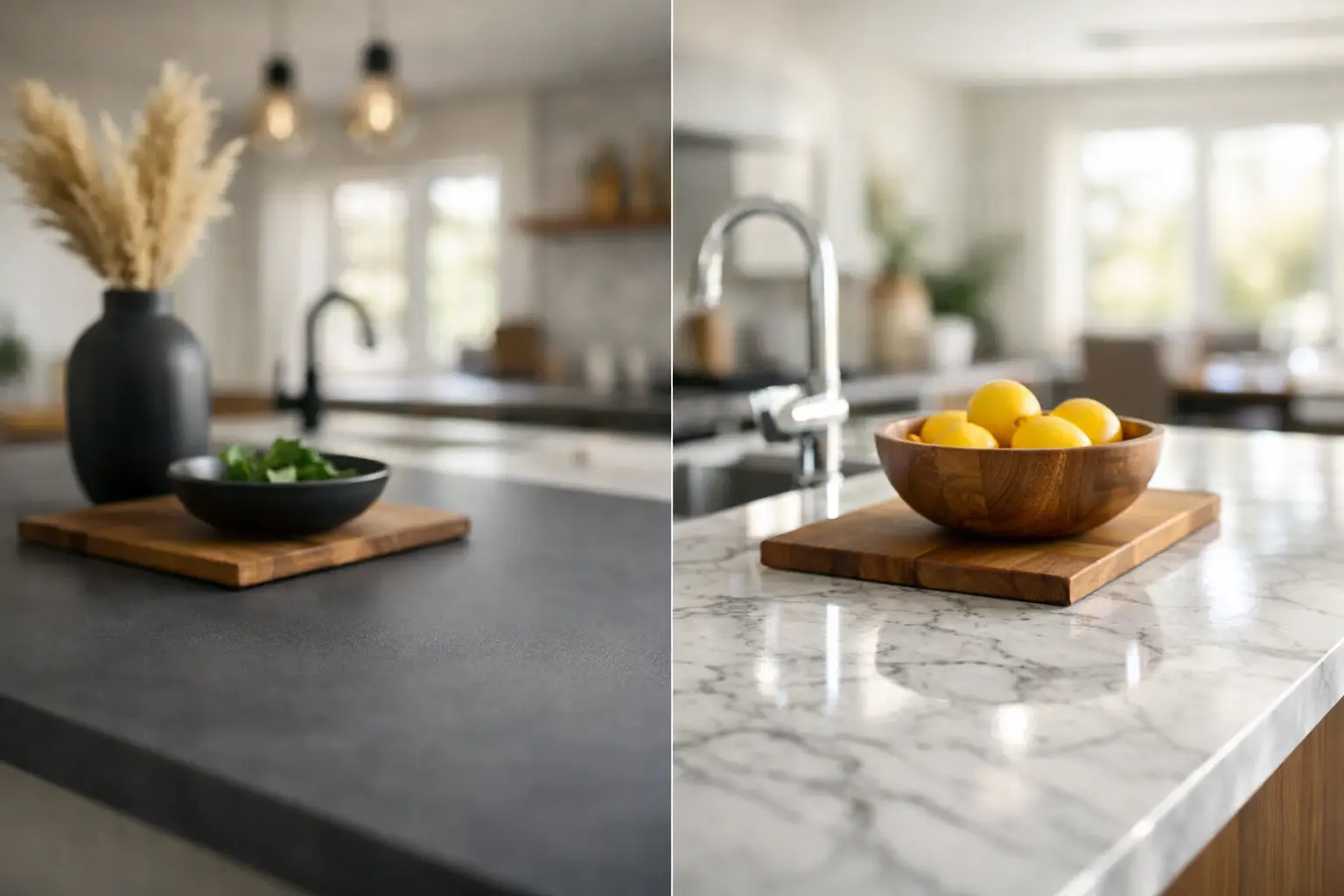
A countertop sample can look completely different once it becomes a large kitchen island under real lighting. That is why the choice between matte or polished countertops should not come down to a quick showroom impression alone. The finish affects how a surface reflects light, shows fingerprints, coordinates with cabinetry, and feels during everyday use.
Both finishes can work beautifully in Ontario homes. The better choice depends on your material, kitchen layout, lighting, household habits, and the look you want to live with for years.
| Feature | Polished | Matte / Honed |
|---|---|---|
| Appearance | Glossy and reflective | Soft and understated |
| Light Reflection | High | Low |
| Shows Fingerprints | More noticeable on dark colours | Often hides fingerprints better |
| Highlights Veining | Excellent | More subtle |
| Modern Style | Works well | Excellent |
| Traditional Style | Excellent | Also suitable |
A polished countertop has a smooth, glossy surface that reflects light clearly. It tends to make colour, veining, and crystal detail appear stronger. On dark stone especially, polish can create depth and a more formal appearance.
A matte finish, sometimes called honed, leathered, or suede depending on the material and texture, has less shine. It diffuses light instead of reflecting it. The result is softer and more understated, with less glare from windows and pendant lights.
These finishes are not always interchangeable. Some slabs are produced only in a particular finish, and not every material can be refinished successfully after installation. A fabricator can explain what is available for the specific slab you select before measurements and fabrication begin.
Polished surfaces often suit homeowners who want the stone pattern to be a focal point. High-contrast marble-look quartz, dramatic quartzite, and granite with visible mineral movement can look especially vivid with a polish. A polished white countertop can also help a smaller kitchen feel brighter because it bounces light around the room.
Matte surfaces work well when the goal is a quieter, more architectural look. They pair naturally with flat-panel cabinetry, warm wood tones, textured tile, black fixtures, and muted paint colours.
Lighting matters more than many homeowners expect. A large south-facing window can create bright highlights across a polished island. Matte finishes reduce those reflections, although they can make a darker room feel slightly less bright.
Before making a final decision, view your samples near a window and under the lighting you plan to use. If possible, look at a full slab rather than a small chip.
Neither finish is maintenance-free, but the types of marks you notice can differ.
Polished countertops are very easy to wipe because the surface is smooth. Crumbs, spills, and dried splashes are usually visible and straightforward to remove.
Matte finishes hide glare and many fingerprints better, making them popular for busy kitchens, bars, laundry rooms, and bathroom vanities.
Quartz is nonporous and does not require sealing regardless of finish.
Granite, marble, and quartzite require care based on the specific slab and sealing schedule.
Leathered granite and quartzite provide additional texture, while porcelain and sintered stone often combine a matte appearance with excellent stain and heat resistance.
A finish does not change the strength of the material. Quartz remains quartz, granite remains granite, and quartzite remains quartzite regardless of surface sheen.
The finish does affect how everyday wear appears. Highly reflective polished surfaces can make fine scratches easier to notice, while matte finishes tend to disguise minor wear more effectively.
Edge profiles also influence the final appearance. A simple eased edge complements almost every finish.
The finish itself usually has less impact on price than slab selection, thickness, fabrication complexity, waterfall panels, edge details, sink cutouts, and installation requirements.
Specialty finishes such as leathered granite may have fewer available slabs, which can influence both price and lead times.
A polished light quartz may be ideal for a busy family kitchen that benefits from extra brightness. A matte porcelain or honed quartzite may work better in a sun-filled space where glare is an issue.
Cabinet style, backsplash design, lighting, slab layout, seam placement, and countertop thickness should all be considered before fabrication begins.
Standard 2 cm and 3 cm countertops can produce very different visual results depending on the chosen finish and edge profile.
Not necessarily. The material itself has a greater effect on stain resistance than the finish. Quartz remains highly stain resistant, while natural stone depends on proper sealing.
They are generally very easy to clean, although fingerprints and water spots may be easier to see on darker colours.
Some natural stone surfaces can be professionally refinished, but many engineered materials cannot. Always confirm your options before installation.
Polished remains the most common finish across quartz and granite, while matte continues to grow in popularity for modern kitchens and contemporary home designs.
There is no universal winner between matte and polished countertops. The best finish is the one that complements your home’s lighting, cabinetry, lifestyle, and chosen material.
If you are comparing slabs, ask to see full-size pieces under natural and artificial light. Reviewing the actual slab before fabrication also allows you to discuss seam placement, edge profiles, waterfall panels, and cutout locations, helping ensure the finished countertop looks exactly as intended.
If you’re planning a new kitchen or bathroom countertop in Ontario, contact Stone Valley Countertops. We’ll help you compare finishes, review full slabs, and recommend the best option for your space before fabrication begins.