
A pot of pasta comes off the stove, the kitchen is busy, and the nearest landing spot is the countertop. That is the moment many homeowners ask: are granite counters heat resistant? In most cases, yes. Granite handles everyday kitchen heat far better than many countertop materials. But heat resistant is not the same as completely immune to damage.
Granite is a natural stone formed under intense geological heat and pressure, so a properly fabricated granite countertop can generally tolerate brief contact with hot cookware. Still, the safest habit is to use a trivet or hot pad. It takes only a second and reduces unnecessary stress on the stone, seams, adhesives, and surrounding installation materials.
Quick Answer: Yes, granite counters are highly heat resistant and can usually tolerate brief contact with hot pots and pans. However, placing extremely hot cookware directly on granite is still not recommended. A trivet helps reduce the risk of thermal shock and keeps intense heat away from seams, cutouts, adhesives, and other vulnerable areas.
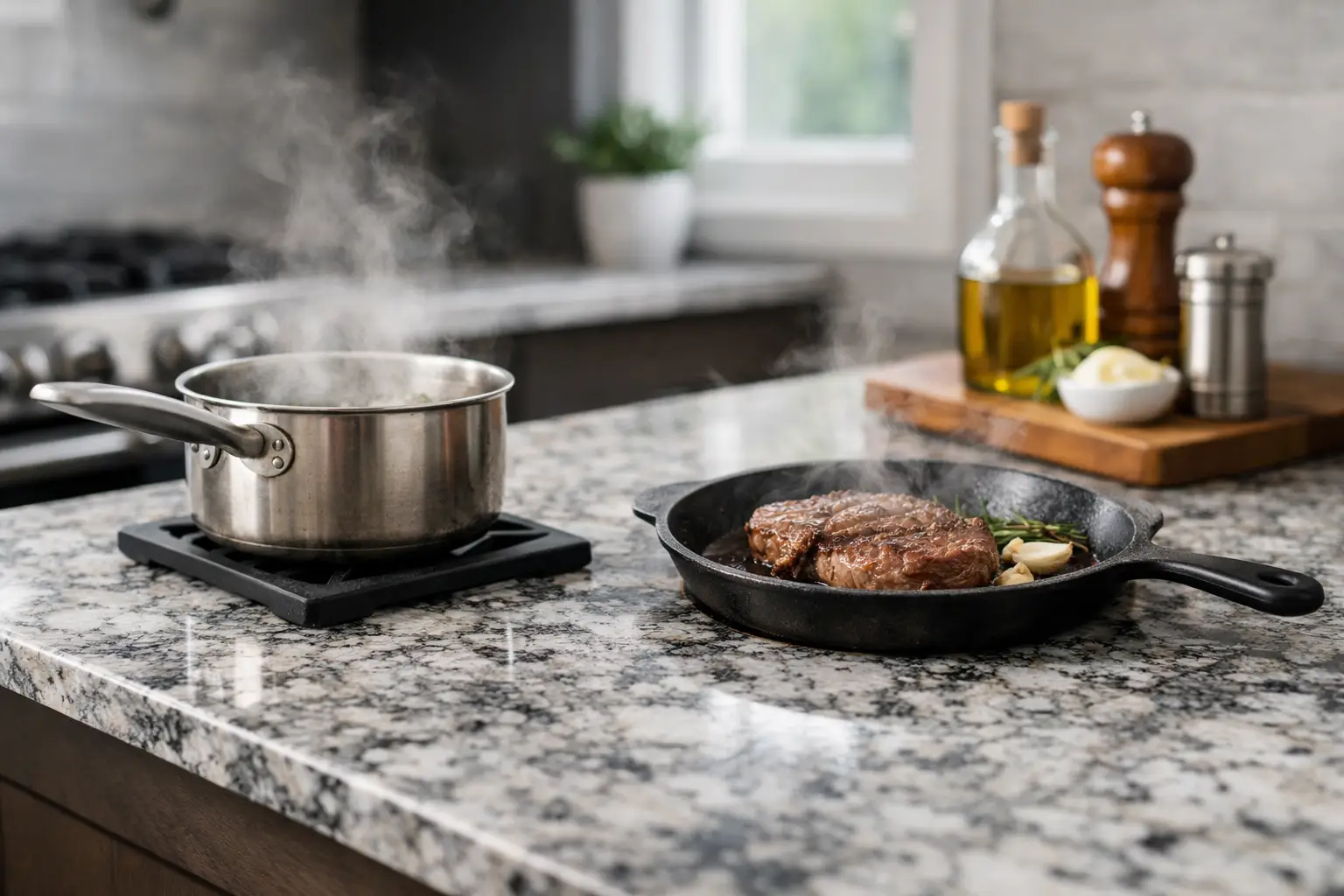
Granite is one of the more heat-tolerant countertop choices for a working kitchen. A hot baking dish, skillet, or serving pan is unlikely to harm the stone during normal use, especially when the countertop is made from a sound natural granite slab and has been properly fabricated and installed.
The reason is straightforward. Granite does not contain the resin binders found in engineered quartz, and it will not soften or scorch at normal cooking temperatures the way some laminate or wood surfaces can.
This makes granite practical near ranges, cooktops, and other areas where hot cookware is part of everyday kitchen use.
However, an installed countertop is not made of stone alone. It can also include seams, adhesives, caulking, sink supports, finished edges, and a penetrating sealer. Some of those components may respond differently to concentrated heat than the granite itself.
For that reason, placing an extremely hot item directly over a seam or near a cutout is best avoided, even though the granite itself has strong heat resistance.
The greater concern with granite is not an ordinary warm pan. It is thermal shock.
Thermal shock occurs when one area of a material heats up or cools down much faster than the surrounding area. That sudden temperature difference can create stress within the stone.
For example, setting an extremely hot cast-iron pan onto a very cold countertop creates a greater temperature contrast than normal kitchen use. The same applies if very hot cookware is placed where cold water is sitting on the surface.
Granite is durable, but every slab is different. Natural stone can contain mineral variation, veins, inclusions, and natural fissures. These characteristics are part of what makes granite visually unique, but they can also affect how an individual slab responds to stress.
Thermal shock damage is uncommon in a typical home kitchen. Still, the risk can increase with unusually intense heat, repeated direct exposure, or heat applied near a naturally weaker area of the slab.
Sink and cooktop openings are among the more vulnerable sections of a stone countertop because material has been removed from the slab.
The narrow stone rails in front of and behind a sink, as well as corners around a cooktop opening, can carry more stress than a wide uninterrupted section of granite.
That does not make granite a poor choice around sinks or ranges. It simply means accurate templating, proper fabrication, suitable support, and careful installation matter.
A well-planned countertop takes cabinet alignment, cutout dimensions, stone thickness, support, and seam locations into account. When possible, avoid placing extremely hot cookware directly on narrow sections of granite beside a sink or cooktop.
Granite sealers are primarily used to reduce the rate at which liquids such as oil, wine, coffee, and sauces can absorb into porous stone. They are not intended to act as a heat-protective coating.
Most penetrating sealers sit within the pores of the stone rather than forming a thick visible layer on top. Brief contact with a warm pan is unlikely to create an obvious problem, but repeated exposure to very high temperatures is still unnecessary.
Using a trivet helps protect the entire countertop system, not just the granite itself.
How often granite requires sealing depends on the specific stone, its porosity, the sealer used, and how the countertop is maintained. Some granites require more frequent attention than others.
For more detail, read our guide on whether granite countertops need sealing.
Granite is unlikely to stain or permanently discolor from normal cooking heat alone. If you notice a mark after moving a hot pan, the cause may be residue from the cookware, moisture, grease, or a surface issue rather than actual heat damage to the stone.
Cracks are less common but should be examined more carefully.
A natural fissure is not automatically a structural problem. Many granite slabs contain stable fissures that formed naturally within the stone. A new crack, particularly near a sink, cooktop, edge, or seam, is different and should be assessed before the area experiences additional stress.
Avoid aggressively scrubbing an unusual mark with abrasive pads, harsh chemicals, or strong acidic cleaners. Granite is generally best maintained with a stone-safe cleaner or mild soap and water, followed by a soft cloth.
For homeowners comparing materials, granite is generally more forgiving around heat than engineered quartz.
Quartz countertops contain natural quartz minerals combined with resins, pigments, and other materials. Those resins can be affected by concentrated heat, which is why trivets and hot pads are especially important with quartz countertops.
You can read more in our guide to quartz countertop heat resistance.
Granite does not contain the same resin content, giving it an advantage when heat resistance is an important consideration.
Marble and quartzite are also natural stones with good heat resistance, although each material has different maintenance considerations.
Marble, for example, can etch when exposed to acidic foods and drinks. Quartzite can offer excellent durability, but its characteristics vary from slab to slab.
Porcelain and sintered stone also perform very well around heat. Their overall performance still depends on the material thickness, fabrication method, edge design, support, and installation details.
If you are choosing between several materials, our guide on how to choose kitchen countertops provides a broader comparison.
There is no need to treat granite as fragile. It is designed to function as a hardworking kitchen surface. A few simple habits can help protect it for the long term:
These are simple precautions rather than restrictive rules. Granite is well suited to busy kitchens and regular cooking when it is properly fabricated, installed, and maintained.
Heat resistance begins with the material, but long-term durability also depends on how the countertop is fabricated and installed.
Slab selection matters because every granite has its own mineral structure, pattern, and natural characteristics.
Layout matters because countertop seams should be planned carefully, particularly around large islands, cooktops, corners, and L-shaped kitchens.
Edge profiles, countertop thickness, and support requirements matter as well. A thick mitered edge can create the appearance of a much thicker countertop, while a standard eased edge provides a simple and durable finish.
Waterfall panels and extended seating overhangs require additional planning so the stone is properly supported and unnecessary stress is not concentrated in one area.
Good fabrication is about more than making the finished countertop look clean. It should also account for how the kitchen will actually be used, where seams belong, how cutouts are reinforced, and where the countertop requires additional support.
If a granite countertop develops a persistent cloudy area, a chip along an edge, a visible change around a seam, or a new crack, it is worth having the area reviewed.
Many countertop problems are localized and may be repairable rather than requiring replacement.
The correct solution depends on whether the issue involves the stone itself, the seam adhesive, a natural fissure, the surrounding support, or another part of the installation.
Granite can generally tolerate brief contact with hot cookware, but placing extremely hot pots or pans directly on the surface is still not recommended. Using a trivet reduces thermal stress and keeps concentrated heat away from seams, cutouts, adhesives, and other vulnerable areas.
There is no single household temperature at which every granite countertop will become damaged. Natural granite varies by slab, and rapid temperature change can be more important than the temperature of the cookware itself. For normal kitchen use, a trivet remains the simplest precaution.
It is possible, although uncommon during normal cooking. Sudden temperature changes can create thermal stress, particularly around natural fissures, narrow sections beside cutouts, seams, edges, or other areas where the stone is under additional stress.
Generally, yes. Granite is natural stone, while engineered quartz contains resins that can be affected by high temperatures. Hot pads and trivets are recommended for both materials, but they are particularly important for quartz.
Using a trivet is recommended. Granite has excellent heat resistance, but a trivet is an easy way to reduce thermal shock and protect seams, adhesives, cutouts, and the surrounding countertop installation from concentrated heat.
So, are granite counters heat resistant? Yes. Granite is one of the better countertop materials for handling normal kitchen heat and can usually tolerate brief contact with hot cookware.
That does not mean there is an advantage to placing extremely hot pots and pans directly on the stone. A simple trivet protects the countertop from unnecessary thermal stress and keeps high heat away from seams and vulnerable areas.
For Ontario homeowners who cook frequently and want a natural stone surface with strong heat resistance, granite remains a practical option when the slab is carefully selected, fabricated, supported, and installed.
Planning a granite countertop project?
Stone Valley Countertops supplies, fabricates, and installs granite and other countertop surfaces throughout Toronto, the GTA, Durham Region, Niagara Region, Hamilton, Burlington, Oakville, Mississauga, Bowmanville, Welland, and surrounding Ontario communities. Contact Stone Valley Countertops to discuss your layout, material options, fabrication details, and installation requirements.