
A countertop edge is one of those details you notice most after the kitchen is finished. It affects how the stone feels under your hand, how easily crumbs wipe away, how thick the counter appears, and whether the overall design feels clean-lined or traditional. The best countertop edge styles are not necessarily the most decorative ones. They are the profiles that suit your material, layout, household, and the amount of visual detail already in the room.
For most Ontario homeowners, the decision comes down to a practical balance. A profile should look intentional without creating a cleaning nuisance, adding unnecessary fabrication cost, or leaving a vulnerable corner near a busy walkway. Here is how the most common options compare and where each one works best.
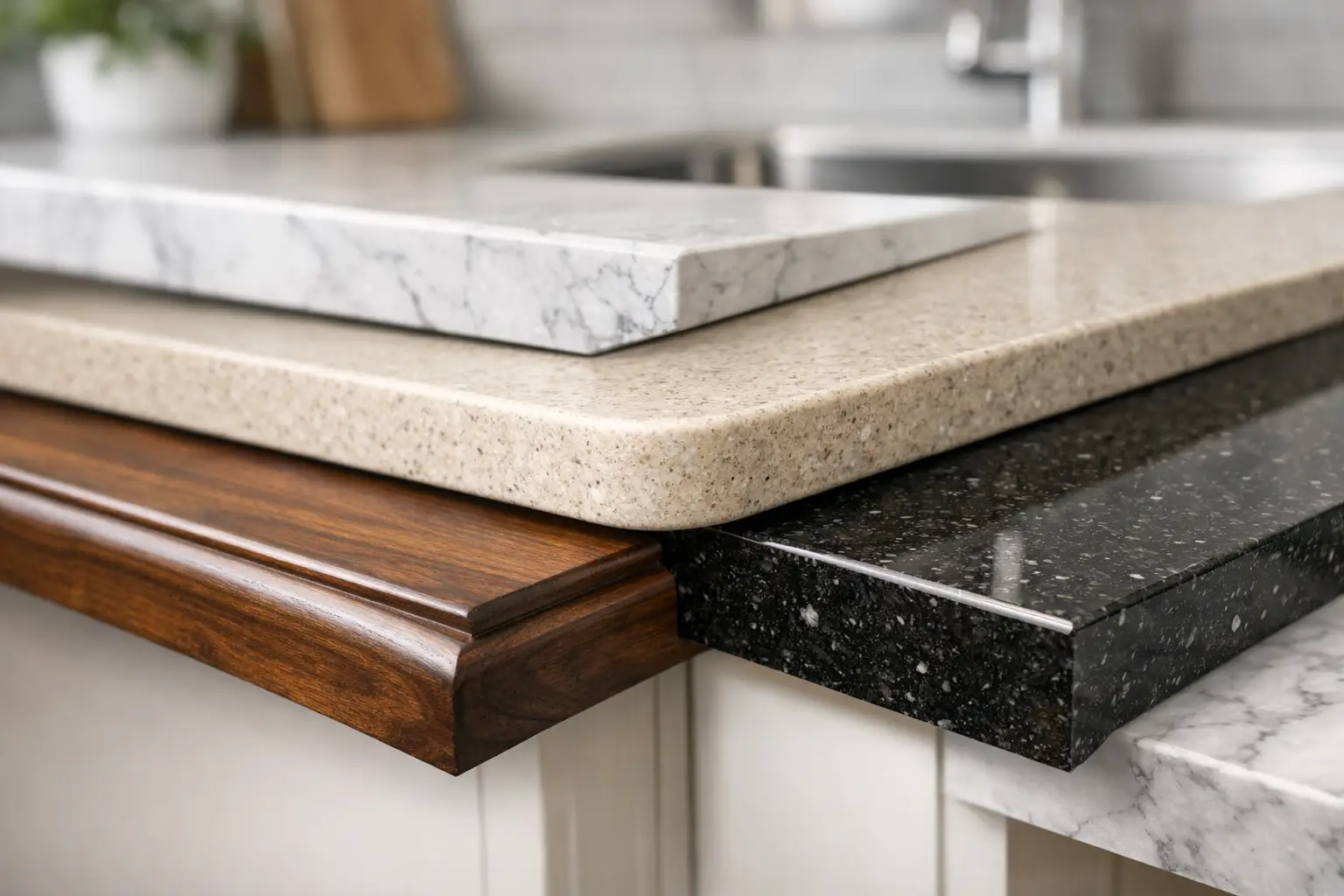
The table below provides a quick comparison of popular countertop edge profiles. The final choice should also account for the countertop material, slab thickness, cabinet style, exposed corners and how the space will be used.
| Edge Style | Best For | Maintenance | Overall Look |
|---|---|---|---|
| Eased | Modern kitchens, vanities and laundry rooms | Very easy to clean | Simple and understated |
| Pencil | Family kitchens, islands and breakfast bars | Very easy to clean | Soft modern |
| Bevelled | Transitional kitchens and architectural designs | Easy to clean | Crisp and defined |
| Half-Bullnose | Traditional kitchens and seating areas | Easy to maintain | Soft and classic |
| Full Bullnose | Bathrooms, bars and traditional interiors | Easy to maintain | Fully rounded |
| Ogee | Formal kitchens, vanities and detailed cabinetry | Requires more detailed wiping | Decorative and traditional |
| Mitered | Waterfall islands and thick contemporary counters | Easy to clean when fabricated properly | Bold and substantial |
An edge profile is the shaped treatment applied to the exposed side of a countertop slab. It is cut and polished during fabrication after final measurements and material details have been confirmed. The right profile can make a standard 3 cm quartz countertop look substantial, soften the appearance of a bold-veined quartzite, or bring a more traditional finish to granite or marble.
An eased edge has a small, softened radius along the top and bottom corners. It is not perfectly sharp, even though it can look square from a distance. This subtle rounding helps reduce the risk of chipping and makes the edge more comfortable during everyday use.
This is one of the most versatile choices for contemporary kitchens, laundry rooms, bathroom vanities and bar tops. It suits quartz especially well because it keeps the focus on the colour and pattern rather than the profile. It is also one of the easiest edges to wipe clean, with no deep grooves where dust or spills can collect.
An eased edge is usually a sensible place to start when comparing countertop estimates. It is straightforward to fabricate, works with nearly every stone material, and does not compete with cabinet hardware, backsplash tile or a statement island.
A pencil edge has a more visible rounded top edge than an eased profile, while the lower edge remains relatively crisp. The result is clean but less angular. It is a good fit when you want a modern kitchen to feel a little more relaxed, or when children regularly use an island or breakfast bar.
Pencil edges work well on quartz, granite and quartzite. On materials with dramatic movement, such as marble-look quartz or natural quartzite, the gentle curve adds softness without interrupting the slab’s pattern. The difference may seem small on a sample, but it becomes more noticeable along a long island or peninsula.
Homeowners comparing natural stone can also review our quartzite countertops guide to learn how edge selection, sealing and fabrication affect long-term performance.
A bevelled edge uses a flat angled cut along the top of the countertop. It catches light differently than a rounded profile, creating a crisp border that can give a simple slab more definition. Bevels vary in width, so a small bevel can remain understated while a wider bevel becomes a more obvious design feature.
This profile suits transitional kitchens, particularly where flat-panel or Shaker-style cabinetry is paired with simple hardware. It can also complement porcelain and sintered stone, which often have a refined, architectural appearance.
Because the angled face is polished, bevelled profiles require accurate fabrication to keep the line consistent around corners, sink cutouts and seams. More information about these production details is available in our guide to countertop fabrication in Ontario.
The trade-off is that the lower corners can be somewhat more exposed than they are on a fully rounded edge. In a narrow kitchen aisle or on an island with frequent traffic, a softer profile may be more forgiving.
A full bullnose is rounded from top to bottom, creating a smooth semicircular face. A half-bullnose rounds mainly over the top edge and drops more vertically beneath it. Both profiles soften the visual weight of stone and reduce the sharpness of exposed corners.
These edges pair naturally with traditional cabinetry, warmer granite patterns and classic marble vanities. They are also comfortable on raised seating areas where people may rest their arms against the counter. A full bullnose can make a countertop appear slightly thinner because the rounded face hides the slab’s straight edge, while a half-bullnose tends to preserve more visual thickness.
There is one practical consideration. A strongly rounded top edge can sometimes guide drips towards cabinet fronts instead of allowing them to fall straight down. This is rarely a major problem in a kitchen, but it can matter around a frequently used bathroom sink. A properly selected faucet and a short backsplash can help manage splashing in these areas.
An ogee profile combines an inward curve and an outward curve for a layered, traditional shape. It has more shadow lines than simpler edge options, giving granite, marble or quartz a more formal appearance. It is often selected for bathroom vanities, bars and kitchens with detailed cabinet doors rather than minimal contemporary designs.
The profile needs enough thickness to be seen properly. On a thin countertop, an ogee can look compressed, while a thicker edge treatment gives it better proportion. It also requires more fabrication time than an eased or pencil edge, so it generally adds to the project cost.
Ogee edges are not especially difficult to maintain, but their curves need more attention during cleaning. For a homeowner who prefers a quick wipe-down after meals, an eased or pencil profile is usually more practical. For a vanity or formal serving area, the added detail may be worthwhile.
The edge shape is only part of the visual decision. Countertop thickness changes how a profile looks and how substantial the finished surface feels. Many quartz and granite countertops are fabricated from 3 cm slabs, which provide a solid appearance and durable performance for standard kitchen applications.
Some materials are available in thinner slabs, especially porcelain and sintered stone. With these materials, a built-up or mitered edge can create the appearance of greater thickness while retaining the benefits of a thinner surface.
A mitered edge joins two pieces of stone at a 45-degree angle to create a thicker-looking front face. The seam is placed at the corner rather than across the visible surface, allowing a 3 cm slab to appear 6 cm or more thick. This treatment is often used for waterfall islands, contemporary vanities and bold statement counters.
A mitered edge is a fabrication detail, not a separate material. Its quality depends on precise cutting, colour matching, adhesive work, polishing and careful handling during installation. Veined materials require additional planning so the pattern continues naturally from the horizontal countertop surface onto the vertical edge.
A poorly planned miter can make an expensive slab look disjointed. A properly executed miter makes the added thickness feel intentional and helps the edge appear as though it was cut from one solid block.
Waterfall panels deserve the same attention. A waterfall is the vertical continuation of the countertop down the side of an island or cabinet end. The edge where the horizontal and vertical pieces meet is often mitered, and the vein direction should be confirmed before fabrication. This is especially important with marble-look quartz, natural marble, quartzite and large-format porcelain.
Quartz countertops are flexible because they can be fabricated in most standard profiles and do not require sealing. An eased, pencil, bevelled or mitered edge usually complements their clean, consistent appearance.
Granite also works well with nearly every profile, including more decorative ogee and bullnose options. Depending on the colour and movement of the slab, however, a highly decorative edge may make an already active pattern appear busier than expected.
Marble and quartzite deserve a little more caution around exposed corners. Both materials can look beautiful with eased, pencil or bullnose profiles, but a sharp square edge is generally more likely to show wear over time. Marble is naturally softer and can etch from acidic products, so while the edge profile will not eliminate that maintenance requirement, it can help reduce visible corner damage.
Porcelain and sintered stone are often selected for their thin, contemporary appearance and excellent resistance to heat and staining. Their edges can be finished simply or built up with miters, but fabrication requires specialised equipment because these materials behave differently than quartz or granite. A narrow, clean edge often complements these surfaces better than a heavily decorative profile.
Bathrooms and laundry rooms usually benefit from prioritising cleaning and practicality over decorative detail. A small eased edge works well with nearly every vanity style. For an entertaining space or large island, however, a thicker mitered edge can create more visual presence without introducing ornate curves.
Simple profiles generally cost less because they require fewer fabrication passes. More complex options, including ogee profiles, multi-step edges and thick mitered builds, require additional labour and material planning. The exact difference depends on the stone, the amount of exposed edge, the number of outside corners and whether the project includes a waterfall end or detailed backsplash returns.
The edge should also be considered alongside overhangs. A countertop seating overhang needs proper support based on the material, thickness and projection. A rounded edge may feel more comfortable along a breakfast bar, but the support requirements remain just as important as the profile itself.
Likewise, sink cutouts deserve careful planning. A polished stone edge around an undermount sink requires smooth transitions and accurate finishing, particularly in kitchens that see heavy daily use.
Edge profiles should also be considered alongside seam placement. Large islands, L-shaped kitchens and long countertop runs often require seams, and thoughtful planning helps make them less noticeable while preserving both strength and appearance. Learn more in our kitchen countertop seams guide.
Before fabrication begins, look at a full-size edge sample against your cabinet door, hardware and selected slab. This gives a much better impression than choosing from a small profile display. Lighting can make a bevel appear sharper, a bullnose softer and a mitered edge considerably thicker than expected.
At Stone Valley Countertops, these details are reviewed during material selection, templating and fabrication planning so the chosen edge works with the slab layout, seams, overhangs and installation conditions. The best edge profile is usually the one that looks natural in the room and remains easy to live with for years to come.
A countertop edge does not need to be elaborate to be effective. Start with how you use the space, then allow the material, slab thickness and cabinetry to guide the final decision. That approach usually creates a countertop that feels balanced rather than overdesigned.
An eased edge is the most popular choice because it suits almost every kitchen style, is comfortable to use, easy to clean and helps minimise chipping at exposed corners.
Eased and pencil edges are generally the easiest to maintain because they have smooth transitions without decorative grooves where crumbs, dust or spills can collect.
Yes. Ogee, double ogee, stacked profiles and thick mitered edges typically require additional fabrication time, making them more expensive than standard eased or pencil edges.
No. A mitered edge is primarily a design feature used to create the appearance of a thicker countertop. Its durability depends on precise fabrication, proper adhesives and professional installation.
Most quartz countertops pair well with eased, pencil, bevelled and mitered edges because these profiles complement the clean, consistent appearance of engineered stone while remaining practical for everyday use.
Choosing the right edge profile is easier when you can compare full-size samples alongside your selected slab. If you’re planning a new kitchen, bathroom or laundry room, the team at Stone Valley Countertops can help you select an edge profile that complements your material, cabinetry and overall design while fitting your budget and lifestyle. Contact us to discuss your project or visit one of our Ontario showrooms.