
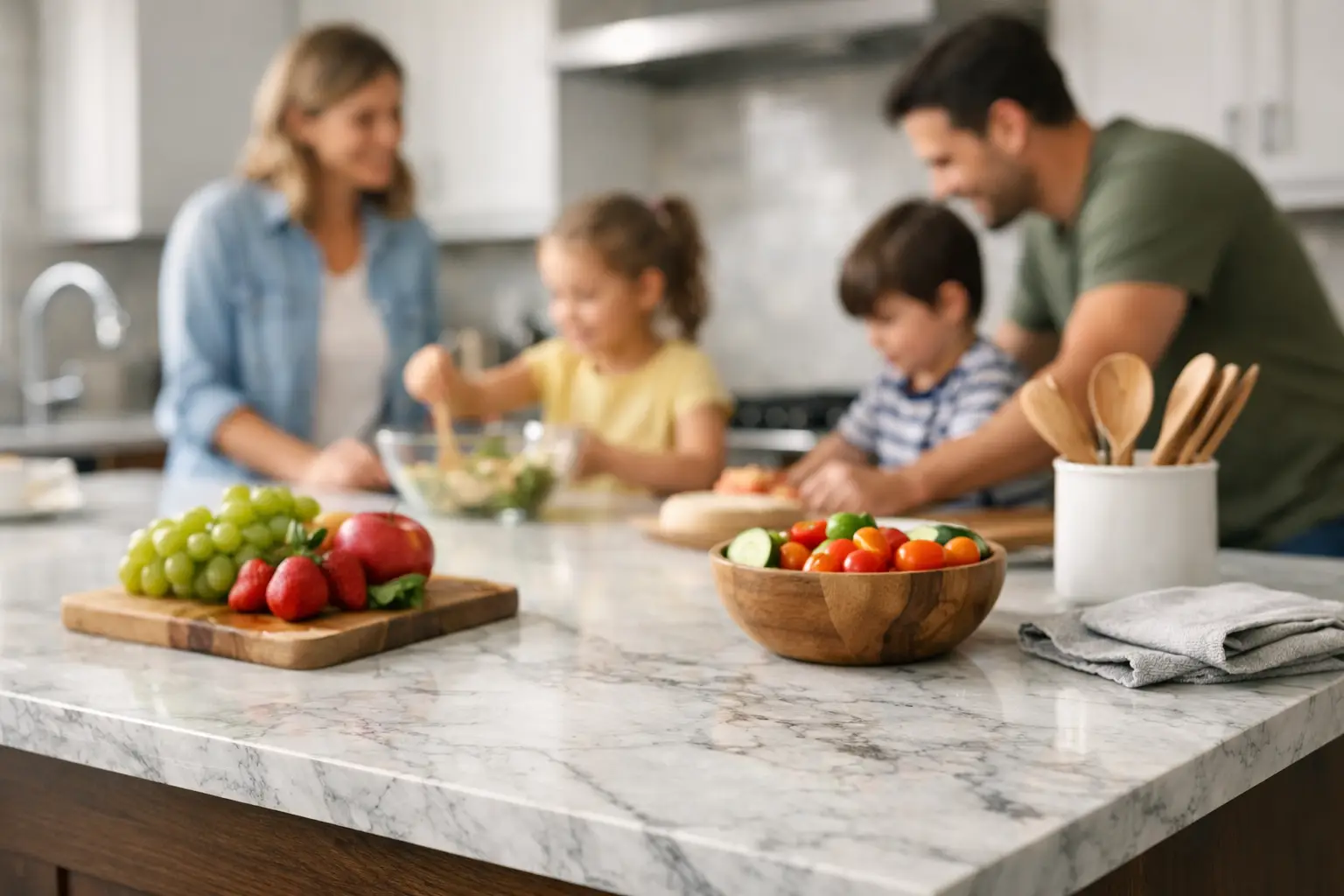
Breakfast spills, school bags on the island, pasta sauce near the cooktop, and someone always setting down a cup without a coaster. That is exactly why choosing the best countertops for busy families comes down to more than colour and pattern. A family kitchen has to handle constant use, easy cleanup, and the occasional rough moment without becoming a source of stress.
For most homeowners, the right answer is not the most expensive slab or the trendiest finish. It is the material that fits the way your household actually lives. If you cook often, host regularly, or have young kids who treat every surface like a workspace, durability and maintenance matter just as much as appearance.
In a high-use kitchen, countertops have to do several jobs at once. They need to resist stains from coffee, juice, oil, and tomato sauce. They should stand up to daily wear around sink cutouts, corners, and seating overhangs. They also need to be easy to wipe down quickly, because most families are not interested in special cleaners or careful routines every single day.
That is why the conversation usually starts with four practical questions. How easily does it stain? How much maintenance does it need? How well does it hide everyday mess? And what happens after a few years of real use?
The fabrication details matter too. A busy kitchen benefits from well-planned seams, durable edge profiles, properly supported overhangs, and precise sink cutouts. Even a strong material can feel less practical if the layout is not thought through carefully.
| Material | Maintenance | Heat Resistance | Stain Resistance | Best For |
|---|---|---|---|---|
| Quartz | Excellent | Good | Excellent | Low-maintenance family kitchens |
| Granite | Good | Excellent | Good | Natural stone lovers who cook often |
| Quartzite | Good | Excellent | Good | Premium natural stone kitchens |
| Porcelain | Excellent | Excellent | Excellent | Modern kitchens, outdoor spaces, and busy homes |
| Marble | Higher | Good | Fair | Homeowners who prioritize natural character |
Quartz countertops are often the most practical fit for family kitchens because they are non-porous, low maintenance, and consistent in pattern. Quartz does not need sealing, and it handles everyday spills well when cleaned normally. For parents who want a surface that looks clean without demanding much attention, quartz is usually near the top of the list.
It also works well in a lot of styles. Some quartz designs have a soft, subtle look, while others mimic marble or concrete. That flexibility helps if you want a family-friendly kitchen that still feels polished.
The main trade-off is heat resistance. Quartz is durable, but it is still smart to use trivets for hot pots and pans. In very active kitchens, that is an easy habit to build, but it is worth knowing upfront. Pricing can vary quite a bit depending on the design, thickness, and edge detail, though many families find the low maintenance worth the investment.
Granite countertops are a strong option if you want natural stone with good durability. Granite handles heat well and stands up nicely to daily use. Families who cook often tend to appreciate that extra heat tolerance, especially around ranges and busy prep areas.
Because granite is natural, each slab has movement and variation. That can be a design advantage, but it also means material selection matters. Some patterns are better at hiding crumbs, fingerprints, and water spots than others. A heavily polished black surface, for example, may show more daily marks than a mid-tone granite with natural variation.
Granite does need sealing over time, so it is not quite as hands-off as quartz. That does not make it high maintenance, but it is a factor. If you love the character of natural stone and do not mind occasional upkeep, granite remains one of the best countertops for busy families.
Quartzite countertops appeal to homeowners who want the look of marble with more durability. Quartzite is hard, attractive, and well suited to active kitchens. Many families choose quartzite when they want something bright and elegant but do not want the maintenance concerns that come with marble.
That said, quartzite is not maintenance-free. It typically needs sealing, and like any natural material, performance can vary slightly depending on the slab. It is also usually priced higher than many quartz and granite options. For some households, the look is worth it. For others, quartz gives a similar visual direction with less upkeep.
Porcelain countertops are becoming more popular in family homes because they are highly resistant to stains, UV exposure, and heat. Porcelain can be an excellent choice for kitchens, laundry rooms, mudrooms, and even outdoor BBQ areas. If your household is hard on surfaces, porcelain deserves a serious look.
One reason homeowners like porcelain is its clean, modern feel. It is available in large-format looks, marble visuals, and minimal patterns that suit contemporary spaces well. It is also practical for vertical applications like backsplashes and waterfall islands.
The trade-off is that fabrication requires precision, especially around edges, sink openings, and panel alignment. When porcelain is measured, cut, and installed well, it performs beautifully. It is less forgiving of poor fabrication than some thicker stone materials.
Marble countertops are beautiful, but for most busy families, marble is not the most practical primary kitchen countertop. It can etch and stain more easily than quartz, granite, quartzite, or porcelain. In a low-traffic baking area or bathroom vanity, it can still make sense. In a family kitchen with constant spills and fast cleanup, it often asks for more care than most households want to give.
That does not mean marble is wrong. It just means the trade-off is real. If you choose it, do so because you love the natural aging and understand that marks are part of the material.
The material matters, but so do the details around it. Families usually do best with eased or pencil edges rather than more delicate profiles. A simpler edge is easier to clean, less likely to chip visibly, and better suited to a kitchen that sees heavy use.
Countertop thickness also affects the final look and feel. Standard thickness works well in most homes, while a thicker build-up can create a bolder island presence. For families, the better question is not which thickness is fanciest but which one fits the kitchen design and budget without adding unnecessary cost.
If you are planning a waterfall island, think about traffic flow and corner exposure. Waterfalls can look sharp and help protect cabinet ends, but they also create prominent edges in a space where kids may be moving quickly. The same practical thinking applies to overhangs. Seating areas need proper support and enough room to use comfortably, especially in a kitchen that doubles as a homework station or breakfast spot.
Seam placement matters more than many homeowners expect. In larger kitchens, some seams are unavoidable. Good planning keeps them in less noticeable areas and aligns pattern flow as cleanly as possible. That is where careful templating and fabrication make a visible difference.
If the goal is the least maintenance with strong everyday performance, quartz usually leads. It is easy to clean, reliable for family use, and available in a wide range of colours and patterns.
If you want natural stone and better heat resistance, granite is a very solid option. If your style leans brighter and more organic, quartzite may be worth the added cost and maintenance. If you want a modern surface with strong stain and heat resistance, porcelain can be an excellent fit.
The best choice depends on what kind of inconvenience bothers you most. Some families want to avoid sealing. Others care more about hot pan resistance. Some want a pattern that hides crumbs and fingerprints between cleanings. There is no single right answer for every household.
Pricing depends on material, slab selection, layout complexity, edge style, sink cutouts, backsplashes, and whether the project includes features like waterfalls or full-height surfaces. A simple kitchen with straight runs will usually cost less than an island-focused layout with multiple cutouts and detailed fabrication.
Timelines also vary, but homeowners should expect a process that includes material selection, field measurements or templating, fabrication, and installation. Precision matters at every stage, especially in family homes where the kitchen cannot stay out of service for long. When the work is handled carefully in-house, communication tends to be clearer and details are easier to control.
For Ontario homeowners comparing options, this is usually where expert guidance helps most. Not because the materials are confusing on their own, but because the right recommendation often comes down to how all the details work together in your specific kitchen.
Quartz is often the best all-around choice because it is non-porous, durable, and easy to maintain. It handles everyday spills well and does not require sealing.
Mid-tone quartz and granite with natural movement generally hide everyday dust, fingerprints, and crumbs better than highly polished solid black or pure white surfaces.
Yes. Quartz is one of the most family-friendly countertop materials because it resists stains, is easy to clean, and requires very little maintenance.
Quartz is usually the better choice for homeowners who want minimal maintenance. Granite is ideal if you prefer natural stone and want greater heat resistance.
Yes. Porcelain is highly resistant to stains, heat, and UV exposure. It can be a strong option for busy kitchens when it is fabricated and installed properly.
Professionally fabricated and installed quartz, granite, quartzite, and porcelain countertops can last for decades when cared for properly.
If your countertops need to survive rushed mornings, weeknight cooking, and years of everyday wear, choose the surface you will still appreciate on an ordinary Tuesday, not just the one that looks best in a showroom.
Stone Valley Countertops helps homeowners across Ontario compare quartz, granite, marble, quartzite, porcelain, Dekton, and sintered stone based on real use, maintenance, layout, and budget. To compare materials for your kitchen, visit a Stone Valley showroom or contact us to get started.