
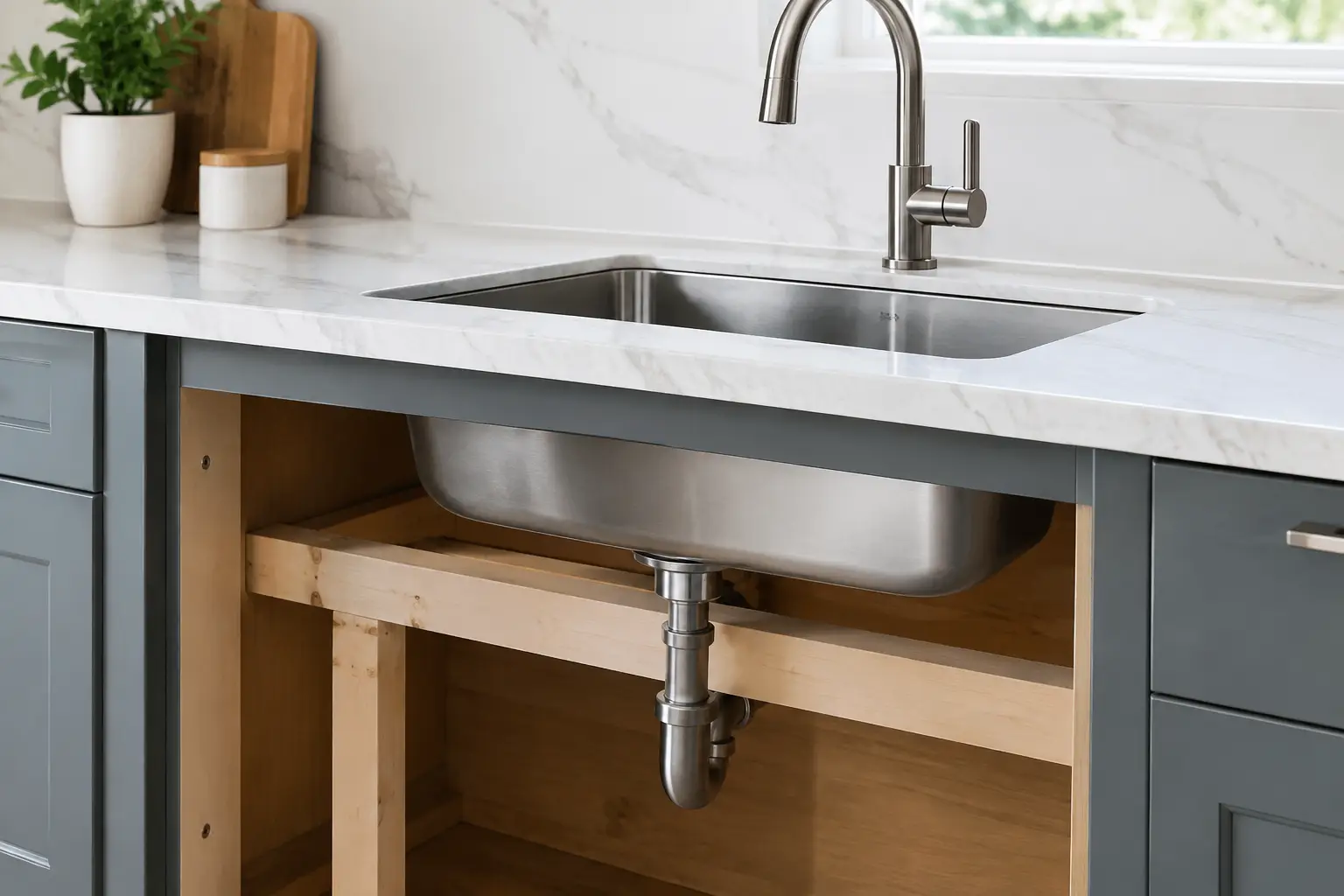
A sink opening is one of the most demanding areas of a countertop. It removes a large section of material, sits beside plumbing, and may carry significant weight every day. So, do sinks need support? Often, yes. The right support depends on the sink style, its weight, the cabinet design, and the countertop material.
The key point for homeowners is simple: the countertop should not be asked to carry more weight than the installation was designed to handle. A properly planned sink installation protects the stone, keeps the sink aligned, and helps prevent issues such as sagging, failed adhesive, cracked cutouts, or gaps between the sink and countertop.
Quick Answer: Most kitchen sinks need a secure mounting or support system. Standard undermount stainless steel sinks may use approved mounting hardware and support methods, while heavier fireclay, cast iron, farmhouse, and stone sinks typically require structural support from the cabinet below. The countertop itself should not be relied on as the primary support for a heavy sink.
Most sinks need some form of support, although that support may come from mounting hardware, the sink cabinet, support rails, brackets, or a combination of these. The answer is rarely a simple yes or no because an undermount stainless steel sink behaves very differently from a heavy fireclay farmhouse sink.
For stone countertops, the sink cutout is fabricated with carefully finished edges and appropriate corner radiuses to reduce stress concentrations. Quartz, granite, marble, quartzite, porcelain, and sintered stone are all durable countertop materials, but none should be treated as a structural frame for an excessively heavy sink.
The mounting method should suit both the sink and countertop system. For heavier models, mechanical support below the sink is generally the more appropriate long-term approach. Adhesive and sealant play important roles in an undermount installation, but a heavy basin should have a support system designed for its weight and the manufacturer’s installation requirements.
Undermount sinks are installed beneath the countertop, creating a clean edge that lets you wipe crumbs and water directly into the basin. They are popular with quartz, granite, quartzite, and other stone surfaces because they create a neat, practical finish.
A standard stainless steel undermount sink is relatively light compared with fireclay or cast iron. Its mounting method will depend on the sink manufacturer, countertop material, cabinet construction, and installation system being used. Support from below can add security, particularly with large or double-bowl sinks, because it reduces the amount of load carried by the sink-to-countertop connection.
The sink reveal also matters. Whether the countertop edge sits flush with the sink, slightly overhangs it, or leaves part of the sink rim exposed, the cutout must be precisely fabricated. Poor alignment can leave an awkward edge that collects residue or makes cleaning harder.
Farmhouse sinks typically need dedicated cabinet support. Their front apron replaces part of the cabinet face, and many models are substantially heavier than a typical stainless steel sink. Fireclay, cast iron, and natural stone farmhouse sinks can become especially heavy once filled with water, cookware, and dishes.
The cabinet should be built or modified to carry the sink load rather than relying on the countertop. The stone is then fabricated around the sink with appropriate clearances and a carefully finished cutout.
A farmhouse sink also affects the countertop template. The exact sink model should be available before measurements are finalized. Even similar-looking apron-front sinks can vary in width, depth, rim shape, and corner detail. Guessing at the opening before the actual sink specifications are confirmed can lead to an expensive mismatch.
A drop-in sink has a rim that rests on top of the countertop. In many installations, the rim distributes load around the opening while mounting clips secure the sink against the countertop. These sinks can have different support requirements than undermount or farmhouse models.
Sink material still matters. A large cast iron drop-in sink is considerably heavier than a stainless steel model, so additional cabinet reinforcement may be appropriate. The countertop cutout must also be accurate. If it is too large, the sink rim may not adequately cover the opening. If it is too tight, installation becomes difficult and may create unwanted contact with the countertop edge.
Some bathroom vanities use integrated solid-surface bowls, vessel sinks, or stone basins. Each requires its own planning. A vessel sink rests on top of the countertop but still needs a correctly positioned drain opening and a stable mounting surface. An integrated basin may be part of a specific material system and should follow the manufacturer’s installation requirements.
For a custom stone vanity, the material thickness, size of the bowl opening, and distance from the cutout to the front and back edges all influence fabrication. Thin porcelain and sintered stone surfaces require fabrication and support methods suited to those materials.
Homeowners often focus on how heavy a sink is, which makes sense, but weight is only part of the decision. The size and location of the cutout matter too.
A wide sink cutout leaves narrower countertop rails at the front and back of the opening. A cutout placed close to a seam, cooktop opening, or countertop edge can further concentrate stress in one area. Fabricators consider these details when laying out the slab, selecting seam locations, and planning reinforcement or support.
Countertop thickness can also affect fabrication and support requirements. A 3 cm quartz or granite slab provides more material depth than a 2 cm slab, but thickness alone does not replace proper sink support. A laminated or mitred edge may create the appearance of a thicker countertop, while the structural characteristics still depend on the actual material and support below.
Natural stone adds another consideration: veining, fissures, mineral movement, and other characteristics of the specific slab. A dramatic marble or quartzite slab may require careful positioning of the sink cutout. Good fabrication is not simply about centring the sink visually. It is also about planning the opening appropriately within the selected slab.
The sink cabinet is the foundation of the installation. It should be level, secure, and appropriately sized for the chosen sink. A cabinet that is out of square, weak at the top rails, or altered after templating can complicate installation and affect the countertop fit.
Depending on the installation system, an undermount sink may use rails, brackets, clips, or another approved mounting method within the cabinet. A heavy farmhouse sink commonly uses a purpose-built internal frame or platform to transfer its weight into the cabinet structure.
This is also why the sink, faucet, and cabinet should be selected before templating whenever possible. The template stage confirms sink placement, faucet hole locations, backsplash clearances, overhangs, seams, and the relationship between the countertop and surrounding walls. Small changes after fabrication can be difficult, particularly with stone surfaces.
A properly installed sink should feel solid and remain aligned with the countertop. Warning signs can include a visible gap between the sink and stone, a basin that moves when loaded, loose mounting hardware, cracking around the cutout, or silicone that repeatedly separates at the joint.
Water stains or swelling inside a wood cabinet can also point to a leak that needs attention. This does not automatically mean the sink support has failed, but ongoing moisture can weaken cabinet components and should be addressed before it causes further problems.
If an undermount sink appears to be pulling away from an existing countertop, avoid loading it unnecessarily with heavy cookware or standing water. A countertop professional can assess whether the problem involves mounting hardware, adhesive failure, cabinet movement, inadequate support, or damage around the countertop cutout.
The best time to solve sink support questions is before the countertop is fabricated. Provide the exact sink model or specification, including its dimensions, material, weight, and installation type. If you are choosing between an undermount stainless steel sink and a heavy fireclay farmhouse model, make that decision before the template appointment.
At Stone Valley Countertops, templating and fabrication planning account for sink cutouts, faucet placement, countertop thickness, seams, overhangs, and the condition of the supporting cabinets. These details may not be the most visible part of a finished kitchen or vanity, but they play an important role in how the finished installation performs.
A well-supported sink should simply work in daily use. There should be no movement, separation, or unnecessary stress around the countertop opening. Choosing the sink and support method early also gives the fabricator the information needed to plan the cutout accurately before the slab is cut.
Yes, an undermount sink needs a secure mounting system. The exact method depends on the sink, countertop material, cabinet construction, and manufacturer requirements. Larger or heavier sinks may benefit from or require mechanical support from below rather than relying primarily on the sink-to-countertop bond.
Quartz countertops can be fabricated for undermount sinks, but the sink still needs an appropriate mounting or support system. The quartz surrounding the opening should not be treated as the sole structural support for a heavy sink.
The sink installed with a granite countertop should be securely mounted according to the sink and installation system. Heavy sinks may require cabinet-mounted rails, brackets, framing, or another mechanical support method so their weight is transferred to the cabinet rather than concentrated around the granite cutout.
Usually, yes. Farmhouse sinks made from fireclay, cast iron, stone, and other heavy materials commonly require a reinforced cabinet platform or frame designed to carry the sink’s weight independently of the countertop.
Ideally, yes. At minimum, the exact sink model and manufacturer specifications should be confirmed before templating. Having the sink information available allows the fabricator to verify the cutout dimensions, corner shape, reveal, faucet placement, and cabinet fit before fabrication begins.
An undermount sink can separate if its mounting system, adhesive, cabinet support, or installation fails. Movement, a growing gap between the sink and countertop, or repeatedly separating silicone should be inspected before the sink is heavily loaded.