
An outdoor counter beside the grill has a harder job than an indoor kitchen island. It may hold hot trays, catch grease splatter, sit under direct sun, and go through Ontario’s freeze-thaw cycles year after year. Choosing the right outdoor BBQ countertop materials means looking beyond colour samples and considering how the slab, seams, cutouts, and support will perform outside.
The best choice depends on whether your BBQ area is fully covered, partly exposed, or open to the weather. It also depends on how you cook. A countertop used for occasional weekend grilling has different needs than one that supports a built-in grill, sink, pizza oven, and regular entertaining.
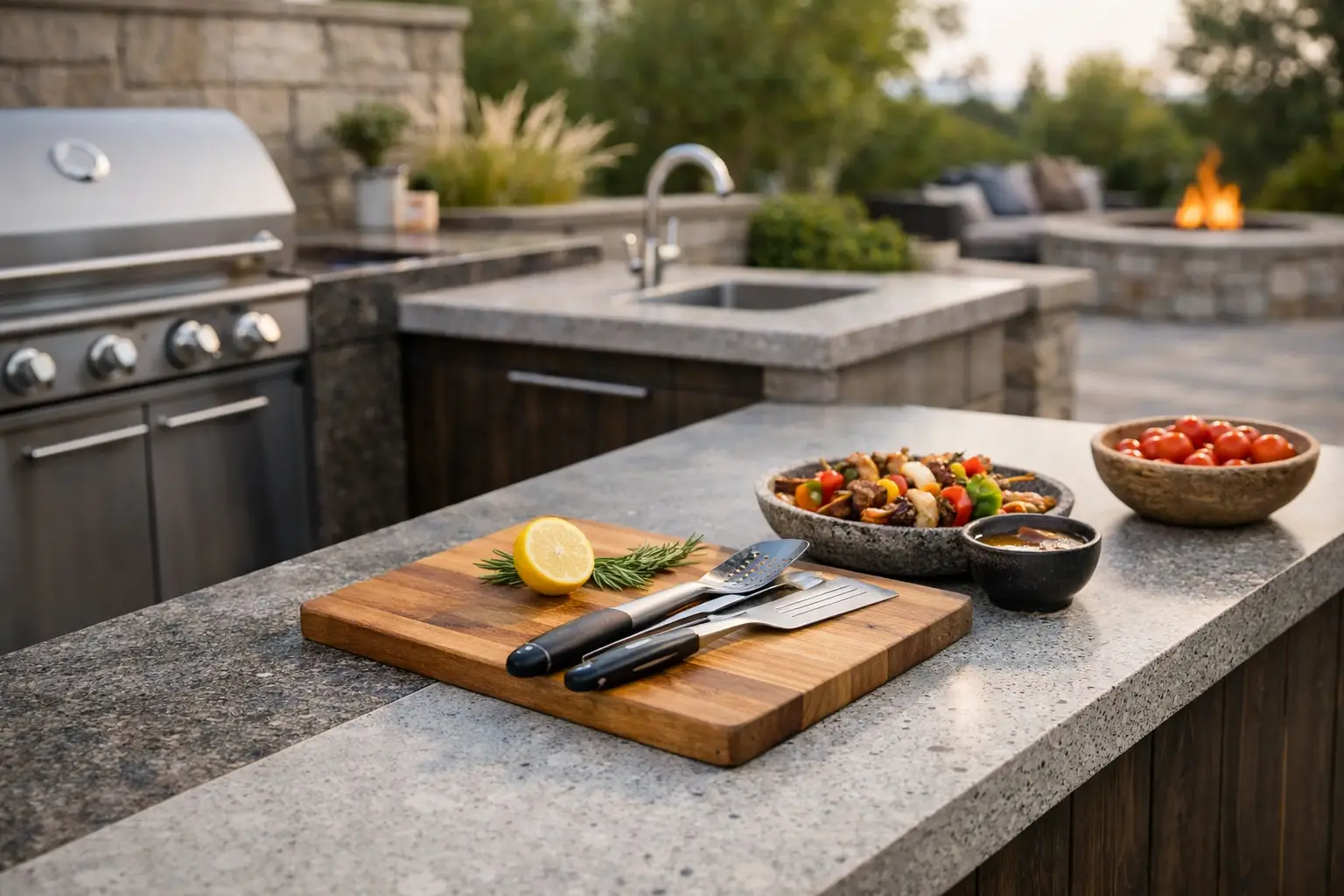
Outdoor surfaces face several stresses at once: sunlight, rain, snow, temperature swings, food acids, oils, and the heat coming from nearby appliances. A material that performs well indoors is not automatically appropriate outside.
UV exposure is often the first issue homeowners miss. Some engineered surfaces can fade, discolour, or lose their finish in direct sunlight. Moisture is another concern, especially where water can enter an unsealed natural stone surface, an exposed cut edge, or a poorly detailed seam. In colder parts of Ontario, trapped moisture and repeated freezing can create avoidable problems over time.
The countertop also needs to be fabricated for the way it will be used. Grill cutouts need appropriate clearances based on the appliance manufacturer’s specifications. Sink openings require properly finished edges. Long overhangs may need concealed steel support, and large L-shaped counters may need seams placed where they are less visible and better supported.
Granite countertops remain one of the most practical outdoor choices. Granite is a natural stone with good heat resistance, natural UV stability, and the strength to handle everyday outdoor use when it is properly fabricated and installed.
Most granite colours will not fade from sun exposure the way some resin-based materials can. Its natural variation also helps it suit outdoor kitchens, stone veneer, brick, stainless steel, and wood elements without looking overly uniform. Darker granites can become very hot in full sun, though, so that is worth considering for a south-facing cooking area.
Granite does need periodic sealing. The exact schedule depends on the specific slab and how exposed the counter is, but sealing helps reduce absorption from cooking oils, marinades, and spills. Routine care is simple: clean with a pH-neutral stone cleaner or mild soap and water, then avoid leaving strongly acidic foods or greasy residue on the surface for long periods.
Granite pricing varies with colour availability, slab yield, edge detail, cutouts, and the complexity of the layout. A straightforward straight-run counter is generally less costly to fabricate than a large U-shaped island with a grill, sink, bar overhang, and multiple seams.
Porcelain and sintered stone are strong options for exposed BBQ areas because they are designed to tolerate sun, moisture, heat, and temperature changes. These surfaces are nonporous or nearly nonporous, so they do not require the regular sealing associated with natural stone.
They are especially appealing for homeowners who prefer a consistent colour or a clean concrete, stone, or marble-look finish. A light porcelain surface can also be more comfortable around a sunny bar area than a dark natural stone, although any countertop will warm up in direct afternoon sun.
Fabrication is where experience matters. Porcelain and sintered stone can be very durable in use, but thinner slabs and narrow areas around cutouts require careful handling, accurate support, and precise cutting. Grill openings, sink corners, and unsupported spans need to be planned before fabrication rather than adjusted on site.
These materials can cost more to fabricate than some granite options because they require specialized tools and careful handling. Still, their low-maintenance performance can make them a sensible fit for a fully exposed outdoor kitchen.
Standard quartz is usually not the right material for an uncovered outdoor BBQ countertop. Quartz slabs contain resins that can react to prolonged UV exposure. Depending on the product and conditions, sunlight may cause fading, yellowing, or changes to the finish. Many quartz manufacturers also limit or exclude warranty coverage for exterior installations.
A covered, screened space may reduce exposure, but it does not automatically make quartz suitable. Reflected sunlight, heat buildup around the grill, and open sides still matter. Before selecting quartz, confirm that the specific product is approved for the exact environment where it will be installed.
For homeowners who like the uniform look and easy cleaning of quartz, porcelain or sintered stone often provides a better outdoor alternative. The visual style can be similar, while the material is better suited to sun and weather.
Quartzite is a natural stone that can work well outdoors when selected carefully and sealed appropriately. It offers strong natural character, good UV stability, and generally better durability than marble. Because quartzite varies substantially from slab to slab, viewing the actual material is valuable. What looks soft and pale in a small sample may have stronger veining, movement, or colour variation across a full countertop.
Like granite, quartzite needs periodic sealing and should be cleaned with stone-safe products. Some quartzites are denser and easier to maintain than others, so material selection should include a conversation about the specific slab rather than relying on the category name alone.
Marble can be used outdoors, but it is a choice for homeowners who accept a lived-in finish. It can etch from lemon, vinegar, wine, and many cooking ingredients. It may also stain or develop a patina over time. For a decorative bar surface under substantial cover, marble may be appropriate. For a heavily used grill station, granite, quartzite, porcelain, or sintered stone is usually more practical.
| Material | UV Resistance | Heat Resistance | Maintenance | Best For |
|---|---|---|---|---|
| Granite | Excellent | Excellent | Periodic sealing | Open BBQ kitchens |
| Porcelain | Excellent | Excellent | Very low | Modern outdoor kitchens |
| Sintered stone | Excellent | Excellent | Very low | Exposed outdoor spaces |
| Quartzite | Excellent | Very good | Periodic sealing | Natural stone appearance |
| Marble | Good | Good | Higher maintenance | Covered decorative areas |
| Standard quartz | Generally poor outdoors | Moderate | Low indoors | Primarily indoor use |
Material choice is only part of the decision. Good outdoor countertop fabrication accounts for water management, support, appliance requirements, and the visual details that make the space feel finished.
A standard 2 cm or 3 cm slab thickness may work depending on the material, cabinet construction, and desired look. A built-up edge can create the appearance of a thicker countertop without using a full thicker slab. This can be useful for a substantial outdoor island profile, but the edge should be designed to shed water rather than create places where moisture and debris collect.
Simple eased edges are common for BBQ counters because they are comfortable, durable, and easy to clean. More detailed profiles can be used in covered entertaining areas, but sharp or highly ornate edges are less practical around grills and outdoor cleanup.
Overhangs deserve attention, particularly at seating areas. The farther the counter extends beyond the base, the more likely it is to require brackets or concealed support. This is not only about preventing movement. Proper support protects the stone from stress near seams, corners, and cutouts.
Seams should be planned around the slab size, layout, and access path to the backyard. A seam may be unavoidable on a long counter or a large L-shape, but its location can often be chosen to keep it away from high-visibility prep areas or narrow sections around a grill cutout. Accurate templating before fabrication helps ensure walls, cabinetry, and appliances align as intended.
For an open, uncovered BBQ kitchen, granite, porcelain, sintered stone, and many quartzites are the strongest starting points. If low maintenance and a consistent appearance are priorities, porcelain or sintered stone often make sense. If you prefer natural movement and do not mind periodic sealing, granite and quartzite offer excellent options.
For a covered outdoor bar with limited direct sun, the material range can be broader, but heat, moisture, and manufacturer guidelines still need to be checked. Standard quartz should never be assumed safe simply because the space has a roof.
Bring photos of the grill, cabinetry, surrounding finishes, and the amount of sun the area receives when selecting slabs. Those practical details help guide material selection, template planning, fabrication, and installation so the finished counter suits the way the outdoor space will actually be used.
Ontario’s climate is one of the biggest reasons material selection matters. Outdoor countertops can experience intense summer sun, heavy rainfall, freezing winters, and repeated freeze-thaw cycles throughout the year. Choosing a material that performs well in these conditions helps reduce long-term maintenance and protects the countertop from avoidable damage.
Cabinets and support structures must also be suitable for outdoor use. Even a durable slab can develop problems if the base underneath it shifts, swells, settles, or does not provide adequate support around appliances and overhangs.
Water should be able to drain away from cabinets, seams, walls, and appliance openings. Outdoor counters should not create low areas where melting snow or rainwater can sit for long periods. Caulking and flexible joints around walls and appliance components should also be inspected periodically because exterior materials expand and contract with seasonal temperature changes.
Proper fabrication and installation are just as important as the surface itself. Well-supported overhangs, carefully planned seams, quality edge finishing, and accurate appliance cutouts all contribute to a countertop that performs reliably through changing Ontario seasons.
Granite, porcelain, sintered stone, and many quartzites are among the best outdoor BBQ countertop materials. They provide strong resistance to UV exposure, weather, moisture, and heat when properly fabricated and installed.
Most standard quartz products are not recommended for uncovered outdoor kitchens. Prolonged UV exposure can cause fading, yellowing, discolouration, or changes to the resin binder. Exterior installations may also be excluded from the manufacturer’s warranty.
Most outdoor granite countertops benefit from periodic sealing to reduce absorption from moisture, cooking oils, marinades, and food spills. The sealing schedule depends on the porosity of the specific granite and how exposed the countertop is to weather.
Lighter-coloured porcelain, sintered stone, granite, and quartzite generally stay more comfortable than very dark surfaces in direct sunlight. However, any countertop can become hot during prolonged afternoon sun exposure.
Both 2 cm and 3 cm slabs can work outdoors depending on the material, base construction, edge design, cutouts, and support requirements. Proper support and fabrication are more important than selecting thickness based on appearance alone.
Heat-resistant materials such as granite, porcelain, quartzite, and sintered stone handle heat better than resin-based quartz. However, using a trivet or heat-resistant pad is still recommended because cookware may carry grease, grit, or concentrated heat that could damage the finish or cause thermal stress.
It depends on the material, slab thickness, overhang depth, base construction, and whether there are nearby seams or cutouts. Longer seating overhangs commonly require brackets, corbels, or concealed steel support to reduce stress on the slab.
The most satisfying BBQ counters are not chosen only for their first-day appearance. Choose a surface whose maintenance, heat tolerance, UV resistance, and natural ageing you will be comfortable with after many summers of cooking, cleaning, and gathering outside.
Stone Valley Countertops supplies, fabricates, and installs outdoor countertops throughout Toronto, the GTA, Durham Region, Hamilton, Niagara Region, and surrounding Ontario communities. To discuss your outdoor kitchen layout, material options, appliance cutouts, and installation requirements, contact Stone Valley Countertops.