
A full-height quartz backsplash can make a kitchen look remarkably calm and intentional. The countertop pattern continues up the wall, grout lines disappear, and cleanup after cooking becomes much simpler. But before choosing one, it helps to understand the real quartz backsplash pros and cons, especially around cost, heat exposure, seams, and the details that affect the finished look.
Unlike a standard tile backsplash, quartz is fabricated as large slabs or carefully sized pieces. That makes material selection, templating, wall conditions, and installation planning more important. The result can be beautiful and practical, but it is not automatically the right choice for every kitchen.
Quick answer: A quartz backsplash is a strong choice for homeowners who want a low-maintenance surface with no grout lines and a coordinated countertop-to-wall design. Its main disadvantages are higher cost, possible seams, limited repair options, and the need to plan carefully around high-heat cooking appliances. It works best when the slab layout, outlet locations, wall conditions, and range clearances are reviewed before fabrication.
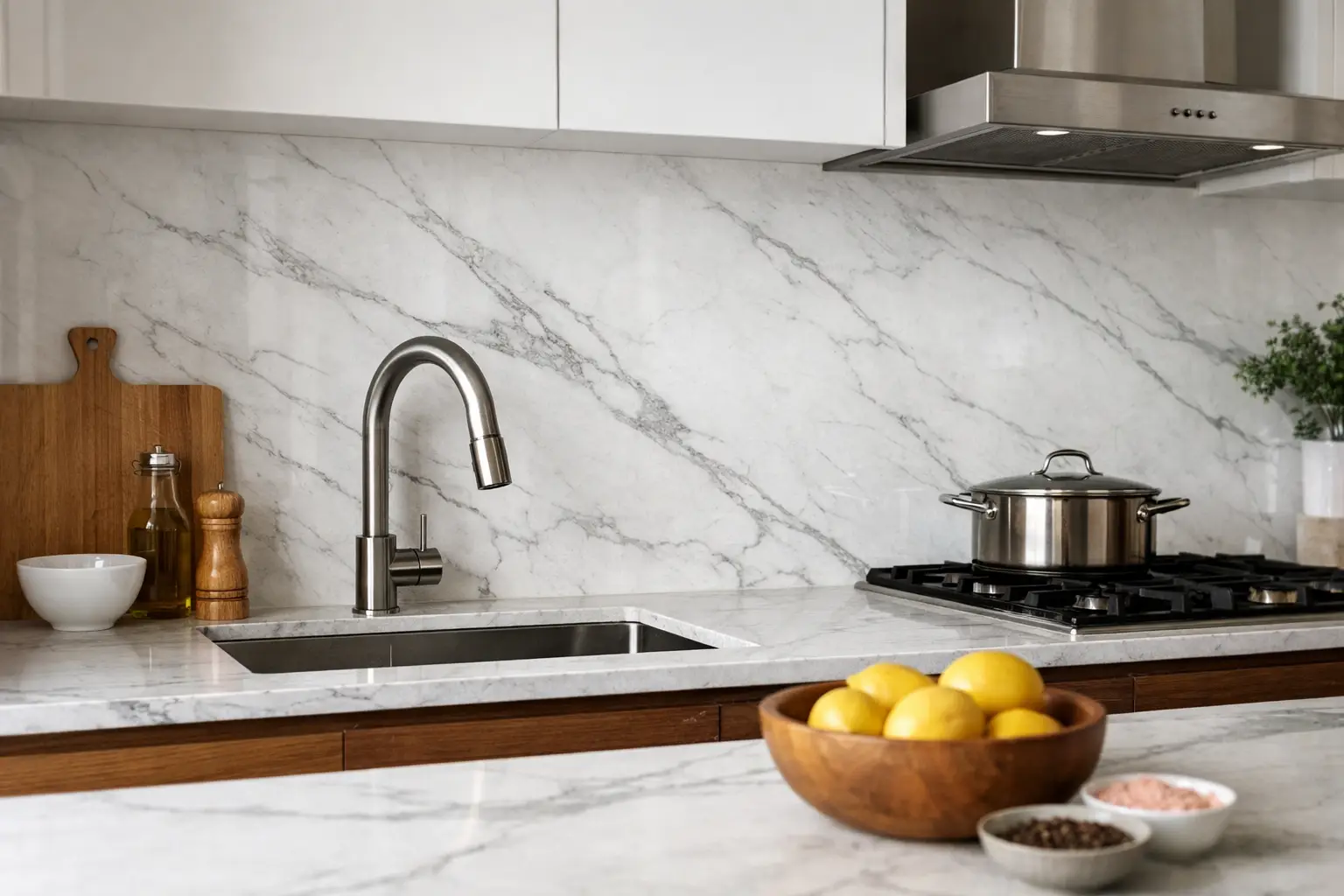
A quartz backsplash is made from engineered quartz, the same material commonly used for countertops. It contains natural quartz minerals combined with resins and pigments, creating a nonporous surface with consistent colour and pattern options.
It can be installed as a short 4-inch backsplash behind the counter, but most homeowners considering quartz choose a full-height application. This runs from the countertop to the bottom of the upper cabinets, range hood, or ceiling.
A full-height backsplash may use one continuous piece or multiple pieces, depending on slab size, layout, wall height, and the locations of windows, outlets, cabinets, and appliances.
| Advantages | Potential Drawbacks |
|---|---|
| No grout lines to scrub or maintain | Usually costs more than ceramic or porcelain tile |
| Nonporous and resistant to everyday stains | May require seams on long or tall walls |
| Creates a coordinated countertop and backsplash design | Requires planning near high-output gas ranges |
| Available in consistent colours and veined patterns | Outlet and switch cutouts can interrupt the pattern |
| Easy to wipe clean around sinks and prep areas | Damage may be difficult to repair invisibly |
| Fewer visual interruptions than most tile installations | Professional templating, fabrication, and installation are required |
The practical benefit is hard to overlook. Quartz has no grout joints to scrub. Tomato sauce, cooking oil, coffee splashes, and everyday marks can usually be cleaned with a soft cloth, warm water, and mild soap.
Because quartz is nonporous, it does not require periodic sealing. This differs from many natural stone surfaces, including some of the materials discussed in our guide to whether granite countertops need sealing.
This makes quartz a comfortable option for busy kitchens, laundry rooms, bars, and bathroom vanity walls where homeowners want a clean surface without adding another maintenance task.
Using the same quartz for the countertop and backsplash creates visual continuity. This is especially effective with veined designs, where the pattern can be planned to move naturally from the horizontal counter to the wall.
The look is not limited to dramatic veining. Soft white, warm beige, concrete-look grey, or finely speckled quartz can also make a kitchen feel less busy than patterned tile. In smaller kitchens, fewer horizontal breaks can help the room feel more open.
Fabrication details matter here. The best layout considers the slab pattern before cutting, rather than treating the backsplash as an afterthought. Planning should account for seams, outlet cutouts, corners, windows, range hoods, and visible pattern movement before fabrication begins.
Quartz stands up well to everyday contact from utensils, dishes, and cleaning. It is generally more resistant to staining than natural marble and does not require periodic sealing.
For a backsplash, where the material sees less direct impact than a countertop, quartz offers more than enough durability for most households.
It is also a useful material choice near a sink. Water splashes do not soak into the material, and there are no grout lines that may discolour over time. A matching quartz ledge or low sill at a kitchen window can further simplify cleaning when the layout allows it.
Tile requires grout joints, and even large-format tile usually has some visible lines. Quartz can cover a wide area with fewer interruptions. This is valuable behind a cooktop, around a window, or on a feature wall where the homeowner wants the material itself to be the focal point.
The number of seams depends on the slab dimensions and backsplash layout. A long wall, tall ceiling, or large range hood area may still require a seam. A skilled fabricator can place it thoughtfully, but promising a completely seamless backsplash without reviewing the measurements would be unrealistic.
Quartz does not require the periodic sealing associated with many natural stone backsplashes. This does not mean it is maintenance-free, but routine care is usually straightforward.
Homeowners should still avoid harsh abrasive cleaners, strong solvents, and scouring pads that could affect the finish. Mild soap, water, and a soft cloth are usually enough for daily cleaning.
A quartz backsplash requires slab material, fabrication, careful handling, transportation, and professional installation. Cutouts for outlets, switches, windows, shelves, or a pot filler add labour and require precision.
These details make quartz more expensive than many ceramic or porcelain tile installations. The final price varies based on the selected quartz, the amount of material needed, wall height, access to the space, edge finishing, seam requirements, and the complexity of the cutouts.
A short quartz backsplash may be a reasonable upgrade, while a full-height installation across multiple walls can become a meaningful part of the kitchen budget.
For some projects, using quartz behind the range and a coordinating tile elsewhere creates a better balance of cost and visual impact. There is no rule that says every wall must use the same finish.
Quartz is heat resistant, but it is not heatproof. The resins within engineered quartz can be affected by concentrated or extreme heat. This matters most directly behind high-output gas ranges, especially where flames or hot cookware may come very close to the wall.
A quartz backsplash can work behind many cooking areas, but the range specifications, manufacturer clearance requirements, and surrounding design should be reviewed before the material is finalized.
In certain applications, porcelain, Dekton, or another sintered stone may be a better fit because these materials generally tolerate higher heat. Homeowners comparing these surfaces can also review our guide to quartz versus porcelain countertops.
The issue is not ordinary cooking splatter. It is prolonged, direct heat exposure in a concentrated location. This is one reason material decisions should happen early, before templates are taken and fabrication is scheduled.
Quartz backsplashes have fewer joints than tile, not necessarily no joints at all. A seam may be needed where walls are long, ceilings are tall, slab dimensions are limited, or the pattern needs to be managed around a window or hood.
The seam is typically filled with a colour-matched adhesive, but it can still be visible at close range. Its appearance depends on the quartz pattern, lighting, seam location, fabrication quality, and how well the two sections align.
Outlet and switch cutouts also deserve attention. Their placement can interrupt a strong vein pattern, and their edges need accurate cutting and fitting. Discussing outlet locations, cover plates, and under-cabinet electrical options before fabrication can reduce unwanted visual distractions.
Quartz is durable, but a sharp impact at an exposed edge can chip it. Small chips can often be repaired or made less noticeable, though an invisible repair cannot always be guaranteed.
A backsplash is less likely to take impact than a counter edge, but corners near open shelving, appliance garages, window returns, and exposed wall ends still need careful handling.
If damage occurs after installation, matching the exact slab pattern for a replacement piece can be difficult. This is particularly relevant with bold, directional veining or discontinued quartz designs.
Quartz is heavier and less flexible than tile. The wall surface must be stable, properly prepared, and suitable for supporting the material.
Uneven walls can create fitting challenges, visible gaps, or stress points. Older homes may require additional preparation before templating or installation, especially around corners, windows, and areas where previous tile or drywall repairs have left the surface irregular.
In many kitchens, yes. Using the same slab for both surfaces creates one of the cleanest and most coordinated looks available.
Whether the countertop and backsplash can come from the same slab depends on the kitchen dimensions, slab size, countertop layout, seam locations, sink and cooktop cutouts, and the amount of usable material available after defects or unsuitable areas are avoided.
During slab layout, the fabricator can review how the veining will move across the countertop and up the wall. In some kitchens, the pattern can be aligned closely. In others, the available slab dimensions or cut locations may make an exact vein match impractical.
Homeowners choosing a directional pattern should review the proposed slab layout before cutting. A small quartz sample will not show how large veins, colour changes, or pattern repeats will appear across an entire kitchen wall.
A quartz backsplash is only as clean-looking as the planning behind it. Walls are not always perfectly flat, level, or square, particularly in older Ontario homes.
During templating, measurements are taken for wall variations, outlet locations, window openings, cabinets, range hoods, appliance clearances, and the final countertop position. The planning process is similar to the steps described in our guide to countertop fabrication in Ontario.
The countertop is typically installed first, followed by the backsplash. This allows the fabricator to confirm the final countertop position and create a close, consistent fit at the wall.
A small bead of colour-matched silicone at the countertop-to-backsplash joint helps accommodate normal movement and makes the transition easier to clean.
Many quartz backsplashes use the same thickness as the countertop, often 2 or 3 centimetres. Matching the thickness creates a substantial, consistent appearance, but it also increases projection from the wall.
In some layouts, a thinner slab or surface may be considered to reduce visual weight or simplify the fit around window trim, electrical boxes, faucets, shelving, and tight cabinet clearances.
The right thickness depends on the selected quartz, cabinet design, wall condition, available fabrication options, and how the backsplash needs to finish at exposed ends.
Electrical cutouts should be confirmed before fabrication. Moving outlets after the quartz has been cut may require additional work or may not be practical.
Homeowners who want a cleaner backsplash may consider under-cabinet outlet strips or carefully positioned receptacles, provided the electrical plan meets applicable building and electrical requirements.
Seams are usually placed where they will be less noticeable and where the pieces can be installed safely. Corners, hood edges, cabinet breaks, and changes in wall direction may provide logical seam locations.
The best placement is not always the shortest seam. Pattern alignment, installation access, slab dimensions, and structural handling must also be considered.
| Feature | Quartz Backsplash | Tile Backsplash |
|---|---|---|
| Cleaning | Easy to wipe with few or no seams | Grout requires additional cleaning |
| Installation cost | Usually higher | Often lower, depending on tile and labour |
| Design | Large-format, coordinated slab appearance | More colour, shape, pattern, and layout options |
| Heat performance | Requires planning around concentrated heat | Varies by tile material |
| Repairs | Replacement pieces may be difficult to match | Individual tiles may be easier to replace |
| Visual joints | Few seams | Multiple grout lines |
Quartz is usually better suited to homeowners who prioritize easy cleaning, fewer joints, and a coordinated slab appearance. Tile may be the better choice when budget flexibility, high heat tolerance, decorative variety, or easier spot replacement are more important.
Quartz is a strong backsplash option for homeowners who want low maintenance, a coordinated countertop-and-wall design, and fewer joints to clean.
It is especially well suited to kitchens with:
It may be less suitable when the budget is tight, the backsplash has many small obstructions, the walls are highly uneven, or the cooking setup calls for the highest possible heat tolerance.
In those cases, porcelain, sintered stone, or tile may better match the project priorities.
A quartz backsplash can be worth the added cost when easy cleaning, minimal grout, and a coordinated countertop-to-wall appearance are important. The value is less clear when the wall has many cutouts or when a lower-cost tile would achieve the desired design.
Quartz can be installed behind some gas ranges, but the appliance specifications, required clearances, burner output, and backsplash location should be reviewed first. Quartz should not be assumed to be suitable for every high-heat cooking setup.
No. Engineered quartz is nonporous and does not require periodic sealing.
Quartz backsplashes are often fabricated from 2-centimetre or 3-centimetre material. The best thickness depends on the selected slab, countertop thickness, outlet depth, window trim, cabinet clearances, and the desired appearance.
Installing quartz directly over existing tile is not always recommended. The surface must be flat, stable, properly bonded, and able to support the added weight. Removing the existing finish often gives the installer better control over wall preparation and fit.
It may. Seam requirements depend on slab size, wall dimensions, pattern direction, access, windows, range hoods, and installation handling. Some smaller walls can be completed in one piece, while larger layouts may require carefully planned seams.
Veining can often be coordinated, especially when the countertop and backsplash are cut from the same slab. Exact alignment is not always possible, so the slab layout should be reviewed before fabrication begins.
A quartz backsplash offers easy cleaning, no grout maintenance, strong stain resistance, and a refined connection between the countertop and wall. Its main limitations are cost, heat sensitivity, visible seams, complex cutouts, and limited replacement options if damage occurs.
Before selecting a slab, look at a full-size section rather than relying only on a small sample. Consider the backsplash as part of the complete fabrication plan, including the countertop layout, range clearances, wall condition, outlets, windows, seams, and pattern direction.
The right backsplash is not simply the material that looks best in a showroom. It is the one that fits how the kitchen is used and allows the fabrication details to look intentional once installation is complete.
Stone Valley Countertops supplies, fabricates, and installs quartz countertops and full-height backsplashes for homeowners across Mississauga, Toronto, the GTA, Durham Region, Niagara Region, Hamilton, Burlington, Oakville, and surrounding Ontario communities.
Before fabrication, our team can review slab dimensions, backsplash height, seam locations, outlet cutouts, range clearances, wall conditions, and pattern direction. This helps identify potential issues before the quartz is cut.
Contact Stone Valley Countertops to discuss your kitchen measurements, material choice, and backsplash layout.