
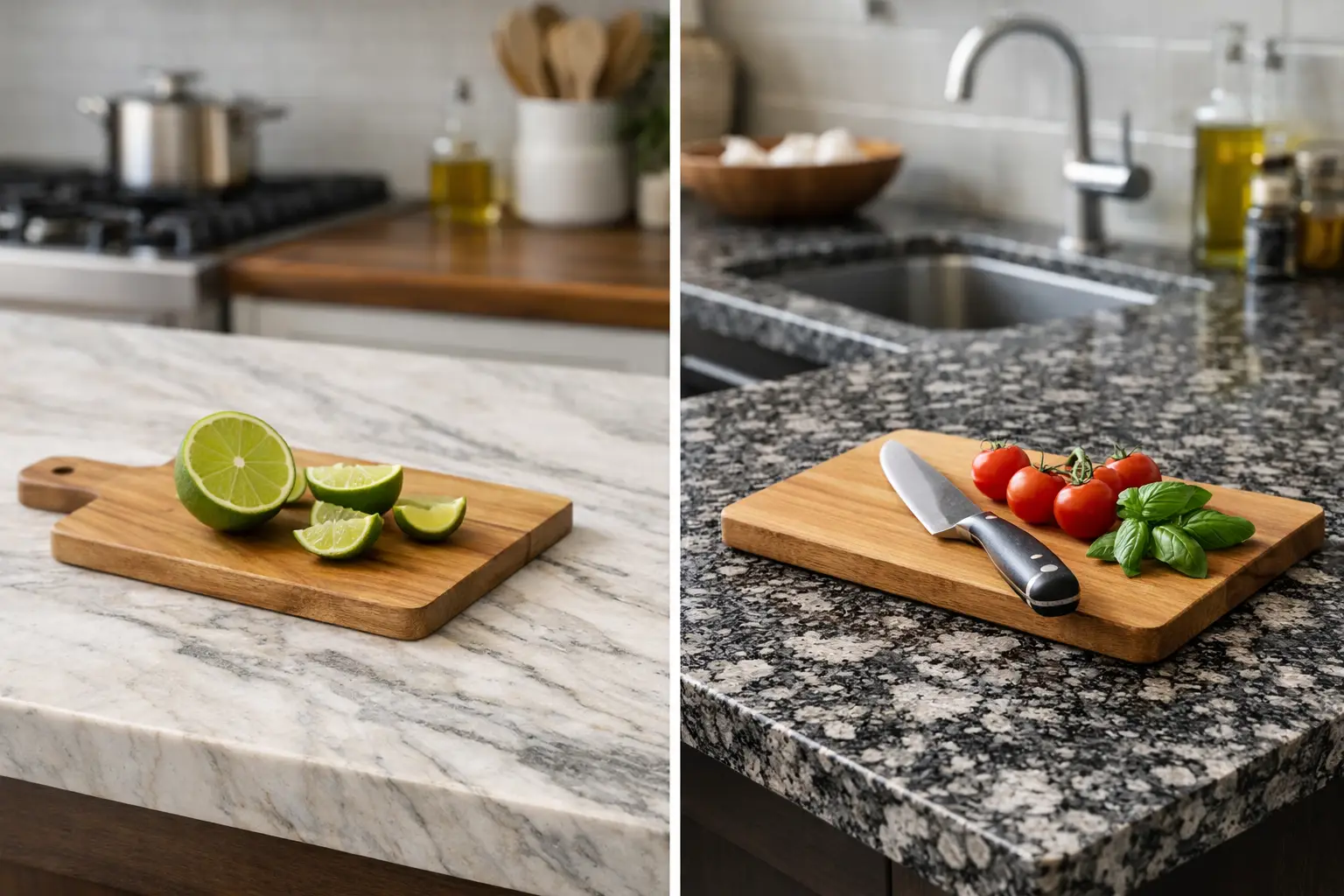
A countertop can look flawless in a slab showroom and still be the wrong fit for the way a kitchen is used. When homeowners compare quartzite vs granite durability, the real question is rarely which stone is stronger on paper. It is which surface will handle hot cookware, busy meal prep, spills, kids, pets, and years of daily cleaning without creating unnecessary maintenance concerns.
Both are natural stones with excellent long-term potential. Both can be fabricated into striking kitchen islands, bathroom vanities, bar tops, fireplace surrounds, and outdoor counters. The practical differences come down to the specific slab, how it is fabricated, where it is installed, and how much routine care you are comfortable providing.
| Feature | Quartzite | Granite |
|---|---|---|
| Scratch resistance | Excellent | Excellent |
| Heat resistance | Excellent | Excellent |
| Stain resistance | Very good with sealer | Very good with sealer |
| Etching resistance | Excellent (true quartzite) | Excellent |
| Maintenance | Periodic sealing | Periodic sealing |
| Appearance | Often resembles marble | Wide variety of colours and patterns |
True quartzite is generally harder than granite and offers exceptional scratch resistance. Granite is also highly durable, heat resistant, and often a little more forgiving when it comes to day-to-day stain concerns and material variation. Neither material is maintenance-free, and neither should be treated as indestructible.
For a hardworking kitchen, either can be an excellent choice. Quartzite often appeals to homeowners who want pale, marble-like movement but need better resistance to scratching and etching than marble provides. Granite is a practical option for those who want a wide range of natural colours and patterns, reliable performance, and a surface that has proven itself in busy kitchens for decades.
The most accurate answer is slab-specific. Granite is a broad category with major variation in mineral makeup and porosity. Quartzite is also frequently mislabeled in the marketplace, so confirming that a slab is true quartzite rather than a softer stone is worthwhile before making a final decision.
Quartzite usually has the advantage in scratch resistance. True quartzite is largely made of fused quartz crystals and typically ranks around 7 on the Mohs hardness scale. Granite commonly falls around 6 to 7, depending on the stone. In a normal home, both materials resist scratches far better than marble, laminate, wood, or many solid-surface counters.
That does not mean a knife should be used directly on either countertop. Cutting on stone dulls knives quickly, and dragging rough ceramic, metal cookware, or gritty items across any polished surface can leave marks or wear in the finish over time. What appears to be a scratch is sometimes metal transfer from a pan or utensil, which can often be removed without damaging the stone.
The finish matters, too. A polished surface makes colours and veining more vivid, but it can make smudges and surface marks easier to see under direct lighting. A honed finish has a softer look and may disguise minor wear better, although it can show fingerprints, oils, or darkened areas more readily on some light stones.
Granite and quartzite handle heat well. A hot pan placed briefly on either surface is unlikely to cause the immediate burn damage associated with laminate or some engineered materials. That is one reason natural stone remains a sensible choice around cooktops, outdoor grills, and fireplace applications.
Still, using trivets is the better habit. Sudden, concentrated temperature changes can create thermal stress, especially near seams, sink cutouts, thin areas, or existing natural fissures. A slow cooker, cast-iron pan, or baking sheet is not usually a problem, but placing extremely hot cookware directly from a burner onto a cold countertop is an unnecessary risk.
Heat resistance also does not apply equally to every part of the installation. Adhesives at seams, caulk around a sink, and the cabinet support below the counter all benefit from reasonable care. The stone may tolerate heat, but the complete countertop assembly deserves protection.
Both quartzite and granite are porous natural materials. They need a quality penetrating sealer to slow the absorption of liquids. Sealer does not make stone waterproof or prevent every stain. It gives you more time to wipe up oil, wine, coffee, juice, sauces, and other spills before they can soak in.
How frequently either material needs resealing depends on the slab and the sealer used. Some dense granites and quartzites may go years between applications, while more absorbent slabs may need attention sooner. A simple water test can help: if a few drops of water darken the stone after several minutes, it may be time to evaluate the sealer.
In practical use, granite can be easier to live with when its colour and pattern naturally hide crumbs, water spots, and the occasional missed spill. Light quartzites can show dark oils or pigments more clearly, particularly around a cooktop or near a frequently used sink.
Avoid harsh chemicals, bleach left sitting on the surface, abrasive powders, and acidic cleaners. Warm water, a soft cloth, and a stone-safe cleaner are usually enough for routine care.
Homeowners are often drawn to quartzite because it can resemble marble. True quartzite is much more resistant to acid etching than marble. Lemon juice, vinegar, and tomato-based foods are far less likely to leave dull etched spots.
Granite also has good resistance to etching, although individual stones vary. The important distinction is that a slab sold as quartzite should be verified carefully since some materials marketed under that name may behave more like marble.
The edge of a countertop is more vulnerable than its flat surface. Quartzite and granite can both chip if a heavy pot strikes an exposed corner, especially around sink cutouts or thin overhangs.
A slightly softened edge profile can reduce the chance of noticeable edge damage compared with a very sharp square edge.
Fabrication has a major role in durability. Sink cutouts require careful handling because they create a narrow section of stone that carries stress. Large islands need proper support, particularly when there is seating overhang or a waterfall panel.
Thickness can influence the appearance of the countertop, but proper fabrication and installation have a much greater impact on long-term durability.
Choose quartzite when scratch resistance is a high priority and you prefer the lighter, layered movement often associated with marble.
Choose granite when you want a proven natural stone that offers excellent heat resistance, dependable durability, and a broad selection of colours and patterns.
Cost varies for both materials. Edge profiles, sink cutouts, waterfall ends, seam complexity, slab selection, installation access, and fabrication details all influence the final project price.
Before making your decision, view the full slab, discuss seam placement, and understand how the material will perform in your specific kitchen. Careful planning before fabrication has just as much influence on long-term satisfaction as the stone itself.
True quartzite is generally harder and slightly more scratch resistant than granite, but both materials are exceptionally durable for residential kitchens.
Both require periodic sealing and routine cleaning with stone-safe products. Maintenance depends more on the individual slab than the stone category.
Both materials resist heat very well, but using trivets is still recommended to reduce the risk of thermal shock and protect seams and adhesives.
Either is an excellent choice. Granite often hides everyday crumbs and water spots better, while quartzite appeals to homeowners looking for a lighter, marble-inspired appearance with excellent durability.
If you’re comparing natural stone options for your home, visit one of our Ontario showrooms to view full slabs in person. Seeing the entire slab, discussing seam placement, and understanding how each material performs in everyday use will help you choose a countertop that looks beautiful and stands up to years of daily life.