
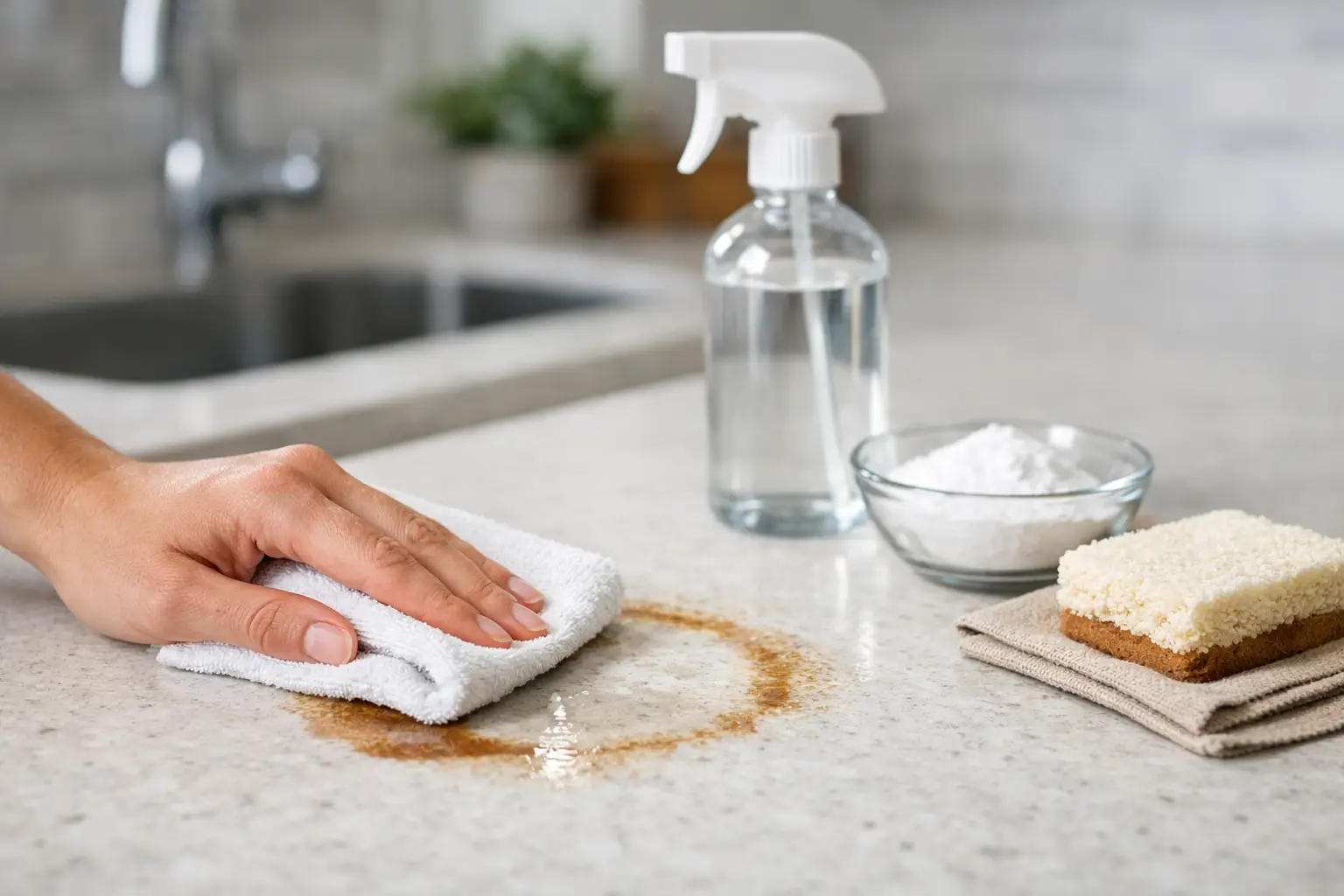
A dark ring beside the sink, a faded spot near the coffee maker, or a rusty-looking mark under a soap dispenser can make an otherwise clean kitchen feel unfinished. Knowing how to remove countertop stains starts with one important distinction: not every mark is actually a stain. The wrong cleaner can turn a small surface issue into a permanent dull spot, especially on natural stone.
The safest approach is to identify the countertop material and the type of mark before reaching for a cleaner. Quartz, granite, marble, quartzite, porcelain, and sintered stone can look similar at a glance, but they do not react the same way to acidic products, abrasives, heat, or moisture.
Start with warm water, mild dish soap, and a soft microfiber cloth. If the mark remains, identify both the countertop material and the likely cause before using a stronger product. Quartz generally needs a nonabrasive quartz-safe cleaner, while granite and quartzite may require a stone-safe cleaner or, for absorbed stains, an appropriate poultice. Marble requires extra care because a dull or light mark may be etching rather than a stain. Porcelain and sintered stone are highly stain resistant, but cleaners should still be appropriate for the manufacturer’s finish.
If you are unsure what caused the mark, avoid experimenting with acids, strong degreasers, abrasive pads, or increasingly aggressive cleaners. Identifying the problem first is safer than trying to scrub it away.
A true stain has penetrated the material or its pores. It often looks darker than the surrounding surface and may remain after normal cleaning. Oil, cooking residue, wine, coffee, makeup, rust, and other pigmented liquids are common causes.
Etching is different. It is surface damage caused when an acidic substance reacts with acid-sensitive stone, most notably marble. Lemon juice, vinegar, wine, and some bathroom cleaners can leave a lighter, dull, or rough-feeling patch. An etched mark may look like a stain, but stain remover will not restore the polished finish because the surface itself has been altered.
Also watch for metal transfer, which is especially noticeable on light quartz. A grey or black streak from a pan, utensil, or appliance base may be sitting on the surface rather than absorbed into it. Hard-water buildup can create a cloudy white film around faucets, while residue trapped around a seam or sink edge can also resemble discoloration.
When in doubt, begin with the gentlest option. Wipe the area with warm water, a small amount of mild dish soap, and a soft microfiber cloth. Rinse with clean water and dry thoroughly. If the mark remains, move to a method suited to the material rather than trying increasingly aggressive household products.
Quartz countertops are nonporous, so most everyday spills remain at or near the surface. In kitchens, common marks include dried food residue, grease, marker, metal transfer, and stubborn pigment from spices or beverages. Mild dish soap and water are appropriate for routine cleaning.
For a tougher mark, use a nonabrasive cleaner specifically approved by the quartz manufacturer or intended for engineered stone, following the product directions. Allowing an approved cleaner a short amount of contact time can help loosen dried residue. Use a soft cloth or non-scratch sponge, then rinse and dry the area.
Avoid scouring powders, steel wool, abrasive pads, oven cleaner, paint remover, and cleaners outside the manufacturer’s recommended pH range. These products can affect the resin-rich surface of quartz and may leave a permanent dull or hazy area.
Quartz also does not require sealing. Applying an aftermarket sealer to solve a stain or surface mark can create additional residue or appearance issues.
If you see a stubborn grey streak, start with a manufacturer-approved nonabrasive cleaner. If the mark does not improve with reasonable cleaning, stop rather than scrubbing harder. A fabricator can help determine whether you are dealing with metal transfer, surface damage, or another issue.
Granite and quartzite are natural stones, and their stain resistance varies by the particular slab, finish, porosity, and condition of the sealer. Many perform extremely well in busy kitchens, but some slabs can absorb liquids if a spill sits long enough or the stone needs resealing.
For fresh oil, food, or drink marks, start with a pH-neutral stone cleaner or mild dish soap, then rinse and dry. Avoid using vinegar, lemon juice, bathroom descaler, or other aggressive household cleaners as a shortcut. Harsh products can affect sealers, finishes, silicone, and surrounding installation materials.
A lingering absorbed stain in natural stone may respond to a poultice. A poultice uses an absorbent material and an appropriate cleaning agent to help draw staining material from the pores of the stone.
The correct treatment depends on what caused the stain and the characteristics of the slab. An oil-based stain, for example, may require a different approach from an organic food or beverage stain. Because an incorrect treatment can alter the appearance of stone, test any approved method in a concealed area and consider professional advice for difficult stains or valuable natural stone.
Do not judge granite or quartzite sealing by the calendar alone. On many natural stones, a simple water absorption test can provide useful information. Place a small amount of water on a clean, dry, inconspicuous section of the stone and observe whether the area begins to darken as moisture absorbs.
If water is being absorbed readily, it may be time to discuss resealing. Our guide to granite countertop sealing explains why sealing requirements vary from one stone to another.
Sealing helps slow absorption. It does not make natural stone completely stain-proof, and prompt spill cleanup is still important.
Marble brings distinctive movement and natural variation to kitchens, bathroom vanities, fireplace surrounds, and bars. It also requires realistic maintenance expectations. The material can absorb liquids and is sensitive to acids, which means homeowners may encounter both staining and etching.
If a marble mark feels smooth but looks darker, it may be a stain. Start by cleaning it gently with a pH-neutral stone cleaner. For a persistent absorbed stain, an appropriately selected poultice may help, but avoid experimenting with acidic cleaners or strong chemicals.
If the spot appears lighter, duller, or less reflective than the surrounding polish, it is more likely to be etching. Scrubbing will not restore the shine because the finish itself has been affected.
Minor etching can sometimes be improved through professional stone restoration. More noticeable damage may require honing and repolishing to blend the affected area with the surrounding finish.
This is one reason marble is generally better suited to homeowners who are comfortable with the natural patina and maintenance that can develop over time.
Porcelain and sintered stone surfaces are dense and highly resistant to staining, making them practical for kitchens, outdoor BBQ counters, and other high-use areas. Most everyday marks can be removed with warm water, mild detergent, and a soft cloth.
Some textured or matte finishes can hold residue more visibly than smoother finishes. Grease around a cooktop, mineral deposits near a faucet, or residue within a textured surface may require a manufacturer-approved cleaner and a soft nylon brush.
Keep cleaning focused on the surface and rinse thoroughly so cleaner does not collect around seams, silicone, or undermount sink edges.
Even durable porcelain and sintered stone should not be treated as indestructible. Avoid impact on exposed edges and do not use abrasive tools that could affect the finish or leave metal residue behind.
The products stored under a kitchen sink are not automatically safe for countertops. Avoid vinegar or lemon juice on marble and other acid-sensitive natural stones. Strong cleaners should only be used when the surface manufacturer specifically approves them, and cleaning products should never be mixed.
Abrasive powders, aggressive scrub pads, and steel wool can leave scratches, dull patches, or metal transfer. Strong degreasers, oven cleaners, and drain cleaners can damage quartz resins, stone sealers, silicone, and other materials around the countertop.
Sharp scraping tools are also not a universal countertop-cleaning solution. A technique that may be permitted by one surface manufacturer could scratch or damage another material or finish.
If a product label does not clearly indicate that it is suitable for your countertop material, stick with mild soap and water until you can confirm an appropriate cleaner.
Fast cleanup makes a bigger difference than most specialty cleaners. Wipe up oil, wine, coffee, tomato sauce, makeup, and cooking spills before they sit. Use coasters or trays under oils, soap dispensers, and frequently used bottles, particularly on natural stone.
Keep hot cookware on trivets and use cutting boards instead of cutting directly on the countertop. This is particularly important with engineered quartz, where excessive heat can damage the resin. You can learn more in our guide to quartz countertop heat resistance.
Avoid leaving wet cloths or standing liquids on natural stone. On a new countertop, ask your fabricator which cleaner and sealing schedule are appropriate for the exact material and finish.
Finish also matters. A honed versus polished countertop can show fingerprints, water marks, residue, and surface wear differently, even when the underlying material is the same.
Consider getting professional advice when a mark remains after appropriate gentle cleaning, when you cannot tell whether the problem is staining or etching, or when the surface has developed a dull patch, chip, crack, or unexplained discoloration.
It is also worth getting advice before applying an unfamiliar chemical or stain treatment to marble, quartzite, granite, or another valuable natural stone. Correcting a damaged finish can be considerably more involved than treating the original mark.
If you are dealing with a countertop stain, surface issue, or damage that normal cleaning has not resolved, contact Stone Valley Countertops. We can help determine whether the issue is related to cleaning, the material itself, or a surface that may require professional attention.
They can. Porous natural stones may absorb oils, pigments, and other liquids, while quartz can develop marks or surface damage from inappropriate cleaners. Treat spills promptly and use cleaning methods recommended for the specific countertop material.
Vinegar should not be treated as a universal countertop cleaner. It can etch marble and other acid-sensitive stone and may not be appropriate for other surfaces or installation materials. Use a cleaner approved for the countertop material instead.
A darker mark may indicate absorbed staining, while a lighter, dull, or less reflective patch often indicates etching. Etching changes the stone’s finish, so ordinary stain removal will not restore the original polish.
Temporary darkening can indicate that moisture is being absorbed into the stone. The amount of absorption varies by granite. If water penetrates readily, the countertop may need to be evaluated for resealing.
Some grey or black marks are surface residue or metal transfer rather than true stains. Begin with a quartz-safe, nonabrasive cleaner recommended for the surface. Avoid aggressive scrubbing because it can create a dull area that is more difficult to correct than the original mark.
No. A suitable impregnating sealer can slow the absorption of liquids into porous natural stone, giving you more time to clean spills. It does not make granite, marble, or quartzite completely stain-proof.