
A countertop can have the right stone, colour, and layout yet still feel slightly off if the edge is not suited to the room. A crisp eased edge reads clean and contemporary, while a rounded profile feels softer in a busy kitchen. This countertop edge profile guide explains what those choices actually mean once the slab is fabricated and installed.
An edge profile is the shaped finish along the exposed perimeter of a countertop, island, vanity, or bar. It affects the way light catches the stone, how easy the surface is to wipe down, the apparent thickness of the countertop, and how well the edge suits everyday use. The best option is not always the most decorative one. It is the one that works with your material, design, budget, and household.
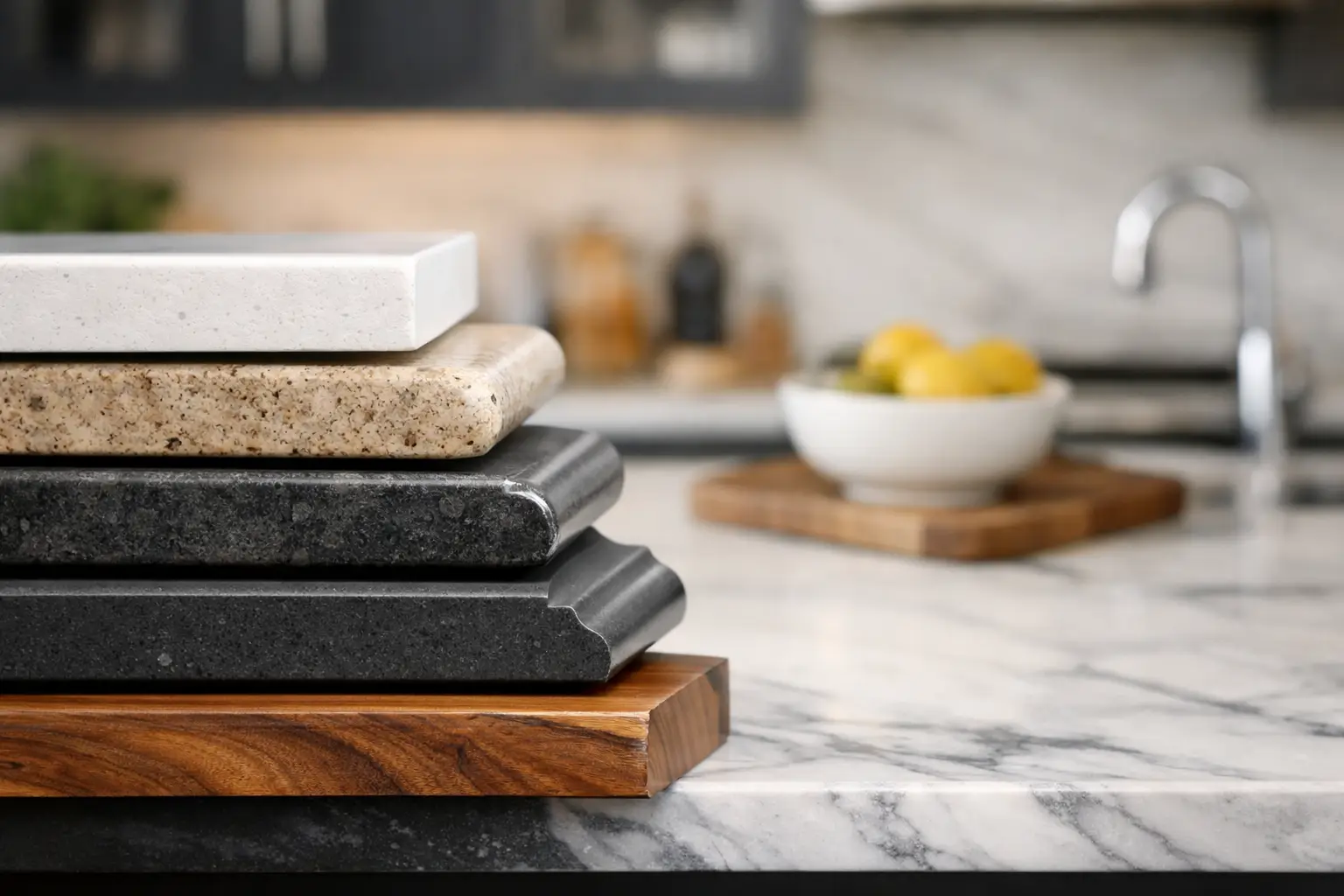
For most kitchens, an eased or pencil-round edge is the most practical choice. These profiles are easy to clean, work with many countertop materials, and suit both modern and transitional kitchens. Bullnose and bevelled edges add more visual detail, while ogee profiles create a traditional look. Mitered edges are used when you want the countertop to appear substantially thicker or need a continuous edge detail on an island or waterfall feature.
The right profile also depends on the countertop material. Quartz, granite, marble, and quartzite can accommodate several edge styles, while porcelain and other thin-format surfaces generally require more careful edge planning and fabrication.
The edge is one of the most visible fabrication details in a kitchen. It frames the countertop from across the room and is especially noticeable on an island, raised bar, peninsula, or vanity with open sides. A profile can make a standard-thickness quartz counter look crisp and minimal, or give a natural-stone island a heavier, more substantial appearance.
Function matters just as much. Profiles with a small radius have fewer sharp corners to bump into and are generally simpler to clean. More detailed edges have grooves and transitions that can collect crumbs, dust, or residue near the front of a working counter.
That does not make decorative profiles a poor choice. It simply means they should be selected with the way the kitchen is actually used in mind. Homes with children, frequent cooking, or busy islands may benefit from simpler profiles that are comfortable and easy to wipe clean.
Edge selection also has a cost component. A simple eased edge generally requires less fabrication than a detailed ogee or built-up mitered edge. The final cost depends on the material, linear footage, number of exposed sides, slab thickness, edge complexity, and amount of hand finishing required.
If you are deciding primarily based on appearance, our guide to the best countertop edge styles provides another useful comparison.
Edge names can vary slightly between fabricators, so a physical sample is more useful than a name alone. Two profiles described as bevelled, for example, may use different angles or widths. Looking at an actual edge sample beside your cabinet finish and slab selection helps prevent surprises.
An eased edge is one of the most common choices for quartz, granite, marble, and quartzite. Despite the name, it is not completely square. The upper corner is lightly softened to remove the sharpness while maintaining a straight, modern appearance.
This profile works well in contemporary kitchens, bathrooms, laundry rooms, and commercial spaces because it is clean, practical, and easy to wipe. It also allows the countertop material to take centre stage, which is useful when quartzite, granite, or marble has pronounced movement.
For many homeowners, an eased edge is the sensible starting point rather than a compromise.
A pencil-round edge has a more noticeable smooth radius than an eased profile. It still looks streamlined, but feels softer to the touch and is forgiving in high-traffic areas. It is a practical option for family kitchens, vanities, and islands where people frequently sit or walk nearby.
Because the profile remains simple, it pairs easily with both shaker-style and flat-panel cabinetry. It provides softness without making the countertop look overly traditional.
A half bullnose rounds the upper portion of the front edge while leaving more definition toward the underside. It gives the countertop a softer, finished appearance and is commonly considered for bathrooms, bars, and kitchens with transitional styling.
A full bullnose curves across both the upper and lower portions, creating a fully rounded front. This provides a comfortable edge with no pronounced corner.
One practical consideration is liquid behaviour. Because the underside is rounded, spills reaching the front edge may follow the curve underneath rather than dropping cleanly away from the cabinet. The softer shape can also make the countertop appear visually different from a crisp eased profile.
A bevelled edge has a flat angled section cut into the upper portion of the countertop edge. It creates a defined line that catches light and adds more detail than an eased or rounded profile. The bevel can be narrow and subtle or wider and more noticeable.
Bevelled profiles work well when homeowners want an architectural detail without the curves of a bullnose or ogee. They require accurate fabrication so the angle and width remain consistent across countertop sections.
With strongly veined materials, the edge should also be considered alongside the backsplash and cabinetry so the additional lines do not make the finished design feel unnecessarily busy.
An ogee is a decorative profile that combines curved sections to create a more traditional edge. It can work particularly well with detailed cabinetry, warm-toned granite, marble, quartzite, and classic bathroom designs.
On a large island, the profile itself can become a noticeable design feature.
An ogee takes more effort to clean because its curved recesses require additional wiping. It also generally involves more machining and hand finishing than a basic edge, which can increase fabrication cost.
This profile tends to work best when it is part of a broader traditional design rather than the only decorative element in an otherwise minimal kitchen.
A mitered edge is fabricated by joining pieces of material at an angled seam to create the appearance of a thicker countertop. Instead of using a much thicker solid slab, the front edge is built down to create additional visual depth.
For example, a 2 cm slab can be fabricated to create the appearance of a much thicker edge depending on the design and material. Mitered fabrication is commonly used for large islands, thick contemporary countertops, and waterfall countertops.
The detail must be measured, cut, assembled, and installed precisely. On veined material, the fabrication plan should also consider how the pattern transitions through the miter so the finished edge looks intentional.
A mitered edge is therefore not simply a thicker countertop. It involves additional fabrication, material, finishing, and planning.
The material itself should influence which profiles make sense. A profile that works easily on 3 cm granite may require a completely different fabrication approach on thin porcelain.
Most quartz slabs accommodate eased, pencil-round, bullnose, bevelled, and certain mitered profiles well. Because engineered quartz is relatively consistent, it gives fabricators flexibility when creating clean, repeatable edges.
The exact profile should still follow the slab manufacturer’s fabrication requirements, particularly around corners, sink cutouts, and thinner materials.
Granite, marble, and quartzite can accommodate a wide range of profiles, including more decorative options. Natural stone, however, contains veins, mineral variation, fissures, and occasional softer areas that need to be considered during fabrication.
A fabricator should inspect the slab before cutting and determine how exposed edges, seams, sink openings, and other finished areas interact with the natural pattern.
Porcelain and sintered stone countertops are generally thinner than traditional stone slabs and require specialized fabrication techniques. Their hardness is an advantage in everyday use, but exposed edges and corners need careful cutting and finishing.
Simple edge details and properly fabricated mitered builds are commonly used. The appropriate solution depends on the product thickness, pattern, intended use, and manufacturer’s fabrication requirements.
Countertop edge pricing is generally based on the amount of fabrication required rather than appearance alone. A standard eased profile is relatively straightforward to machine and polish, while decorative or built-up edges require additional shop time.
Several factors can affect the cost, including the number of exposed linear feet, countertop material, slab thickness, edge complexity, hand polishing requirements, corners, and mitered sections.
A large island with four exposed sides, for example, has considerably more finished edge than a countertop installed between two walls. That difference matters when comparing edge upgrades.
It is worth confirming which edge profile is included in your countertop quote and which options are considered upgrades before fabrication begins.
An edge profile does not exist separately from the rest of the countertop design. A 2 cm or 3 cm slab with an eased edge creates a different visual weight than a built-up or mitered edge designed to look substantially thicker.
On a large island, added visual thickness can help balance the countertop against tall cabinetry, waterfall panels, or a substantial seating area.
Overhangs should also be reviewed before the edge is finalized. Seating overhangs may require concealed support depending on the material, slab thickness, depth, layout, and manufacturer’s requirements. A rounded or decorative edge does not replace proper structural support.
The same consideration applies around sink cutouts, where enough material must remain around the opening to maintain strength and allow proper finishing.
For undermount sinks, a simple polished sink cutout and appropriate reveal usually create an easy-to-clean transition. The front countertop edge and sink cutout are separate fabrication details, but they should be discussed together before the slab is cut.
Start with the room’s overall lines. Flat-panel cabinets, slim hardware, and large-format backsplashes often suit eased, pencil-round, or restrained mitered edges. Traditional cabinet doors, detailed fixtures, and warmer natural stone may support a half bullnose, bevelled, or ogee profile.
Then think about how the space will be used. A busy family kitchen often benefits from an edge that can be wiped clean quickly and does not have deep decorative grooves.
Next, view your chosen slab with a physical edge sample whenever possible. This is particularly useful with white quartz, dark granite, and heavily veined quartzite because shadows and pattern movement can make the same profile appear quite different from one material to another.
Before approving fabrication, confirm which countertop sides will be exposed, where seams are expected, which edge profile is being used, whether an island requires support, and whether a waterfall or thickened edge is part of the design.
These details are much easier to resolve before cutting begins than after the countertop reaches the installation stage.
An eased edge is one of the most commonly selected profiles because it provides a clean appearance, works with many countertop materials, and is easy to maintain. Pencil-round edges are another practical option when a slightly softer corner is preferred.
Eased and pencil-round profiles are among the easiest to clean because they have very little decorative detailing. Profiles such as ogee have additional curves and recesses that require more attention when wiping the countertop.
There is no single best island edge. Eased and pencil-round profiles work well for practical everyday islands, while mitered edges can create the appearance of a thicker, more substantial island. The right choice depends on the slab material, island size, cabinetry, seating, and surrounding design.
Usually, yes. A mitered edge requires additional cutting, material, assembly, finishing, and installation precision compared with a standard eased profile. Vein and pattern matching can also add fabrication complexity.
No. Quartz, granite, marble, and quartzite can accommodate many common profiles, but porcelain, sintered stone, and certain thin materials may have more specific fabrication requirements. The slab thickness and manufacturer’s specifications should always be considered before choosing an edge.
Ideally, yes. The edge profile, exposed sides, waterfall panels, overhangs, sink details, and other fabrication requirements should be confirmed before the countertop enters production. This gives the fabricator the information needed to plan the finished pieces accurately.
The best countertop edge is usually the one you stop noticing because it works naturally with the kitchen. It should feel comfortable at the island, complement the slab rather than compete with it, and suit the way the space is used every day.
If you are selecting quartz, granite, marble, quartzite, porcelain, or another countertop surface for an Ontario project, Stone Valley Countertops can review edge options alongside the slab, layout, overhangs, sink details, and fabrication requirements before production begins.
Contact Stone Valley Countertops to discuss your countertop project or compare edge profiles for your selected material.