
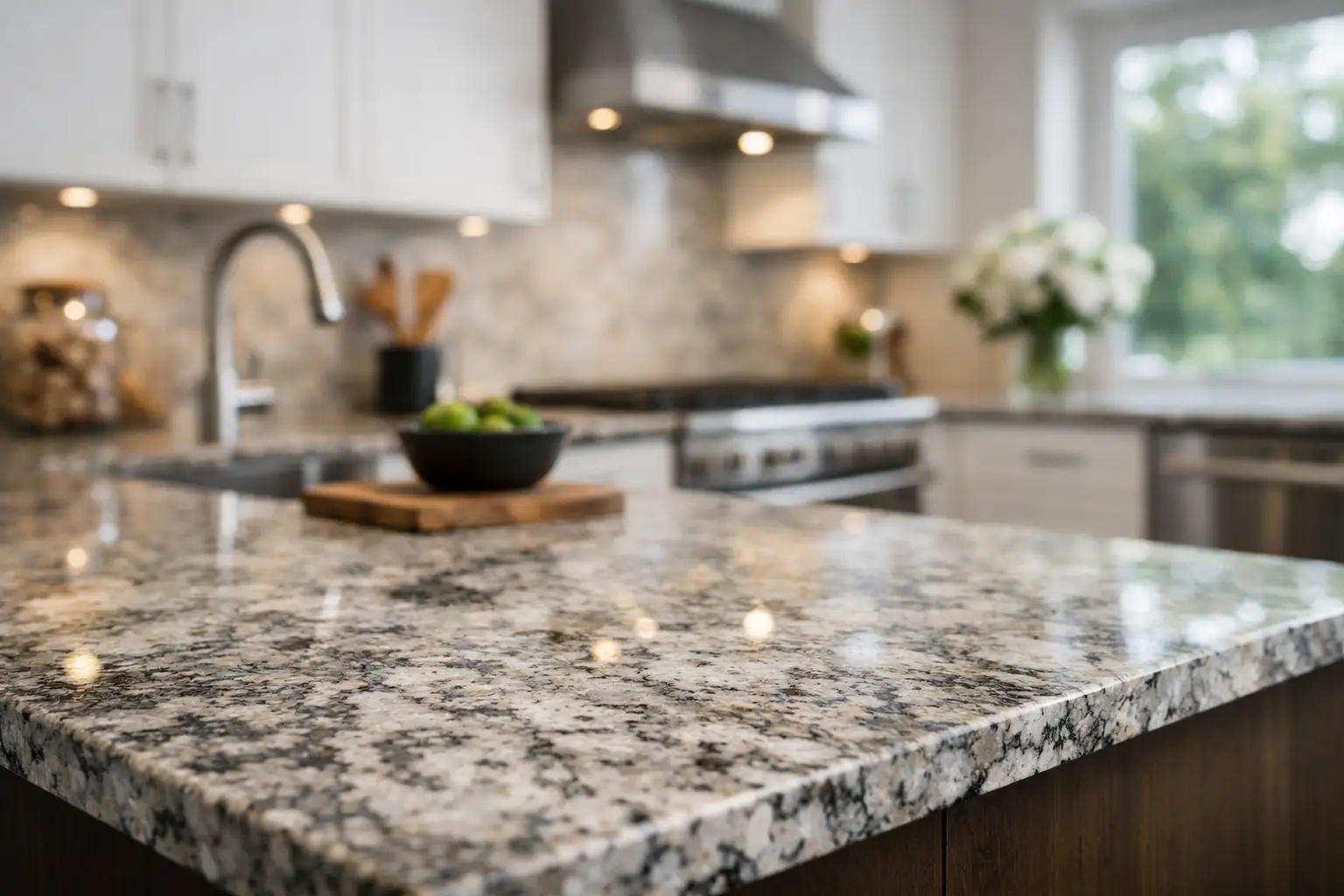
A slab of granite can look completely different in a showroom than it does across a full kitchen island. That is the useful starting point for any granite countertop review: granite is durable, natural, and practical, but its variation is part of the purchase. You are not choosing a uniform manufactured pattern. You are choosing a specific piece of stone with its own movement, mineral deposits, colour shifts, and character.
For many Ontario homeowners, granite remains a strong choice for kitchens, bathrooms, bars, and outdoor BBQ areas. It handles daily use well, offers genuine heat resistance, and brings depth that quartz can imitate but not exactly duplicate. The right decision comes down to how you cook, how much natural variation you want, and whether routine sealing fits your maintenance expectations.
Granite is a durable natural-stone countertop that offers excellent heat resistance, good scratch resistance, and unique colour and mineral variation. Most granite should be sealed periodically, and the exact slab should be reviewed before fabrication because pattern, porosity, and appearance vary naturally. For homeowners who want real stone and are comfortable with basic maintenance, granite remains a practical countertop option.
Granite is an excellent countertop material when you want real stone, a surface that stands up to regular kitchen use, and a one-of-a-kind appearance. It is not maintenance-free, and it is not automatically the best material for every household. But a properly selected, fabricated, sealed, and installed granite countertop can perform well for many years.
Granite is an igneous natural stone. Its strength and appearance vary by slab, which is why seeing the actual material before fabrication matters. Some granites have a quiet, consistent grain, while others have dramatic veining, speckles, or large mineral movement. A sample can suggest the colour, but it cannot show how the full slab will read beside your cabinets, flooring, and lighting.
In day-to-day use, granite resists scratches better than many natural stone options and is more forgiving with hot cookware than quartz. You can place a warm pan on it without the same resin-related heat concerns associated with engineered quartz, although a trivet is still sensible for very hot cookware and helps reduce the risk of thermal shock or accidental marks.
Granite makes sense in hardworking kitchens because it is dense, durable, and capable of handling regular food preparation. It also works well for bathroom vanities, laundry rooms, wet bars, fireplace surrounds, and outdoor counters. For exterior applications, granite is often worth considering because it does not contain the polymer resins found in engineered quartz that can be affected by prolonged UV exposure.
Its natural variation is also useful from a design standpoint. A granite with movement can soften a kitchen with simple cabinet doors and solid-colour finishes. A quieter black, grey, white, or brown granite can provide a more restrained look while still giving the room the depth of natural stone.
The material is especially worth considering if you want an island to feel distinct from the perimeter counters. A slab with directional veining or mineral movement can become a focal point, particularly when the pattern is carried down a waterfall end. That detail requires careful slab layout and miter fabrication so the movement aligns as naturally as possible at the corner. Our guide on planning a waterfall island explains the fabrication details that should be considered before cutting.
The main trade-off is sealing. Granite is porous to varying degrees, so many granite countertops benefit from sealing to reduce the chance of oils, wine, sauces, cosmetics, or other liquids soaking into the stone. How often it needs attention depends on the specific granite, the sealer used, and how the surface is used.
A simple water test can help indicate whether resealing may be due. Place a few drops of water on a clean countertop and allow them to sit for several minutes. If the stone begins to darken as it absorbs the water, the sealer may no longer be providing adequate protection. For more detail, see our guide on whether granite countertops need sealing.
Granite can also chip at exposed edges, especially around a sink cutout, cooktop opening, or sharp corner. This is not usually a concern during normal use, but heavy cookware can damage stone if it strikes an edge hard enough. Rounded or softened countertop edge profiles can be practical for busy kitchens. A square eased edge gives a cleaner contemporary look, while a more detailed profile can suit traditional cabinetry.
Cracks and natural fissures are another point that deserves a clear explanation. A fissure is a naturally occurring feature in the stone and is not necessarily a structural problem. A crack, by contrast, may need assessment before fabrication. The slab should be examined before cutting so that sink openings, cooktop cutouts, seams, and other vulnerable areas can be planned appropriately.
Quartz is often the easier choice for homeowners who want a more uniform appearance and minimal maintenance. It does not normally require routine sealing, and its more consistent pattern can make matching multiple countertop sections easier. Granite offers natural variation, stronger tolerance to direct heat, and a surface without a manufactured repeating pattern.
Neither material is automatically better. A household that prefers low-maintenance cleanup and a consistent white or soft grey counter may lean toward quartz countertops. Someone who cooks often, values natural stone, or wants a slab with individual character may prefer granite countertops.
Cost is also more nuanced than the material name alone. Granite pricing depends on slab availability, colour, thickness, slab yield, edge profile, sink and cooktop cutouts, backsplash pieces, and installation complexity. A large island, a full-height stone backsplash, or a waterfall end requires more material and fabrication time than a simple straight run. Comparing quotes works best when you compare the complete scope, not just a price per square foot.
A good granite installation is not just about selecting a slab. Fabrication decisions determine how the countertop looks and performs once it is in place.
Granite is available in different slab thicknesses, with 2 cm and 3 cm being common depending on the supplier and material. Thicker-looking edges can also be created with a built-up or mitered detail. The best choice depends on the slab, cabinet design, edge profile, and the visual weight you want.
A mitered edge can create a substantial island profile, but it requires precise fabrication because the joint can remain visible at close range. The stone’s pattern also needs to be considered so that the transition across the miter looks intentional.
Overhangs need planning, especially at seating areas. The amount of unsupported stone that is appropriate depends on the material, thickness, cabinet structure, overhang depth, and project conditions. Deeper overhangs can require hidden steel supports or brackets. Support requirements should be determined before fabrication and installation rather than treated as an afterthought.
Seams are sometimes unavoidable when a countertop is longer or wider than the available slab, when the layout requires multiple pieces, or when moving a very large section safely into the home would be impractical.
The goal is not to promise an invisible seam. The goal is to place it thoughtfully, colour-match the adhesive closely, and keep adjoining pieces properly aligned. Our kitchen countertop seams guide explains why seam placement is part of both fabrication and installation planning.
Slab layout matters even more with heavily veined or directional granite. Before cutting, the fabricator should consider where the movement will land on the island, how adjacent pieces will relate to one another, and whether a waterfall return or full-height backsplash should continue the pattern.
An undermount sink is a common pairing with granite because it creates a clean edge for wiping crumbs and water directly into the basin. The cutout must be precisely shaped and polished, and the sink needs appropriate support. The narrow stone areas around sink openings also need to be considered carefully during fabrication, transport, and installation.
A top-mount sink can also work, particularly when replacing a counter without changing certain plumbing or cabinetry details, but it leaves a rim above the countertop surface.
For cleaning, use a soft cloth, warm water, and a stone-safe cleaner when needed. Avoid acidic cleaners, abrasive powders, and products that leave a heavy film. Wipe spills promptly, particularly oils, citrus, vinegar, wine, and strongly coloured foods. Granite care is straightforward, but consistency helps protect the stone and sealer.
Before approving a granite selection, ask to view the actual slab or slabs allocated to your project. Natural stone can vary considerably even between slabs carrying the same material name.
Look at the entire slab rather than relying only on a small sample. Pay attention to large veins, mineral concentrations, colour changes, natural fissures, and the direction of movement. For larger projects requiring more than one slab, check how well the slabs relate to one another. Our guide on how to compare stone slabs covers what to look for before making a final selection.
Before fabrication, confirm important project details such as:
It is also helpful to understand the project sequence. At Stone Valley Countertops, the countertop process is coordinated from material selection through templating, fabrication, and installation. Accurate templating after cabinets are installed helps account for the actual walls, corners, appliance openings, sink locations, and site conditions in the home.
Granite rewards homeowners who take a little time with the details. Choose a slab you genuinely like, not just a small sample you can tolerate. Then let practical decisions about seams, edges, support, fabrication, and maintenance shape a countertop that will be easy to live with long after the renovation is finished.
Granite can be worth considering if you want a durable natural-stone countertop with strong heat resistance and unique slab-to-slab variation. The main maintenance consideration is sealing, which varies according to the stone and sealer used.
Many granite countertops benefit from sealing because natural stone has varying levels of porosity. Some granites are denser than others, so sealing requirements and intervals are not identical for every slab.
Granite has excellent heat resistance and generally tolerates kitchen heat better than resin-based engineered surfaces. Even so, using a trivet for very hot cookware is recommended because it reduces the risk of thermal shock and protects the countertop finish.
Granite is highly scratch resistant under normal kitchen use, but it is not impossible to damage. Cutting boards are still recommended because they protect the countertop, prevent unnecessary wear, and are easier on knife blades.
Granite and quartz suit different priorities. Granite provides natural variation, strong heat resistance, and individual slab character. Quartz offers more consistent patterns and generally does not require routine sealing. The better fit depends on how the countertop will be used and the appearance and maintenance level you prefer.
Granite is commonly considered for outdoor kitchens and BBQ counters because it is natural stone and does not contain the polymer resins used in engineered quartz. Outdoor installations still need proper fabrication, support, drainage considerations, and material selection for Ontario’s seasonal conditions.
If you are comparing granite slabs for a kitchen, vanity, island, outdoor counter, or another project, Stone Valley Countertops can help you review the material and the fabrication details that affect the finished installation.
Visit our granite countertops page to learn more, or contact Stone Valley Countertops to discuss your project in Ontario.