
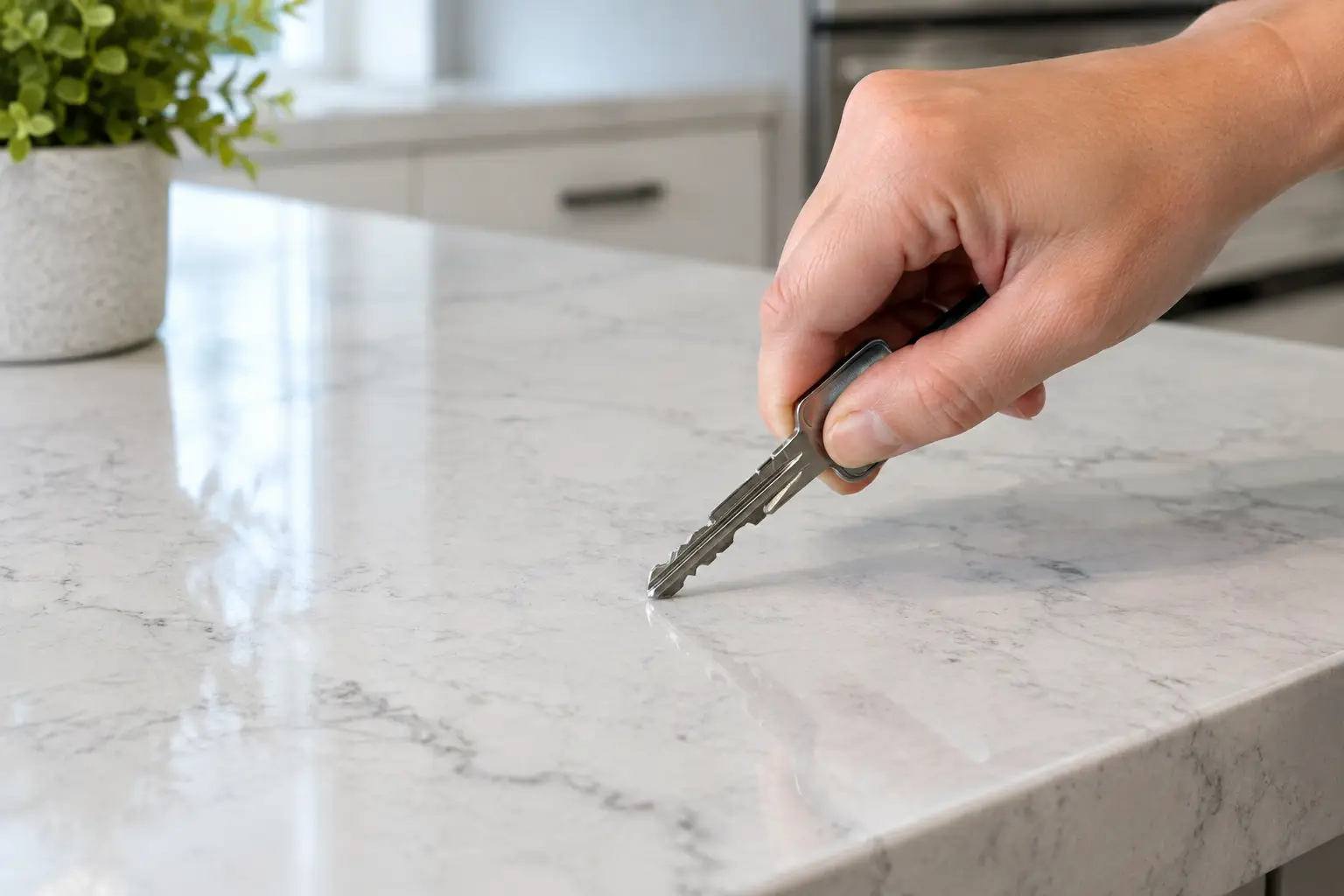
A new quartz countertop can look almost indestructible, especially once it is installed as a large, clean kitchen island or a continuous run along the wall. It is tough, practical, and far less delicate than marble. But does quartz scratch? Yes, it can. The better question is what causes those marks, how likely they are in everyday use, and what you can do to keep the surface looking good for years.
Quartz is one of the more scratch-resistant countertop materials available for busy kitchens, bathrooms, laundry rooms, and bar areas. Still, scratch-resistant does not mean scratch-proof. A little daily care goes a long way.
Yes. Quartz countertops can scratch, but they are highly resistant to scratching during normal household use. Cutting directly on the surface, dragging gritty objects, using abrasive cleaning pads, or moving heavy items across the countertop can cause marks. Using cutting boards, soft cleaning materials, and protective pads helps keep quartz looking its best.
Engineered quartz countertops are made primarily from quartz minerals combined with resins, pigments, and other components. Natural quartz is very hard, which helps give the finished countertop strong resistance to everyday wear.
In a typical kitchen, quartz stands up well to plates, cups, grocery bags, small appliances, and routine food preparation. You should not expect it to pick up scratches from ordinary use. It is also less prone to etching than marble, which can dull or mark when exposed to acidic foods and drinks.
However, sharp tools, abrasive debris, and harder materials can leave a visible mark. The resin portion of a quartz slab is not as hard as the quartz mineral itself. That means the finished surface can be damaged if it is treated like a cutting board or scrubbed with the wrong product.
A countertop may also show marks differently depending on its colour and finish. Dark, solid-colour quartz often makes fine scratches, fingerprints, and dried water spots easier to notice. A heavily veined or patterned design can be more forgiving because the movement in the slab helps disguise small signs of use.
The most common cause is cutting directly on the counter. Kitchen knives can score the surface, and they will also dull faster when used against quartz. A wood, plastic, or composite cutting board protects both the countertop and the knife.
Grit is another frequent issue. Sand, tiny stones, and debris can become trapped under a ceramic dish, appliance, or decorative tray. Dragging that item across the counter can create fine scratches. This can be especially relevant near patio doors, mudrooms, outdoor living areas, and kitchen islands that get a lot of traffic.
Some marks are not actually scratches. Metal cookware, utensils, and the bottoms of small appliances can leave grey or silver transfer marks on quartz. These marks may look alarming, but they can sometimes be residue sitting on the surface rather than damage to the quartz itself. A gentle cleaner suitable for quartz and a non-abrasive cloth may remove them.
Avoid harsh scouring pads, steel wool, pumice-based cleaners, and abrasive powders. They can dull the finish or create fine surface damage over time. The same applies to aggressively scrubbing a stubborn spot with a rough sponge.
Countertop durability is not just about hardness. It also involves heat resistance, impact resistance, stain resistance, fabrication quality, support, and how the surface is used.
Quartz performs very well against staining when spills are cleaned within a reasonable amount of time. Its nonporous surface does not normally require routine sealing, which is one reason many homeowners choose quartz countertops for busy kitchens and bathrooms.
Heat is where care is especially important. Hot pans taken directly from the stove or oven can cause discolouration, thermal damage, or damage to the resin binder. Our guide to quartz countertop heat resistance explains this in more detail. Always use a trivet or hot pad.
Impact can also be a concern at vulnerable areas. The middle of a properly supported quartz countertop is very strong, but edges, sink cutouts, cooktop cutouts, and unsupported overhangs are more susceptible to chips or cracks if struck hard. Precision templating, proper fabrication, correct support, and careful installation all help reduce those risks.
If scratch resistance is high on your list, quartz is a strong option, but it is not automatically the right material for every kitchen.
Granite countertops are also highly scratch-resistant and generally tolerate heat better than engineered quartz. Because granite is natural stone, every slab has its own variation in colour, pattern, and mineral structure. Depending on the specific stone, finish, and sealer used, granite may also require periodic resealing.
For homeowners who frequently cook with hot cookware, granite may be worth considering. You can learn more in our guide to granite countertop heat resistance.
Quartzite is a natural stone that can offer excellent scratch and heat resistance. It also provides the natural movement many homeowners like in marble.
Quartzite should not be confused with quartz. Quartzite is quarried natural stone, while quartz countertops are manufactured using quartz minerals, binders, pigments, and other components. Quartzite also has different sealing and maintenance requirements depending on the stone.
Marble is softer and more susceptible to scratching and etching than quartz. It develops a natural patina over time, which appeals to some homeowners, but it may not suit someone who wants a countertop to remain visually uniform with minimal maintenance.
Porcelain countertops and many sintered stone surfaces offer excellent resistance to scratching, heat, and UV exposure. They can be useful for outdoor countertops, fireplace applications, and other projects where heat or sunlight exposure is an important consideration.
Their fabrication and installation require specialized handling because these materials behave differently during cutting, edge fabrication, transportation, and installation than engineered quartz.
The daily routine for quartz is simple. Use cutting boards for food preparation, trivets for hot cookware, and protective pads under heavy decorative items or appliances that may be moved. Wipe away sand or gritty debris before sliding anything across the counter.
For cleaning, use a soft cloth or non-abrasive sponge with warm water and mild soap. Drying the surface afterward can help reduce visible water spots, especially on darker colours or matte finishes. For stubborn residue, follow the care instructions provided by the quartz manufacturer.
Be careful with heavy cast-iron cookware, particularly around countertop edges. A dropped pan can chip many countertop materials. The same caution applies around an undermount sink cutout, where a large section of the countertop has been removed to accommodate the sink.
For a kitchen island, think about how it will be used before finalizing the material and finish. A polished white quartz with soft veining can be practical for a family kitchen. A dark matte quartz may create a very different look, but fingerprints, water marks, and signs of daily use can be more noticeable.
Sometimes, but the appropriate repair depends on what you are actually seeing. A surface transfer mark or residue may simply need cleaning. A shallow scratch may be less noticeable in a patterned material, while deep scratches, chips, and cracks can be more complicated.
One challenge is that quartz has a factory-finished surface. Attempting to sand or polish one small area can change its sheen, leaving a dull or glossy patch that is more noticeable than the original mark.
For that reason, avoid experimenting with aggressive abrasive pads, sandpaper, or home polishing kits before having the damage assessed.
If damage is near an edge, seam, sink, or cooktop cutout, it is particularly important to determine whether you are dealing with a cosmetic mark, chip, crack, or another issue. The repair approach depends on the colour, pattern, finish, location, and extent of the damage.
Quartz is a sensible choice for homeowners who want a low-maintenance countertop with strong stain resistance and good everyday durability. It works particularly well in kitchens, bathroom vanities, laundry rooms, and bars where easy cleanup matters.
The material selection should also reflect your cooking habits and design priorities. If high heat is a major concern, granite, quartzite, porcelain, or sintered stone may deserve a closer look. If you want consistent colour, minimal routine maintenance, and strong resistance to everyday wear, quartz remains a practical option.
The details of fabrication matter just as much as the slab itself. Countertop edge profiles, seam placement, sink cutouts, countertop thickness, and properly supported overhangs all influence how the finished countertop performs.
Quartz does not need to be treated like a fragile surface. It simply benefits from sensible habits: cut on a board, set hot pans on a trivet, clean with non-abrasive products, and investigate unusual marks before trying an aggressive fix.
No. Quartz is highly scratch-resistant during normal household use, but it is not scratch-proof. Sharp objects, abrasive debris, and improper cleaning products can damage the surface.
You should not cut directly on quartz. A cutting board protects the countertop from potential marks and helps prevent your knives from becoming dull.
A knife or other sharp object can potentially mark or damage a quartz surface, particularly with repeated or forceful contact. Using a cutting board is the safer approach.
No. Metal transfer, residue, dried spills, and other surface marks can sometimes look like scratches. Start with gentle cleaning using products suitable for quartz before assuming the surface is permanently damaged.
Not always. Quartz has a factory-finished surface, and polishing a small area can alter its sheen. Significant scratches should be assessed before sanding or polishing is attempted.
Quartz, granite, quartzite, porcelain, and sintered stone can all provide strong scratch resistance, but each has different characteristics related to heat, staining, maintenance, fabrication, and repair. The best material depends on how the countertop will actually be used.
Considering quartz for your countertop project?
Stone Valley Countertops supplies, fabricates, and installs quartz and other countertop materials for homeowners across the GTA, Durham Region, Niagara Region, Hamilton, Orillia, and surrounding Ontario communities. Contact Stone Valley Countertops to discuss your project or visit one of our showroom locations to compare materials in person.