
A fireplace surround is not just a decorative frame. It is a large, highly visible surface that has to work around heat, appliance clearances, wall conditions, and the layout of the room. Choosing the best stone for fireplace surround projects depends less on a single material being superior and more on the fireplace type, the size of the cladding area, and the appearance you want from the slab.
For many Ontario homeowners, the decision comes down to granite, quartzite, marble, porcelain, sintered stone, or engineered quartz. Each has different characteristics, and not every product is appropriate for every fireplace.
The material should be chosen after confirming the fireplace manufacturer’s installation and clearance requirements. Stone facing does not replace those requirements, especially around gas inserts, wood-burning units, or openings with significant heat exposure.
Quick Answer: What Is the Best Stone for a Fireplace Surround?
Granite and appropriately specified quartzite are practical natural stone options for many fireplace surrounds. Marble works well when decorative veining is a priority, while fireplace-approved porcelain and sintered stone can be excellent choices for large-format fireplace walls.
Important: The final choice must be compatible with the fireplace manufacturer’s instructions, expected surface temperatures, substrate, and installation system. Engineered quartz requires particular caution because its resin binders can be affected by heat.
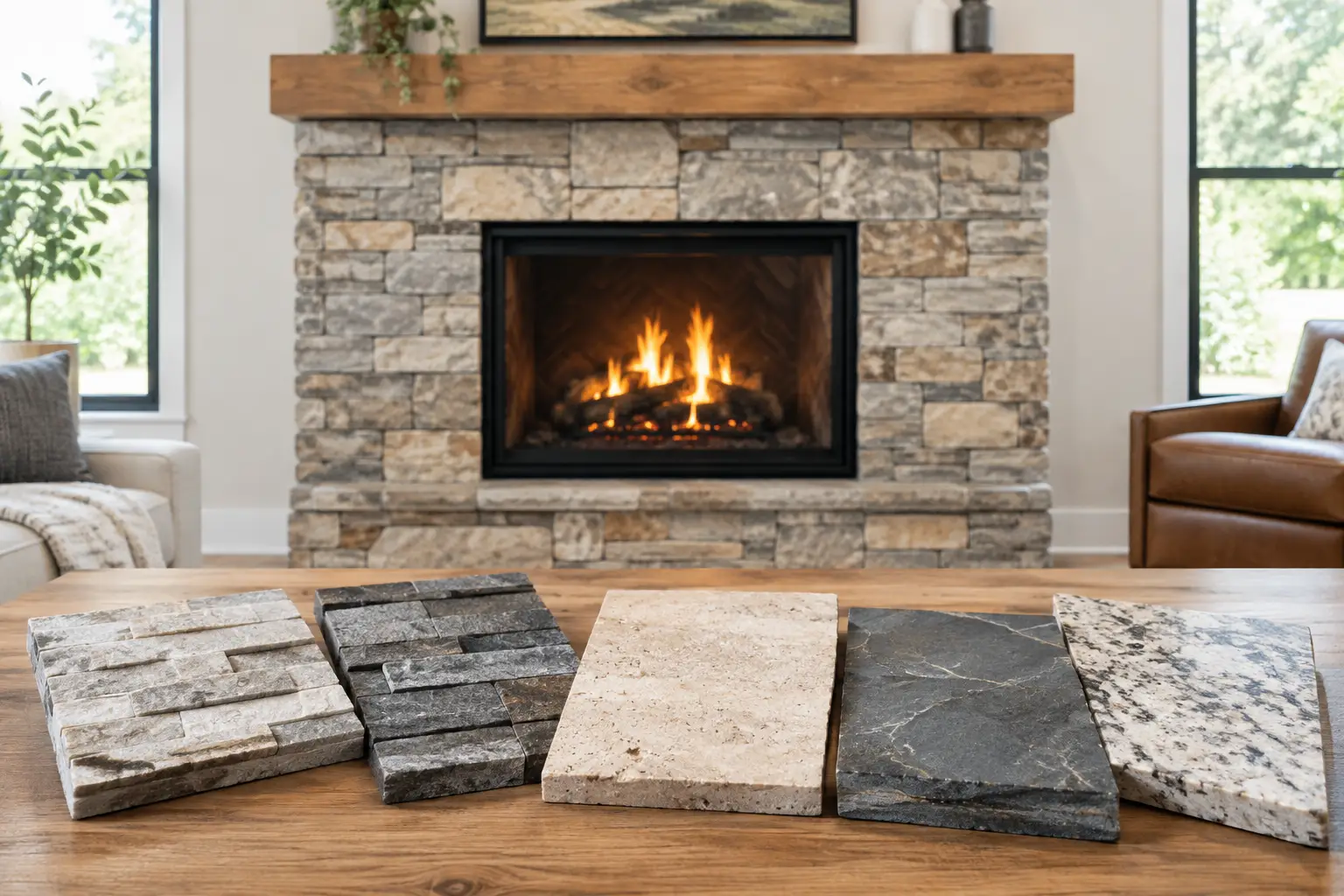
A small showroom sample can tell you about colour and surface texture, but it cannot show how the material will behave across an entire fireplace wall.
Before selecting a slab, confirm the appliance model, its required clearances, approved facing materials, and where heat is discharged. A direct-vent gas fireplace, for example, can create different conditions than an electric unit or a wood-burning fireplace.
The wall construction matters too. The installer needs a suitable, flat substrate that is compatible with the finished material and fireplace specifications.
If a mantel, television recess, hearth, or projecting ledge is part of the design, those details should be coordinated early. A beautiful slab layout cannot correct a mantel set too close to the opening or a wall that is not ready to receive large-format material.
One important distinction: A stone slab may be non-combustible, but that does not automatically make the complete wall assembly suitable for high temperatures. Backing boards, adhesives, framing, and fastening systems must also meet the applicable installation requirements.
Each material offers different advantages. The following comparison provides a starting point for selecting a surround, but the specific slab and fireplace requirements should determine the final decision.
| Material | Heat Considerations | Maintenance | Design Strength |
|---|---|---|---|
| Granite | Naturally heat-resistant; installation approval still required | Generally moderate to low | Natural variation and durability |
| Quartzite | Properties vary by slab; confirm suitability | Varies by porosity and finish | Dramatic natural veining |
| Marble | Commonly used for surrounds; assembly must be suitable | Requires care against stains and etching | Classic veining and soft depth |
| Porcelain | Use products approved for the fireplace application | Generally low | Large-format, contemporary designs |
| Sintered Stone | Product-specific thermal and installation requirements | Generally low | Thin profiles and modern finishes |
| Engineered Quartz | Heat-sensitive binders; manufacturer approval essential | Generally low in approved applications | Consistent colour and pattern |
Granite is often a sensible choice for a fireplace surround because it is a natural stone with good durability and a broad range of colours, movement, and finishes.
Darker granites can suit traditional fireplace designs, while lighter or more linear slabs can work in contemporary spaces. Honed finishes can soften the reflection of a polished slab, though finish availability varies by material.
Like other natural stones, granite is not uniform from slab to slab. Viewing the actual slab is especially worthwhile when the fireplace wall is a focal point.
A small sample may not reveal mineral variation, veining, or changes in background colour. Some granites may benefit from sealing based on the particular stone and finish, particularly if the surround includes a hearth where soot, ash, or spills are possible.
Explore the characteristics of granite surfaces when comparing natural stone options.
Quartzite is a natural stone homeowners often consider when they want pronounced veining or lighter colours without choosing marble.
It can be a strong option for a fireplace wall, but quartzite is a broad commercial category, and slabs vary considerably in composition, porosity, and appearance. The specific slab should guide the conversation, not the label alone.
A quartzite surround can look especially effective when the veins are planned to run continuously from the hearth up the face of the fireplace.
That planning takes place during slab layout. Depending on the fireplace dimensions and slab size, the fabricator may need to add seams, change vein direction, or recommend a different layout to make the design feel intentional.
When comparing quartzite surfaces, ask to see the full slab rather than relying on a small sample.
Marble remains a favourite for formal and transitional fireplace surrounds because its veining and soft depth are difficult to duplicate.
It is well suited to projects where natural patina is part of the appeal. However, marble can etch or stain more easily than many other stone options, and a light polished marble hearth may show soot or marks over time.
That does not make marble the wrong choice. It means the homeowner should be comfortable with its character and maintenance needs.
For a decorative surround around an electric fireplace, marble may be an appropriate fit when the installation is approved. For a heavily used wood-burning fireplace or hearth, the location and expected use deserve a more careful discussion.
Homeowners considering marble surfaces should review the finish, slab variation, and cleaning requirements before making a final selection.
Porcelain and sintered stone are manufactured surface materials that can offer consistent patterns, substantial slab sizes, and a wide selection of stone-look or contemporary finishes.
They are often considered for floor-to-ceiling fireplace walls because a large format can reduce the number of visible joints.
These materials need experienced fabrication and handling. Their thickness, edge treatment, backing requirements, and cutout details differ from natural stone.
A mitered return or thick-looking mantel profile may be possible, but it needs to be designed around the selected product rather than assumed from a photograph.
Manufacturer guidance should also be reviewed for use around the specific fireplace and heat source.
For a more detailed discussion of porcelain slab characteristics, read our porcelain slab review and sintered stone versus porcelain comparison. These guides focus on countertop applications, so fireplace approval must still be checked separately.
Engineered quartz offers predictable colour and pattern options, but it should not be treated as a universal fireplace material.
Quartz contains resin binders, and its suitability depends on the product, the fireplace design, and the distance from heat.
Some applications may be appropriate, particularly away from the firebox, while others may not meet manufacturer guidance or appliance installation requirements.
If you are drawn to a quartz look, bring the fireplace model and dimensions into the selection discussion.
This is a situation where confirming details early can prevent choosing a slab that is better suited to a countertop than a high-heat surround.
Material selection becomes easier when the intended design and fireplace type are considered together.
Large-format porcelain, sintered stone, marble, granite, and quartzite can all create an uninterrupted visual effect when suitable slab dimensions are available.
For tall walls, the key considerations are slab size, seam placement, weight, wall preparation, and the method used to secure the material.
Thin slabs are not automatically easier to install. Their handling and support requirements can be quite different from those of thicker natural stone.
Granite and marble are common choices for traditional surrounds. Granite may appeal to homeowners who prefer lower maintenance, while marble offers softer veining and a more classic appearance.
The hearth requires separate consideration because it may experience ash, soot, dropped objects, and direct contact with fireplace accessories.
Hearth dimensions and construction must follow the requirements applicable to the fireplace.
Modern fireplace designs often use large slabs, narrow joints, and simple edges.
Porcelain and sintered stone can be attractive options, particularly when a consistent finish is desired across a large wall.
However, a modern gas fireplace may discharge substantial heat through specific areas of its enclosure. An electric fireplace can also have defined ventilation and clearance requirements.
Neither should be treated as a decorative appliance with no installation restrictions.
On a large fireplace wall, fabrication decisions are visible from across the room.
The key questions are usually where seams will fall, whether veins will bookmatch or run in one direction, and how the material will wrap around corners or return toward the fireplace opening.
A bookmatched layout mirrors adjacent slab sections so veins create a symmetrical pattern.
It can be striking behind a mantel or on a full-height feature wall, but it requires suitable material and may increase waste.
A continuous vein layout can feel calmer and may use the slab more efficiently.
Neither approach is automatically better. The right choice depends on the stone’s movement and the room’s architecture.
For more guidance, see our article on matching stone veining. Many of the same visual planning principles apply to fireplace walls.
Seams are sometimes unavoidable, particularly on tall walls or designs wider than a slab.
Good seam placement aims to make them less noticeable, but a seam is still a seam. It will be more visible in some colours, patterns, and lighting conditions than in others.
Discuss seam locations while reviewing the slab layout, rather than after fabrication has begun.
Our guide to stone seam options explains how slab dimensions, layout, and material movement influence seam decisions.
Thickness and edge details also affect the finished look.
A standard slab can be installed with a simple eased edge for a clean, low-profile finish where the application permits it.
A thicker visual edge, a mitered mantel shelf, or a projecting hearth can add presence, but these details require suitable support and careful planning.
Heavy stone should not rely on decorative trim or cabinetry for structural support unless the supporting construction has been designed for it.
Choosing the right material is only part of the project. The fabrication and installation approach can have just as much influence on the finished result.
Large stone slabs require a suitable supporting surface. The wall must be assessed for flatness, structural capacity, and compatibility with the selected cladding system.
Depending on the material and fireplace specifications, installation may require an approved non-combustible backing system, specialized setting materials, or engineered mechanical support.
Ordinary drywall, construction adhesive, or a standard decorative wall assembly should not automatically be assumed suitable.
Openings around the firebox require accurate measurements and careful fabrication.
The stone should not obstruct vents, access panels, required air gaps, or appliance components.
Inside corners, narrow stone sections, and large openings may also affect how the slab is cut and supported.
These details are especially important for porcelain and sintered stone, where fabrication techniques and minimum material dimensions may be product-specific.
Fireplace walls experience temperature changes during operation.
Different materials expand and contract at different rates. The installation system must account for those movements where required by the appliance and cladding manufacturers.
Joints, setting materials, and edge clearances should be designed for the application rather than copied from an ordinary countertop installation.
Learn more about how stone is prepared in our stone fabrication process guide.
A fireplace surround usually sees less daily wear than a kitchen countertop, but it is not maintenance-free.
Natural stone may require sealing depending on the material and finish. Clean it with a product appropriate for the stone, particularly marble and other calcite-based surfaces that can react to acidic cleaners.
For wood-burning fireplaces, regular removal of soot and ash helps limit staining on a hearth or lower surround. Allow surfaces to cool before cleaning.
Avoid assuming that a sealer makes stone immune to marks. Sealers can improve resistance to absorption, but they do not eliminate the need for prompt cleaning or appropriate products.
Porcelain and sintered stone generally have different care needs from natural stone, so the recommended cleaner should follow the manufacturer’s guidance.
Avoid abrasive pads or harsh chemicals unless they are approved for the specific finish.
The most useful decision point is often a full-slab viewing after the fireplace dimensions and design are known.
You can see the real background colour, natural variation, and strongest veining, then decide what portion should become the focal area.
This is particularly valuable with marble, quartzite, and granite, where every slab has its own character.
Bring photos of the room, the fireplace specifications, approximate wall dimensions, and any mantel or hearth details to the selection appointment.
A fabricator can then discuss realistic seam locations, edge profiles, vein direction, and whether the material is suitable for the planned application, subject to the fireplace and material manufacturers’ requirements.
Stone Valley Countertops helps Ontario homeowners with slab selection, fabrication planning, and installation for suitable stone fireplace surround projects.
The best result is rarely the material that looks best in a sample rack. It is the slab and layout that suit your fireplace, meet the appliance requirements, and look considered when the fire is off and the room is being used every day.
Granite and appropriately specified quartzite are practical natural stone options for many fireplace surrounds. Marble is popular for decorative veining, while approved porcelain and sintered stone products can work well for large-format wall cladding. The best material depends on the fireplace model, heat exposure, substrate, and installation requirements.
Engineered quartz should only be used where both the quartz manufacturer and fireplace manufacturer permit the application. Quartz contains resin binders that can be affected by heat. It should not be assumed suitable directly around a gas fireplace opening.
Granite generally offers greater resistance to staining and everyday wear, while marble provides distinctive natural veining and a classic appearance. Marble requires more care against staining and etching. Both materials need an appropriate installation system for the specific fireplace.
Yes, certain porcelain slab products are suitable for fireplace surrounds. Confirm that the selected product is approved for the intended application and that the substrate, fixing system, joints, and temperature conditions meet the relevant manufacturer requirements.
Some granite, marble, and quartzite surfaces benefit from sealing depending on their porosity and finish. Porcelain and sintered stone generally do not require penetrating sealers. Always follow the selected material’s care instructions, particularly around a working fireplace.
Planning a Stone Fireplace Surround in Ontario?
Stone Valley Countertops supplies, fabricates, and installs stone surfaces for residential projects across the GTA, Durham Region, Niagara Region, and surrounding Ontario communities.
Whether you are considering granite, marble, quartzite, porcelain, or sintered stone, we can help you review slab options, layout, seams, edge details, and fabrication requirements.
Bring your fireplace specifications and project dimensions so material suitability can be assessed before fabrication begins.
Contact Stone Valley Countertops to discuss your fireplace surround project.