
A countertop can look nearly new for years, or show wear surprisingly quickly, depending on what is placed on it, how it is cleaned, and whether its material is understood. Good countertop care is not complicated, but it is not identical for every surface. The cleaner that works well on quartz may be a poor choice for marble, and a hot pan that leaves no visible mark on granite can still damage a nearby seam or affect a resin-treated surface.
The most useful approach is simple: know what your countertop is made of, clean it gently and consistently, and protect the areas that receive the most use. That includes the space around the sink, cooktop, dishwasher, and any overhang used for seating.
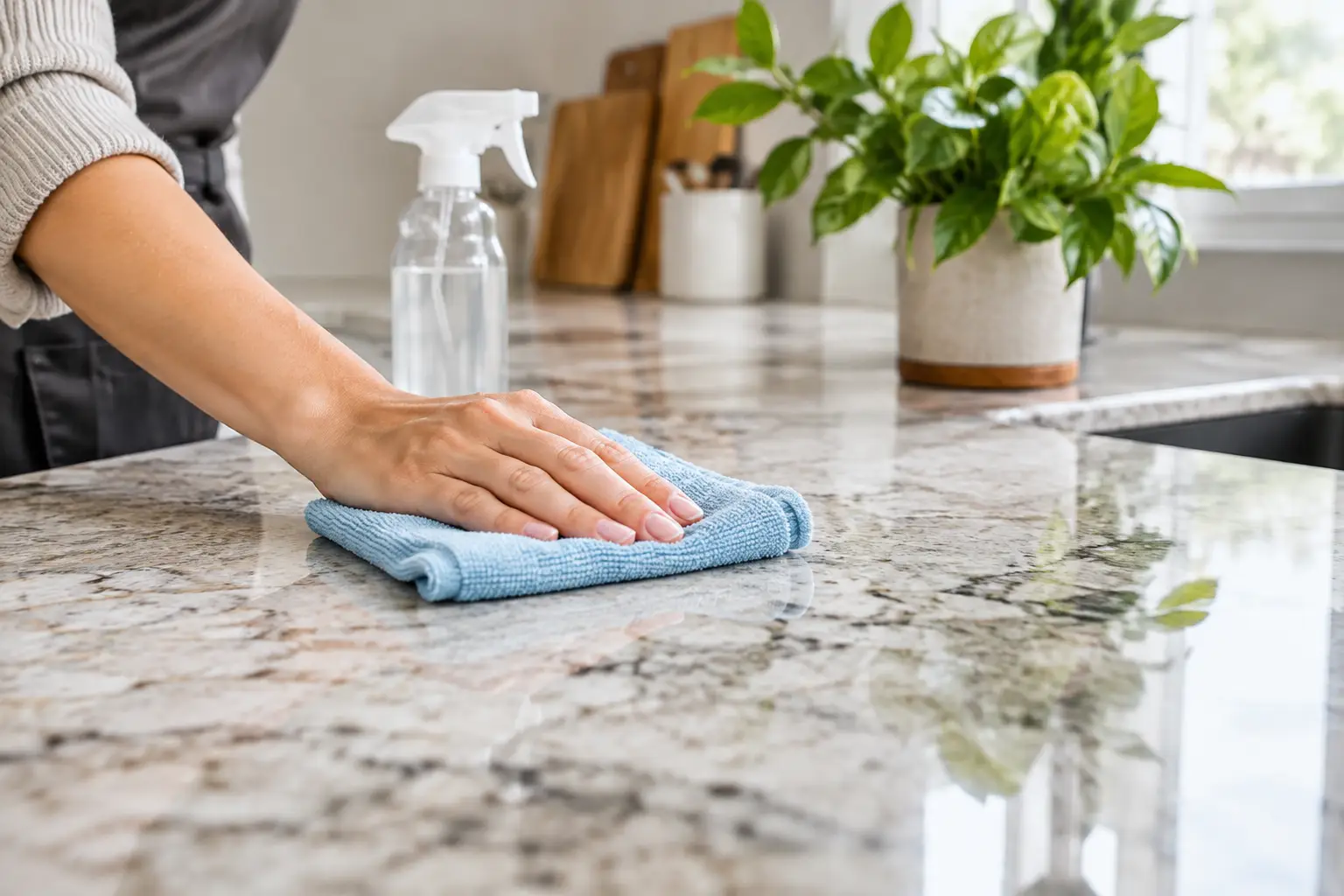
The best countertop care routine is to remove crumbs and grit, clean with a soft cloth and a mild cleaner approved for the material, wipe spills promptly, and use cutting boards and trivets. Quartz generally does not need sealing, while granite, marble, and quartzite may require sealing depending on their porosity and finish.
Avoid abrasive cleaning products, concentrated heat, heavy impacts near cutouts, and excessive weight on unsupported overhangs. Always follow the countertop manufacturer’s specific care instructions.
Quartz, granite, marble, quartzite, porcelain, and sintered stone each have different strengths and limitations. A countertop should not be treated as fragile, but it also should not be treated as indestructible.
Quartz is an engineered surface made with natural mineral content and binders. For daily cleaning, a soft cloth, warm water, and mild soap are generally enough.
Avoid abrasive scouring pads and harsh cleaners, particularly products containing strong acids, high-pH degreasers, bleach, or solvents unless the slab manufacturer specifically permits them. These products can leave dull areas or affect the surface finish over time.
Quartz countertops generally do not require sealing, but they can be damaged by excessive heat or sudden temperature changes. Use a trivet for hot cookware rather than placing it directly on the surface.
Granite is a natural stone with good resistance to many types of everyday wear. However, its absorption characteristics vary between slabs and finishes.
Some granite countertops benefit from periodic sealing. Wipe spills promptly, especially cooking oil, wine, coffee, and coloured sauces. Use a stone-safe, pH-neutral cleaner for routine maintenance.
For more information about sealing, see our guide on whether granite countertops need sealing.
Quartzite is a natural stone often selected for its appearance and resistance to scratching. However, not every slab sold as quartzite has identical absorption characteristics or mineral composition.
Use a pH-neutral stone cleaner, wipe spills promptly, and confirm whether the slab requires sealing. Avoid assuming that a hard stone is automatically stain-proof.
Our quartzite countertop care guide explains cleaning, sealing, and daily maintenance in greater detail.
Marble requires additional awareness in a busy kitchen because it reacts to acidic substances.
Lemon juice, vinegar, wine, and some household cleaners can cause etching. Etching is a change in the stone finish, often appearing as a lighter or duller spot. It is different from a stain, and sealing does not prevent it.
Some homeowners appreciate the naturally softened appearance marble develops over time. Others prefer to use it in bathroom vanities or areas where acidic spills are less frequent.
Learn more about protecting marble countertops and why marble etches.
Porcelain and sintered stone are dense surfaces that generally offer straightforward daily maintenance.
However, their resistance to staining and heat does not mean every installation detail is equally resistant to damage. Edges, corners, cutouts, seams, and certain surface finishes still require appropriate care.
Follow the manufacturer’s cleaning instructions, particularly for textured finishes, decorative surfaces, and products with specific treatment requirements.
The following table provides a practical overview of routine maintenance. Exact requirements depend on the product, finish, and manufacturer’s instructions.
| Material | Daily Cleaning | Sealing | Main Precaution |
|---|---|---|---|
| Quartz | Mild soap and soft cloth | Generally not required | Excessive heat and harsh cleaners |
| Granite | pH-neutral stone cleaner | Depends on stone and finish | Absorption and concentrated impacts |
| Quartzite | pH-neutral stone cleaner | Depends on stone and finish | Staining and improper cleaning products |
| Marble | pH-neutral stone cleaner | Often beneficial | Acid etching and staining |
| Porcelain | Manufacturer-approved mild cleaner | Generally not required | Edge impacts and product-specific finishes |
| Sintered Stone | Manufacturer-approved cleaner | Generally not required | Edge impacts and installation details |
For most countertops, daily cleaning should be uneventful. Remove crumbs and grit first, then wipe the surface with a soft microfiber cloth or non-abrasive sponge, warm water, and a small amount of mild dish soap.
Finish with a clean damp cloth and dry the surface if water spotting is a concern.
The reason for this basic routine is practical. Grit can act like fine sandpaper when dragged across a polished surface. Cleaner residue can create haze, especially on dark slabs or honed finishes. Reaching for stronger products too often can cause more trouble than the spill itself.
For sticky spills, let a warm, damp cloth sit on the area briefly before wiping. For oils or heavier cooking residue, use a mild cleaner formulated for the countertop material rather than immediately reaching for an aggressive household degreaser.
If you are unsure what caused a mark, identify the countertop material before attempting treatment. Test an approved cleaner in an inconspicuous area first.
Many countertop problems are caused by concentrated heat, standing water, heavy impact, or unsupported weight in a vulnerable location.
Use trivets under hot pots, pans, slow cookers, and countertop appliances that generate significant heat.
This is particularly relevant for quartz, but it is good practice for every material. Heat can affect surface finishes, adhesives, seams, and resin-treated natural stone.
A hot pan placed over a seam or close to a cutout may create additional risk compared with a broad, well-supported area of countertop.
Keep standing water from collecting around sink edges, faucet bases, and seams.
Water alone is not usually a concern for a properly installed countertop, but repeated exposure can affect caulking and the surrounding cabinet materials. It can also allow residue and staining substances to remain unnoticed.
Dry the rim of an undermount sink and the countertop near the dishwasher after heavy use. If caulking becomes loose or begins separating, arrange for appropriate maintenance.
A breakfast bar or island extension may be designed for normal use, but it is not a place for someone to climb, sit heavily, or apply concentrated weight near the outer edge.
Whether an overhang needs brackets or other support depends on the material, thickness, cabinet construction, span, and fabricator’s design requirements.
If support was included during installation, do not remove or alter it without professional guidance.
For more information, read our guide on measuring countertop overhangs.
Seams are a normal part of many countertop layouts. Their placement depends on slab size, room access, material characteristics, layout, vein direction, and safe handling during installation.
A properly fabricated seam should be neat and appropriately filled, but it is still a transition point rather than one uninterrupted slab.
Do not strike seams with heavy cookware or use them as leverage points when moving appliances.
If a seam develops a noticeable opening, changes height, or begins catching on a cloth, arrange for an assessment instead of filling it with household caulk or adhesive.
The same applies to chips near an edge or sink cutout. Small repairs are often more manageable when addressed early.
For additional guidance, see what causes countertop seam visibility.
Sink cutouts are another area that needs sensible use.
Do not stand in a sink or place excessive weight on the narrow countertop sections around an undermount sink.
If you notice movement, a gap in caulking, or signs that the sink is no longer properly supported, stop placing heavy loads in it and have the installation reviewed.
The countertop, sink mounting system, and cabinet structure work together in this area.
Our article on supporting sinks under stone countertops explains why proper mounting matters.
Many granite, marble, and quartzite countertops benefit from sealing, but the need and frequency depend on the stone, finish, sealer, and use of the space.
A dense quartzite slab may behave differently from a more absorbent marble or granite.
Sealing helps reduce how quickly certain liquids absorb into natural stone. It does not make the surface immune to stains, etching, scratches, or heat-related problems.
A simple indication that a natural stone surface may need attention is a water test in an inconspicuous area, provided the stone supplier permits it.
Place a small amount of water on the surface and observe whether the stone darkens as it sits. Wipe it dry after a few minutes. If the stone absorbs water noticeably, ask your fabricator or a stone-care professional whether sealing is appropriate.
This test is only an indication of absorption. It does not identify the correct sealer or establish a fixed resealing schedule.
Avoid applying a random sealer simply because it is labelled for stone. The wrong product can leave residue, alter the appearance, or fail to address the actual issue.
Polished, honed, leathered, and textured finishes show everyday use differently.
A polished dark stone may reveal fingerprints and water spots more readily. A honed marble may make etching less reflective but will not stop it from occurring. Textured finishes can hold crumbs or residue in low areas and may need a soft brush as part of normal cleaning.
For a more detailed comparison, see our article on honed versus polished stone finishes.
This is why countertop care begins before installation as well as after it.
During slab selection, consider not only colour and pattern but how the finish will look in your lighting and how you use the room.
A full slab view is valuable because natural variation, movement, and porosity can be difficult to judge from a small sample.
Most routine cleaning and maintenance can be handled by homeowners. However, certain changes deserve a professional assessment.
Contact a countertop fabricator if you notice:
Do not attempt to repair structural cracks or unsupported stone sections with household adhesive. The cause should be identified before a repair is selected.
For most stone countertops, a soft microfiber cloth and a mild, manufacturer-approved cleaner are suitable for everyday maintenance. Natural stone generally benefits from a pH-neutral stone cleaner. Avoid acidic or abrasive products unless specifically approved for the material.
Vinegar should not be used on marble, limestone, travertine, or other acid-sensitive natural stones because it can cause etching. It is also best to avoid vinegar on engineered quartz unless the manufacturer specifically approves its use.
There is no universal sealing schedule. Some granite and quartzite slabs require periodic sealing, while denser materials may need little or no additional treatment. The correct interval depends on the stone, finish, existing sealer, and usage.
Quartz countertops are generally low maintenance and do not require sealing. Daily cleaning with mild soap and water is usually sufficient. Protect the surface from excessive heat, abrasive scrubbing, and cleaners not approved by the manufacturer.
Yes. The risk varies by material, but concentrated heat can damage engineered quartz, certain surface treatments, adhesives, and seams. Even heat-resistant natural stone can experience thermal stress. Using trivets is the safest routine.
Avoid placing additional weight or impact near the damaged area. Small chips may be repairable, but cracks near cutouts, seams, or unsupported sections should be assessed by a qualified countertop fabricator before attempting repairs.
Yes. Polished finishes may show fingerprints and water spots, honed finishes can show oils or surface marks differently, and textured finishes may require additional cleaning to remove residue. The stone material still determines which cleaners and treatments are appropriate.
Countertops are built to be used. The goal is not to avoid everyday cooking, cleaning, or entertaining. It is to understand the material’s limitations and prevent avoidable damage.
For existing countertops, gentle cleaning, sensible heat protection, and early attention to small changes will usually do more for long-term appearance than aggressive cleaning products.
For new countertops, material selection, fabrication details, sink support, seams, and finish all influence how easy the surface will be to maintain.
Stone Valley Countertops supplies, fabricates, and installs quartz, granite, marble, quartzite, porcelain, and sintered stone countertops across Ontario.
With showroom locations in Mississauga, Bowmanville, Welland, and Orillia, our team can help you compare materials, understand maintenance requirements, and plan fabrication details before installation.
Visit our Ontario countertop showroom guide to prepare for your visit, or contact Stone Valley Countertops to discuss your project.