
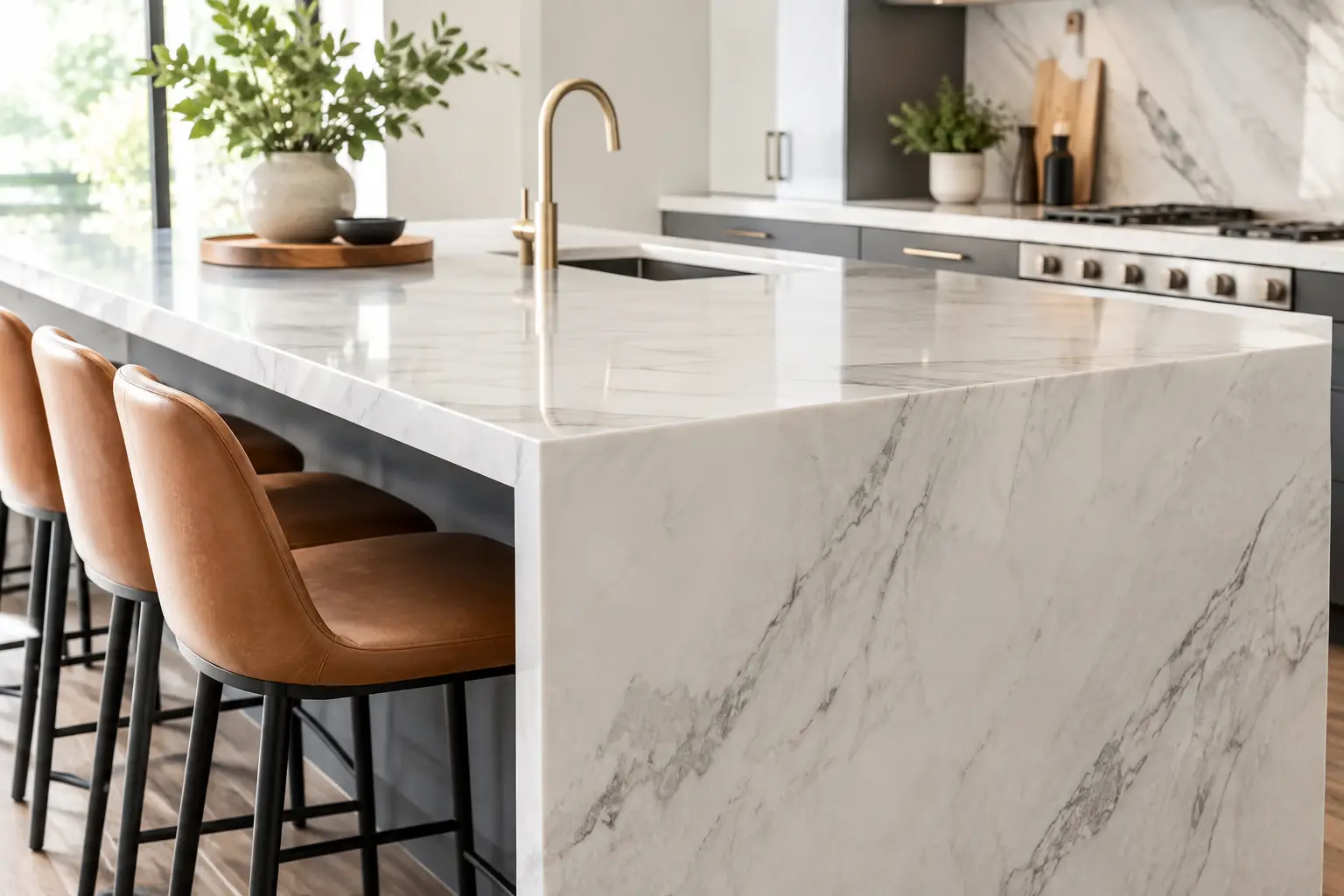
A waterfall countertop changes more than the edge of an island. Instead of stopping at the cabinet line, the stone continues vertically down one or both sides to the floor. That detail can make an island feel more substantial and intentional, but it also adds material, fabrication, and installation considerations.
So, are waterfall countertops worth it? For many kitchens, yes, provided the layout, material, and budget all support the decision. The best waterfall islands are planned as part of the whole kitchen rather than added at the end because they look good in a photo.
Quick Answer: Waterfall countertops can be worth it when an island is a major visual feature, has an exposed cabinet end, or uses a stone worth showcasing. They add material and fabrication cost, and they require careful planning for vein matching, seating, outlets, support, and mitered corners. One waterfall end can often provide much of the visual impact while using less material than wrapping both sides.
A waterfall countertop is usually worth considering when the island is a visual focal point and its exposed end would otherwise be a large, plain cabinet panel. The vertical stone creates a finished, furniture-like appearance, especially in open kitchens where the island is visible from the living or dining area.
It can also serve a practical purpose. A stone panel protects the end of the island from scuffs, chair impacts, and everyday traffic. In a busy home, that protection can be useful near a seating area or walkway where cabinet ends tend to take abuse.
That said, not every island needs one. If your kitchen is compact, the island has limited visibility, or the added expense takes money away from a more suitable countertop material or an important functional feature, a standard finished cabinet end may make more sense.
A waterfall is a design and fabrication feature, not a requirement for a well-built kitchen.
The added cost of a waterfall comes from more than one extra piece of stone. It can require additional slab material, careful slab layout, precision cutting, edge preparation, transport, and more involved installation.
The vertical leg must align closely with the horizontal countertop, particularly at the corner where the two pieces meet.
A mitered edge joins the pieces at an angle so the corner can appear to be made from one continuous piece of stone. It is a refined detail, but it demands accurate fabrication and careful handling. The quality of this corner has a major effect on the finished appearance.
Material yield matters too. A slab may technically have enough square footage for the countertop and waterfall panel, yet its veining or pattern may not run in a direction that produces an attractive transition.
For a dramatic marble-look quartz or natural quartzite with strong movement, additional material may be needed to position the pattern properly. This is why two waterfall islands with similar dimensions can have very different material requirements.
A waterfall on one end is often a sensible middle ground. It gives the island a strong finished focal point while using less material than wrapping both ends.
Quartz, granite, quartzite, marble, porcelain, Dekton, and other sintered surfaces can all be used for waterfall designs, but they do not behave or look exactly the same once fabricated.
Quartz countertops are popular for waterfall islands because they are consistent, low-maintenance, and available in designs ranging from quiet solid colours to dramatic marble-inspired patterns.
Quartz resists staining well and does not require routine sealing. For households that use the island heavily, it can offer a practical balance between appearance and everyday maintenance.
The main limitation is heat. Hot cookware should not be placed directly on quartz countertops. Quartz is also generally intended for indoor use because prolonged UV exposure can affect some resins and colours.
Granite and quartzite give waterfall islands natural variation and depth. Their movement can make the stone appear to flow over the edge, particularly when the slab layout is carefully planned.
Both can be durable choices, although maintenance requirements vary by slab. Many natural stones benefit from periodic sealing to help resist staining.
With heavily veined quartzite, the actual slabs should be reviewed before fabrication. A small sample cannot show how a large vein will move across an island and down its waterfall leg.
Marble can make a striking waterfall, particularly when the veining continues from the horizontal surface onto the side panel.
It also requires realistic expectations. Marble can etch when exposed to acidic foods and drinks, and it can develop marks and patina with use.
Some homeowners appreciate that natural ageing. Others prefer a countertop that changes less over time, particularly on a heavily used kitchen island.
Porcelain countertops and sintered stone can create a clean, contemporary waterfall profile. These materials offer strong resistance to heat, staining, and UV exposure, with many products also suitable for outdoor applications.
Because large-format porcelain and sintered surfaces can be relatively thin and rigid, fabrication and handling require specialized equipment and experience. Edge construction and support should be planned before the material is cut.
A waterfall can look ordinary or exceptional depending on how the pattern meets at the corner.
With directional veining, the goal is often to continue the movement from the horizontal countertop down the vertical panel. The success of that transition depends on the actual slab, island dimensions, cutting layout, and number of waterfall ends.
Perfect continuity is not always possible. Natural stone varies, and engineered patterns can repeat in ways that limit the cutting layout.
When pattern movement matters, ask to review the slab layout before fabrication. This is especially useful with quartzite, marble, granite, and heavily veined quartz.
Our guide on how to compare stone slabs explains why viewing the complete slab is particularly important when movement and vein direction affect the finished project.
Before choosing a waterfall, consider how the island will work every day. The stone leg occupies the area where a finished cabinet end would normally be, which can affect outlet placement, storage access, seating, and circulation.
If the island includes stools, the overhang needs to provide comfortable knee clearance. A waterfall panel should not occupy space needed for someone’s legs or feet.
In many designs, the waterfall is placed at the end opposite the primary seating area. When seating is required on multiple sides, the layout deserves closer review before fabrication.
If you are still working through these dimensions, read our detailed guide on how to plan a waterfall island. It covers seating, overhangs, slab dimensions, support, seams, and fabrication considerations in more detail.
Stone is heavy, and a full-height waterfall panel needs a properly prepared cabinet and floor structure. Level cabinets and accurate templating are especially important because even a small irregularity can become noticeable along a long, straight mitered joint.
If the island includes a sink, cooktop, or large seating overhang, support planning becomes even more important. Cutouts remove material from the countertop while an overhang extends weight beyond the cabinet structure.
Stone should not simply be expected to support a large projection by itself. Reinforcement requirements depend on the material, slab thickness, overhang, cabinet construction, and nearby cutouts.
Outlet placement should be considered early. Depending on the kitchen design and applicable electrical requirements, outlets may need to be incorporated into the island.
If an electrical box or device will be installed through a waterfall panel, the required location and cutout should be coordinated before templating and fabrication. Altering a finished stone leg later is much more difficult than planning the opening before the slab is cut.
Waterfall countertops can perform very well when the material, fabrication, support, and installation are appropriate for the project.
The exposed lower corner deserves particular attention. Stone is durable, but corners and edges can still be more vulnerable to hard impacts than a flat cabinet panel. This matters most in narrow kitchens, high-traffic walkways, and homes where the end of the island is regularly bumped by chairs or other objects.
Material thickness and edge construction also affect the finished installation. A 2 cm or 3 cm countertop may be appropriate depending on the material and design.
A mitered build-up can also create the appearance of a thicker countertop without requiring the entire surface to be made from an unusually thick slab.
Cleaning the waterfall itself is generally straightforward. Use a soft cloth, warm water, and a cleaner appropriate for the countertop material.
Avoid abrasive pads and harsh chemicals, particularly on natural stone.
The vertical surface usually stays cleaner than the horizontal countertop, although it can collect fingerprints, shoe marks, and scuffs near the floor. These can normally be removed during regular kitchen cleaning.
A waterfall may not be the right choice if it forces compromises that affect daily use. Reducing comfortable seating, blocking useful storage, or choosing a less suitable countertop material simply to fit the waterfall into the budget can make the feature less worthwhile over time.
It may also add little value if the end of the island is mostly hidden by a wall, appliance, or tall cabinetry.
In those situations, the available material or renovation budget may have more impact elsewhere, such as a larger island top, a full-height stone backsplash, or a countertop material better suited to the household.
For homeowners who prefer a softer or more traditional kitchen, a furniture-style cabinet panel or decorative end can also suit the room better.
Two waterfall ends create a symmetrical appearance and can make an island look like a single piece of stone furniture. They also require more material and can restrict seating, cabinetry, electrical locations, or access to the ends of the island.
A single waterfall end often provides much of the same visual effect while leaving the opposite side available for seating, cabinetry, or an open overhang.
There is no universal rule. The right configuration depends on what surrounds each end of the island and how people will move around and use it.
Start with the island layout before deciding on the waterfall configuration. Determine where seating will go, how the island will be approached, which ends are visible, where electrical components are located, and whether one or two stone panels make sense.
Then look at the actual countertop material. If you are considering natural stone or a strongly veined engineered surface, think about how the pattern will move from the top to the vertical panel and whether the slab dimensions can accommodate the layout.
A well-planned waterfall countertop is more than a decorative add-on. It is a precision-fabricated stone detail that can protect an exposed island end, showcase an interesting slab, and give the island a more complete appearance.
For Ontario homeowners, the decision is ultimately about whether those benefits justify the additional material and fabrication for the specific kitchen. If the layout works and the material suits your household, a waterfall can be a worthwhile part of the countertop design.
Usually, yes. A waterfall requires additional countertop material plus extra cutting, edge preparation, slab layout, handling, and installation. Highly veined materials can also require additional slab material to achieve the desired pattern placement.
Generally, one waterfall end requires less stone and fabrication than wrapping both sides of an island. The exact material requirement depends on the island dimensions, slab size, pattern direction, and cutting layout.
No. Mitered corners are commonly used because they can create the appearance of the countertop flowing continuously down the side, but other joint details may be appropriate depending on the material, thickness, and design.
Yes. Seating can work very well with a waterfall island, but stool positions, knee clearance, overhang depth, and support should be planned before templating. A single waterfall end can sometimes provide more flexibility than wrapping both sides.
There is no single best material. Quartz offers predictable patterns and low maintenance, while granite and quartzite provide natural variation. Marble offers distinctive veining but can etch. Porcelain, Dekton, and other sintered surfaces can provide a slim profile with strong heat and UV resistance. The best choice depends on the design and how the kitchen will be used.
Often, yes, but the result depends on the slab dimensions, pattern direction, island size, and cutting layout. Reviewing the actual slab and proposed layout before fabrication gives the fabricator the best opportunity to create a natural-looking transition.
Stone Valley Countertops supplies, fabricates, and installs quartz, granite, marble, quartzite, porcelain, Dekton, and other countertop surfaces across the GTA, Durham Region, Niagara Region, Hamilton, Burlington, Oakville, Orillia, and surrounding Ontario communities.
If you are considering a waterfall island, bring your cabinet drawings, approximate island dimensions, and material ideas to the discussion. We can review the layout, slab requirements, waterfall configuration, vein direction, edge details, and fabrication requirements before the stone is cut.
Contact Stone Valley Countertops to discuss your waterfall countertop project.