
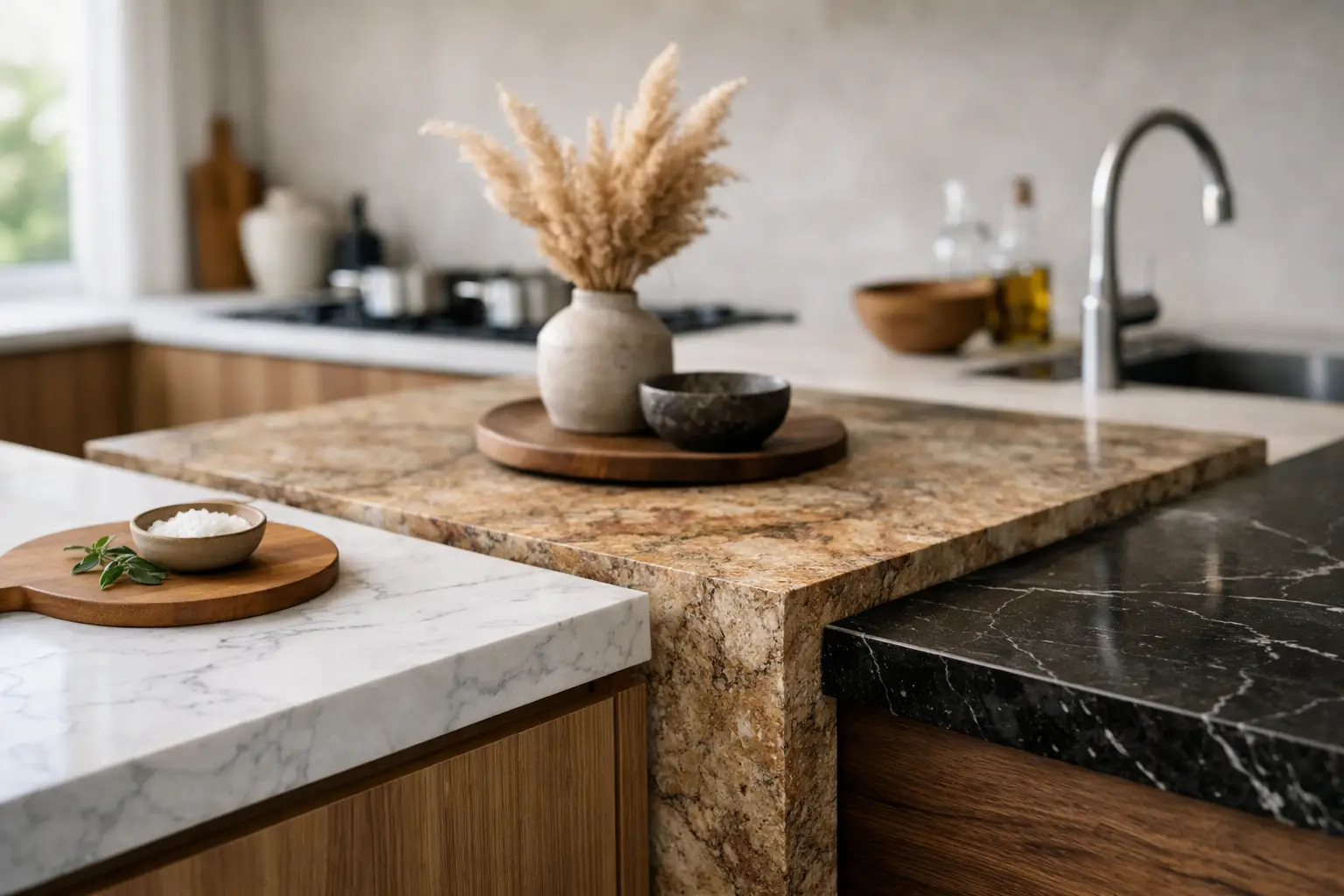
A countertop is no longer chosen only for its colour or its ability to survive a busy kitchen. The countertop design trends 2026 homeowners are responding to are more considered: warmer materials, less visual clutter, purposeful details, and surfaces selected for how a room is actually used.
The goal is not a kitchen that looks dated after a few seasons. It is a surface that feels personal, functions well, and is fabricated with the right details from the start.
For Ontario homes, that also means thinking beyond the slab sample. Natural light, cabinet colour, room size, cooking habits, sink choice, and the skill behind templating and installation all affect the finished result.
Quick Answer: The strongest countertop design trends for 2026 focus on warm whites, quieter veining, full-height backsplashes, thoughtfully used waterfall panels, refined thick-edge details, and natural stone selected with realistic maintenance expectations. The most timeless projects balance appearance with practical fabrication, seam placement, support, and everyday use.
Bright white quartz with bold grey veining is not disappearing, but the look is becoming softer. In 2026, many homeowners are moving toward warm whites, creamy backgrounds, muted taupe veining, soft mushroom tones, and stones with movement that feels natural rather than overly printed.
This shift works especially well with wood cabinetry, warm-painted islands, brushed metal hardware, and off-white walls. A countertop does not need to match every finish in the room. It should provide a steady visual connection between them.
For a clean, low-maintenance option, quartz in a warm white or light beige can offer a calm background with reliable day-to-day performance. If you prefer authentic variation, quartzite and certain granites bring depth that cannot be repeated from slab to slab.
Marble remains appealing for its softer veining and classic character, but it asks more of the homeowner. It can etch or stain if acidic foods and spills are left sitting, so it is often best for people who are comfortable with a surface developing character over time.
The practical lesson is simple: view full slabs whenever possible. A small sample cannot show the spacing of veins, mineral variation, or how a pattern will sit across a large island.
The 2026 countertop look is not flat or boring. It is edited. Instead of dramatic veining everywhere, many kitchens use a quieter perimeter countertop and place the stronger visual moment on the island, a full-height backsplash, a bar, or a fireplace surround.
This approach can make a room feel more balanced. A heavily veined material across several large runs, backsplash walls, and waterfall ends may overwhelm a compact kitchen. On the other hand, a statement slab on a wide island can become a focal point without competing with the rest of the space.
Bookmatching is also being used more selectively. When two adjoining pieces of natural stone are mirrored so their veins create a symmetrical effect, the result can be striking.
Bookmatching requires careful slab selection, additional material planning, and precision fabrication. It can work well for a backsplash feature wall or fireplace, but it is not necessary for every countertop project.
Porcelain and sintered stone are increasingly relevant because they can offer dramatic stone-inspired patterns in large-format slabs. Their resistance to heat, UV exposure, and staining makes them useful for outdoor BBQ countertops and sunny areas.
Fabrication is specialized, however, and the finished edge can look different from a thick quartz or natural-stone profile. The material should suit both the design and the desired edge detail.
A four-inch backsplash still has a place in some renovations, particularly when budget or existing wall conditions guide the decision. But full-height stone backsplashes remain one of the clearest countertop design trends 2026 will carry forward.
Running the countertop material from the work surface to the upper cabinets or range hood creates a clean, continuous field. It reduces the visual interruption of grout lines and can make a smaller kitchen feel taller. It also gives a simple countertop a more finished appearance without adding another competing tile pattern.
There are trade-offs. Full-height material requires additional slabs, fabrication, transport, and installation time. Vein placement needs to be planned before cutting, especially behind a range.
Outlet locations, cabinet gaps, range hood dimensions, and wall irregularities also need close attention during templating. Good results depend on accurate measurements and a fabrication plan that considers where seams will fall.
A practical compromise is to use the countertop material only behind the range or across one main wall, then use a quieter backsplash elsewhere. This can retain the focal point while controlling cost.
A substantial island edge is still popular, but the look is becoming more refined. Instead of making every countertop visually heavy, homeowners are mixing thicknesses with intention.
A standard 2 cm or 3 cm profile may work well around the perimeter, while a built-up or mitered edge gives the island more presence.
A mitered edge joins two pieces at a 45-degree angle to create the appearance of a thicker solid slab. It is commonly used for two-inch or three-inch looks and for waterfall panels. The finished corner should be precise, with consistent pattern alignment and a tight seam. This is one place where fabrication quality is highly visible.
Thicker edges add cost because they require more material and labour. They can also affect clearance around drawers, seating overhangs, and appliance openings.
Before choosing an oversized edge, confirm that it works with the cabinet design and countertop material. A clean eased edge or small pencil round often gives a modern result while keeping the focus on the stone itself.
Waterfall islands, where the countertop continues vertically down one or both ends, remain popular in 2026. The difference is that homeowners are using them with more restraint.
A waterfall can protect the end of an island, conceal a panel transition, and create a strong finished line. It is especially effective with a material that has directional veining or a warm, textural pattern.
The best waterfall installations consider vein flow before fabrication. A vein that continues from the horizontal surface down the side panel looks intentional. A random cut can make the joint more noticeable.
Mitered corners, floor conditions, cabinet support, and installation access all need to be reviewed in advance.
Not every island needs a waterfall. If seating is required on both ends, the kitchen is narrow, or the budget is better directed toward a full-height backsplash, a standard island overhang may be the smarter choice.
For seating, the overhang depth and support should be planned around the material, thickness, and unsupported span rather than guessed after fabrication.
Homeowners are showing renewed interest in materials with natural variation, mineral detail, and a less uniform appearance. Granite, quartzite, and marble each offer that individuality, but they behave differently in daily use.
Granite is generally durable and heat resistant, with a wide range of colours and patterns. Quartzite is often chosen when a homeowner wants marble-like movement with stronger resistance to scratching and etching, although sealing needs can vary by slab.
Marble offers a distinct softness and can be a beautiful choice for bathrooms, bars, fireplaces, or kitchens where its patina is appreciated rather than feared.
Quartz remains a practical option for busy kitchens, laundry rooms, and vanities because it is nonporous and easy to maintain. It does not need sealing, but it should not be treated as indestructible. Very hot cookware, harsh chemicals, and heavy impacts along edges or sink cutouts can still cause damage.
The trend is not about declaring one material better than another. It is about selecting the right surface for the room.
A homeowner who cooks daily may value easy cleanup. Someone creating a quieter bar area may prioritize natural movement. An outdoor project may need UV and weather performance above all else.
The most enduring projects are often defined by details that are easy to overlook in a showroom.
Sink cutouts should match the chosen sink and reveal style. An undermount sink can have a positive reveal, negative reveal, or flush reveal, and each creates a different look and cleaning experience.
A flush reveal creates a clean transition, but it requires accurate coordination between the sink dimensions and the countertop fabricator. Final sink specifications should be confirmed before fabrication begins.
Seams deserve the same consideration. Many larger kitchens require at least one seam, particularly with long runs, L-shaped layouts, full-height backsplashes, or oversized islands.
The goal is not to promise an invisible seam in every material. It is to place seams thoughtfully, align patterns where possible, and fabricate clean joints that do not distract from the room.
Slab size, access into the home, cabinet layout, cooktop cutouts, sink placement, and the direction of veining can all affect where a seam should be located.
For a closer look at what happens after a slab is selected, read our guide to countertop fabrication in Ontario.
Edge profiles also matter more than many people expect. Eased edges suit modern kitchens and are easy to live with. Rounded profiles can soften a traditional space and reduce sharp corners.
More decorative profiles can fit certain cabinetry styles, but they may not suit thin materials or a simple contemporary design.
The best edge is usually the one that works with the slab thickness, cabinet style, overhang, and daily use. It should support the design without becoming the only detail people notice.
Countertop trends are only useful when the installation process supports them. A material with bold movement, a full-height backsplash, a waterfall end, or an oversized island requires planning before the final measure.
Cabinets must be installed, secured, and level. Sinks, faucets, cooktops, and other fixtures should be selected. Finished cabinet panels that affect overhangs or waterfall dimensions should also be in place before templating.
Turnaround time varies based on material availability, project complexity, and the fabrication schedule. Simple countertops can move quickly once measurements are confirmed, while bookmatched walls, multiple mitered edges, and complex cutouts need more planning.
Asking about slab layout, seam locations, edge details, support, and installation access before fabrication helps avoid last-minute compromises.
The best 2026 countertop choice will not necessarily be the one that appears most dramatic in a photo. It will be the one that fits your kitchen’s light, your daily routines, and the details your fabricator can execute properly.
Warm whites, cream, beige, taupe, mushroom, and soft grey remain popular. Homeowners are also choosing natural stone and quartz patterns with softer movement instead of very sharp, high-contrast veining across every surface.
No. White quartz remains popular because it is versatile and easy to maintain. The change is toward warmer backgrounds, softer veining, and patterns that feel less cold or heavily printed.
Yes, but they are being used more selectively. A waterfall panel can work well when it protects an island end, improves the finished appearance, or continues a strong vein pattern. It may not be the best use of material in every kitchen.
It can be practical and easy to clean because it avoids grout lines. It also requires more material, careful outlet planning, accurate wall measurements, and thoughtful seam placement. The wall condition should be reviewed before fabrication.
There is no single timeless material for every home. Granite, quartzite, marble, quartz, porcelain, and sintered stone can all age well when the colour, pattern, maintenance needs, and fabrication details suit the room.
No. Countertops usually look more natural when they coordinate with the cabinet undertone rather than matching it exactly. Full slab viewing is especially helpful because small samples may not show the true background colour or pattern movement.
Not automatically. A thicker or mitered edge can add presence to an island, but it also adds cost and may affect drawers, appliances, seating, and overhang clearance. A standard edge can look just as finished when it suits the material and cabinet design.
Material, edge profile, sink, faucet, cooktop, backsplash plans, and major overhang details should be confirmed before templating. Vein layout, seams, waterfall panels, and mitered edges should be reviewed before the slab is cut.
Good countertop design is not about copying every current look. It is about using the strongest ideas in a way that fits the home, the material, and the people who will use the space.
Warm colours, quieter patterns, full-height backsplashes, natural stone, and refined waterfall details can all feel timeless when they are planned carefully. Fabrication, seam placement, support, edge work, and installation access matter just as much as the slab itself.
Stone Valley Countertops supplies, fabricates, and installs quartz, granite, marble, quartzite, porcelain, Dekton, sintered stone, and other countertop surfaces across Ontario. To discuss materials, slab layout, edge details, or installation planning for your project, contact Stone Valley Countertops.