
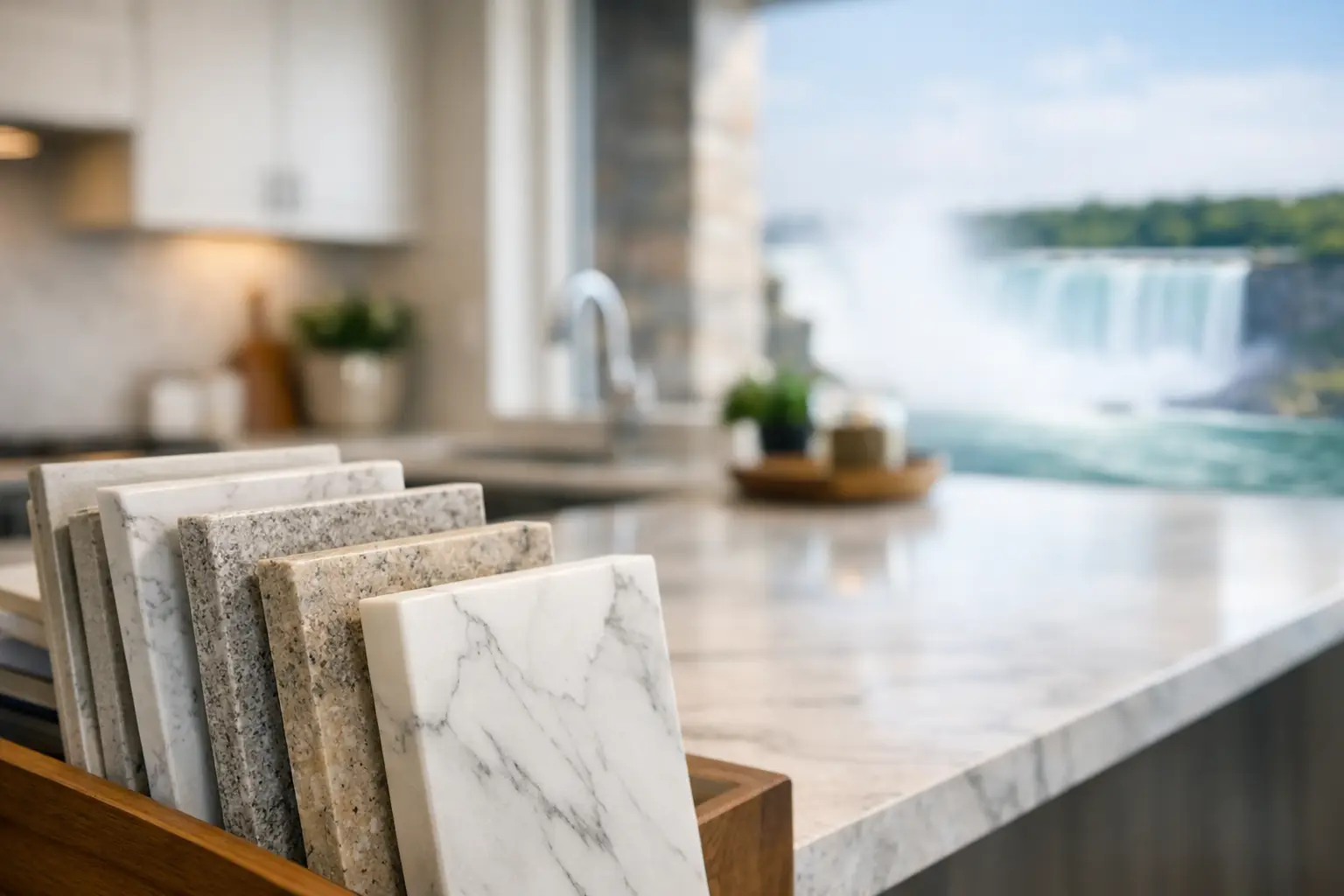
A countertop can look perfect in a showroom and still be the wrong choice for the way a household actually cooks, cleans, entertains, or uses its bathroom. For homeowners choosing custom countertops in Niagara Region, the best decision starts with the room’s daily demands, not just a sample colour.
A bright quartz with soft veining may suit a busy family kitchen. Natural granite may make more sense when heat resistance is a priority. In a powder room, where spills and heavy cookware are not major concerns, marble can be a practical design choice when the owner understands its character.
Custom work matters because the finished result depends on more than the slab. Accurate measurements, thoughtful seam placement, sink cutouts, edge details, support and installation all affect how the surface performs and looks years later.
Quick answer: The best countertop for a Niagara Region home depends on how the space is used. Quartz is popular for low-maintenance kitchens, granite offers natural variation and strong heat resistance, quartzite combines natural movement with excellent hardness, and porcelain or sintered stone can work well for selected indoor and outdoor applications. Material selection is only part of the project. Templating, slab layout, fabrication, seams and installation also determine the final result.
The first question is not “Which material is best?” It is “What will this surface need to handle?” A kitchen island used for daily meals, homework and food preparation needs different qualities than a bar top, bathroom vanity or fireplace surround.
For high-use kitchens, homeowners often prioritize stain resistance, simple cleaning and a predictable appearance. Quartz is popular for this reason. It is nonporous, does not normally require sealing and handles common food and beverage spills well.
It is not indestructible, though. Hot pans should not be placed directly on quartz countertops, and hard impacts around an edge or cutout can cause damage.
Granite and quartzite are natural stones with good heat resistance and distinct movement from slab to slab. Granite is generally a practical choice for active kitchens when properly maintained. Quartzite can offer some of the visual movement homeowners associate with marble while providing excellent hardness, but porosity and maintenance requirements can vary between slabs.
If you are considering natural stone, it helps to compare the actual slabs before buying. Colour, veining, fissures and movement can vary significantly even when slabs have the same material name.
Marble has a softer, more reactive surface. It can etch when exposed to acidic foods or cleaners, creating dull marks that are different from stains. Homeowners considering it should understand why marble etches and how it changes with use. Some people appreciate that lived-in patina, especially in bathrooms, baking areas or lower-use spaces. Others prefer a material that remains more visually consistent.
Porcelain and sintered stone are also worth considering for thin-profile designs, shower walls, fireplace surrounds and certain outdoor applications. Their heat, UV and stain resistance can be useful, but fabrication requires specialized handling. Large-format material also requires careful planning for transport, support, cutouts and installation.
A custom countertop is not simply a standard-size slab cut to fit. It is planned around the room, cabinetry, appliances, plumbing fixtures and the details that make the finished installation look intentional.
Cabinets can appear straight until a precise template shows a wall that runs slightly out of square or an island that is not perfectly rectangular. Templating captures those conditions before fabrication begins. This can be particularly important during renovations and in older Niagara homes where walls and corners may not be uniform.
Accurate templates also establish the position of faucet holes, cooktops, drop-in or undermount sinks and other openings. They allow the fabricator to confirm overhangs, finished dimensions and areas that may require additional support.
A small error around a sink opening can affect reveal consistency, silicone joints and fixture fit. These details are much easier to address during planning than after the countertop has been fabricated.
Many kitchens require a seam because of slab dimensions, countertop layout, access into the home or safe handling requirements. A properly fabricated seam should be tight, level, appropriately supported and colour-matched as closely as practical.
It will still be a seam, particularly in natural stones or engineered materials with prominent veins.
Discuss seam placement before fabrication. A homeowner may prefer a seam away from the primary work area, while the slab layout may favour another position to maintain vein movement or use the material efficiently.
The right solution depends on the slab and the room. Our countertop seam guide explains what homeowners should expect and why some layouts require seams.
A simple eased countertop edge works in almost any kitchen and is easy to clean. A bevel creates a more defined line, while a built-up or mitred profile can give an island the appearance of a much thicker countertop.
The best edge is usually one that suits the cabinet style, material and way people move through the room rather than simply the most decorative option available.
Overhangs deserve equal attention. A modest seating overhang may require little or no visible support depending on the material and layout, while deeper overhangs can require brackets, steel or another engineered support system.
Material, thickness, cabinet construction and overhang depth all matter. Planning support before fabrication helps avoid having to compromise the finished design later.
Waterfall ends create a continuous drop from the countertop to the floor and can be particularly effective with a strongly veined quartz, quartzite or porcelain surface.
The visual result depends heavily on slab layout. Pattern direction, vein continuation, mitred joints and the dimensions of the vertical panels need to be considered before cutting begins.
If this feature is part of your renovation, see our guide on how to plan a waterfall island before finalizing the slab and layout.
Niagara Region includes everything from newer subdivisions and family homes to condos, century homes, cottages and properties designed around outdoor entertaining. A material that works well in one setting may be unnecessary or impractical in another.
Quartz works well for homeowners who want low day-to-day maintenance and a large selection of colours and patterns. Its consistent appearance can also make it easier to coordinate countertops across kitchens, vanities, laundry rooms and other areas of the home.
Because quartz contains resins, it should be protected from excessive heat and is generally better suited to indoor installations.
Granite offers natural variation, good heat resistance and a wide range of colours and patterns. It can be a practical kitchen surface when properly maintained and sealed as required.
Homeowners who cook frequently may also want to read our explanation of granite countertop heat resistance.
Quartzite is a natural stone known for hardness and distinctive movement. Many slabs offer lighter colours and flowing patterns that appeal to homeowners who like marble but want a harder natural stone.
Not every quartzite behaves identically. Porosity, finish and maintenance requirements should be evaluated based on the actual material being considered.
Marble is valued for natural depth, veining and a surface that develops character with use. It is softer and more acid-sensitive than granite or quartzite, so homeowners should choose it with realistic expectations about etching and maintenance.
Finish can also affect its appearance and how everyday marks are perceived. Our comparison of polished versus honed marble countertops explains the practical differences.
Porcelain and sintered stone can provide strong heat, stain and UV performance. They are useful for selected kitchens, fireplaces, wall applications and outdoor projects where the specific product is approved for that use.
Because these materials behave differently during cutting and installation than traditional stone slabs, fabrication experience matters.
Outdoor kitchens and BBQ areas need additional consideration in Southern Ontario. The surface may be exposed to direct sunlight, rain, snow and repeated freeze-thaw cycles throughout the year.
For an outdoor BBQ countertop in Ontario, material selection should account for UV exposure, temperature changes and the location of grills or other heat-producing appliances.
Quartz is generally not the preferred choice for an uncovered outdoor installation because prolonged UV exposure can affect its appearance. Granite, porcelain and sintered stone may be better options depending on the specific product, design and site conditions.
Countertop pricing is based on more than the number of square feet. The selected material is a major factor, but slab yield, thickness, edge profile, number of cutouts, seam requirements, backsplash pieces, waterfall panels and installation access can all affect the final cost.
A straightforward vanity with one sink opening is very different from a kitchen with a large island, two sinks, a cooktop, full-height backsplash and vein-matched waterfall panels. Both projects might use the same material, but their fabrication requirements are not comparable.
When comparing estimates, check exactly what is included. Ask about templating, fabrication, delivery, installation, sink cutouts, faucet holes, edge finishing, removal of existing countertops if required, backsplash work and any necessary support.
Our guide to the stone countertop quote process explains what homeowners should look for when comparing estimates.
Most custom countertop projects move through material selection, templating, fabrication and installation. By the time templating takes place, cabinets should normally be installed, secured and level so final countertop dimensions can be captured accurately.
Sinks, faucets, cooktops and other fixtures should also be selected early enough for their dimensions and installation requirements to be confirmed.
After templating, the measurements are used to plan the pieces, seams, cutouts and slab layout before fabrication. The countertop is then cut, finished and prepared for installation.
Custom details such as waterfalls, full-height backsplashes, multiple seams or more complex edge work require additional planning. Rushing the measuring or fabrication stage is rarely worthwhile. Precision at each step is what produces clean joints, accurate openings and a secure final fit.
For a deeper look at this stage of the project, read our guide to countertop fabrication in Ontario.
Stone Valley Countertops supplies, fabricates and installs quartz, granite, marble, quartzite, porcelain and sintered stone for projects throughout Niagara Region, including Welland, St. Catharines, Niagara Falls and surrounding communities.
Having templating, fabrication and installation handled as part of the same countertop process also makes it easier to address practical details such as seam locations, sink openings, slab layout, edge profiles and installation requirements before material is cut.
If you are beginning a project, bring approximate measurements, photos of the existing space and any cabinet, sink or appliance information you already have. Those details make the initial conversation much more useful and help narrow down suitable materials before final templating.
There is no single best material for every kitchen. Quartz is popular for low maintenance and consistency. Granite provides natural variation and good heat resistance. Quartzite is a strong natural stone option for homeowners who want distinctive movement. The right choice depends on cooking habits, maintenance expectations, design and budget.
Yes. Final templating allows the fabricator to capture the actual cabinet layout, walls, corners, appliance openings, sink locations and finished dimensions before the countertop is fabricated. Approximate measurements are useful for quoting, but they should not replace a final template.
Possibly. Seam requirements depend on slab dimensions, countertop length, room access, layout, material and safe handling limits. Seam locations should be discussed before fabrication, especially when the material has prominent veining.
Granite, porcelain and certain sintered stone products can be good options for outdoor applications when properly specified and installed. The material should be selected with UV exposure, moisture, freeze-thaw conditions and nearby cooking equipment in mind. Quartz is generally better kept indoors unless the manufacturer specifically approves the product for exterior use.
Start with approximate measurements or cabinet plans, photos of the space and an idea of the materials you are considering. It also helps to identify the sink, cooktop, backsplash, edge profile and any special features such as a waterfall island. These details allow the initial quote to reflect the actual scope more accurately.
Yes. Stone Valley Countertops serves homeowners, contractors and renovation projects throughout Niagara Region, including Welland, St. Catharines, Niagara Falls and surrounding Ontario communities.
If you are comparing materials or planning a kitchen, bathroom, outdoor counter or other custom stone project, start with the layout and how the space will actually be used. Stone Valley can help you review material options, fabrication details and installation requirements before you make the final selection.
Contact Stone Valley Countertops with your measurements, photos or project details to get started.