
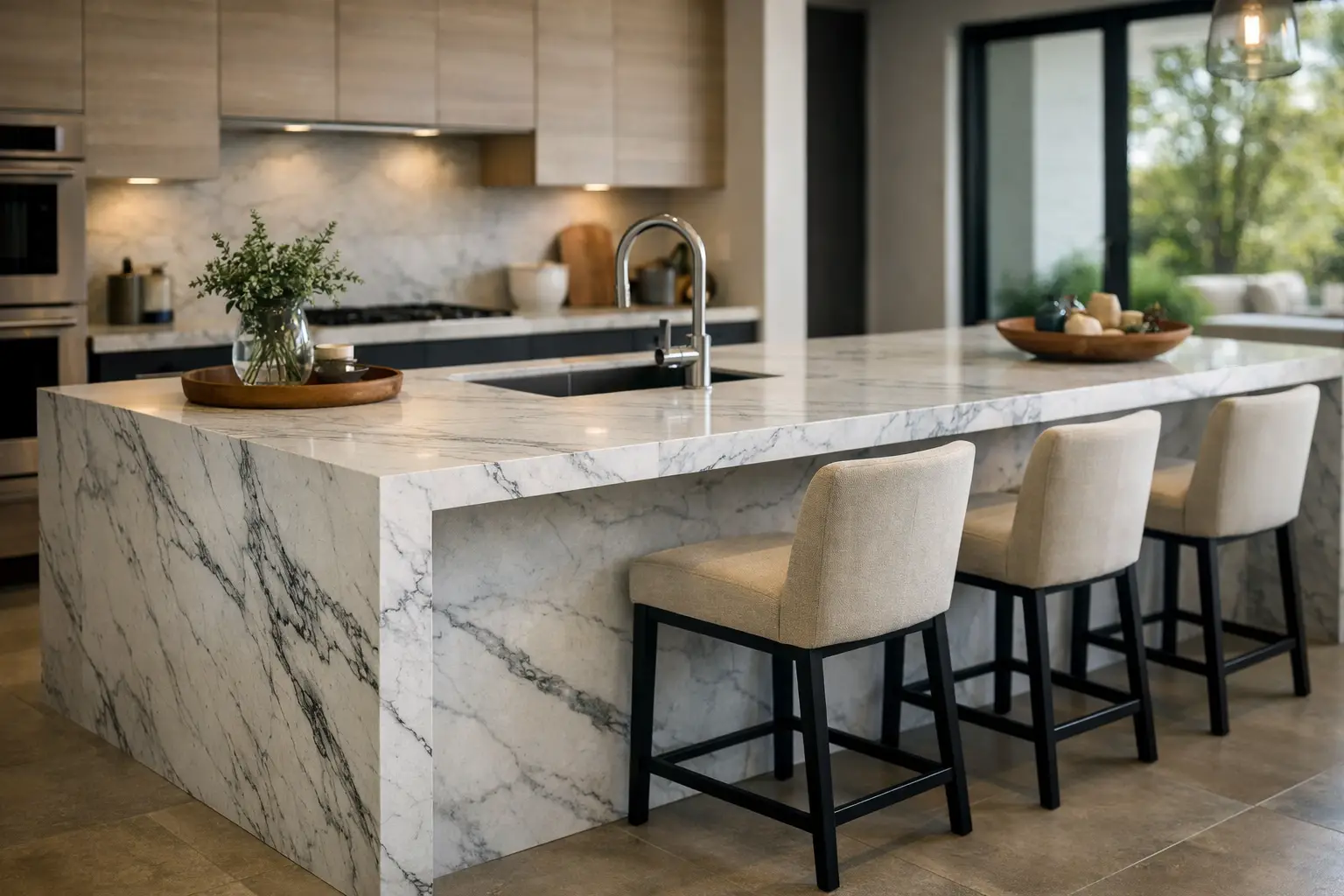
A waterfall island project can make a kitchen feel more intentional because the countertop material continues down one or both island ends to the floor. That clean vertical return creates a strong visual line, but it also requires more planning and fabrication than a standard island top.
Material selection, cabinet construction, slab layout, seam placement, overhang support, mitred corners and precise templating all affect how the finished island looks and performs. For homeowners, the goal is not simply to add a dramatic detail. It is to create an island that works for daily meals, seating, storage and cleanup while using stone in a way that suits the room and budget.
A successful waterfall island project starts with the island dimensions, cabinet layout, slab size, material thickness, vein direction, seating overhang and support requirements. The countertop and vertical waterfall panels should be planned together before fabrication. For strongly veined quartz, quartzite, granite or marble, reviewing the slab layout before cutting can also help create a more natural transition from the horizontal countertop to the waterfall end.
A standard island countertop ends at the cabinet edge, usually with an eased, bevelled or more detailed edge profile. A waterfall design extends the countertop material down the side of the island, creating the appearance of one continuous surface.
Some islands have one finished stone end, while others have waterfall panels on both short ends. A two-sided design can look balanced on a freestanding island centred in an open kitchen. If one end meets a wall, contains seating or is rarely visible, however, a second waterfall may not provide enough practical or visual benefit to justify the additional material and fabrication.
If you are still deciding whether one or two waterfall ends make sense, read our guide on how to plan a waterfall island before finalizing the cabinet layout.
One of the most noticeable fabrication details is the mitred corner where the horizontal countertop meets the vertical waterfall panel. The adjoining edges are cut on an angle and joined to create a crisp transition.
When the slab pattern and fabrication are planned carefully, the joint can be subtle and the stone movement can appear to continue around the corner. It is still a joint, however. Homeowners should expect a fine finished seam rather than an entirely invisible, uninterrupted piece of stone.
Quartz, granite, quartzite, marble, porcelain and sintered stone can all be used for waterfall islands. The best material depends on how the kitchen is used, the desired appearance and the amount of maintenance the homeowner is comfortable with.
Quartz is a practical choice for busy kitchens because it is nonporous, easy to clean and available in a wide range of consistent colours and patterns. It does not require routine sealing, which makes it appealing for islands used daily for meals and food preparation.
The main consideration is heat. Quartz should not be treated as a landing spot for very hot cookware. Using a trivet or hot pad is a simple habit that helps protect the surface.
Granite and quartzite offer natural variation, depth and mineral character that manufactured materials cannot exactly reproduce. They can work particularly well when the waterfall is intended to showcase the movement of a full natural stone slab.
With strongly veined natural stone, slab selection becomes especially important. The waterfall return may require additional material to position the horizontal top and vertical panel in a visually pleasing way. Some veins can flow naturally around the mitre, while others cannot.
For this reason, homeowners considering a natural stone waterfall should look at the actual slabs whenever possible. Our guide on how to compare stone slabs before you buy explains what to examine before fabrication.
Granite and many quartzites may also require sealing depending on the particular stone and its porosity. Maintenance should be discussed when the slab is selected rather than after installation.
Marble can create a distinctive waterfall island, particularly when the slab has strong natural movement. It is best suited to homeowners who understand that marble can etch from acidic foods and drinks and may develop visible patina with use.
Porcelain and sintered stone offer a different balance. They provide strong resistance to heat and staining and are available in patterns that resemble natural stone. Their relatively thin profiles can create a clean contemporary waterfall, but fabrication requires specialized handling around mitres, cutouts and finished edges.
Waterfall islands can be fabricated using different slab thicknesses, including common 2 cm and 3 cm countertop materials. The selected thickness changes both the visual weight of the island and how its edges and waterfall corners are fabricated.
A thicker-looking profile can also be created using a mitred build-up. This allows the visible edge to appear substantially thicker without requiring the entire slab to have that thickness.
This is more than a cosmetic detail. A built-up edge affects fabrication, material use, mitre construction and the relationship between the countertop and cabinetry. It should be decided before the slab is cut.
Simple square or eased profiles usually work well with waterfall designs because the goal is to create a continuous plane from the countertop toward the floor. More decorative countertop edge styles are generally better suited to designs where the exposed horizontal edge is intended to be a feature.
The island cabinets should be securely installed, level and in their final position before countertop templating. This is particularly important with waterfall panels because even a small difference in cabinet position, floor level or island squareness can affect how a tall vertical stone piece fits.
The countertop fabricator also needs to understand the finished floor condition. A waterfall panel runs close to the floor, so its dimensions cannot simply be estimated from standard cabinet measurements.
For a detailed explanation of what happens at this stage, see our guide to the countertop templating process.
Seating deserves particular attention. A deeper island overhang may require concealed steel or another support method depending on the material, thickness, unsupported span and cabinet construction.
Support should be planned before fabrication so brackets do not interfere with the countertop, cabinetry or stool positions. Our countertop overhang support guide explains why the material and cabinet structure need to be considered together.
Sink and cooktop locations can also affect a waterfall island project. Faucet holes, sink cutouts, seams, overhangs and nearby mitred corners should be considered as one layout rather than as separate details.
Removing material for a sink or cooktop creates narrower sections of countertop around the opening. The fabricator needs to consider those areas when planning support, seam locations and the overall slab layout.
A waterfall island cannot always be fabricated without seams. Large islands, two waterfall ends, slab dimensions, directional patterns and installation access can all influence where joints are required.
This is normal countertop fabrication. The more important question is where those seams are positioned and how they interact with the slab pattern.
A seam may be placed where the slab layout provides the strongest and most visually balanced result. With bold veining, the fabricator may also orient adjoining pieces so the movement continues as naturally as the available material allows.
There are practical limits. Natural stone patterns do not repeat perfectly, and even printed quartz patterns can shift across joints. A clean, well-supported seam is usually preferable to wasting substantial material or creating a structurally awkward layout simply to force a vein match.
For more detail, read our kitchen countertop seams guide.
A waterfall island typically costs more than a standard island because it uses additional countertop material and requires more fabrication and installation work.
The major cost factors include the selected material, slab size, number of waterfall panels, thickness, mitred edge construction, vein alignment, seams, sink or cooktop cutouts, overhang support and installation access.
A single waterfall end fabricated from a relatively consistent quartz pattern may be considerably simpler than a large natural quartzite island with two waterfall ends, dramatic vein matching, a thick mitred profile, sink cutout and extended seating overhang.
When comparing estimates, look at the complete project scope rather than only the material’s square-foot price. Our countertop fabrication cost breakdown explains why two projects with similar square footage can have very different fabrication requirements.
Once the material and basic island design are selected, professional templating confirms the actual dimensions and site conditions. The fabricator can then review overhangs, cutouts, edge details, waterfall locations and pattern orientation.
Fabrication follows the approved layout. Pieces are cut, finished edges are prepared, mitres are fabricated and the components are checked before installation.
Installation requires careful handling because the horizontal island top and tall waterfall panels need to meet precisely. The installer sets and levels the pieces, completes the joints and checks the alignment of the waterfall edges against the cabinetry and finished floor.
More complicated projects may require additional fabrication or installation time. Finalizing the sink, faucet, cooktop, waterfall sides, edge thickness, seating arrangement and slab layout before fabrication helps prevent avoidable delays.
Routine care depends on the countertop material, but the basics are straightforward. Wipe spills promptly, use cleaners appropriate for the surface and avoid abrasive pads or harsh chemicals unless specifically approved for the material.
The lower waterfall panel may collect scuffs from shoes, stools, bags or vacuum equipment, particularly around seating areas. Gentle cleaning is usually enough for ordinary marks.
The exposed mitred corner also deserves sensible care. Avoid striking it with heavy cookware or repeatedly allowing stools and chairs to hit the edge. Quartz, granite, quartzite, porcelain and sintered stone are durable countertop materials, but no finished stone corner is immune to a hard impact.
No. One waterfall end is often enough, particularly when the opposite side is used for seating, storage or sits against another part of the kitchen. Two waterfall panels create a more symmetrical appearance but require additional material and fabrication.
Often, yes, but the result depends on the slab pattern, island dimensions and available material. Reviewing the slab layout before cutting gives the fabricator the best opportunity to create a natural-looking transition between the island top and vertical panel.
The horizontal countertop and vertical panel are separate fabricated pieces, so there will be a joint at the waterfall corner. Accurate fabrication, careful colour matching and good installation can make the joint subtle, but homeowners should not expect it to be completely invisible.
Usually. A waterfall design uses additional material and requires extra fabrication, mitred corners and installation work. Two waterfall ends, bold vein matching, thicker-looking edges and complex cutouts can increase the scope further.
Yes. Quartzite can be an excellent choice for a waterfall island, particularly when the goal is to showcase natural movement. Because every slab is different, the actual stone should be reviewed carefully and the vein direction considered before fabrication.
The major design decisions should be made before templating, and slab layout, seams, mitres and pattern orientation should be confirmed before fabrication. Waiting until installation day to make these decisions can severely limit the available options.
A well-planned waterfall island should feel like part of the kitchen rather than a feature that demands constant attention. When the material, slab layout, support, mitres and installation details are handled carefully, the island can provide a clean focal point while still standing up to everyday use.
Stone Valley Countertops supplies, fabricates and installs quartz, granite, marble, quartzite, porcelain, Dekton and other countertop surfaces across the GTA, Durham Region, Niagara Region, Hamilton, Burlington, Oakville and surrounding Ontario communities.
If you are planning a waterfall island project, contact Stone Valley Countertops to discuss your island dimensions, material options, slab layout and fabrication requirements before the stone is cut.