
A small sample can tell you the material name and basic colour. It cannot tell you how a full kitchen island will look, where a seam may fall, or whether the veining will suit your cabinet layout. Knowing how to compare stone slabs means looking beyond the showroom sample and considering the full slab, the fabrication plan, and how the surface will work in your daily routine.
For most homeowners, the right choice is not simply the prettiest slab. It is the slab that fits the room, holds up to how the space is used, and can be fabricated with clean, thoughtful details.
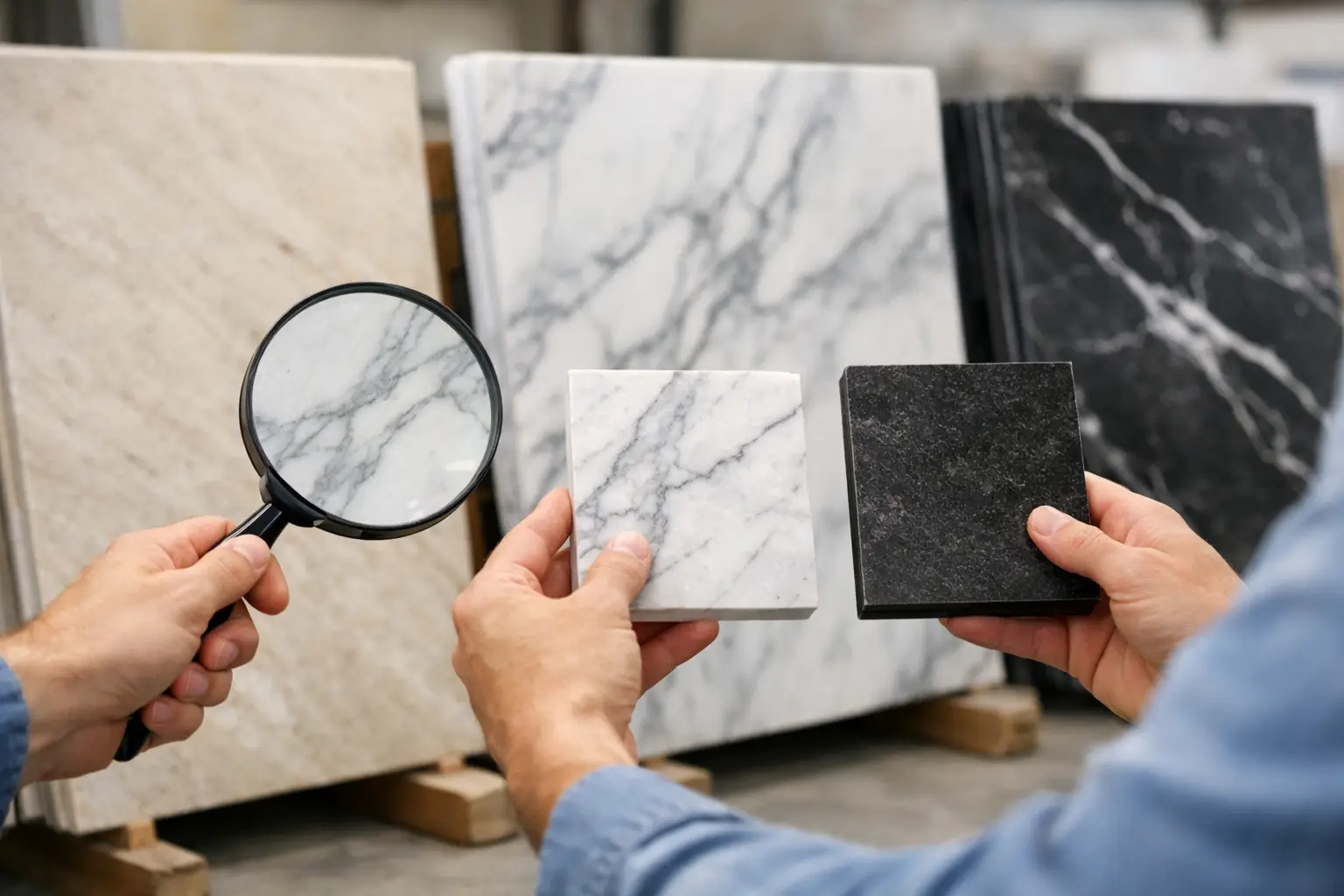
Quick Answer: When comparing stone slabs, look at the full slab rather than relying on a small sample. Compare the material, overall colour, pattern direction, slab dimensions, thickness, natural characteristics, maintenance requirements, seam possibilities, fabrication layout, and total installed cost.
If your project requires more than one natural stone slab, also ask whether the slabs are from the same bundle or are sequential. This can make a major difference when matching colour and vein movement across a large kitchen or island.
Before comparing colours and patterns, narrow down the type of stone or surface that fits your priorities. Every material has trade-offs, especially around maintenance, heat resistance, movement in the pattern, and cost. If you are still deciding between materials, our guide to choosing kitchen countertops can help narrow the options first.
Quartz is consistent, nonporous, and straightforward to clean. It works well for busy kitchens, bathroom vanities, laundry rooms, and bars. However, it should not be treated like a hot landing pad for cookware. Use trivets, particularly near a cooktop or on an island where pans are regularly set down.
Granite offers natural variation, strong heat resistance, and a surface that feels distinctly natural. It needs periodic sealing, although the frequency depends on the specific stone and finish.
Quartzite is often chosen for its dramatic movement and durability, but it is a natural stone, so it also benefits from sealing and a realistic conversation about maintenance. If you are deciding between these two natural stones, see our comparison of quartzite vs granite durability.
Marble has a softer look and a softer surface. It can etch from acidic foods and drinks, which shows as a dull mark rather than a stain. That character can be appealing in a lower-use bathroom, fireplace surround, or a kitchen where the homeowner accepts a lived-in finish. It is less practical for someone who wants a perfectly uniform surface after years of heavy cooking.
Porcelain and sintered stone are thin, dense surfaces with strong resistance to heat, staining, and UV exposure. They can be excellent for shower walls, fireplace surrounds, outdoor BBQ counters, and contemporary kitchens. Their fabrication requires care because the material is thinner and exposed edges require precise cutting and finishing.
Once you know which materials suit the project, compare actual slabs from the same material category. Natural slabs can vary significantly. Even engineered materials can have some variation between production batches.
Always view the whole slab when possible. A sample may show one attractive section, while the full slab may have more movement, darker areas, fissures, crystals, or colour shifts. None of these are automatically defects. In natural stone, they are part of what makes each slab individual. The question is whether you want those features in your room.
Stand back several feet, then move closer. From a distance, look at the overall colour balance and pattern direction. Up close, check for areas that may affect your expectations, such as natural pits, filled fissures, mineral deposits, or changes in polish.
Ask whether a visible line is a natural fissure, a vein, or a repaired area. An experienced fabricator should be able to explain what you are seeing and how it may appear once the countertop is installed.
Bring cabinet doors, paint swatches, backsplash samples, and flooring samples if you have them. A warm white cabinet can make a cool grey slab look blue, while a bright white backsplash can make an ivory countertop appear more yellow than expected.
Compare materials under natural daylight and interior lighting. Kitchen lighting, especially warm under-cabinet lights, can change how a white, grey, or beige surface reads.
A bold vein may look balanced on a large island but overwhelming on a short bathroom vanity. Fine, repeated movement is usually easier to carry across several countertop runs. Large, directional veins require more planning and may need additional material to keep the pattern flowing in the preferred direction.
If your design includes a waterfall island, ask to see how the vein could meet at the corner. A mitered waterfall can create a continuous visual effect when the slab layout allows it. That detail takes more material, precise cutting, and careful fabrication, so it should be included in the planning stage rather than decided after a slab has been selected.
If your kitchen needs two or more slabs of granite, marble, or quartzite, ask whether they are from the same bundle. Ideally, strongly patterned materials should be selected from sequential slabs when available.
Sequential slabs are cut next to one another from the same stone block. Their colour, movement, and veining are generally more closely related, which gives the fabricator more flexibility when planning an island, perimeter, waterfall panels, or full-height backsplash.
This does not mean every vein will connect perfectly. Natural stone is unpredictable by nature. However, choosing related slabs gives the project a better starting point for pattern and colour continuity.
Slab size affects seams, waste, cost, and design options. A typical kitchen may have a perimeter, an island, a backsplash, and perhaps a window ledge or bar top. Even when the total square footage seems to fit within one slab, the shape and direction of each piece may require more material.
A large island is often the deciding factor. If an island is wider or longer than the usable slab dimensions, a seam may be necessary. Some materials and patterns make seams less noticeable than others. A quiet, light quartz often hides a seam better than a dark glossy surface or a slab with dramatic veins that must align.
Ask where seams are likely to go before making a final selection. The goal is not always to eliminate every seam. That is not possible with every layout. Instead, seams should be placed thoughtfully.
A seam should avoid high-visibility areas when practical and should not interrupt a strong feature in the pattern unnecessarily. For a deeper explanation of what affects seam location and appearance, see our kitchen countertop seams guide.
Also consider sink and cooktop cutouts. A large farmhouse sink, an undermount sink, or a wide cooktop changes how the countertop pieces can be nested on the slab. These openings are planned during templating, but discussing them early helps avoid surprises.
The slab thickness alone does not tell the full story. A 2 cm or 3 cm material can be fabricated in different ways depending on the desired look, edge profile, and application. Many homeowners prefer 3 cm countertops for a substantial appearance without a built-up edge.
A thicker-looking profile can also be created with a mitered edge, especially for islands, waterfall panels, and modern designs.
Edge selection affects both style and maintenance. A simple eased edge is clean, practical, and easy to wipe. A beveled or ogee edge creates more detail but can collect crumbs along its profile. For a busy family kitchen, a straightforward edge is often the easiest choice. For a formal bar or vanity, a more decorative edge may be worth the additional fabrication work.
Do not overlook overhangs. A standard seating overhang may be possible without additional support in some applications, while deeper or longer overhangs can require brackets or another support method. The material, thickness, cabinet construction, and layout all matter.
This should be reviewed before fabrication so supports can be planned without interfering with seating or the finished appearance.
Two slabs with similar colours can have very different project costs. Material availability, slab size, thickness, pattern complexity, finish, and the number of slabs needed all affect pricing.
Fabrication details matter too. A simple straight run with one sink cutout is very different from a kitchen with a large island, waterfall ends, full-height backsplash, multiple seams, and several cutouts.
When reviewing an estimate, make sure it accounts for the details that matter to your design:
The least expensive material is not always the lowest-cost decision over time. If you strongly dislike ongoing sealing or worry about etching, choosing a surface that matches your maintenance comfort level can prevent regret later.
On the other hand, a homeowner who values natural variation may find that the character of granite, marble, or quartzite is worth the extra care.
A beautiful slab can lose its impact if the layout is not planned well. Fabrication is where the material becomes a countertop tailored to your room. Before work begins, ask how the template, slab layout, seams, and vein direction will be reviewed.
For patterned slabs, a layout review is particularly valuable. It helps identify where the most attractive area of the stone will sit, how the veins will travel across an island, and which portions will be used for smaller pieces.
It also allows the fabricator to avoid placing a prominent natural feature directly beside a sink cutout or in another visually sensitive location when the slab layout permits.
Precision matters at exposed edges, mitres, sink openings, and seam joints. It also matters where the countertop meets walls that are not perfectly straight, which is common in existing homes.
Accurate templating and careful fabrication help create a closer fit while still allowing for the small clearances needed for proper installation. You can learn more about the process in our guide to countertop fabrication in Ontario.
Before approving a slab, use this checklist to make sure you are comparing more than colour:
The best slab for a polished showroom display may not be the best slab for a busy Ontario kitchen. Think about who uses the space, how often you cook, whether children use the island for homework, and how much maintenance feels reasonable to you.
A quiet quartz may bring calm to a busy room. A strongly veined quartzite may become the visual centre of an island. A honed marble vanity may be exactly right where its patina can be appreciated rather than fought.
If you are choosing between two slabs, do not rush the decision based on a small colour difference. Compare the full slabs, confirm how each will be laid out, and review the practical details that affect the finished result.
A careful selection process gives your fabricator the information needed to create countertops that look intentional from every angle.
Compare the entire slab rather than only a small sample. Look at overall colour, pattern direction, slab dimensions, thickness, natural characteristics, maintenance requirements, possible seam locations, edge options, fabrication requirements, and total installed cost.
For natural stone, using slabs from the same bundle is usually preferable when a project requires multiple slabs. Sequential slabs can provide more similar colour and vein movement, which gives the fabricator more options when planning adjoining countertops, islands, waterfalls, and backsplashes.
Whenever possible, view the full slab before making a final decision. A small sample is useful for checking colour and finish, but it cannot show the complete pattern, large veins, natural characteristics, or how the material will look across a large island.
Natural stone can contain veins, fissures, mineral lines, and repaired areas that may look similar at first glance. Ask the slab supplier or fabricator to explain any feature you are concerned about. The important point is understanding whether it is a normal characteristic of the stone and how it will be handled during fabrication.
Yes. Slab dimensions and usable slab area directly affect how large countertop pieces can be fabricated. Large islands, long countertop runs, directional patterns, sink cutouts, and cooktops can all influence whether a seam is required and where it can be placed.
For strongly patterned granite, marble, quartzite, and other materials with significant movement, reviewing the slab layout before cutting can be very helpful. It allows you and the fabricator to discuss vein direction, focal areas, seams, waterfall pieces, and how prominent features will appear in the finished countertop.
If you are comparing quartz, granite, marble, quartzite, porcelain, or sintered stone for an Ontario countertop project, Stone Valley Countertops can help you review the material from both a design and fabrication perspective.
We can look at slab dimensions, pattern direction, seam possibilities, edge details, cutouts, and the overall layout before fabrication begins. Contact Stone Valley Countertops to discuss your project or arrange the next step.