
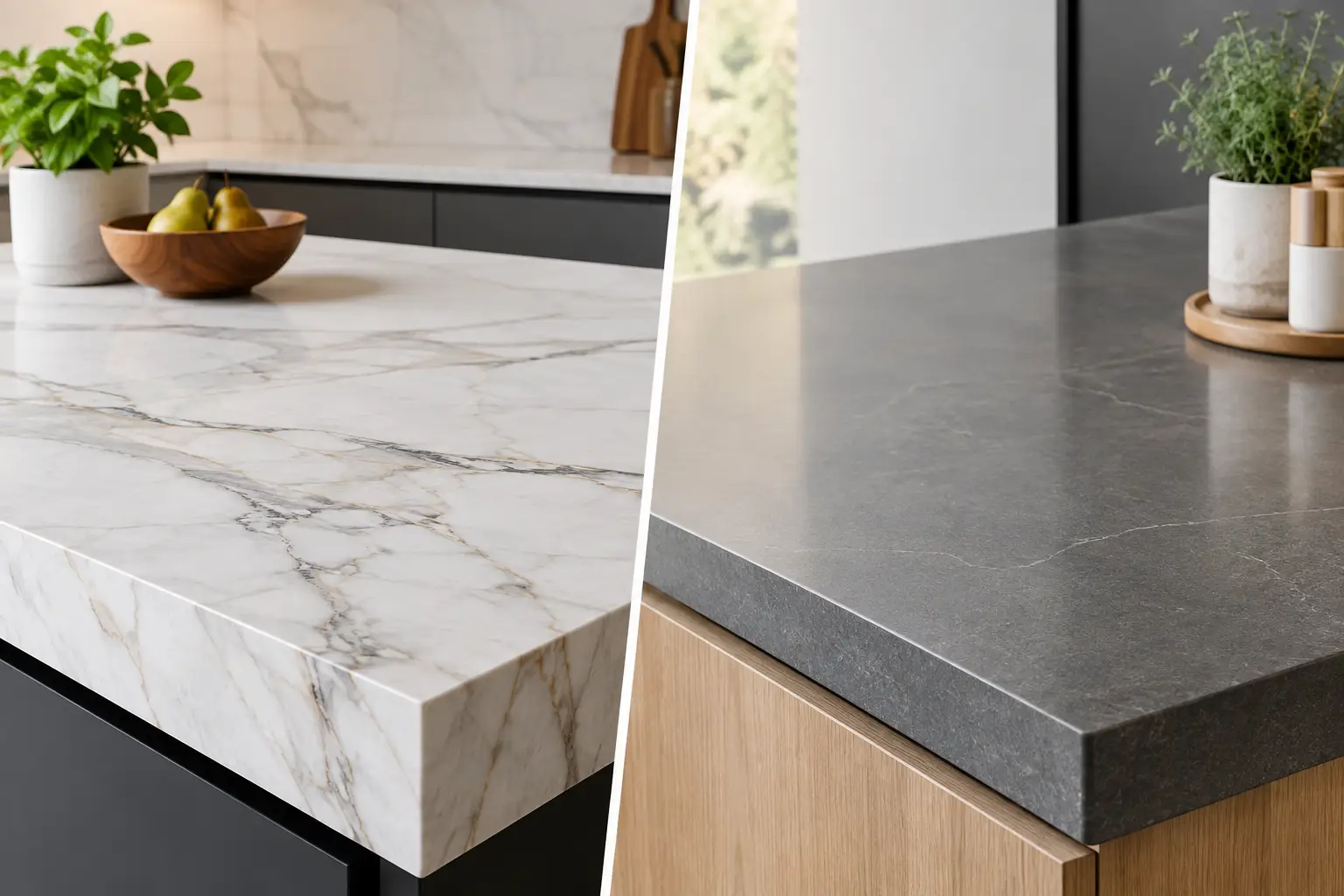
A hot pan beside the cooktop, red wine near the island, a heavy pot set down too quickly. These are the everyday moments that shape a countertop decision. When comparing sintered stone vs porcelain, both materials offer impressive resistance to heat, stains, and moisture. The more useful question is how each slab will perform after fabrication in your specific kitchen, bathroom, or outdoor area.
Both are practical choices for homeowners who want a low-maintenance surface with a modern look. But they are not interchangeable in every project. Slab size, thickness, edge details, cutouts, pattern selection, and the experience of the fabricator can all affect the finished result.
Both sintered stone and porcelain are dense, low-maintenance slab materials with strong resistance to heat, stains, moisture, and UV exposure. Porcelain is primarily made from refined clay and minerals fired at high temperatures, while sintered stone generally uses a blend of natural minerals compacted and heated during manufacturing. For countertops, the best choice often depends less on the category name and more on the specific slab, thickness, design, edge requirements, and fabrication details.
Porcelain slabs are made from refined clay, feldspar, minerals, and pigments. They are pressed and fired at extremely high temperatures, creating a dense, nonporous surface. Large-format porcelain countertops and panels can be used for countertops, backsplashes, shower walls, fireplace surrounds, and outdoor kitchens.
Sintered stone is also made with natural minerals and produced under intense heat and pressure. The manufacturing process creates a dense slab designed for demanding surface applications. Depending on the brand and collection, the exact mineral composition and manufacturing process can vary.
In practice, the line between the two can be less clear than homeowners expect. Both are high-performance manufactured slab materials, and product terminology varies between manufacturers. Instead of relying only on the label, look at the actual slab, its thickness, approved applications, available finishes, warranty, and fabrication requirements.
For everyday countertop use, porcelain and sintered stone are both highly resistant to staining. Their nonporous surfaces generally do not require sealing, which makes routine cleanup straightforward. A soft cloth, warm water, and a suitable mild cleaner are usually enough for daily care.
Heat resistance is another major advantage. Both materials generally tolerate heat very well. Even so, using a trivet is a sensible habit. Sudden temperature changes can place stress on countertop materials, particularly around cooktop openings, cutouts, joints, and unsupported areas.
Scratch resistance is also strong, but neither material should be treated as indestructible. Cutting directly on the countertop can dull knives, and hard or heavy objects can damage an exposed edge if they strike it with enough force.
This distinction is important. The broad surface of a slab may be extremely durable while a thin exposed edge, corner, sink opening, or cooktop cutout is more vulnerable to impact.
Porcelain and many sintered stone products also offer excellent UV stability, making suitable products practical for bright rooms and exterior applications. For an Ontario outdoor kitchen, however, the entire installation needs to be planned for the setting. Cabinet construction, support, drainage, product specifications, and exposure to Ontario freeze-thaw cycles all matter.
These materials are hard and durable, but that does not mean they are simple to fabricate. Large slabs, thin profiles, and detailed cutouts require careful handling from templating through installation.
A porcelain or sintered stone countertop can be made with a thin profile, creating a clean contemporary look. Many homeowners also choose a mitered countertop edge to create the appearance of a thicker slab.
A mitered edge is formed by joining precisely cut pieces so the front of the countertop appears substantially thicker. It can work particularly well on islands and vanities, but accurate cutting and alignment become important when working with light colours or directional veining.
Sink and cooktop openings deserve particular attention because cutting an opening removes material from the slab. The fabrication method, corner radius, appliance clearances, and support all need to follow the requirements of the specific product.
Undermount sinks also need appropriate support rather than relying on the countertop alone to carry the sink’s weight. This becomes increasingly important with large or heavy sinks.
Waterfall islands are possible with both materials, but the design should be discussed before fabrication begins. If the veining or pattern is directional, the slab layout determines how the pattern turns from the horizontal countertop onto the vertical panel.
A well-planned waterfall can make the pattern appear continuous. With heavily veined designs, slab layout should be reviewed before cutting rather than leaving the pattern alignment until installation.
The visual difference often comes down to the individual collection rather than simply choosing porcelain or sintered stone.
Porcelain is available in marble looks, concrete finishes, solid colours, metal-inspired designs, and natural stone patterns. Many slabs use surface decoration, so the face pattern may not continue through the body or along an exposed edge in the same way it does with natural stone.
Sintered stone is available in many of the same design directions, from quiet neutrals to dramatic veining. The appearance of the body, edge, and surface pattern varies significantly by manufacturer and collection, so it is worth examining the actual product rather than assuming all sintered slabs behave or look alike.
A sample is useful for comparing colour and texture, but it should not replace viewing the full slab whenever possible. A small sample cannot show where the veining will land on an island, whether pattern repetition will be noticeable, or how a large surface responds to natural and artificial light.
If you are comparing several slabs, our guide to how to compare countertop slabs covers the details worth checking before making a final selection.
Either material can create a clean, low-grout backsplash that runs from the countertop to the upper cabinets or range hood.
Using the same design for the countertop and backsplash can reduce visual breaks, but slab backsplashes require accurate measurements and careful planning around outlets, switches, windows, cabinets, and range hoods.
Pattern placement matters too. A dramatic vein that looks excellent on an island may need to be positioned differently when it continues vertically up a backsplash.
It is difficult to say that sintered stone is always more expensive than porcelain, or the reverse. Pricing changes based on the manufacturer, collection, slab size, thickness, finish, availability, and complexity of the project.
Fabrication also has a meaningful effect on the final cost. Straight runs with simpler edge details and a single sink opening are generally less involved than a kitchen with mitered edges, waterfall panels, full-height backsplash, multiple seams, drain grooves, or several appliance cutouts.
Large-format slabs can also require additional planning for transportation and access into the home. Stairs, elevators, narrow doorways, finished cabinetry, and the size of individual countertop pieces can affect how an installation needs to be approached.
When comparing countertop quotes, make sure each one reflects the same scope. One estimate may include a standard edge while another includes a mitered buildup. Seam locations, backsplash work, cutouts, installation, and material thickness may also differ.
For most homeowners, there is no universal winner in the sintered stone vs porcelain comparison. Start with the application and the specific slab rather than choosing based only on the category name.
For a busy kitchen, both can be practical options when strong heat, stain, moisture, and UV resistance are priorities. For a bathroom vanity or shower wall, large-format panels can reduce grout lines and simplify everyday maintenance.
For a fireplace surround or outdoor counter, suitable porcelain and sintered stone products can offer useful heat and UV performance, but the manufacturer’s approved applications should always be confirmed. Not every thickness, finish, or collection is designed for every use.
Your design priorities should guide the final selection as well. If you want a particular marble look, compare full slabs and inspect the edge appearance. If you want a substantial-looking island, discuss whether a mitered edge makes sense. If your kitchen has long countertop runs, ask where seams will be located and how the pattern will align.
At Stone Valley Countertops, these details are considered before fabrication begins. Accurate templating, realistic seam planning, slab layout, and precise fabrication help ensure the material works around the sink, cooktop, backsplash, and island rather than simply looking good as a showroom sample.
The best choice is usually the specific slab that fits your daily use and project details. Bring your cabinet layout, appliance specifications, sink information, and design preferences when selecting material. Those details make it much easier to determine whether a particular porcelain or sintered stone product is suitable for the project.
No. They are related high-performance manufactured surfaces, but their raw materials and manufacturing processes can differ. Product terminology also varies between manufacturers, so homeowners should compare the specifications of the individual slab rather than relying only on the category name.
Both can perform very well in a kitchen. The better fit depends on the specific product, thickness, available slab sizes, desired edge treatment, pattern, cutouts, and fabrication requirements.
These surfaces are generally nonporous and typically do not require the periodic sealing associated with materials such as granite or marble. Always follow the care instructions provided by the manufacturer of the specific product.
Both materials offer strong heat resistance, but using trivets is still recommended. Protecting the surface from extreme or sudden temperature changes is a simple precaution, particularly near cutouts, edges, and joints.
Many products are suitable for exterior applications because of their low water absorption and UV resistance. The specific product must be approved for exterior use, and the installation should account for proper support, drainage, weather exposure, and Ontario’s freeze-thaw conditions.
Yes, depending on the slab and manufacturer’s fabrication requirements. The sink opening needs to be fabricated correctly, and the sink should have appropriate mechanical support rather than relying solely on adhesive or the countertop to carry its weight.