
A vanity top has to do more than look good beside a new faucet. It needs to fit the cabinet precisely, handle water and everyday products, work with the sink, and suit the way your household uses the bathroom. Knowing how to choose vanity top materials and details before ordering helps prevent expensive surprises once fabrication begins.
A small guest bathroom may need a simple, easy-care surface with a clean sink cutout. A busy family bathroom may need stronger stain resistance, more room for daily products, and a layout that keeps water from collecting around the faucet. Start with function, then narrow down the design choices.
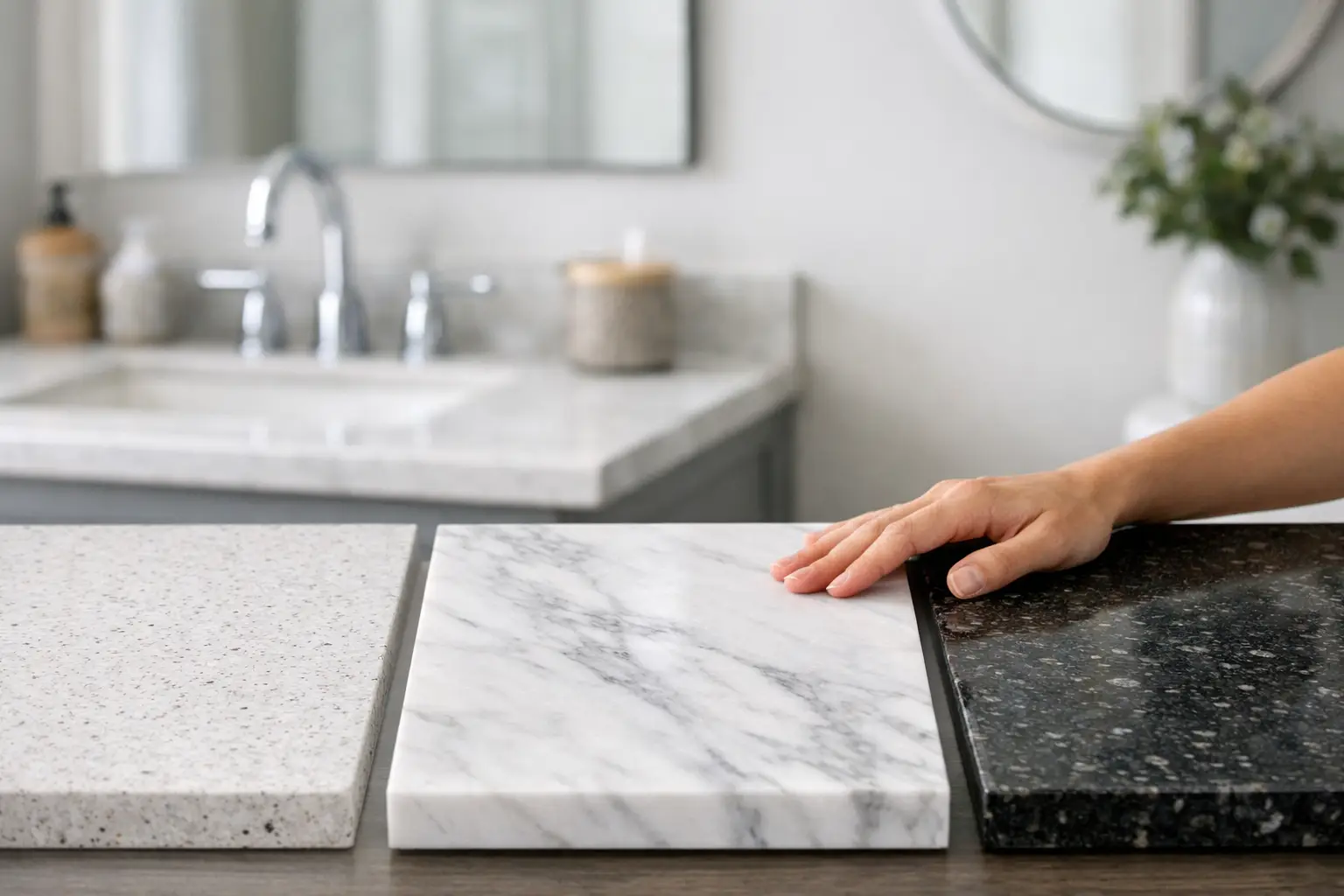
Start with the vanity cabinet size, then choose a material based on maintenance, moisture resistance, appearance, and budget. Quartz is one of the easiest materials to maintain, while granite, marble, and quartzite offer natural variation. Choose the sink and faucet before templating, confirm the backsplash and edge profile, and have the finished cabinet professionally measured before fabrication.
The right material depends on your tolerance for maintenance, the bathroom’s traffic, and the look you want to achieve. Unlike a kitchen countertop, a vanity top usually sees less heat and food staining. It does, however, deal with standing water, soap, toothpaste, cosmetics, hair products, and cleaning products on a regular basis.
Quartz is often a practical choice for bathroom vanities because it is nonporous and does not require sealing. It resists common bathroom stains well and has a consistent surface that is easy to wipe clean with mild soap, water, and a soft cloth.
It is available in everything from quiet whites and soft concrete looks to detailed marble-inspired patterns. That consistency is especially useful when coordinating more than one vanity or matching a separate backsplash piece.
Quartz can still be damaged by harsh chemicals or abrasive pads, so gentle cleaning matters. For most households, though, it is one of the lower-maintenance vanity-top options.
Granite brings genuine movement and mineral variation that cannot be repeated exactly. It is durable and performs well in bathrooms when properly sealed.
Natural stone requires a little more care than quartz. Sealer should be maintained when needed, and cosmetics, oils, or coloured liquids should not be left sitting on the surface for long periods.
For homeowners who prefer a one-of-a-kind slab rather than a uniform pattern, that trade-off can be worthwhile. You can also read our guide on when granite countertops need sealing.
Marble has distinctive veining and a softer appearance that works particularly well in certain bathroom designs. Its main limitation is etching. Products containing acids, including some cosmetics and cleaning products, can leave dull areas on polished marble.
Marble can also stain if spills are ignored. It suits homeowners who understand that the surface may develop character over time rather than remain completely unchanged.
Quartzite is often selected for dramatic natural movement and greater hardness than marble. It is still natural stone and different slabs can have different absorption levels. The specific slab should be assessed so sealing and maintenance expectations are clear before fabrication.
Porcelain, Dekton, and other sintered surfaces can provide a crisp, modern appearance, particularly when a thinner-looking vanity design is preferred. These materials offer strong resistance to moisture and common staining.
Fabrication requires careful handling and precision around sink cutouts, faucet holes, narrow front rails, mitred edges, and exposed ends.
They can be an excellent fit when you want a large-format pattern or clean profile, but the edge treatment and cabinet support should be discussed before the material is finalized.
The vanity cabinet determines the starting dimensions, but the finished top is normally slightly larger than the cabinet itself. A modest front and side overhang creates a finished appearance and helps keep water away from the cabinet face.
The exact overhang depends on the cabinet style, bathroom layout, and whether the vanity is installed against one wall, between two walls, or left exposed on one side.
Do not assume the surrounding walls are perfectly straight or square. Professional templating captures the actual conditions after the vanity cabinet has been installed, levelled, and secured.
This matters especially in older Ontario homes, where walls may vary noticeably across even a relatively short vanity.
Think about depth as carefully as width. A standard-depth vanity provides useful counter space, while a shallow bathroom may benefit from a reduced-depth vanity and top to improve walking clearance.
For a double vanity, leave enough usable countertop on both sides of each sink instead of simply fitting the largest two basins possible into the available width.
The sink style affects usable counter space, cleaning, faucet placement, and the required stone cutout. It should be selected before templating whenever possible.
Undermount sinks are common with stone vanity tops because the countertop runs cleanly to the bowl. There is no rim sitting on top of the stone to collect residue, and water can be wiped directly toward the sink.
The sink is mounted below the stone, so the cutout, support, and reveal around the opening all require accurate fabrication.
A top-mount or drop-in sink has a visible rim that rests on the countertop. It can suit certain bathroom designs and may cover more of the cutout edge, but it also occupies additional surface area.
Vessel sinks create a stronger visual focal point, but faucet height and finished vanity height become more important. A bowl that sits on top of the counter can make the overall sink height uncomfortable if the cabinet and countertop were not planned around it.
Confirm the faucet layout at the same time. Widespread, centreset, wall-mounted, and single-hole faucets all require different clearances.
If the faucet is mounted through the countertop, there must be enough space behind the sink for the faucet body and handles without crowding the backsplash or wall.
A short stone backsplash is practical behind a bathroom vanity because it protects the wall from splashes and makes everyday cleaning easier.
It can be fabricated from the same material as the vanity top for continuity, or you may choose tile or a painted wall above the counter instead.
A low backsplash keeps the vanity top as the main feature. A full-height stone backsplash creates a more continuous surface and can make strong use of a slab with expressive veining.
If you choose heavily patterned natural stone or marble-look quartz, ask how the veins will travel between the vanity top and backsplash. Slab layout planning makes a noticeable difference once the pieces are installed.
If you are comparing backsplash heights, our countertop backsplash height guide explains the practical differences between common options.
Countertop thickness changes the visual weight of a vanity. A 2 cm or 3 cm countertop can create a noticeably different appearance depending on the cabinet style and material.
A thicker profile tends to feel more substantial and works well with traditional or transitional cabinetry. A thinner profile can feel cleaner and more contemporary.
Some designs use a mitred or built-up edge so the visible front appears thicker while the main slab remains its normal thickness.
For most bathroom vanities, a simple eased edge is practical. Its lightly softened corners are comfortable to use and easy to clean.
A bevel adds more definition, while decorative profiles can complement traditional cabinetry. More detailed edges may collect additional residue around their contours, so consider how much everyday cleaning you want.
You can compare common profiles in our countertop edge profile guide.
A waterfall edge, where the stone continues down one or both sides of the vanity, can work especially well on a floating vanity or feature-piece bathroom.
It requires careful vein or pattern alignment and additional fabrication. It is most effective when the side of the vanity remains visible rather than being tightly installed between walls.
Most single bathroom vanities can be fabricated without a seam. Longer double vanities, unusual layouts, or slabs with limited usable dimensions may require one.
If a seam is necessary, its position should be planned around sink openings, slab movement, structural considerations, and the least noticeable viewing angle.
Sink cutouts require similar planning. The narrow stone sections in front of and behind a sink need enough material to remain suitable for fabrication, transport, and installation.
Very large sink openings, closely spaced double sinks, or multiple faucet holes can reduce the amount of stone left around those areas. These details should be reviewed before production rather than discovered during installation.
Also consider what will actually live on the vanity. Electric toothbrushes, soap dispensers, skincare products, hair tools, and trays all require usable landing space. In everyday use, that extra surface area can matter more than gaining another inch or two of sink width.
Vanity-top pricing is influenced by material, slab selection, dimensions, thickness, edge profile, sink and faucet cutouts, backsplash pieces, and installation conditions.
A simple quartz vanity top with an eased edge and one undermount sink is generally more straightforward to fabricate than a large natural-stone double vanity with waterfall ends, a full-height backsplash, and detailed vein matching.
If you need to prioritize your budget, focus first on:
Those decisions affect daily use and long-term appearance more than an elaborate edge profile.
A bathroom vanity may be smaller than a kitchen countertop, but the fabrication still requires precision. Sink openings, faucet holes, backsplash pieces, wall conditions, and exposed edges all need to line up accurately.
At Stone Valley Countertops, vanity projects are reviewed through material selection, templating, fabrication, and installation so details such as sink specifications, overhangs, backsplash dimensions, and slab layout are confirmed before production.
The best vanity top is rarely the one with the most dramatic sample in the showroom. It is the one that fits the room properly, makes daily use easier, and still feels like the right choice after years of ordinary use.
Quartz is one of the most practical choices for many bathrooms because it is nonporous, does not require sealing, and is easy to maintain. Granite, marble, quartzite, porcelain, and sintered stone are also good options depending on the desired appearance, maintenance expectations, and fabrication requirements.
Quartz requires less routine maintenance because it does not need sealing and has a consistent pattern. Granite provides natural variation and a one-of-a-kind appearance but may require periodic sealing. Both can perform well in bathrooms when properly fabricated and maintained.
Yes. The sink model should ideally be confirmed before templating because its dimensions affect the cutout, faucet position, available counter space, and the amount of stone surrounding the opening.
The exact overhang depends on the cabinet and room layout. A modest front and side overhang is common, but the final dimensions should be confirmed during templating rather than assumed from cabinet measurements alone.
A backsplash is not always required, but it is useful for protecting the wall from water and simplifying cleaning. Common options include a short matching stone backsplash, tile, or a full-height stone backsplash.
Many single vanities can be fabricated as one piece. Longer double vanities or unusual layouts may require a seam depending on slab dimensions, sink locations, transportation, and installation access.
If you already have your vanity cabinet, sink, or material ideas selected, Stone Valley Countertops can help review the dimensions, material options, edge details, backsplash, and fabrication requirements before the project moves forward.
Contact Stone Valley Countertops to discuss your bathroom vanity project or request a quote.