
Quartz Countertops Cost in Ontario: 2026 Price Guide for Homeowners
Quartz countertops cost in Ontario varies depending on the material brand, fabrication quality, layout complexity, and installation details. However, most homeowners want more than a rough number. They want to know what they are really paying for, what changes the final quote, and whether quartz is still worth it compared with granite and other surfaces. That is exactly what this guide explains.
Quick answer: In Ontario, quartz countertops are often priced by the square foot, and the final installed cost usually depends on the slab style, thickness, cutouts, edge profile, backsplash choice, and the skill of the fabricator and installer. Therefore, two kitchens with the same size can still end up with very different prices.
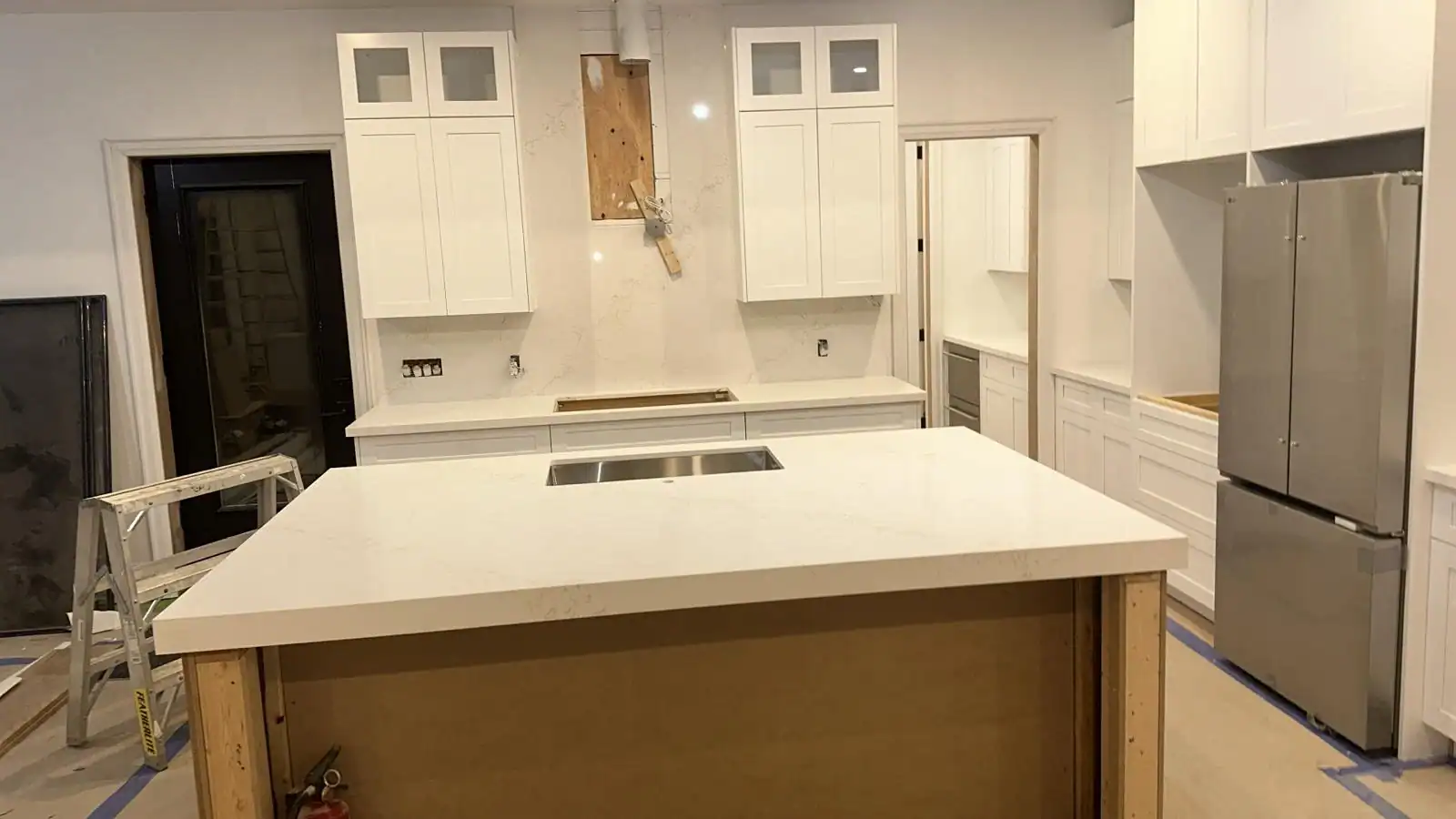
The kitchen above features premium quartz countertops installed in an Ontario home. Because quartz is durable, low maintenance, and available in many colours and patterns, it remains one of the top choices for kitchen renovations, vanity tops, laundry rooms, bars, and fireplace surrounds. In addition, quartz works well for homeowners who want a clean, consistent look without the ongoing sealing that natural stone may require.
In this article, we will break down quartz countertop price per square foot in Ontario, explain what affects the total cost, compare quartz vs granite pricing, and help you understand how to shop smarter before requesting a quote. We will also answer the exact questions people ask Google and AI tools every day.
How Much Do Quartz Countertops Cost in Ontario?
For most Ontario projects, quartz countertop pricing is usually discussed in price per square foot. Yet the truth is simple: the cost can move up or down quickly based on the slab selected and the work required to fabricate and install it properly. As a result, homeowners should look at quartz pricing as a range, not as one flat number.
Typical quartz countertop price ranges in Ontario
- Entry-level quartz: often suitable for simpler kitchens and more budget-focused renovations.
- Mid-range quartz: a popular choice for many Ontario homes because it balances appearance, durability, and value.
- Premium quartz: usually includes designer colours, stronger marble-look veining, luxury finishes, and more complex fabrication requirements.
When homeowners ask, “What is the price per square foot for quartz countertops?” the practical answer is this: the installed price often includes much more than the slab itself. It may include measuring, templating, fabrication, sink cutouts, polishing, installation, seam planning, and finishing work. Therefore, a lower material number does not always mean a lower final job cost.
| Quartz Project Type | What Usually Affects Price | Typical Notes |
|---|---|---|
| Small vanity top | Minimum job charge, sink cutout, edge finish | Even a small top can cost more per square foot because setup and travel still apply. |
| Standard kitchen | Square footage, sink cutout, faucet holes, seams, backsplash | This is where most homeowners compare quartz countertop cost most closely. |
| Large island | Slab usage, waterfall sides, overhang support, seam strategy | Big islands can increase waste and require advanced handling. |
| Luxury kitchen | Premium slab, full-height backsplash, mitered edges, matching patterns | Designer features can raise labour and fabrication time significantly. |
So, how much do quartz countertops cost in Ontario? In simple terms, a small straightforward job may stay closer to the lower end, while a custom kitchen with a waterfall island, book-matched style veining, full-height backsplash, and premium brand slab will land much higher. Because of that, the best quote is always based on the actual layout, not only on square footage.
What Affects Quartz Countertop Prices?
There is no single reason why one quartz kitchen costs more than another. Instead, several pricing factors work together. Once homeowners understand them, quotes become much easier to compare.
1. Brand and slab design
First, the brand matters. Well-known names such as Caesarstone Quartz and Cambria Quartz are often chosen for premium collections, refined finishes, and strong design consistency. In many cases, quiet solid colours cost less than dramatic marble-look patterns with bold veining. Therefore, appearance alone can shift the final number.
2. Thickness and edge profile
Next, thickness affects cost. Standard polished tops are usually more straightforward than thick-looking mitered edges. If a homeowner wants a luxury apron, a chunky profile, or a 4-inch mitered waterfall appearance, extra labour is required. Consequently, fabrication time rises and so does the quote.
3. Layout complexity
Straight runs are easier. Corners, angles, long spans, window notches, cooktop cutouts, and oversized islands require more planning and handling. In addition, large pieces may need special transport and more installers on site. Therefore, complexity is one of the biggest hidden pricing factors.
4. Sink cutouts and accessories
Undermount sink cutouts, faucet holes, soap dispenser holes, cooktop cutouts, and drain grooves all add work. Although they may look like small details, they require precision. Because quartz is engineered and dense, clean finishing matters. A poor cutout can ruin the visual result and the long-term performance.
5. Backsplash choice
A simple 4-inch backsplash usually costs less than a full-height quartz backsplash. Yet many homeowners still choose full-height because it looks more modern and gives the kitchen a stronger luxury feel. As a result, backsplash style should always be discussed early in the quote process.
6. Overhangs and support requirements
Island seating areas often need support depending on the overhang depth and slab thickness. Therefore, homeowners should review support requirements before fabrication begins. You can learn more in our Countertop Overhang Guide. This step is important because proper support protects the quartz and helps avoid future stress on unsupported areas.
7. Fabrication and installation quality
Finally, not all quotes represent the same workmanship. Precision measuring, seam placement, edge polishing, and careful installation all matter. In fact, a cheaper quote can become expensive later if seams are poor, overhangs are unsupported, or the slab is not installed correctly. For that reason, homeowners should always compare value, not just price.
What Is the Price Per Square Foot for Quartz Countertops?
Many people search for “quartz countertop price per square foot in Ontario” because they want a fast way to budget. That is understandable. Still, square-foot pricing should be treated as a planning tool, not as the final invoice. A 40-square-foot kitchen and another 40-square-foot kitchen can price very differently when one includes a waterfall panel, a premium slab, and multiple cutouts.
As a budgeting approach, homeowners should think in three levels: budget-friendly quartz for clean everyday projects, mid-range quartz for strong resale-friendly kitchens, and premium quartz for luxury design-focused spaces. Moreover, if the slab chosen has strong movement or veining, extra care may be needed to keep the design visually balanced across seams and backsplashes.
If you are still early in the planning stage, our Quartz Countertops page is a good place to explore the material further and understand how quartz performs in real homes.
Are Quartz Countertops Worth the Cost?
Yes, for many homeowners, quartz countertops are worth the cost. They offer a strong mix of durability, style, and low maintenance. Because quartz is non-porous, it does not need routine sealing like some natural stones. In busy family kitchens, that convenience matters. Likewise, quartz is available in a wide variety of looks, from clean modern whites to warm marble-inspired patterns.
In addition, quartz often delivers strong everyday value. It resists stains better than many people expect, it is easy to clean, and it suits both contemporary and classic kitchen designs. Therefore, homeowners who want a premium appearance with less upkeep often see quartz as a smart long-term investment.
Why many Ontario homeowners choose quartz
- It offers a clean, consistent look across kitchens, bathrooms, bars, and laundry rooms.
- It is easy to maintain, which makes daily cleaning simpler.
- It pairs well with modern cabinetry, warm wood tones, and luxury backsplashes.
- It works well for resale-focused renovations because buyers recognize the material.
- It gives homeowners access to marble-look designs without the same maintenance routine.
Of course, quartz is not the cheapest countertop category on the market. However, homeowners are not only paying for the slab. They are paying for the finished surface, the fabrication, the fit, the edge work, and the installation quality. When viewed that way, quartz often makes sense for people who want fewer maintenance worries and a polished finished result.
Is Quartz Cheaper Than Granite?
This is one of the most common questions online, and the honest answer is: sometimes yes, sometimes no. Basic granite colours can come in lower than premium quartz. On the other hand, many mid-range quartz options are very competitive, and some exotic granite colours can cost much more. Therefore, quartz is not automatically cheaper or more expensive than granite every time.
The better comparison is value. Granite offers natural variation and one-of-a-kind movement. Quartz offers consistency, easier maintenance, and a broad range of engineered designs. As a result, the best option depends on what matters most to the homeowner. If you want a predictable look and less upkeep, quartz can be the better fit. If you want natural stone character above all else, granite may be the right direction.
Also, brand choice changes the comparison. Entry-level quartz may compete closely with many granite options, while designer quartz collections may land higher. Because of that, homeowners should compare actual slab selections, not only general material labels.
How Homeowners Can Save Money Without Making a Bad Choice
Saving money on quartz does not mean choosing the cheapest quote. Instead, it means making smarter decisions early. First, choose a slab that fits your renovation goals. A clean, timeless quartz can still look high-end without pushing the project into the premium tier. Second, keep the layout practical. Straightforward edges and standard backsplashes usually cost less than heavy custom details.
Third, finalize sink and appliance choices before templating. Changes after fabrication can become expensive. Fourth, ask how seams will be placed and what is included in the quote. Finally, work with an experienced fabricator who can explain where the cost comes from. That way, you are buying clarity and craftsmanship, not confusion.
Final Thoughts on Quartz Countertops Cost in Ontario
Quartz countertops remain one of the best all-around surfaces for Ontario homes. They look premium, perform well, and fit many renovation styles. Even so, the final cost depends on more than slab size. Brand, colour, thickness, edge profile, cutouts, backsplash selection, overhang support, and installation quality all influence the quote.
If you are planning a kitchen renovation, the smartest move is to compare both design and workmanship. In other words, look at what is included, how the layout will be fabricated, and whether the installer understands the details that protect the surface long term. When that is done properly, quartz becomes a beautiful and practical investment.
FAQ: Quartz Countertops Cost in Ontario
How much do quartz countertops cost in Ontario?
Quartz countertops in Ontario are usually priced within a broad installed range that depends on the slab, fabrication work, and installation complexity. A simple project will cost less than a custom kitchen with premium quartz, waterfall ends, full-height backsplash, and multiple cutouts.
What affects quartz countertop prices?
The main factors are brand, slab design, thickness, edge profile, backsplash type, sink and cooktop cutouts, layout complexity, seam planning, island size, overhang support, and installation quality.
Are quartz countertops worth the cost?
Yes, many homeowners believe quartz is worth the cost because it is durable, low maintenance, stylish, and available in many colours and marble-look patterns. It also suits both everyday family kitchens and luxury renovations.
Is quartz cheaper than granite?
Sometimes. Basic granite can be less expensive than premium quartz, while many mid-range quartz options are very competitive. The right comparison depends on the specific slab selected and the project details.
What is the price per square foot for quartz countertops?
Quartz is commonly quoted by the square foot, but the final installed amount depends on more than surface area. Homeowners should use per-square-foot pricing as a planning guide while remembering that cutouts, edge work, backsplashes, and installation details will affect the final quote.
Pricing ranges can move based on supplier costs, slab availability, project scope, edge details, backsplash choices, and installation conditions. Therefore, the best way to price a quartz project accurately is through a real layout-based quote.
