
Best Materials for Laundry Countertops at Home
A laundry countertop works harder than its small footprint suggests. It may hold wet clothing, detergent bottles, a laundry basket, a utility sink, and the occasional hot appliance. The best materials for laundry countertops are the ones that suit how you use the room, not simply the material that looks best in a sample.
For most homeowners, the decision comes down to moisture resistance, cleaning habits, the need for a sink cutout, and the look of nearby cabinetry or flooring. A countertop in a closed laundry room also has different demands than one in a mudroom, basement utility area, or combined laundry-bathroom space.
Quick Answer: Quartz is often the best all-around material for laundry countertops because it is nonporous, easy to maintain, and available in many colours and patterns. Granite is a durable natural stone alternative, while porcelain and sintered stone offer excellent moisture resistance and contemporary designs. Quartzite and marble can also work, but their maintenance requirements and sensitivity to certain laundry products deserve consideration.
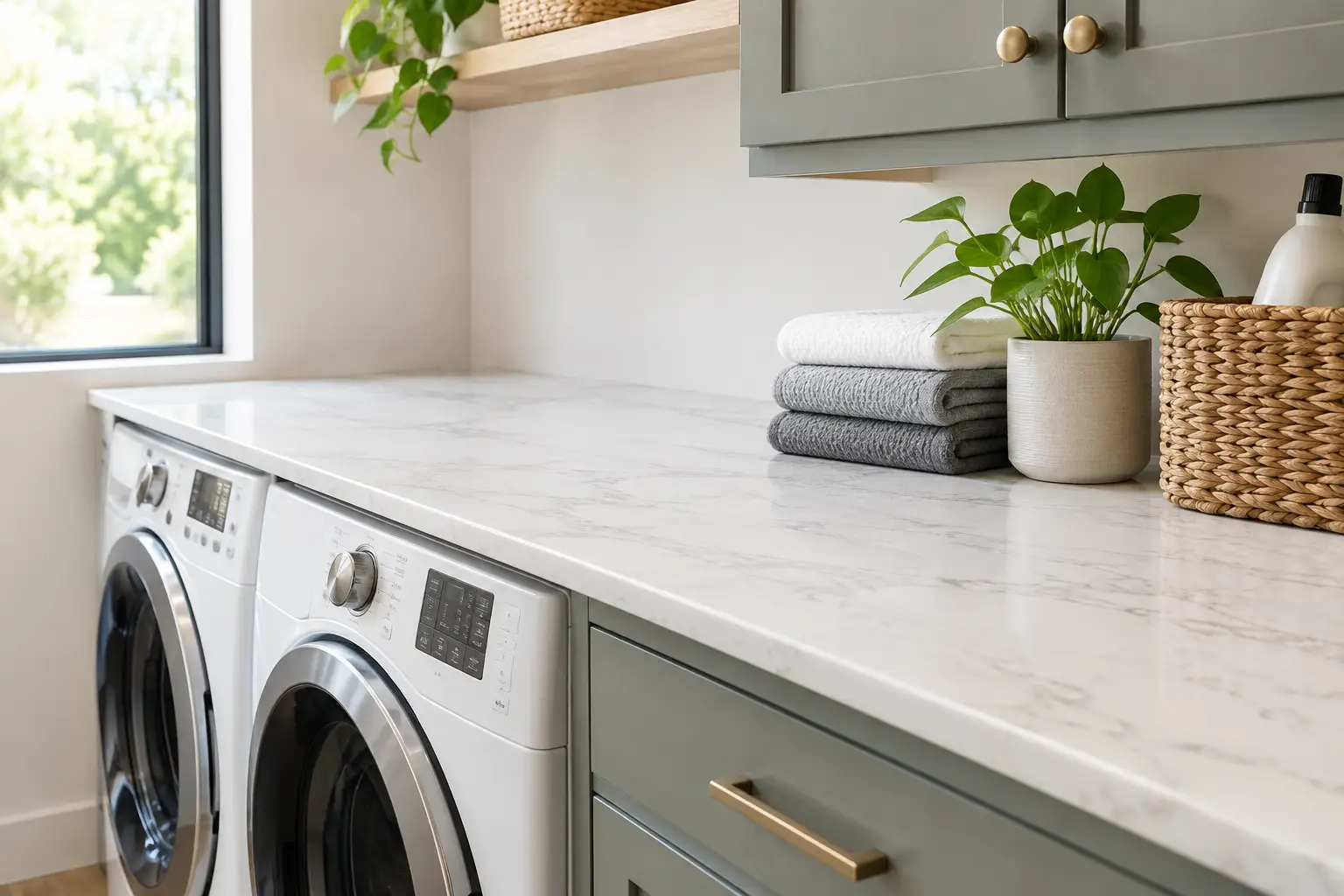
Best Materials for Laundry Countertops Compared
Quartz, granite, porcelain, sintered stone, quartzite, and marble can all be used for laundry countertops. Their differences become more important when the room includes a utility sink, frequent detergent spills, or appliances that generate heat.
| Material | Moisture Resistance | Maintenance | Best Suited For |
|---|---|---|---|
| Quartz | Excellent | Low; no sealing required | Everyday family laundry rooms |
| Granite | Good to excellent, depending on the stone | Stone-specific sealing and cleaning | Busy laundry rooms with natural stone finishes |
| Porcelain | Excellent | Low; careful edge protection | Modern laundry rooms and wall cladding |
| Sintered Stone | Excellent | Low; product-specific care | Slim profiles and contemporary designs |
| Quartzite | Varies by slab | Stone-specific sealing and care | Decorative laundry rooms with natural veining |
| Marble | Variable; sensitive to staining and etching | Higher maintenance | Lightly used decorative laundry spaces |
These comparisons describe typical characteristics. Performance varies by manufacturer, slab, finish, and the chemicals used in the room. No countertop material should be assumed resistant to every laundry detergent, bleach, solvent, or stain remover.
Quartz for a Clean, Consistent Look
Quartz countertops are often a sensible fit for laundry rooms because they are nonporous and easy to wipe down after routine spills. They are available in a wide range of colours and patterns, from quiet solid tones to designs that resemble marble or concrete.
That consistency can be especially useful in a compact room where you want the countertop, cabinet colour, and wall tile to feel coordinated.
Quartz is well suited to folding counters and areas around an undermount or drop-in utility sink. It does not require sealing in the way many natural stones do.
Still, quartz should not be treated as damage-proof. Strong chemicals, including certain concentrated cleaners, can affect the surface or finish if left sitting. Follow the manufacturer’s care guidance, and wipe up bleach, detergent, and stain remover spills rather than allowing them to dry on the counter.
Heat deserves attention as well. A hot clothing iron, curling iron, or appliance part should not be placed directly on quartz. A heat-resistant pad is a simple precaution in a laundry room.
Granite for Natural Variation and Everyday Durability
Granite countertops bring genuine natural movement to a laundry room. Every slab varies, so homeowners who choose granite should view the full slab before fabrication whenever possible.
A small sample cannot show the full range of mineral patterns, background colours, or veining that may appear across a longer counter.
Granite generally handles ordinary laundry room use well, but it is a natural stone and its porosity varies by material. Sealing requirements depend on the particular granite and the sealer used.
Sealing helps reduce the absorption of certain liquids, but it does not make granite stain-proof or resistant to every cleaning chemical. Bleach and harsh cleaners should still be wiped away promptly.
A darker or more patterned granite can be forgiving in a busy mudroom-laundry combination, where lint, water marks, and everyday use are part of the routine.
Porcelain and Sintered Stone for Slim, Contemporary Designs
Porcelain countertops and sintered stone are worth considering when you want a more architectural look, a thin profile, or a countertop that continues up the wall as a full-height backsplash.
These surfaces are manufactured in large-format panels and can offer stone, concrete, metal, or uniform-colour visuals.
They are highly resistant to everyday moisture and generally straightforward to clean. Their performance and fabrication requirements, however, are not identical from one product to another.
Thickness, finish, edge treatment, sink cutout details, and the manufacturer’s approved fabrication methods all matter. This is particularly relevant with a utility sink, where cutout geometry and proper support help protect the material during use.
Porcelain and sintered stone can create crisp, minimal-looking laundry counters, but their edges need careful fabrication. A thicker-looking edge may require a mitred build-up, which introduces a joint at the edge.
Although these materials generally offer strong heat resistance, hot appliances should still be used according to the surface manufacturer’s recommendations.
Quartzite When You Want Natural Stone With More Movement
Quartzite is a natural stone that can offer dramatic veining and depth that manufactured materials do not fully replicate.
It is often considered by homeowners carrying the same stone from a kitchen, bar, or bathroom into the laundry room.
The trade-off is that quartzite varies substantially by slab. Some materials are denser and less absorbent than others, and different slabs can have natural fissures, colour variation, or movement that is part of the stone’s character.
Sealing and care needs should be discussed for the specific material selected. For more information, see our quartzite countertop cleaning and maintenance guide.
If the laundry room is mainly a utility space, quartzite may be more material than the room needs. If it is visible from the main living area or part of a coordinated renovation, it can be a compelling choice.
Marble for a Low-Traffic Decorative Laundry Room
Marble countertops have a distinct appearance, but they require realistic expectations.
Marble can etch when acidic products contact the surface, and it may stain or show wear more readily than quartz, granite, porcelain, or sintered stone.
Laundry products are not always gentle, especially when they include brighteners, bleach, or spot-treatment chemicals. Some chemicals can damage marble’s finish even when the stone has been sealed.
Marble can work in a lightly used laundry area where appearance is the priority and the homeowner understands its maintenance needs. It is usually less practical beside an active utility sink or a folding station used daily by a busy household.
Which Laundry Countertop Handles Water and Cleaning Products Best?
Moisture resistance is one of the most important considerations in a laundry room, particularly around utility sinks and areas where damp clothing is regularly placed.
Quartz, porcelain, and many sintered stone products are practical choices because their surfaces are nonporous or have very low water absorption.
Granite and quartzite can also perform well, although absorbency varies by slab. Their care requirements should be confirmed before installation.
It is important to separate water resistance from chemical resistance. A surface that handles water well may still be affected by concentrated bleach, strong alkaline cleaners, solvents, or other laundry chemicals.
For any countertop material, the safest routine is to clean spills promptly with a product approved by the manufacturer. Avoid leaving chemical-soaked clothing or leaking detergent containers directly on the surface.
The Countertop Layout Matters as Much as the Material
A good material can still be the wrong solution if the layout is not planned around the room’s actual use.
Start by deciding whether the counter is primarily a folding surface, a sink surround, a cover above front-loading machines, or a landing area beside storage cabinets.
That decision affects seams, cutouts, support, and thickness.
Countertops Above Washers and Dryers
A countertop installed above front-loading washers and dryers needs an appropriate support system from the cabinetry or wall structure.
Stone countertops should not rest directly on washing machines or dryers. Machines can move or vibrate during operation, and their service and ventilation clearances must be maintained.
Before templating, confirm the appliance dimensions, manufacturer-required clearances, countertop support locations, and how the machines will be removed for future servicing.
Long spans may require additional structural support, depending on the stone, thickness, depth, and available cabinet or wall supports.
Utility Sink Cutouts and Support
Sink placement should be resolved before templating.
An undermount utility sink creates a clean transition from counter to basin, but the cutout, sink reveal, and sink support must be planned for the chosen material.
A drop-in sink may cover more of the cutout edge, although it changes the finished look and cleaning line around the rim.
Large utility sinks can become heavy when filled with water. Appropriate sink support should be designed independently of relying only on adhesive or the countertop edge.
The fabricator should also confirm faucet-hole locations, plumbing access, cabinet clearances, and any manufacturer restrictions on sink cutouts.
Planning Seams and Slab Layout
For longer counters, a seam may be necessary because of slab size, room access, cabinet layout, or the material’s pattern direction.
Fabricators aim to place seams thoughtfully, but a seam is not invisible.
With veined quartz, quartzite, or porcelain, slab layout and vein direction should be reviewed before fabrication so the finished result matches expectations.
Our guide to matching countertop veining explains why pattern placement should be considered before the slab is cut.
Thickness, Edges, and Backsplashes
Many laundry counters use a standard countertop thickness, but a thicker visual edge can change the room’s proportions.
A simple eased edge is practical and understated. More detailed edge profiles can suit traditional cabinetry, although laundry rooms usually benefit from a profile that is easy to clean and unlikely to collect residue.
The appropriate thickness also depends on the material, support conditions, span, and manufacturer’s fabrication requirements. Thin porcelain or sintered stone panels may require different support and edge construction than thicker quartz or granite slabs.
A short stone backsplash can protect the wall behind a sink and simplify cleanup. A full-height backsplash creates a more finished look, especially when the counter is visible from another room.
If the countertop has bold veining, the backsplash layout should be discussed early. Depending on the slab, vein matching may be possible, but it can affect material yield and fabrication complexity.
How to Choose the Right Laundry Countertop
For a busy family laundry room, quartz is often a practical starting point because of its nonporous surface and broad design range.
Granite is a strong option for homeowners who prefer natural stone and are comfortable following stone-specific care guidance.
Porcelain or sintered stone may suit a modern design with a slim profile or wall cladding. Quartzite and marble make more sense when natural variation is a central design priority and their maintenance trade-offs fit the household.
Before approving any material, consider these practical questions:
- Will the counter mainly be used for folding clothing, storage, or a utility sink?
- Will wet clothing or laundry chemicals frequently contact the surface?
- Does the countertop need to span above a washer and dryer?
- Is there adequate support without restricting appliance access?
- Will a backsplash be needed around the sink?
- How important are natural veining, colour consistency, and ease of maintenance?
Review the actual slab or panel when variation matters, confirm the sink and backsplash plan before templating, and ask how seams and edges will be handled.
A laundry room may be functional first, but a well-planned countertop can make daily tasks more organized while fitting naturally into the rest of the home.
Frequently Asked Questions About Laundry Countertops
What Is the Best Countertop Material for a Laundry Room?
Quartz is often the best all-around option for a busy laundry room because it is nonporous, easy to clean, and available in many colours. Granite, porcelain, and sintered stone are also practical choices. The best material depends on the room’s layout, sink requirements, cleaning products, and maintenance preferences.
Is Quartz or Granite Better for Laundry Countertops?
Quartz is generally easier to maintain because it does not require sealing. Granite offers natural variation and good everyday durability, but its absorbency and sealing requirements vary by slab. Both can work well when properly fabricated and maintained.
Can You Install a Stone Countertop Over a Washer and Dryer?
Yes. Quartz, granite, and other stone countertops can be installed above front-loading washers and dryers when supported by suitable cabinetry or structural supports. The countertop should not rest directly on the appliances. Manufacturer-required clearances and future service access must also be maintained.
What Countertop Material Handles Laundry Detergent and Bleach Best?
Quartz, porcelain, and sintered stone generally offer good resistance to everyday moisture and routine cleaning. However, concentrated bleach and harsh laundry chemicals can affect some surfaces or finishes. No material should be assumed chemical-proof. Follow the manufacturer’s instructions and clean spills promptly.
Do Laundry Room Countertops Need a Backsplash?
A backsplash is not always necessary, but it is useful behind utility sinks and areas exposed to splashing. A short stone backsplash helps protect the wall and makes cleaning easier. Full-height backsplashes are another option when a continuous stone finish is part of the design.
Planning a Stone Countertop for Your Laundry Room?
Stone Valley Countertops supplies, fabricates, and installs quartz, granite, marble, quartzite, porcelain, and sintered stone countertops for residential projects across Ontario.
Whether you need a simple folding counter, a utility sink surround, or a countertop above front-loading appliances, our team can help review the material, support requirements, sink details, and finished layout before fabrication.
Visit one of our showrooms in Mississauga, Bowmanville, Welland, or Orillia, or contact Stone Valley Countertops to discuss your laundry room countertop project.