Porcelain Countertops

Best Stones for Waterfall Islands in Your Kitchen

Best Stones for Waterfall Islands in Your Kitchen

A waterfall island is more than a countertop with stone on the sides. The material continues vertically from the island surface to the floor. As a result, every vein, edge, seam, and corner becomes more visible. Choosing the best stones for waterfall islands therefore starts with more than colour. You need a surface that suits how your kitchen works and allows for clean, well-planned transitions.

A waterfall design can make a simple island feel intentional and architectural. Poor material choices or rushed fabrication, however, become easier to notice on this type of installation. The right stone depends on the look you want, the island size, your maintenance preferences, and the importance of pattern continuity.
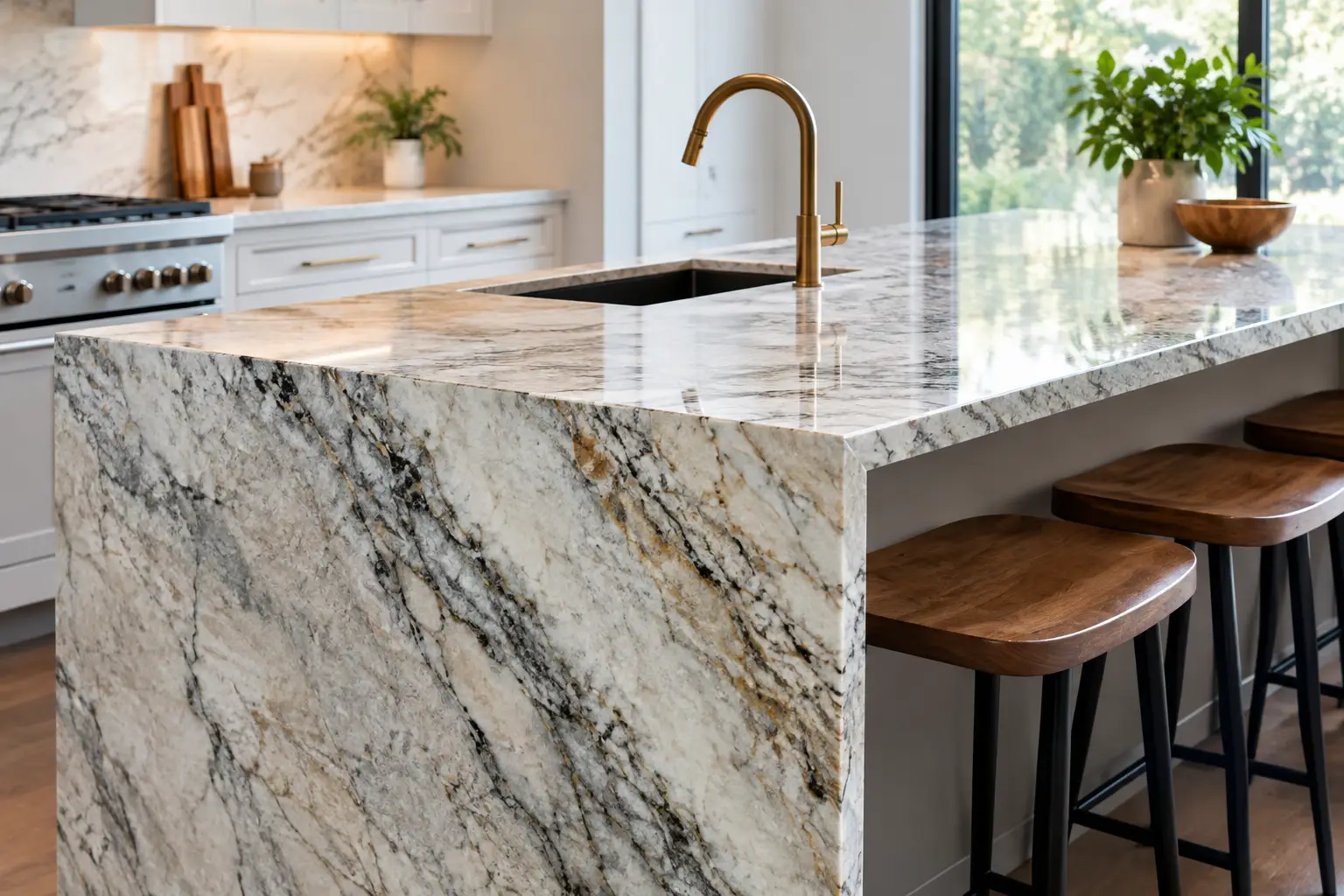
Waterfall kitchen island showing continuous stone veining from the countertop down the side panel

Quick Answer: What Are the Best Stones for Waterfall Islands?

Quartz, quartzite, granite, marble, porcelain, and sintered stone can all work well for waterfall islands. Quartz offers practical, low-maintenance performance. Quartzite combines natural movement with durability, while granite performs well in busy kitchens. Marble provides distinctive natural veining. Porcelain and sintered stone can create a thin, contemporary profile. Your best option depends on maintenance, slab size, pattern, edge construction, and the desired transition across the waterfall corners.

What Makes a Stone Work for a Waterfall Island?

Fabricators commonly join the horizontal countertop to the vertical side panels with a mitered edge. A well-executed miter makes the stone pattern and thickness appear continuous around the corner. Creating that effect requires accurate cutting, polishing, alignment, and support. Even a narrow mismatch can stand out at eye level.

Materials with a consistent background or controlled pattern are generally easier to plan. Dramatic natural veining can look exceptional, but it requires more attention. Before cutting, the fabricator must determine slab orientation and vein direction. The layout should also account for how the pattern will move from the top down each end.

Appearance is only part of the decision. Waterfall ends sit close to foot traffic, stools, pets, and vacuum cleaners. For busy households, resistance to stains, chips, and daily wear can matter as much as the pattern.

Quartz: A Practical Choice for Most Waterfall Islands

Quartz countertops are often one of the best choices for waterfall islands. Quartz combines a predictable appearance with straightforward maintenance. Its nonporous surface does not require sealing. Everyday spills such as coffee, cooking oil, or juice are also unlikely to leave a mark when you clean them promptly.

For a clean, modern island, consider solid white, warm beige, soft grey, or subtle concrete-look quartz. These designs create crisp waterfall panels without forcing the eye to follow a complicated pattern. Fine-veined quartz also suits homeowners who want a marble-inspired appearance with less maintenance.

Heat is the main trade-off. You should not treat quartz as a landing zone for hot cookware. Manufacturers also produce quartz in slabs with repeating or controlled patterns. These designs can appear less organic than natural stone.

That consistency can work in your favour on a waterfall island. It often simplifies the visual transition on long islands or designs with two exposed ends.

Quartzite: Natural Movement With Strong Everyday Performance

Quartzite countertops suit homeowners who want genuine natural stone with movement and crystalline detail. The material can provide more natural variation than engineered quartz while still offering strong everyday performance.

A quartzite waterfall island can range from quiet and sandy to bold and heavily veined. Dramatic slabs deserve careful layout planning. With the right slab, fabricators can align the movement from the countertop into the waterfall panel. This approach creates a deliberate transition instead of a random break at the corner.

Not every quartzite performs exactly the same way. Some varieties are denser and less absorbent than others, and sealing needs can vary. Your fabricator should assess the specific slab rather than relying only on the quartzite label.

Natural fissures and mineral variation are normal characteristics of many quartzites. Reviewing those features before fabrication helps set clear expectations for the finished countertop.

Granite: A Durable Natural-Stone Option

Granite countertops remain a sensible choice for waterfall islands. They suit households that want natural stone with strong heat resistance and reliable everyday performance. Granite also comes in a broad range of colours and patterns. Options range from relatively uniform dark surfaces to slabs with sweeping movement and visible mineral flecks.

A quieter granite can create a tailored island without competing with cabinets or a busy backsplash. More active granite can become the kitchen’s focal point. In that case, slab layout deserves extra attention.

The fabricator may need to adjust the template position to preserve an important feature in the stone. Careful planning can also help the pattern transition more naturally into the waterfall end.

Many granites benefit from periodic sealing, although requirements vary by stone and use. The maintenance is usually manageable. Homeowners who prefer a surface that does not require sealing may find quartz more suitable.

Marble: Beautiful, but Best for a Considered Kitchen

Marble countertops give a waterfall island natural depth and distinctive veining. Engineered surfaces can imitate this appearance, but natural marble has its own variation and character. It works especially well when the island serves as a visual centrepiece.

The practical trade-off is that marble can etch when it comes into contact with acidic ingredients. Lemon juice, vinegar, and wine are common examples. Etching changes the finish rather than necessarily staining the stone, and polished marble often shows it more clearly.

Marble also requires sealing and thoughtful daily care. Those requirements do not rule it out for a waterfall island. They simply make lifestyle and expectations more important.

Homeowners who appreciate a lived-in patina may enjoy marble for many years. If every mark will become frustrating, a marble-look quartz or soft-veined quartzite may be more appropriate.

Porcelain and Sintered Stone: Slim, Contemporary, and Heat-Friendly

Porcelain countertops and sintered stone are strong options for contemporary waterfall islands. They work particularly well when you want a thinner profile or a large-format surface with a controlled pattern. Both materials resist stains well and generally handle heat effectively.

Thin slabs can create a sharp, refined appearance, but fabrication requires specialized handling. Fabricators must cut corners, cutouts, and mitered edges precisely to reduce chipping. Accurate alignment also helps create a convincing wrapped edge.

Installation planning matters just as much. The waterfall panels need proper alignment and support throughout the installation.

Porcelain and sintered surfaces can reproduce marble, concrete, metal, and other stone looks with impressive consistency. This control can help when directional veining needs to travel across a long island and down both ends.

For a closer look at their differences, read our guide to sintered stone vs porcelain countertops.

Vein Matching Matters More Than Most Homeowners Expect

The defining detail of a waterfall island is the point where the countertop turns downward. Veined materials make this transition particularly noticeable. A basic miter can place the side-panel pattern beside the countertop pattern. More detailed layout planning can make the movement appear to continue around the corner.

Achieving a continuous look may require a larger slab, different slab orientation, or extra material. These requirements can increase the project cost. On a feature island facing the main living area, however, careful pattern planning can make a noticeable visual difference.

Subtle quartz, quieter granite, and solid colours may not need the same level of matching. Strongly veined materials usually benefit from more detailed planning.

Ask to review the slab layout before cutting if your chosen material has prominent veins or large mineral movement. The same advice applies to surfaces with a distinct directional pattern. Our guide on how to match countertop veining explains why slab orientation and cutting decisions matter before fabrication begins.

Thickness, Edges, and Seams

Many waterfall islands use 2 cm or 3 cm countertop material. Fabricators can use a mitered build-up with some 2 cm materials to create a thicker-looking profile. A 3 cm slab naturally creates more visual weight. Material type, cabinet design, fabrication method, and desired proportions should guide the choice.

Most waterfall designs use a simple eased edge or clean mitered corner rather than an elaborate decorative profile. Detailed edge profiles can distract from the vertical drop. Some profiles also do not transition naturally around a waterfall miter.

A lightly softened edge is often enough to make the surface comfortable while preserving the island’s clean lines.

Seam placement also deserves early planning. A large island may require more than one slab, and some patterns hide seams more successfully than others. When possible, the layout may keep seams away from prominent areas such as the main seating zone. Sink and cooktop locations can also affect seam planning.

The final seam position depends on slab dimensions, pattern layout, fabrication requirements, and safe installation.

Waterfall Islands Need Proper Support

The waterfall panels form only one part of the island’s structural plan. Seating overhangs, sink openings, cooktops, cabinet construction, and material weight can all affect support requirements.

A thick-looking mitered edge does not automatically mean the countertop can handle a large unsupported span. Visual thickness and structural support are separate considerations. Overhang depth, cabinet construction, stone type, and cutout locations should all receive attention before fabrication.

If your design includes seating, read our countertop overhang support guide. It explains the factors that determine when additional support may be appropriate.

Choose for Your Kitchen, Not Just the Showroom Sample

A small sample cannot show how a full slab will look when it wraps down one or both sides of an island. Whenever possible, view the actual slab before making the final decision. Discuss which faces of the finished island will remain exposed.

Look at the cabinets, flooring, backsplash, lighting, and stool placement as part of the same design. A bold pattern can look striking in a bright, open kitchen. It may feel busier when several surrounding finishes also demand attention.

Function matters too. If stools tuck beneath the island, waterfall panels affect where the seating overhang begins and where people can comfortably place their feet. The design needs to balance seating space with proper countertop support.

Confirm sink cutouts, cooktops, large overhangs, and waterfall dimensions during templating. Resolving these details before fabrication reduces the chance of surprises after cutting begins.

For homeowners in Ontario planning a custom island, Stone Valley Countertops can help compare the actual slab, edge approach, vein direction, and layout before fabrication. The best result is rarely about choosing the most expensive stone. It comes from selecting a material that suits daily use and planning the fabrication details carefully.

A well-chosen waterfall island should still feel right after the first busy dinner, first spill, and years of regular use. Start with a material you will be comfortable living with. Then let careful slab layout and precise fabrication create the visual impact.

Frequently Asked Questions About Waterfall Island Countertops

What is the best stone for a waterfall kitchen island?

There is no single best material for every waterfall island. Quartz offers easy maintenance, while quartzite provides natural movement and strong everyday performance. Granite offers durability and heat resistance. Marble provides distinctive natural character, while porcelain and sintered stone can create a slim contemporary appearance. Your kitchen, maintenance expectations, slab layout, and design preferences should guide the decision.

Is quartz good for a waterfall island?

Yes. Quartz works particularly well for waterfall islands because its relatively consistent pattern can simplify the transition between the countertop and vertical panels. The nonporous surface also does not require sealing. Highly veined quartz still needs careful slab planning when you want the pattern to flow across the corner.

Can you vein-match a waterfall countertop?

Yes, depending on the slab, pattern, dimensions, and available material. Fabricators can plan cuts so prominent veins appear to continue from the horizontal countertop into the waterfall panel. Complex matching may require extra material or a specific slab orientation.

Does a waterfall countertop need a mitered edge?

Fabricators commonly use a mitered joint to create a clean transition between the horizontal countertop and vertical waterfall panel. The exact construction depends on the material, thickness, design, and fabrication requirements.

Are waterfall islands more expensive than standard islands?

Waterfall islands generally require more countertop material because the design includes one or two vertical panels. Mitering, vein matching, slab layout, handling, and installation can add labour as well. The final cost depends on the material, island dimensions, number of waterfall ends, and fabrication complexity.

Should I choose the slab before planning the waterfall layout?

For natural stone and strongly veined engineered surfaces, reviewing the actual slab before finalizing the layout is useful. Slab dimensions, vein direction, natural features, and cutout locations can influence the final pattern. They can also determine whether the desired movement can continue from the top into the waterfall ends.

Planning a Waterfall Island in Ontario?

If you are comparing materials for a new waterfall island, bring your kitchen measurements, cabinet plans, or inspiration photos when reviewing slabs. Stone Valley Countertops can help evaluate slab dimensions, veining, seams, edge construction, and waterfall-panel placement before fabrication begins.

Visit one of our Ontario showrooms or contact Stone Valley Countertops to discuss your project.

Best Countertops for Outdoor Kitchens: Heat & Weather-Proof Picks

Best Countertops for Outdoor Kitchens

Best countertops for outdoor kitchens in Ontario

Designing an outdoor kitchen in Ontario? Choosing the best countertops for outdoor kitchens can completely transform your backyard into a practical and stylish space. In fact, the right material must be durable, heat-resistant, UV-stable, and simple to maintain through every season.

At Stone Valley Countertops, we’ve helped homeowners across Ontario design outdoor cooking areas that stand up to sun, rain, BBQ spills, and poolside fun. Additionally, each installation is built to look stunning year after year.

Key Features of the Best Countertops for Outdoor Kitchens

Before choosing your surface, it’s important to understand what makes an outdoor countertop last. The following features are essential:

  • UV Resistance: Prevents fading or yellowing from direct sunlight exposure.
  • Heat Resistance: Resists cracking or discoloration from grills and hot pans.
  • Non-Porous Surface: Makes it easy to wipe away spills, rain, or stains.
  • Scratch Resistance: Keeps your prep areas looking new, even with daily use.

Top Outdoor Countertop Materials for Ontario Homes

1. Porcelain Countertops for Outdoor Kitchens

Porcelain remains one of the best countertops for outdoor kitchens because it’s non-porous, stain-resistant, UV-proof, and highly heat-resistant. Furthermore, it’s available in designs that mimic marble, concrete, and even wood. It’s a beautiful yet functional option that thrives in Ontario’s climate. Learn more from Caesarstone’s porcelain collection.

2. Granite Countertops

A classic for outdoor use, granite is tough, weather-resistant, and naturally beautiful. However, sealing it once or twice a year enhances protection against moisture and stains. With proper care, it lasts for decades.

3. Dekton Countertops

Engineered by Cosentino, Dekton offers unbeatable durability. It’s fireproof, waterproof, UV-stable, and scratch-resistant — in other words, the ultimate low-maintenance material for outdoor kitchens in Ontario.

4. Quartzite Countertops

Quartzite is a natural stone that delivers elegance and strength. Unlike engineered quartz, it can handle direct sunlight without fading. Therefore, it’s ideal for homeowners who love the look of natural stone outdoors.

What to Avoid: Quartz Countertops Outdoors

While indoor quartz looks amazing, it doesn’t perform well outdoors. Prolonged UV exposure can cause fading and weakening. Instead, materials like porcelain and Dekton are designed to withstand outdoor conditions.

Outdoor Kitchen Countertop Design Trends in Ontario

Outdoor spaces are increasingly being designed as extensions of the home. As a result, the most popular design trends for outdoor kitchens include:

  • Waterfall edges for a sleek, modern finish
  • Stone slab cladding around grills and bars
  • Neutral tones that blend indoor and outdoor areas
  • Low-maintenance, high-durability materials

Stone Valley’s Recommended Countertops for Outdoor Kitchens

Based on hundreds of successful installations, our team recommends:

  • Porcelain: The perfect balance of style and strength.
  • Dekton: Virtually indestructible and completely weatherproof.
  • Granite: Classic, natural, and built for beauty.

You can explore these materials in action through our project gallery, which showcases outdoor kitchen designs across Ontario.

Ready to Install the Best Countertops for Your Outdoor Kitchen?

Whether you’re building a small BBQ station or a luxury entertainment area, Stone Valley Countertops can help you find the best material for your outdoor space. Our expert team handles fabrication and installation across Ontario. As a result, you’ll enjoy countertops built to last through every season.

Get your free quote today and start planning your dream outdoor kitchen.

Frequently Asked Questions About Outdoor Countertops

Can porcelain countertops handle Ontario’s cold winters?

Absolutely. Porcelain is frost-resistant and designed to handle temperature swings. Moreover, it won’t fade or crack in extreme conditions.

Do granite outdoor countertops require regular maintenance?

Yes, but it’s simple. A light seal once or twice a year helps granite stay water-resistant and glossy, ensuring long-term performance outdoors.

What is the most durable outdoor countertop material?

Dekton is widely considered the most durable material for outdoor kitchens. It resists scratches, UV rays, stains, and high heat without any sealing.

Can I use indoor quartz for my outdoor BBQ kitchen?

Unfortunately, no. Quartz isn’t UV-stable, so it may fade or discolor in sunlight. For outdoor use, we recommend porcelain or Dekton instead.

Porcelain Countertops: Pros, Cons & Why They’re a 2025 Must-Have

Porcelain Countertops: Pros, Cons & Why They’re a 2025 Must-Have

Porcelain surfaces are becoming a favourite among Ontario homeowners thanks to their durability, heat resistance, and sleek design. In this guide, you’ll discover the main advantages, drawbacks, and why this premium material is one of the top countertop choices for 2025 kitchens and bathrooms.

FREE QUOTE TOOL: Want to know what your new kitchen countertop would cost? Click here to get a custom quote in less than 30 seconds.
Mitered edge countertop on a porcelain bathroom vanity – Stone Valley Countertops

What Are Porcelain Countertops?

These countertops are made from refined ceramic materials baked at extremely high temperatures. As a result, they form a dense, non-porous surface that’s both strong and visually stunning. Originally popular across Europe, porcelain slabs are now trending throughout North America because they resist UV rays and can replicate natural stone, concrete, or even wood textures.

Advantages of Porcelain Surfaces

  • Heat Resistant: Withstands hot pans without damage.
  • Stain Resistant: Non-porous and simple to maintain.
  • Scratch Resistant: Harder than granite for daily durability.
  • UV Resistant: Ideal for outdoor kitchens and bright interiors.
  • Stylish: Large-format slabs deliver a seamless, modern appearance.
  • Low Maintenance: No sealing required, unlike natural stone.

Potential Drawbacks

While porcelain offers many benefits, there are a few considerations to keep in mind. For instance, edges can be brittle if hit hard, and fabrication requires precision tools. Nevertheless, these limitations are minimal compared to the long-term performance.

  • Brittle Edges: Corners may chip with heavy impact.
  • Limited Edge Profiles: Fewer custom shapes than granite or quartz.
  • Specialized Fabrication: Needs experienced installers for best results.

Why They’re Gaining Popularity

Homeowners in Ontario are turning to this porcelain material for its modern European aesthetic and eco-friendly composition. Designers love how it provides pattern consistency across backsplashes, waterfall islands, and full-height walls. In addition, its low maintenance makes it ideal for busy households.

Compare porcelain vs Dekton →

Porcelain vs Quartz: Which Is Better?

Choosing between quartz and porcelain depends on your lifestyle and design preferences. For example, quartz offers more edge profiles, while porcelain performs better outdoors because it doesn’t fade under sunlight.

View our Quartz Countertops Guide →

FeaturePorcelainQuartz
Heat Resistance✅ Excellent⚠️ Moderate
UV Resistance✅ Won’t fade outdoors❌ May discolor in sunlight
Design Variety✅ Wide range of looks✅ Natural stone appearance
Edge Options⚠️ Limited✅ Many profiles

Stone Valley’s Recommendation

Our experts typically recommend porcelain for:

  • Outdoor kitchens exposed to sunlight
  • Contemporary or minimalist interiors
  • Clients wanting easy, long-term maintenance

For inspiration, visit our Gallery or explore similar materials like Granite and Marble.

Client Review

“I was torn between porcelain and quartz. Stone Valley walked me through the pros and cons — now my kitchen looks like it came straight from a design magazine.”
— Chris L., Burlington

Final Thoughts

Overall, porcelain slabs offer one of the best combinations of beauty, strength, and performance. Because they are lightweight yet resilient, these countertops are suitable for both indoor and outdoor use. If you’re planning a renovation, porcelain is a stylish, sustainable investment that delivers lasting value.

Ready to explore porcelain for your kitchen? Contact Stone Valley Countertops today for a free consultation!

Countertop Trends 2025: The Hottest Styles, Materials, and Innovations

The 2025 countertop trends are shaping up to be all about innovation, sustainability, and bold aesthetics. Homeowners and designers are looking for materials that are durable, stylish, and eco-friendly, while also integrating cutting-edge technology. Whether you’re planning a kitchen remodel or updating a bathroom vanity, knowing the latest countertop trends can help you make an informed decision. Let’s dive into what’s hot and what’s fading in kitchen and bathroom countertops this year.

1. Popular Colors & Patterns in 2025 Countertop Trends

Color psychology and modern aesthetics are influencing countertop choices. The biggest color and pattern trends for 2025 include:

  • Earthy and warm neutrals – Shades like beige, taupe, greige, and warm grays dominate modern designs.
  • Bold veining and statement slabs – Expect high-contrast marble-inspired patterns that make a dramatic impact.
  • Matte and leathered finishes – Glossy surfaces are fading, while textured and soft-touch finishes are gaining popularity for a more natural feel.

➡️ Trending Countertop Colors & Patterns for Modern Kitchens

2. Material Innovations in 2025 Countertop Trends

Luxury modern kitchen featuring 2025 countertop trends with quartz, sintered stone, and porcelain surfaces in a matte finish and waterfall edge design.

The demand for high-performance and eco-friendly materials is driving exciting innovations:

  • Sintered Stone & Porcelain Countertops – These ultra-durable surfaces offer heat resistance, stain resistance, and scratch-proof performance.
  • Recycled & Sustainable Options – Materials like recycled glass countertops, paper composite surfaces, and reclaimed wood are becoming must-haves for eco-conscious homeowners.
  • Quartzite & Engineered Stone – Offering the look of natural stone but with superior durability, quartzite and engineered quartz remain top choices.

➡️ Eco-Friendly Countertops for Your Home: Best Sustainable Options
➡️ Dekton vs Porcelain: The Ultimate Countertop Showdown – Which One Wins?

3. Edge Profiles & Finishes for 2025 Countertops

The details matter! The hottest edge profile trends are:

  • Mitered edges – Perfect for waterfall kitchen islands, creating a seamless, luxurious look.
  • Eased & beveled edges – Subtle shaping that softens sharp angles and enhances usability.
  • Textured & leathered finishes – Adds depth and warmth while reducing visible fingerprints and smudges.

➡️ Mitered Edge Countertops: Durable Style for Kitchens & Bathrooms

4. Technology in 2025 Countertop Innovations

Smart homes need smart countertops! The latest innovations include:

  • Integrated wireless charging – Charge devices directly on quartz and solid surface countertops.
  • Antimicrobial coatings – Prevent bacteria buildup, making kitchen and bathroom countertops more hygienic.
  • Self-healing surfaces – Some materials now feature heat-sensitive technology that repairs minor scratches.

5. What’s Out of Style in 2025 Countertop Trends?

Some styles are phasing out in favor of more contemporary, minimalist choices:

  • ❌ Busy granite patterns – Homeowners are ditching overly speckled granite for solid or subtly veined slabs.
  • ❌ High-gloss finishes – More people are opting for honed, matte, or leathered surfaces.
  • ❌ Thin countertops – Chunky, thick slabs (1.5″ or more) are making a statement instead of thin, fragile-looking surfaces.

6. Best Countertops for Resale Value in 2025 Trends

If you want to boost your home’s resale value, these are the best countertop investments:

  • Quartz Countertops – The #1 choice for home buyers due to its durability and modern aesthetic.
  • Quartzite Countertops – A luxurious natural stone alternative to marble, with better resistance to etching and staining.
  • Porcelain & Ultra-Compact Surfaces – Long-lasting, heat and scratch-resistant surfaces gaining traction in high-end kitchens.

➡️ Best Kitchen & Bathroom Countertops – Top Choices & Benefits
➡️ Quartzite Countertops: Benefits, Costs, and Maintenance Guide

Conclusion

The 2025 countertop trends focus on durability, sustainability, and modern aesthetics. Whether you’re drawn to eco-friendly countertops, smart surfaces, or bold statement slabs, making the right choice ensures your kitchen and bathroom countertops stay stylish and functional for years to come.

Are you planning a countertop upgrade this year? Check out our in-depth guides for expert advice!

➡️ Most Durable Countertops: What Lasts the Longest?
➡️ How to Maintain Your Countertops for a Lifetime

Most Durable Countertops: What Lasts the Longest?

Most Durable Countertops: What Lasts the Longest?

When choosing the most durable countertops, it is easy to focus on a single question: which material is the toughest? In practice, countertop durability depends on several factors, including resistance to scratches, heat, stains, chips, and everyday wear.

Quartzite, granite, porcelain, and quartz can all be durable countertop materials, but they perform differently. The best choice depends on how you use your kitchen, how much maintenance you are comfortable with, and which types of damage matter most to you.

If you are still comparing your options, our guide to countertop materials provides a broader look at popular surfaces for kitchens and bathrooms.

What Makes a Countertop Durable?

There is no single measurement that determines whether a countertop is durable. A practical comparison should consider several characteristics:

  • Scratch resistance: How well does the surface handle everyday contact with cookware, dishes, and other objects?
  • Heat resistance: How does the material respond to hot cookware and changes in temperature?
  • Stain resistance: How easily can common kitchen spills penetrate or discolor the surface?
  • Impact and chip resistance: How vulnerable are the surface, edges, and cutouts to impact?
  • Maintenance: Does the material require sealing or other routine care?

A material that performs extremely well in one category may have limitations in another. That is why choosing a countertop based only on hardness can be misleading.

Quartzite Countertops

Quartzite is a natural stone known for its hardness and distinctive appearance. Many quartzites offer excellent scratch resistance and can perform well in busy kitchens when properly selected, fabricated, installed, and maintained.

  • Scratch resistance: Generally excellent, although properties vary between stones sold as quartzite.
  • Heat resistance: Natural quartzite generally tolerates heat well, but trivets are still a sensible precaution around hot cookware.
  • Appearance: Available in natural patterns ranging from subtle movement to dramatic veining.
  • Maintenance: Depending on the stone’s porosity and finish, sealing may be recommended to help reduce staining.

Because natural slabs vary, it is important to evaluate the specific stone rather than assuming every slab sold as quartzite will perform identically.

Good fit for: Homeowners who want a durable natural stone and are comfortable with the variation and maintenance that can come with natural materials.

Learn more about quartzite countertops.

Granite Countertops

Granite has a long history as a kitchen countertop material because it combines good scratch and heat resistance with the unique appearance of natural stone.

  • Scratch resistance: Generally very good for normal kitchen use.
  • Heat resistance: Granite handles heat well, although using trivets remains good practice.
  • Appearance: Every natural slab has its own colour, mineral structure, and pattern.
  • Maintenance: Some granites benefit from periodic sealing, while others are relatively dense and may require it less frequently.

The actual performance of granite depends on the specific stone, finish, fabrication details, and how the countertop is used.

Good fit for: Kitchens where natural stone, heat resistance, and long-term durability are priorities.

Learn more about granite countertops or read our guide explaining when granite countertops need sealing.

Porcelain Countertops

Porcelain offers a different combination of durability characteristics. It is highly resistant to heat, moisture, and many common household stains, making it useful for countertops, backsplashes, shower walls, and other applications.

  • Stain resistance: The surface is highly resistant to absorption and generally does not require sealing.
  • Heat resistance: Porcelain performs very well around heat.
  • UV resistance: Many porcelain products can also be suitable for outdoor applications, subject to the manufacturer’s specifications.
  • Fabrication: Slab thickness, edges, cutouts, handling, and installation require careful planning because porcelain behaves differently from thicker stone slabs.

Porcelain can be extremely durable in everyday use, but fabrication quality matters. Edge and cutout design should be considered before the slab is fabricated rather than after installation.

Good fit for: Homeowners looking for a low-maintenance surface with strong heat, stain, and moisture resistance.

Explore our porcelain countertop options or compare sintered stone vs porcelain.

Quartz Countertops

Quartz remains one of the most practical countertop choices for busy kitchens because it combines good durability with low routine maintenance and a large selection of colours and patterns.

  • Stain resistance: Quartz is non-porous and does not normally require sealing.
  • Scratch resistance: It handles normal everyday use well, although it is not scratch-proof.
  • Consistency: Engineered patterns can make colour and design selection more predictable than many natural stones.
  • Heat: Quartz contains resins and should be protected from hot cookware with trivets or heat pads.

Quartz is durable, but it should not be treated as indestructible. Cutting directly on the surface, exposing it to excessive heat, or subjecting edges and cutouts to heavy impact can cause damage.

Good fit for: Busy kitchens where easy cleaning, consistent appearance, and minimal routine maintenance are important.

Explore quartz countertops, learn whether quartz can scratch, or read about quartz heat resistance.

What About Concrete Countertops?

Concrete can create a distinctive custom or industrial appearance, but it is different from the slab materials Stone Valley typically fabricates and installs.

Concrete can be durable when properly designed, poured, reinforced, finished, and sealed, but it may develop stains, small cracks, or changes in appearance over time. For homeowners primarily comparing fabricated slab countertops, quartzite, granite, porcelain, and quartz are generally more relevant options to evaluate.

Comparing Durable Countertop Materials

Material Scratch Resistance Heat Resistance Stain Resistance Routine Sealing
Quartzite Excellent* Excellent Varies by stone Often recommended
Granite Very good Excellent Good to very good Depends on stone
Porcelain Very good Excellent Excellent No
Quartz Very good Moderate Excellent No

*Natural stone characteristics vary by slab and geological composition. Product-specific specifications and manufacturer guidance should always be considered.

Which Durable Countertop Is Right for Your Kitchen?

Instead of looking for one material that wins every durability category, consider which characteristics matter most in your home.

  • If heat resistance is especially important: Granite, quartzite, and porcelain are worth considering.
  • If minimal maintenance is the priority: Quartz and porcelain generally require less routine maintenance than many natural stones.
  • If you want natural stone: Granite and quartzite provide natural variation with strong everyday performance.
  • If consistent colours and patterns matter: Quartz offers a large selection of engineered designs.
  • If the project is outdoors: Material selection should account for UV exposure, temperature changes, moisture, and the manufacturer’s approved applications.

The slab itself is also only part of countertop durability. Proper templating, seam placement, sink support, cutout design, fabrication, and installation can all affect how a finished countertop performs.

See Countertop Materials in Person

Samples and online photos are useful for narrowing down your options, but natural slabs and full-size engineered surfaces can look very different in person. Colour variation, veining, finish, thickness, and edge details are easier to evaluate at full scale.

Stone Valley Countertops supplies, fabricates, and installs stone surfaces for kitchens, bathrooms, islands, backsplashes, and other applications across Ontario.

Visit one of our showrooms or contact Stone Valley Countertops to discuss your project and compare materials based on the way you actually use your space.