
Quartzite Countertop Care Guide: Cleaning, Sealing and Daily Maintenance
A quartzite kitchen can look nearly unchanged after years of use, or it can develop dull spots, dark rings and stains that could have been avoided with a few simple habits. This quartzite countertop care guide explains how to clean, protect and maintain natural quartzite countertops after installation.
Quartzite is a natural stone, not engineered quartz. Its density, mineral makeup, finish and absorbency can vary from one slab to another. That variation is part of its appeal, but it also means care should be based on the specific material installed in your home rather than broad promises about all quartzite.
Quick Answer: Clean quartzite countertops with warm water, a soft cloth and a pH-neutral stone cleaner. Wipe spills promptly, use cutting boards and trivets, and avoid acidic or abrasive cleaning products. Some quartzite slabs benefit from periodic sealing, but the need depends on the stone’s porosity, finish and existing sealer. Always follow the care recommendations for your particular slab.
Start With the Actual Slab, Not the Label
The name “quartzite” is sometimes used loosely in the stone market. True quartzite generally forms when sandstone is changed by heat and pressure, producing a hard, crystalline stone. Some materials sold under the quartzite category may behave differently, particularly when exposed to acids or moisture.
Before making assumptions about maintenance, ask your fabricator or stone supplier what they know about the selected slab. A polished surface, honed surface, heavily veined material and a more porous slab can each require a slightly different approach.
Viewing the full slab before fabrication is useful not only for colour and vein movement, but also for identifying natural fissures, mineral variation and areas that may need thoughtful layout around a sink or cooktop cutout.
Natural fissures are not necessarily cracks. They are common features in many stone slabs and may be stabilized during fabrication where appropriate. They do, however, deserve normal care. Avoid striking them with heavy cookware or assuming a visually dramatic section of a slab will perform exactly like a uniform area.
If you are still comparing materials, explore our quartzite countertops collection or read our guide to choosing a countertop slab.
Daily Quartzite Countertop Care
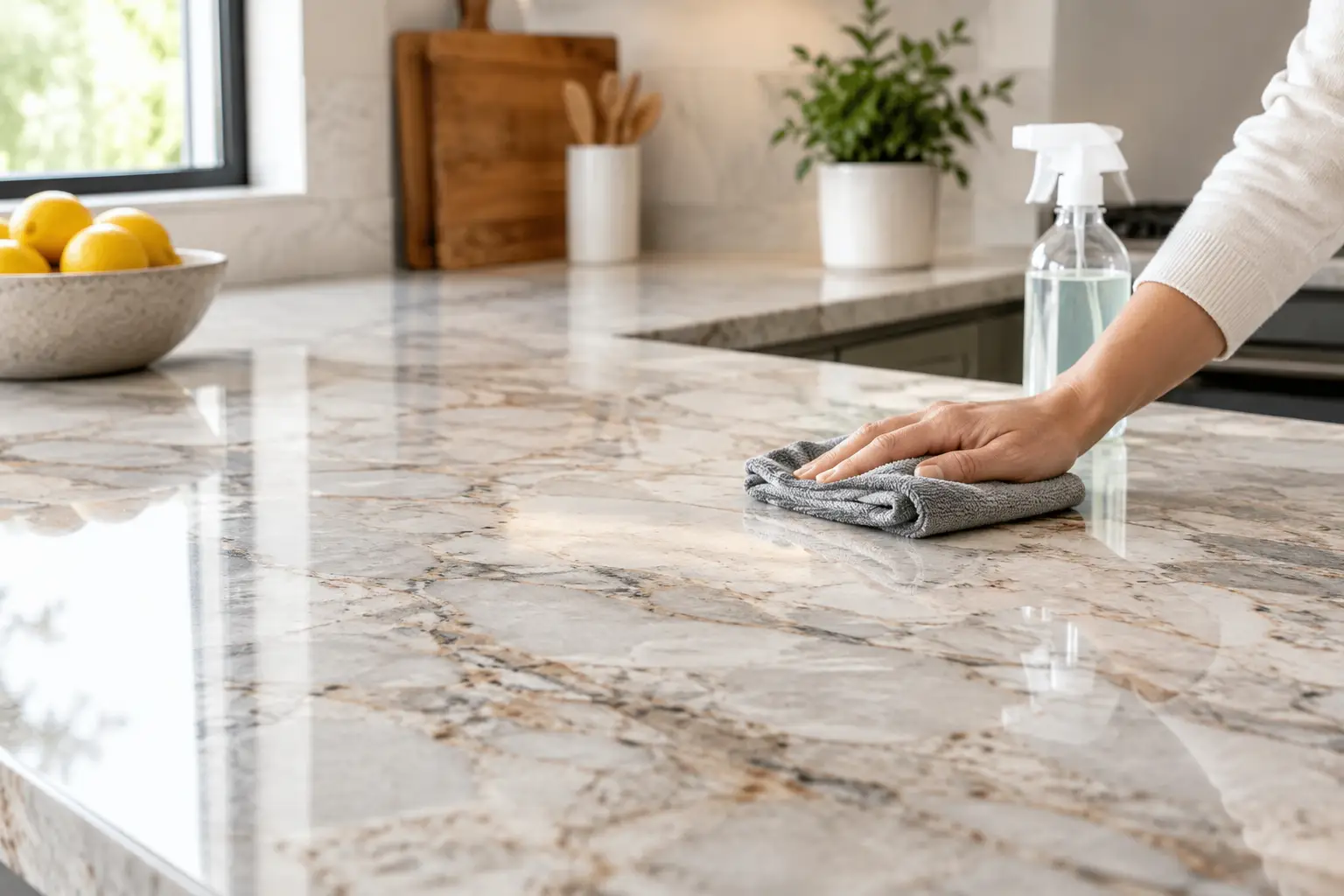
For most kitchens, daily care is straightforward. Wipe up spills with a soft cloth or sponge, then clean the surface with warm water and a pH-neutral stone cleaner, following the product directions.
A small amount of mild dish soap can be suitable for routine cleanup, but repeated heavy soap use can leave a film that makes polished stone look hazy.
After cleaning, wipe the surface dry with a clean microfiber cloth. This is especially helpful around the faucet, behind a coffee maker and beside the range, where hard-water residue and cooking oils tend to build up gradually.
How to Clean Quartzite Countertops Step by Step
- Step 1: Remove crumbs and loose debris using a soft, clean cloth.
- Step 2: Wipe the countertop with warm water and a pH-neutral stone cleaner or a small amount of mild dish soap.
- Step 3: Gently clean areas around the sink, faucet and cooking surfaces where residue tends to accumulate.
- Step 4: Remove remaining cleaner with a clean, damp cloth when required by the product instructions.
- Step 5: Dry the countertop with a microfiber cloth to reduce water spots and streaks.
Avoid abrasive powders, scouring pads and cleaners formulated for tubs, tile grout or oven interiors. Products containing strong acids, alkalis or other aggressive chemicals may affect the finish or leave the surface looking uneven.
Vinegar, lemon-based cleaners and other acidic household solutions should stay off natural stone, even if the countertop seems dense and durable. Avoid bleach and ammonia-based cleaners unless the specific product is approved for your stone and finish.
The same caution applies to homemade cleaning mixtures. A product that works well on glass, ceramic tile or stainless steel is not automatically appropriate for quartzite.
Use Cutting Boards and Trivets
Quartzite is often selected for its hardness and resistance to everyday wear, but it is still not a cutting board. Knives can leave metal marks, damage the knife edge or mark a softer mineral area within the stone.
A cutting board also protects the countertop from impact near edges and corners.
Use trivets or hot pads for cookware coming directly from the stove, oven, grill or slow cooker. Quartzite can tolerate normal kitchen heat better than many surface materials, but sudden temperature changes and prolonged concentrated heat are different matters.
Heat can also affect seams, adhesives and the area around cutouts, even when the stone itself appears unaffected.
Quartzite Countertop Maintenance Checklist
Quartzite does not usually require a complicated maintenance routine. Consistent care is more useful than occasional aggressive cleaning.
Daily Maintenance
- Wipe up food and beverage spills promptly.
- Use a soft cloth and stone-safe cleaner.
- Dry standing water around sinks and faucets.
- Use cutting boards for food preparation.
- Place hot cookware on trivets or heat-resistant pads.
Periodic Maintenance
- Inspect areas around sinks and faucets for persistent moisture.
- Check seams and exposed edges for changes or damage.
- Remove accumulated residue using a cleaner approved for natural stone.
- Review sealing needs based on the slab, finish, sealer instructions and observed moisture absorption.
- Contact a stone-care professional if stains or surface changes do not respond to normal cleaning.
Does Quartzite Need Sealing?
Many quartzite countertops benefit from sealing, but not every slab has the same requirements. Some dense quartzites absorb very little moisture, while others are more porous or contain mineral areas that behave differently.
An impregnating sealer is intended to reduce how quickly liquids enter the stone. It does not create a plastic coating over the surface, and it will not prevent etching, scratches, impact damage or every possible stain.
How often a countertop needs resealing depends on the slab’s porosity, the sealer used, the finish and how the kitchen is used.
A busy kitchen with frequent oil, wine, coffee and cooking spills may need closer attention than a lightly used bathroom vanity. Honed finishes can also show moisture and fingerprints differently than polished surfaces.
How to Tell Whether Quartzite May Need Resealing
Rather than resealing on a fixed calendar schedule, pay attention to how the countertop responds to moisture and whether the existing sealer is still providing adequate protection.
If water quickly darkens the stone or appears to absorb into it, the surface may need further evaluation. However, water beading alone does not prove that a sealer is working properly. Surface finish, residues and natural stone characteristics can all influence how water behaves.
Ask your installer or stone-care professional about an appropriate absorption test before applying another coat of sealer.
Applying the wrong product, applying too much or leaving sealer on the surface too long can create residue or an uneven appearance. Follow the manufacturer’s directions and confirm that the product is suitable for the specific stone.
How to Prevent Stains on Quartzite Countertops
Quick cleanup is the best defence against staining. Blot a spill rather than aggressively rubbing it across the surface, then clean with a stone-safe product and dry the area.
Cooking oil, grease, red wine, coffee, tea, fruit juice, tomato sauce and coloured spices deserve prompt attention.
A darkened area after a spill does not always mean permanent damage. Moisture can temporarily deepen the colour of some natural stone until it evaporates. Oil-based stains may take longer to dissipate and may require professional guidance if regular cleaning does not resolve them.
Do not reach immediately for a harsh stain remover. The right treatment depends on what caused the mark and whether it is in the stone, on the surface or related to residue from a cleaner.
Quartzite Staining vs. Etching
Staining and etching are different problems, and understanding the difference can prevent unnecessary cleaning attempts.
Staining occurs when a substance penetrates the stone and causes discolouration. Oil, coffee and other coloured liquids may leave marks if they are absorbed.
Etching is a chemical reaction that alters an acid-sensitive mineral or surface finish. It may appear as a dull or lighter patch, particularly on polished stone.
True quartzite is generally resistant to common household acids. However, some stones commercially labelled quartzite contain acid-sensitive minerals or are classified differently in geological terms. These materials may etch when exposed to lemon juice, vinegar or other acidic substances.
A sealer can help reduce liquid absorption, but it does not prevent chemical etching.
If a mark looks dull rather than discoloured, do not assume it is a stain. Ask a stone-care professional to identify the problem before attempting treatment.
Protect Quartzite Edges, Seams and Cutouts
The broad field of a countertop is usually the easiest area to maintain. The more vulnerable locations are often the details created during fabrication and installation.
Countertop Edges
Edges can chip if struck by a heavy pan, especially at a sharp or more squared profile. A softened countertop edge profile may be less prone to noticeable damage, but every profile still needs reasonable care.
Avoid leaning heavily on unsupported edge areas or dragging heavy appliances across the countertop.
Seams and Joints
Seams are necessary when a layout exceeds slab dimensions or when handling and access conditions require separate pieces.
A good seam should be planned around slab layout, vein direction, cabinet configuration and the practical limits of the material.
Avoid placing heavy impact loads directly on seams or exposing them to unnecessary concentrated heat.
Sink and Cooktop Cutouts
Sink and cooktop cutouts also need attention. Do not allow water to sit around an undermount sink rim for long periods, and address a leaking faucet, soap dispenser or dishwasher connection quickly.
Persistent moisture inside the sink cabinet can affect cabinetry, supports and adhesives even if the stone surface itself looks fine.
For raised bars, islands and other overhangs, follow the support plan established during fabrication and installation.
Natural stone is strong in compression but can be vulnerable when unsupported and loaded at an edge. Sitting or standing on an overhang creates unnecessary risk.
For additional guidance, see our article on how to measure countertop overhang.
What to Expect From Natural Quartzite Variation
Quartzite is not meant to look perfectly uniform. Veins, crystals, colour shifts, pits, fissures and reflective mineral areas are part of many slabs.
Some features become more visible under direct sunlight, under-cabinet lighting or after the slab is polished and installed across a large kitchen.
This is why slab selection and layout discussions matter. Before fabrication, homeowners should review where major veins will fall, how pieces will meet at seams and how the material will look across an island, backsplash, waterfall leg or full-height wall application.
Care begins with a layout that respects the character of the stone and avoids placing its most visually active areas where they may be difficult to live with.
Our stone fabrication process guide explains how templating, cutting, seam planning and finishing affect the completed countertop.
When Should You Contact a Countertop Professional?
Contact a countertop professional if you notice a new crack, a chip near a sink or cooktop, persistent darkening, a seam that appears to be changing or a stain that does not respond to normal stone-safe cleaning.
Photographs and a description of what was spilled, cleaned or changed nearby can help identify the issue.
For chips, cracks or possible etching, avoid attempting repairs with household adhesives, abrasive pads or polishing compounds. The correct repair method depends on the stone and the type of damage.
Frequently Asked Questions About Quartzite Countertop Care
What is the best cleaner for quartzite countertops?
A pH-neutral cleaner specifically formulated for natural stone is generally a suitable choice. Warm water and a soft microfiber cloth work well for light daily cleaning. Mild dish soap may also be appropriate when used sparingly and rinsed thoroughly. Avoid acidic and abrasive cleaning products.
How often should quartzite countertops be sealed?
There is no universal resealing schedule for quartzite. The frequency depends on the slab’s porosity, finish, existing sealer and everyday use. Some dense slabs may need little intervention, while more absorbent materials require periodic attention. Follow the stone and sealer manufacturer’s recommendations.
Can you put hot pans directly on quartzite?
Quartzite is generally heat resistant, but placing hot cookware directly on the countertop is not recommended. Sudden temperature changes and concentrated heat can create risks around natural fissures, seams, adhesives and cutouts. Use trivets or hot pads to protect the finished installation.
Does quartzite stain easily?
Stain resistance varies by slab. Many dense quartzites resist everyday spills well, particularly when appropriately sealed. More absorbent materials can develop stains from oil, wine, coffee or other liquids. Prompt cleanup and suitable sealing help reduce the risk.
Can vinegar damage quartzite countertops?
Vinegar is not recommended for cleaning quartzite countertops. True quartzite is generally resistant to common household acids, but some stones sold as quartzite contain acid-sensitive minerals that can etch. A pH-neutral stone cleaner is the safer routine choice.
What is the difference between quartz and quartzite maintenance?
Engineered quartz is generally nonporous and does not require sealing. Natural quartzite can vary in absorbency and may benefit from sealing. Both materials should be cleaned with suitable nonabrasive products, and hot cookware should be kept on trivets. Read our quartz vs. quartzite comparison for more details.
Keeping Your Quartzite Countertops Looking Their Best
Quartzite can be a practical and long-lasting surface when the material is properly selected, fabricated and maintained. The best care routine is usually uncomplicated: clean gently, wipe spills promptly, protect edges and cutouts, and understand the specific characteristics of your slab.
For Ontario homeowners planning a new quartzite project, it is worth discussing care expectations during slab selection rather than after installation.
Planning Quartzite Countertops in Ontario?
Stone Valley Countertops supplies, fabricates and installs quartzite countertops for kitchens, bathrooms, islands and custom stone applications. We can help you review slab characteristics, finishes, edge profiles, seams and maintenance considerations before fabrication begins.
Visit our showrooms in Mississauga, Bowmanville, Welland or Orillia, or contact Stone Valley Countertops to discuss your project.