Malik

Quartzite Countertops Pros and Cons

Quartzite Countertops Pros and Cons

You usually know quartzite is on the shortlist when you want the movement of natural stone but need something tougher than marble for daily use. That is why homeowners keep asking about quartzite countertops pros and cons – not just how they look in a showroom, but how they perform once the kitchen is busy, the coffee spills happen, and the island becomes the center of the house.

Quartzite can be an excellent countertop material, but it is not the right fit for every project. It sits in that middle ground where beauty, durability, fabrication, and maintenance all matter. If you are comparing it with quartz, granite, or marble, the right decision usually comes down to how you cook, how much upkeep you are comfortable with, and what kind of look you want long term.

Quartzite Countertops Pros and Cons at a Glance

Quartzite is a natural stone formed from sandstone under intense heat and pressure. That process creates a hard, dense material with a look many homeowners love because it often resembles marble, but with better scratch and heat resistance.

The biggest advantages are durability, natural variation, and strong heat performance. The biggest drawbacks are cost, sealing requirements, and the fact that not every slab behaves exactly the same. Since quartzite is natural stone, each slab has its own movement, veining, mineral content, and fabrication considerations.

That last part matters more than people expect. A stone can look perfect on a sample, but the full slab determines seam placement, waterfall matching, sink cutout strength, and how an island layout will actually look once fabricated.

The Pros of Quartzite Countertops

Strong everyday durability

Quartzite is one of the harder natural stones used for countertops. In a busy kitchen, that usually means it holds up well against normal wear, especially when compared with softer stones like marble. If you cook often, slide small appliances around, or use your island heavily, that extra hardness is a real benefit.

It also handles heat well. Hot pans should still be treated carefully, but quartzite generally performs better with heat than many engineered surfaces. For homeowners who want less stress around hot cookware, that can make a difference.

A natural look that feels high end without feeling overdone

One reason quartzite stays popular is its appearance. It often has soft veining, movement, and depth that look more organic than many manufactured materials. If you like the elegance of marble but want a surface that is generally more practical for everyday use, quartzite often hits the balance well.

It also works across a wide range of designs. A polished white quartzite can suit a bright modern kitchen, while a warmer or more dramatic slab can work in a traditional space, bar area, fireplace surround, or bathroom vanity.

Good option for large features like islands and waterfalls

Quartzite can look especially strong on statement pieces. A large island with noticeable movement in the slab, a full-height backsplash, or a waterfall edge can give the stone room to show its character.

That said, these details depend on layout planning. Vein direction, slab size, and cut sequencing matter if you want a waterfall to line up properly or want the best visual flow across a long run. This is where precise templating and fabrication become just as important as the material itself.

Better scratch resistance than softer natural stones

Homeowners often ask whether quartzite scratches easily. In most cases, it is more scratch resistant than marble and many other natural stones. That does not make it scratch proof, but for normal kitchen use it tends to perform well.

If your priority is a natural stone that can handle a lot of daily traffic without looking worn too quickly, quartzite is usually a stronger candidate than marble.

The Cons of Quartzite Countertops

It usually costs more than many alternatives

Quartzite is often priced above entry-level granite and many quartz options, especially if the slab has dramatic veining or comes from a premium selection. The material cost is only part of it. Fabrication can also be more demanding because quartzite is hard, heavy, and tougher on tools.

If your project includes a waterfall island, multiple sink cutouts, a cooktop cutout, mitered edges, or a full-height backsplash, the total price can rise quickly. Homeowners sometimes compare slab prices alone and miss how edge details, seam planning, and installation complexity affect the finished number.

Sealing and maintenance are part of the deal

Quartzite is lower maintenance than marble in many situations, but it is not maintenance free. Most quartzite countertops need sealing to help protect against staining. How often depends on the specific slab, the finish, and how the countertop is used.

This is one of the biggest trade-offs when comparing quartzite with quartz. If you want a surface that needs very little ongoing maintenance, quartz may feel easier. If you prefer natural stone and are comfortable with periodic sealing, quartzite may still be worth it.

Stain resistance can vary from slab to slab

This is where homeowner expectations need to stay realistic. Not every quartzite performs exactly the same. Some slabs are denser and less absorbent than others. Some are marketed as quartzite but may behave more like softer stone. That is why stone identification, slab selection, and honest guidance matter.

In practical terms, you should still wipe up oils, wine, coffee, and acidic messes promptly. A properly sealed quartzite countertop is durable, but it is still a natural material with some variation in performance.

Repairs and seams still need careful planning

Quartzite is strong, but that does not mean every design detail is simple. Long spans, narrow areas around sink cutouts, unsupported overhangs, and dramatic vein patterns all require planning. Seams are sometimes unavoidable, especially on large kitchens or oversized islands.

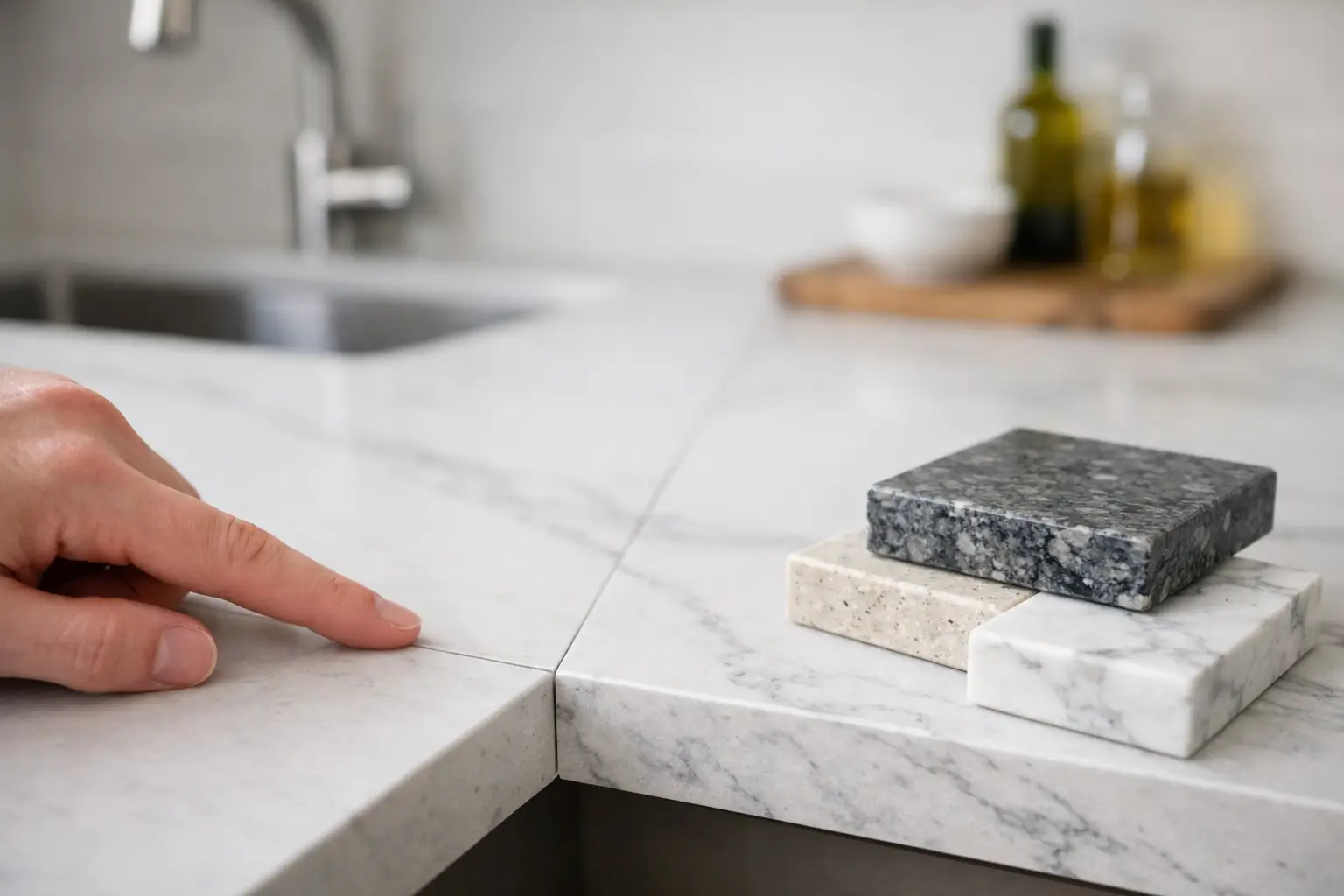
A good seam can be discreet, but it will never disappear completely. The same goes for vein matching across seams and waterfalls. Homeowners who love the look of heavily veined slabs should know that fabrication quality has a major effect on the final result.

Quartzite vs Quartz, Granite, and Marble

Quartzite vs quartz

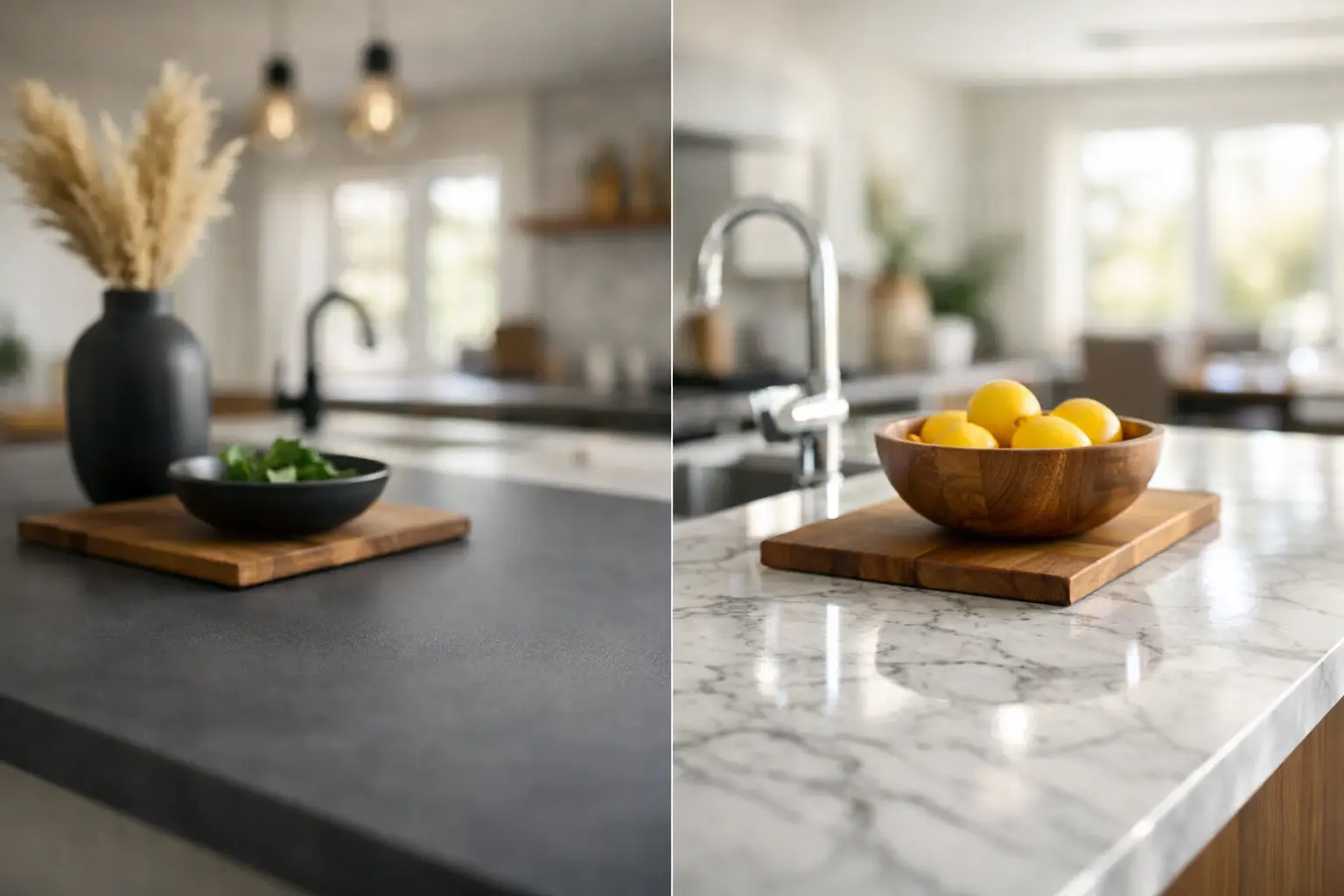
This is one of the most common points of confusion. Quartzite is a natural stone. Quartz is an engineered material made with crushed quartz and resins. If you want natural variation and better heat resistance, quartzite has the edge. If you want lower maintenance and more uniform patterning, quartz often makes more sense.

For many families, the decision is simple: choose quartzite for the look and feel of real stone, and choose quartz for easier upkeep.

Quartzite vs granite

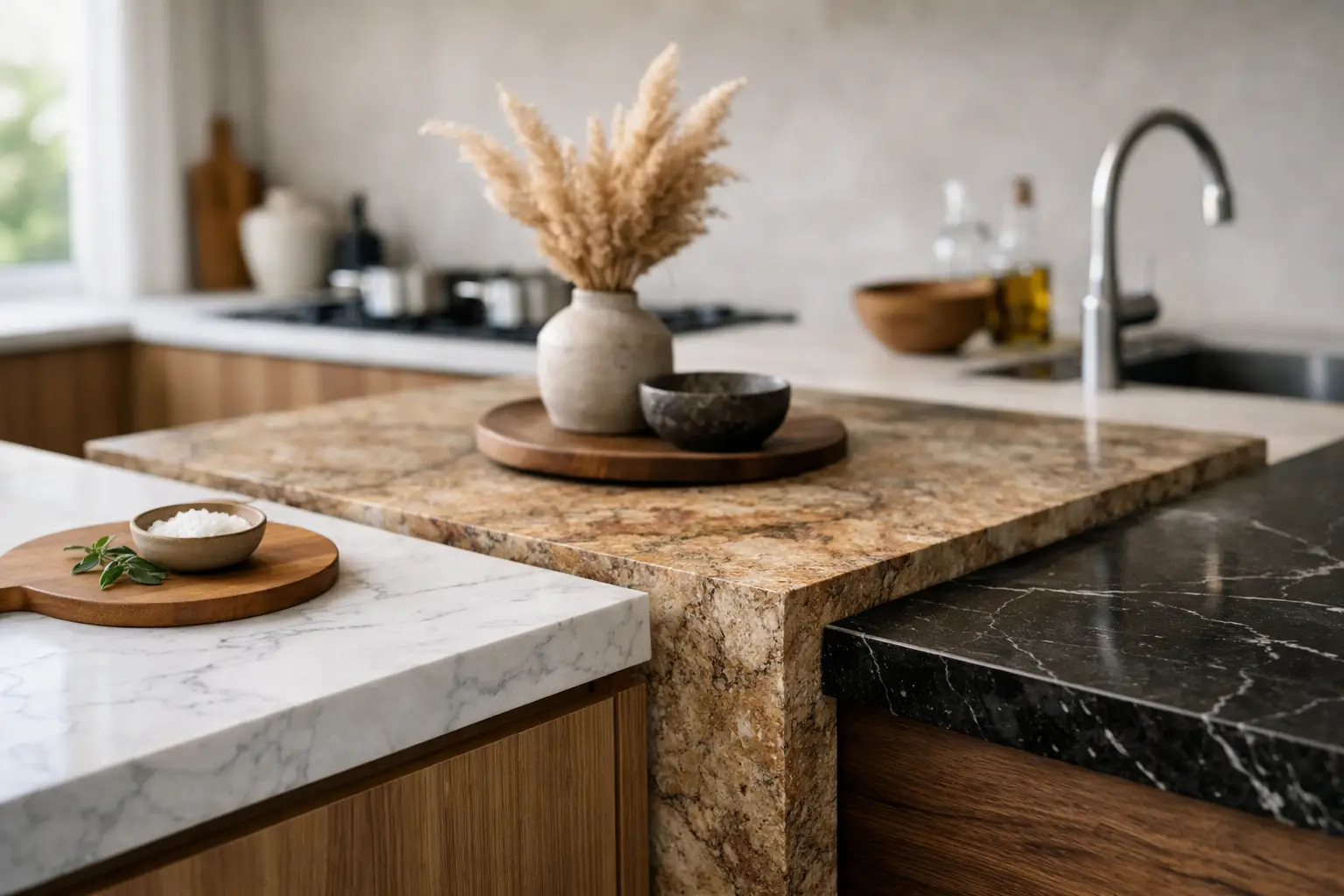
Granite and quartzite are both durable natural stones, but their appearance is usually different. Granite often has a more granular pattern, while quartzite tends to have softer movement and veining. Homeowners drawn to marble-like visuals usually lean toward quartzite.

From a practical standpoint, both can perform very well. The better fit often comes down to the slab you choose, your budget, and whether you prefer subtle movement or a busier natural pattern.

Quartzite vs marble

If appearance alone were the only factor, many people would choose marble. But real kitchens are rarely that simple. Marble is softer and more prone to etching and scratching. Quartzite is usually the more practical option if you want a similar feel with better day-to-day durability.

That does not mean quartzite behaves exactly like a worry-free surface. It just tends to offer a better balance between beauty and function for households that actually use their kitchen hard.

Design and Fabrication Details That Matter

When homeowners research quartzite countertops pros and cons, they often focus on the slab and forget the fabrication details. Those details shape the final look just as much as the stone itself.

Thickness affects the visual weight of the countertop. A standard thickness can look clean and timeless, while a thicker build or mitered edge creates a bolder profile. Edge style matters too. A simple eased edge keeps the focus on the slab, while more decorative profiles change the overall feel.

Sink cutouts, overhangs, and seam locations should also be decided early. An undermount sink is common with quartzite, but the area around the sink needs careful support and clean fabrication. Overhangs for seating may need additional support depending on the depth and layout. On large islands, seam planning and slab direction can make a big difference in how natural the countertop looks once installed.

Installation timelines matter as well. Once the slab is selected and measurements are finalized, templating, fabrication, and installation need to follow a precise sequence. Natural stone leaves less room for guesswork, especially on waterfalls, full-height backsplashes, and layouts where vein flow matters.

Is Quartzite the Right Choice for Your Home?

Quartzite is a strong fit if you want natural stone, appreciate one-of-a-kind movement, and are comfortable with some maintenance. It works especially well in kitchens where durability matters but the look still needs warmth and character.

It may not be the best fit if your main priority is the lowest possible maintenance, a tighter budget, or a highly uniform look. In those cases, quartz or certain granite options may be easier to live with.

For most homeowners, the best decision comes from seeing full slabs, talking through seams and edge details, and thinking honestly about how the space will be used. Quartzite rewards good planning. When the slab, layout, fabrication, and installation all line up, it gives you a countertop that feels natural, durable, and well considered for the long haul.

10 Marble Countertop Maintenance Tips

10 Marble Countertop Maintenance Tips

Marble looks best when it is lived with carefully, not treated like indestructible stone. That is why good marble countertop maintenance tips matter so much. A polished white marble island can stay beautiful for years, but only if you understand what marble does well, where it is vulnerable, and how small daily habits make the biggest difference.

For many homeowners, marble is chosen for its natural movement, soft depth, and timeless look. It gives a kitchen or bathroom a character that manufactured patterns often cannot fully copy. The trade-off is that marble is softer and more reactive than quartz or granite, so maintenance is part of the decision from the start. That does not mean marble is impractical. It means it rewards realistic expectations.

Why marble needs a different kind of care

Marble is a natural stone made largely of calcium carbonate. That composition is what gives it its classic beauty, but it also makes the surface sensitive to acids. Lemon juice, vinegar, wine, tomato sauce, and even some bathroom products can leave etch marks. Etching is not always a stain. It is a change to the finish itself, which is why homeowners are often surprised when a mark looks dull or cloudy rather than dark.

Marble can also absorb liquids if it is left unsealed or if spills sit too long. Oils, cosmetics, coffee, and strongly pigmented foods are common trouble spots. Compared with quartz, marble asks for a little more attention. Compared with some granites, it is usually less forgiving. If you love the look, the right approach is not to avoid marble altogether. It is to use it knowingly.

Marble countertop maintenance tips for everyday use

The most effective care routine is simple and consistent. Wipe the surface with a soft cloth, warm water, and a pH-neutral stone cleaner when needed. That is usually enough for daily cleanup. Harsh sprays, bleach-heavy products, abrasive powders, and rough scrub pads can wear down the finish or leave the stone looking uneven over time.

One of the best marble countertop maintenance tips is to clean spills right away, especially anything acidic or oily. If orange juice, salad dressing, coffee, or red wine sits on the surface, the risk goes up quickly. Fast cleanup matters more than aggressive cleaning later.

It also helps to keep a microfiber cloth nearby in kitchens and bathrooms. Marble often stays in great shape when homeowners build easy habits into normal use instead of waiting for deep cleaning days.

Use the right cleaner, not the strongest one

A common mistake is assuming stone needs heavy-duty cleaning products to stay sanitary. In reality, the wrong cleaner causes more damage than everyday use in many homes. Products labeled for granite are not always ideal for marble, and general-purpose kitchen sprays may contain acids or degreasers that are too harsh.

If you are unsure, choose a cleaner specifically made for natural marble and test it in a less visible area first. Simpler is usually better.

Protect the finish from daily wear

Coasters, trays, and cutting boards make a real difference. A marble kitchen countertop should not be used as a cutting surface, even if the slab looks thick and durable. Knives can scratch the finish, and food prep introduces oils, acids, and pigments directly onto the stone.

Around sinks, soap bottles and metal cans can leave rings or trap moisture underneath. In bathrooms, cosmetics and toothpaste are often the bigger issue. Keeping these items on a tray is a small change that prevents a lot of cleanup.

Sealing marble and what it actually does

Sealing helps marble resist absorption, but it does not make the surface stain-proof or etch-proof. That distinction matters. A good sealer slows down how quickly liquids soak in, giving you more time to wipe up spills. It does not stop acid from reacting with the stone.

This is where expectations often get off track. Homeowners hear that marble is sealed and assume that means maintenance is no longer necessary. In practice, sealed marble still needs prompt cleanup and gentle care.

How often marble needs resealing depends on the slab, the finish, and how the space is used. A busy kitchen island usually sees more wear than a bathroom vanity. Honed marble may also show use differently than polished marble. A fabricator or stone professional can help you understand the needs of your specific material rather than giving a one-size-fits-all timeline.

Honed vs. polished marble maintenance

Finish changes how marble wears and how marks appear. Polished marble has a reflective surface that shows etching more clearly, especially in bright kitchens with a lot of natural light. Honed marble has a softer, matte finish that tends to hide etching better, which is one reason many homeowners choose it for busy kitchens.

That said, honed marble can darken more noticeably from oils if spills are ignored. Neither finish is maintenance-free. They simply age differently. If your goal is a cleaner, more formal look, polished may still be worth it. If you want a more relaxed surface that wears with less visual drama, honed is often easier to live with.

What to do about stains, etches, and dull spots

Not every mark on marble means the slab is ruined. The first step is figuring out what kind of mark you are seeing. If the spot is darker than the surrounding surface, it may be a stain from absorption. If it looks lighter, cloudy, or less reflective, it is often etching.

Stains and etches are treated differently, and using the wrong method can make things worse. Scrubbing harder is rarely the answer. Some stains can be improved with specialty stone-safe treatments, while etching often needs professional refinishing or repolishing depending on the finish and severity.

This is one area where homeowners benefit from expert advice. Marble fabrication and installation are precision work, and surface repair often requires the same level of care. A small dull ring around a faucet or prep area may be manageable, but widespread etching usually needs a more deliberate solution.

Design choices that make marble easier to maintain

Maintenance does not start after installation. It starts with the slab choice, finish, layout, and intended use. If you are selecting marble for a kitchen, think about where prep happens most, where seams will fall, and how the surface will be used day to day.

A large island that doubles as a baking surface may be a good fit for marble if the household is comfortable with some patina. A perimeter counter beside a cooktop or sink may need more attention because of oils, sauces, and acidic splashes. In bathrooms, marble around sink cutouts often sees toothpaste, soap, and cosmetics, so daily wipe-downs matter more than many people expect.

Finish, edge profile, and backsplash design can also affect upkeep. Ornate edge details create more places for buildup, while simpler eased or mitered edges are usually easier to keep clean. Full-height marble backsplashes look beautiful, but they should be chosen with the same care as the countertop itself because they are exposed to splashes too.

When marble is the right choice and when it may not be

Marble is not automatically the best material just because it is beautiful. For some households, quartz or quartzite is a better match for the way the kitchen functions. If you cook often, have young kids, or want the lowest-maintenance surface possible, marble may feel high-touch. If you value natural variation and do not mind a surface that develops character with use, marble can be a very satisfying choice.

There is no wrong answer here. The key is matching the material to your habits. Homeowners who regret marble are often reacting less to the stone itself and more to expectations that were set too high. Homeowners who love it usually understood the trade-offs from the beginning.

At Stone Valley Countertops, these conversations come up often because material choice affects everything that follows, from fabrication details to long-term satisfaction. The best countertop is not just the one that looks good on installation day. It is the one that still makes sense once real life starts happening on it.

A practical routine you can actually keep

If you want marble to age well, keep the routine realistic. Clean with a soft cloth and stone-safe cleaner. Wipe spills quickly. Use cutting boards, coasters, and trays where they help most. Reseal when needed. Pay attention to dull spots before they spread. That is usually enough to keep the surface looking cared for without turning maintenance into a chore.

Marble does not ask for perfection. It asks for awareness. If you like materials that show natural depth and evolve over time, that is often part of the appeal.

Granite Countertops for Bathrooms: Pros and Cons

Granite Countertops for Bathrooms: Pros and Cons

A bathroom vanity gets used harder than most people expect. Toothpaste, soap, standing water, skincare products, hot tools, and dropped items all end up on the surface. That is why granite countertops for bathrooms stay on so many homeownersโ€™ shortlists – they look substantial, hold up well in daily use, and give each vanity a natural pattern that does not feel mass-produced.

Granite is not the right fit for every bathroom, though. Some homeowners want the lower maintenance of quartz. Others love the movement and variation that only natural stone can give. The right choice usually comes down to how you use the space, how much maintenance you are comfortable with, and what kind of look you want once everything is installed.

Why granite countertops for bathrooms still make sense

Granite works well in bathrooms because it is a hard natural stone that stands up to regular wear. On a practical level, it handles water exposure well when properly sealed, and it resists scratches better than many softer natural materials. In a primary bathroom, that matters. Hair tools, lotion bottles, metal grooming tools, and everyday clutter can take a toll on a weaker surface over time.

There is also the visual side of granite. No two slabs are exactly alike, so a bathroom vanity can feel custom without needing an overly complicated design. Some granites are subtle and uniform, while others have bold veining, mineral movement, or strong contrast. That range gives homeowners more flexibility than they sometimes expect.

For smaller powder rooms, granite can also add weight and character without needing a lot of square footage. A single vanity top with a clean edge profile and the right sink cutout can make a compact room feel finished.

The trade-offs to know before choosing granite

Granite is durable, but it is not maintenance-free. That is the biggest distinction between granite and quartz in a bathroom. Because granite is a natural stone, it should be sealed to help protect against moisture and staining. In a bathroom, that usually is not difficult to manage, but it is still part of ownership.

Some granites are denser than others, so maintenance can vary by slab. Lighter colors may show certain marks more easily, while darker polished granites can show water spots or product residue if they are not wiped down regularly. That does not make granite a bad choice. It just means the best slab for one household may not be the best slab for another.

There is also more natural variation in granite than in engineered surfaces. Many homeowners see that as the main appeal, but if you want a very controlled pattern or a pure white look with little movement, granite may not deliver exactly what you have in mind.

Granite vs. quartz in a bathroom vanity

This is usually the comparison homeowners care about most. Both materials are strong options, but they perform a little differently.

Granite gives you a natural surface with one-of-a-kind patterning. It tends to handle heat well, which matters less in a bathroom than in a kitchen, but it still adds to the materialโ€™s durability. It also offers a classic look that works in traditional, transitional, and many modern spaces depending on the slab you choose.

Quartz is more consistent in pattern and usually requires less routine maintenance because it does not need sealing in the same way granite does. If your main priority is easy cleaning and a uniform look, quartz may have the edge.

If your main priority is natural character, variation, and the feel of real stone, granite often wins that comparison. For many bathrooms, it comes down to whether you prefer lower maintenance or more organic visual movement.

Cost of granite countertops for bathrooms

Bathroom countertops are usually more affordable than kitchen countertops simply because they use less material. That said, price still depends on several details beyond the slab itself.

Granite pricing can vary based on color, rarity, slab availability, thickness, and how much fabrication is required. A simple single-sink vanity with a standard eased edge will cost less than a larger double vanity with an undermount sink, custom edge profile, backsplash pieces, and cutouts for widespread faucet drilling.

Bathrooms can also involve tighter layouts, wall irregularities, and detailed fitting around side splashes or alcoves. Precision matters here. A vanity top may look simple, but proper templating and fabrication make the difference between an average result and one that fits cleanly against the wall with consistent overhangs.

If you are comparing quotes, make sure you are comparing the same scope. Thickness, edge profile, sink cutout type, backsplash height, side splashes, and installation details can all affect the final number.

Design details that affect the finished look

A granite vanity top is not just a slab on a cabinet. Small fabrication and design choices change the overall result quite a bit.

Thickness and edge profile

Most bathroom vanities are fabricated in standard thicknesses, often with either a straightforward modern profile or something slightly more detailed depending on the style of the home. A simple eased edge works in almost any bathroom. It looks clean, does not compete with the stone pattern, and is easy to live with.

More decorative edges can suit traditional spaces, but in many current bathroom designs, simpler is better. It keeps the focus on the stone and avoids making the vanity feel heavy.

Sink cutouts and faucet spacing

Undermount sinks are common with granite because they give a clean look and make wipe-down easier. The cutout shape, reveal, and sink alignment all need to be planned carefully during fabrication. Small details matter, especially on narrower vanities where faucet placement and sink size need to work together.

Backsplashes and side splashes

Some bathrooms look best with a matching granite backsplash and side splash, especially where walls may see regular water exposure. Others look cleaner with no stone backsplash at all, particularly if tile or a painted wall is carrying the design. This is not just a style choice – it also depends on how the vanity is used and how much splash protection you want behind the faucet area.

Seams and layout

Many bathroom vanity tops can be fabricated from a single piece, which keeps the look cleaner. In larger double vanities, seam placement may become part of the plan depending on slab size and layout. A well-planned seam should be intentional, tight, and as visually quiet as possible.

Cleaning and maintenance

Granite is easy to maintain when homeowners know what it needs. Daily cleaning is usually just a soft cloth and a gentle stone-safe cleaner. Harsh chemicals and abrasive products are best avoided because they can dull the finish or affect the sealer over time.

It also helps to wipe up standing water, toothpaste, makeup, and skincare spills instead of letting them sit. In bathrooms, most day-to-day marks are not permanent problems if they are cleaned promptly.

Sealing is the part many people ask about. The schedule depends on the specific granite and how much use the vanity gets. Some stones need attention sooner than others. A fabricator can help you understand what your slab is likely to need instead of giving a one-size-fits-all answer.

Where granite works best in a bathroom

Granite can work in almost any bathroom, but it tends to be especially effective in primary bathrooms, guest bathrooms, and powder rooms where homeowners want a more custom look. It is a strong option for double vanities, furniture-style vanities, and designs where the countertop is meant to add natural pattern rather than disappear into the background.

It can also be a smart choice when you want the vanity top to coordinate with other stone features without matching everything exactly. For example, if the room includes shower walls or accent surfaces in another material, granite on the vanity can add contrast while still feeling grounded.

For very small bathrooms, choosing the right slab matters more than choosing granite in general. Busy movement on a small top can feel crowded, while a quieter granite can make the room feel more balanced.

What to expect from fabrication and installation

Bathroom projects move best when measurements are accurate and the design decisions are made early. Once the cabinet dimensions, sink style, faucet drilling, overhang, backsplash details, and slab selection are confirmed, templating can be done precisely.

From there, fabrication includes cutting the slab, polishing edges, completing sink and faucet cutouts, and preparing any backsplash or side splash pieces. Installation day is usually efficient, but bathrooms do not leave much room for error. Tight walls, plumbing alignment, mirror clearances, and faucet placement all need careful attention.

That is where in-house coordination helps. At Stone Valley Countertops, the difference usually shows up in the small things – tighter fit, cleaner cutouts, better seam planning, and a finished vanity that looks intentional rather than pieced together.

Granite is a practical bathroom surface, but it is also a visual decision. If you like natural stone, do not mind basic upkeep, and want a vanity top with real variation and substance, it is a material worth serious consideration. The best result comes from choosing the right slab for the room, not just choosing granite in the abstract.

What Countertop Thickness Is Best?

What Countertop Thickness Is Best?

A countertop can look perfect in the showroom and still feel off once it is in your kitchen. Often, the issue is not the color or material. It is the profile. If you are asking what countertop thickness is best, the real answer depends on how you want the surface to look, how it will be used, and what material you are choosing.

Thickness affects more than appearance. It influences edge design, overhang support, sink installation details, seam planning, weight, and cost. For homeowners comparing quartz, granite, marble, quartzite, porcelain, or other stone surfaces, this is one of those decisions that seems small at first but has a big impact on the finished result.

What countertop thickness is best for most homes?

For most kitchens, 3cm countertops are the standard choice because they offer a solid look, strong performance, and simple fabrication. In many cases, 3cm quartz or natural stone works well for kitchen counters, islands, bathroom vanities, and bars without needing the added buildup that thinner material often requires.

That said, 2cm is not wrong. It can be the better choice when the design calls for a lighter, cleaner profile or when the material itself is commonly fabricated that way, such as certain porcelain applications. The best thickness is not always the thickest one. It is the one that fits the material, the layout, and the style of the space.

The difference between 2cm and 3cm countertops

When homeowners compare countertop thickness, they are usually deciding between 2cm and 3cm slabs. In simple terms, 2cm is about 3/4 inch thick, and 3cm is about 1 1/4 inches thick.

A 3cm slab has a heavier, more substantial appearance. It tends to feel more grounded in the room, especially on large kitchen islands or perimeter counters with simple straight edges. It is also a practical choice because it often allows for strong installations with fewer extra support details.

A 2cm slab gives a slimmer, more modern look. In the right kitchen, that thinner line can look sharp and intentional, especially with contemporary cabinetry and minimal edge profiles. But thinner material may need additional substrate or buildup depending on the application, overhang, and material type. That affects both fabrication and final appearance.

Material matters as much as thickness

Thickness should never be chosen in isolation. The material changes what makes sense.

Quartz

Quartz is commonly used in both 2cm and 3cm formats, but 3cm is often preferred for kitchens because it delivers a fuller edge and strong day-to-day performance. It works well for busy households that want durability with low maintenance. For bathroom vanities, 2cm quartz can also look excellent, especially when a lighter profile suits the design.

Granite and quartzite

Granite and quartzite are often selected in 3cm for kitchen use because they are strong, natural materials that suit thicker, more substantial installations. A thicker slab can also complement the movement and depth you see in natural stone. In some projects, 2cm is still used, particularly when a laminated edge is planned to create a thicker visual profile.

Marble

Marble can be fabricated in either thickness, but the right choice depends on the application and how the slab will be used. For vanities, fireplace surrounds, and lower-traffic spaces, thinner profiles can work beautifully. In kitchens, thickness should be considered alongside maintenance expectations, edge style, and support.

Porcelain and sintered stone

Porcelain and sintered stone are often much thinner by design. These materials are valued for their sleek appearance, stain resistance, and heat performance, but they behave differently than thicker quartz or natural stone slabs. With these surfaces, the best thickness is usually whatever the specific product and application are designed to support. Fabrication quality matters a lot here, especially around sink cutouts, corners, and edges.

Style goals can change the right answer

If your goal is a classic kitchen with a strong island presence, 3cm usually looks better. It gives the counter visual weight and pairs well with eased, pencil, and mitered edge profiles. It also tends to look more natural on waterfall ends, where the slab thickness becomes a visible design feature.

If you want a modern, understated look, 2cm may be the better fit. A thin profile can feel cleaner and more architectural. This is especially true in smaller kitchens, bathrooms, laundry rooms, and bar areas where a bulky edge would feel out of scale.

Waterfalls deserve special attention. A true waterfall using 3cm material creates a bold, solid look. A thinner slab can still be used, but the design effect is different. Neither is automatically better. It comes down to whether you want the countertop to feel visually light or intentionally substantial.

Thickness affects price, but not always the way people expect

Many homeowners assume thinner countertops always cost less. Sometimes they do, but not always.

A 2cm slab may use less raw material, yet it can require more fabrication steps depending on the project. If a laminated edge is added to make the front appear thicker, labor increases. If extra support or substrate is needed, that changes the total cost as well. A thinner slab with more fabrication can end up closer in price to a thicker slab than expected.

A 3cm slab may cost more in material, but it often simplifies fabrication and installation. That can make it a straightforward value for kitchens where durability and edge presence matter.

This is one reason exact pricing should always be tied to the full project scope, not just slab thickness alone. Material type, edge profile, sink style, cutouts, overhangs, backsplash details, and seam layout all play a role.

Practical details homeowners should think about

Overhangs and seating areas

If your island includes seating, thickness matters because overhangs need proper support. A thicker slab can improve rigidity, but support planning still depends on the depth of the overhang, the material, and the layout. This is especially important on large islands and breakfast bars.

Sink cutouts

Areas around sink cutouts are high-stress points. Fabrication quality matters more than thickness alone, but the slab thickness and material type affect how those areas are reinforced and finished. This is one of those behind-the-scenes details that helps a countertop perform well over time.

Edge style

Some edge profiles look better on thicker material. A simple eased edge on a 3cm slab gives a clean, substantial look without trying too hard. On a 2cm slab, that same edge feels lighter and more minimal. If you want a dramatic mitered edge or a thicker-looking island, slab thickness becomes part of the design conversation early.

Seams

Large kitchens and long islands often require seams no matter what thickness you choose. Thickness does not eliminate seams, but it can influence how they are planned and how visible they feel within the overall design. Material pattern, slab size, and fabrication precision matter just as much.

So, what countertop thickness is best for kitchens, baths, and more?

For most kitchen countertops, 3cm is the best all-around choice. It offers a balanced mix of strength, appearance, and practicality. It works especially well in quartz, granite, and quartzite kitchens where homeowners want durability and a finished look that feels solid.

For bathroom vanities, laundry rooms, mudrooms, bars, and some contemporary spaces, 2cm can be an excellent choice. It keeps the look lighter and can suit the scale of the room better.

For porcelain and sintered stone, the best thickness is usually driven by the product itself and the specific application. These surfaces need thoughtful fabrication and installation, especially where edges and cutouts are involved.

If you are torn between 2cm and 3cm, the easiest way to decide is to look at three things together: the material, the style of the room, and how the counter will be used every day. A family kitchen with heavy daily use may call for something different than a guest bath vanity or a modern basement bar.

At Stone Valley Countertops, this is usually the point where samples, edge details, and layout drawings make the decision much easier. Thickness is easier to choose when you can see how it changes the whole project, not just the slab.

The best countertop thickness is the one that looks right in your space and performs well after installation day, when the island becomes a homework station, the vanity gets daily use, and the details start to matter more than the sample ever could.

Waterfall Island Countertop Cost Guide

Waterfall Island Countertop Cost Guide

A waterfall island can change the whole look of a kitchen, but it also changes the budget in ways many homeowners do not expect. When people ask about waterfall island countertop cost, they are usually picturing the stone itself. In practice, the final price is shaped just as much by slab sizing, vein direction, fabrication detail, and installation logistics as by the material you choose.

That is why two islands that look similar in photos can land in very different price ranges. A small quartz island with one waterfall panel is a different project from a large quartzite island with bookmatched movement, mitered edges, and tight access into the home. If you understand what drives the number, it becomes much easier to decide where to spend and where to simplify.

What a waterfall island adds to the project

A standard island countertop is a horizontal surface. A waterfall design continues the countertop material vertically down one or both ends of the island to the floor. Visually, it creates a cleaner, more architectural look. From a fabrication standpoint, it adds material, more cutting, more edge work, and more planning.

That vertical panel is not just an offcut attached to the side. In many cases, the fabricator has to account for grain or veining direction, match the pattern through the corner, and build a strong, clean connection where the top meets the leg. This is where the cost starts to climb.

Waterfall island countertop cost by material

Material choice is one of the biggest variables. Quartz is often the most predictable option for pricing because it comes in consistent patterns, standard slab sizes, and generally simpler fabrication. Granite can vary more depending on the specific stone, thickness, and slab availability. Marble and quartzite tend to cost more, especially when the look depends on strong natural veining that needs careful layout. Porcelain and sintered stone can also fall on the higher side when the project calls for specialty handling and precise fabrication.

For many homeowners, quartz offers the best balance between appearance, maintenance, and budget. It works especially well for waterfall islands because the pattern is often easier to align than highly directional natural stone. If you want a dramatic vein look, though, quartzite or marble can create a striking result, with the understanding that the fabrication and slab selection become more important.

In Ontario, a single waterfall island in quartz may add a meaningful premium over a standard island top, while natural stone can push that increase further depending on the slab and the amount of matching required. There is no single universal number because the island dimensions and slab yield matter so much.

Why slab size matters more than most people think

Homeowners are often surprised to learn that an island may require an extra slab even when the square footage seems modest. That happens because countertop pricing is not only about total area. It is also about how the pieces fit onto the slab.

A waterfall leg is tall and narrow, and it must often be cut in a specific orientation. If your island top is large, and the waterfall panel needs to come from the same slab for color consistency or pattern alignment, the material usage can become less efficient. A project that looks simple on paper can suddenly require more stone than expected.

This is especially important with veined quartz, marble, and quartzite. If the goal is to make the veining flow from the top down the side, the fabricator may need larger sections of slab with very specific placement. That level of control can affect both material cost and waste.

One waterfall side or two

This is an obvious factor, but it is worth stating clearly. One waterfall panel costs less than two. If your island only has one exposed end and the other side connects to cabinetry, a single waterfall can still give you the design effect without doubling the added fabrication.

For homeowners trying to manage cost, this is often one of the smartest design choices. You still get the visual impact on the main sightline, but you reduce material usage and labor. In some kitchens, that is the difference between staying within budget and having to change materials entirely.

The edge detail changes the price

Not every waterfall edge is fabricated the same way. A simple eased edge is usually more budget-friendly. A mitered edge, which is often used to create the look of a thicker slab, requires more fabrication and precision. It can look excellent, especially on modern waterfall islands, but it adds labor.

The same goes for thickness. A 2 cm slab with a built-up mitered edge can achieve a substantial look, but that look is created through extra fabrication steps. A 3 cm material may reduce some of that complexity depending on the design, though it can bring its own material cost considerations.

This is where good planning matters. If your goal is a clean, modern island, you may not need the most complex edge profile to get there. Sometimes simplifying the edge allows you to put more of the budget into a better material selection or larger slab.

Seams, pattern matching, and fabrication detail

A seamless look is usually the goal, but it is not always possible or practical. Large islands, tight hallways, elevators, stair turns, and heavy stone pieces can all affect how many sections the fabricator can safely produce and install.

Seams are not automatically a problem. A well-planned seam can be discreet and structurally sound. But if you want the waterfall corner to carry a bold vein pattern cleanly from horizontal to vertical, the fabrication becomes more specialized. That can increase the price because the shop needs to spend more time on slab layout, cutting, polishing, and installation.

This is one of the biggest reasons estimates can vary from one project to another. The design may look simple, but the behind-the-scenes fabrication work can be quite detailed.

Installation access affects the final number

A waterfall leg is a large stone panel. The bigger and heavier it is, the more care it takes to move and install. Homes with narrow entryways, long carry distances, tight turns, or upper-floor kitchens may require additional labor and planning.

That does not mean the project cannot be done. It just means installation is part of the cost conversation, not an afterthought. An experienced team will usually flag this early during measuring and planning so there are no surprises later.

Common price expectations homeowners should keep in mind

Rather than chasing a generic online number, it is better to think in terms of cost drivers. A smaller quartz island with one waterfall side and a straightforward pattern is typically the most budget-friendly version of this feature. A large island with two waterfall ends, dramatic veining, mitered edges, and exact pattern alignment will sit higher.

If you are comparing quotes, make sure you are comparing the same scope. Ask whether the estimate includes slab selection, templating, fabrication, delivery, installation, finished edges, seam placement, and pattern matching. A lower quote may not reflect the same level of detail.

Homeowners also sometimes compare the added waterfall cost to the square footage of the kitchen counters, which can be misleading. Waterfall pricing is often more fabrication-driven than perimeter counters because of the vertical panels and visual alignment work.

How to control waterfall island countertop cost

If you love the look but want to stay practical, there are a few choices that make a real difference. Choosing one waterfall side instead of two is often the easiest adjustment. Quartz can also offer strong value because it is low maintenance and typically more predictable to fabricate. Selecting a pattern that does not require perfect dramatic vein matching can help as well.

It also helps to finalize the island design early. Last-minute changes to overhangs, thickness, support details, or end panel dimensions can affect slab usage and fabrication. When the countertop team is involved before fabrication begins, it is easier to build around the slab efficiently.

This is where in-house templating, fabrication, and installation can make the process smoother. With one team handling the project, there is usually better control over measurements, seam planning, finish quality, and timeline.

Is a waterfall island worth the extra cost?

For many homeowners, yes. A waterfall island is one of the few countertop upgrades that changes both the look and the function of the space. It protects exposed island ends from everyday scuffs, gives the kitchen a more finished appearance, and creates a strong focal point without adding clutter.

That said, it is not the right upgrade for every budget or every layout. If the kitchen already has several high-cost features, a standard island with a great material selection may be the smarter move. The best projects are usually the ones where the waterfall is planned intentionally, not added at the last minute because it looked good in a photo.

If you are pricing a kitchen renovation, the most useful next step is not asking for a generic number. It is getting a quote based on your island size, your material, and the level of detail you want. That is where the real answer lives, and it is also where good craftsmanship starts to show.