
Porcelain Slab Countertops Review: Pros, Cons & Installation Advice
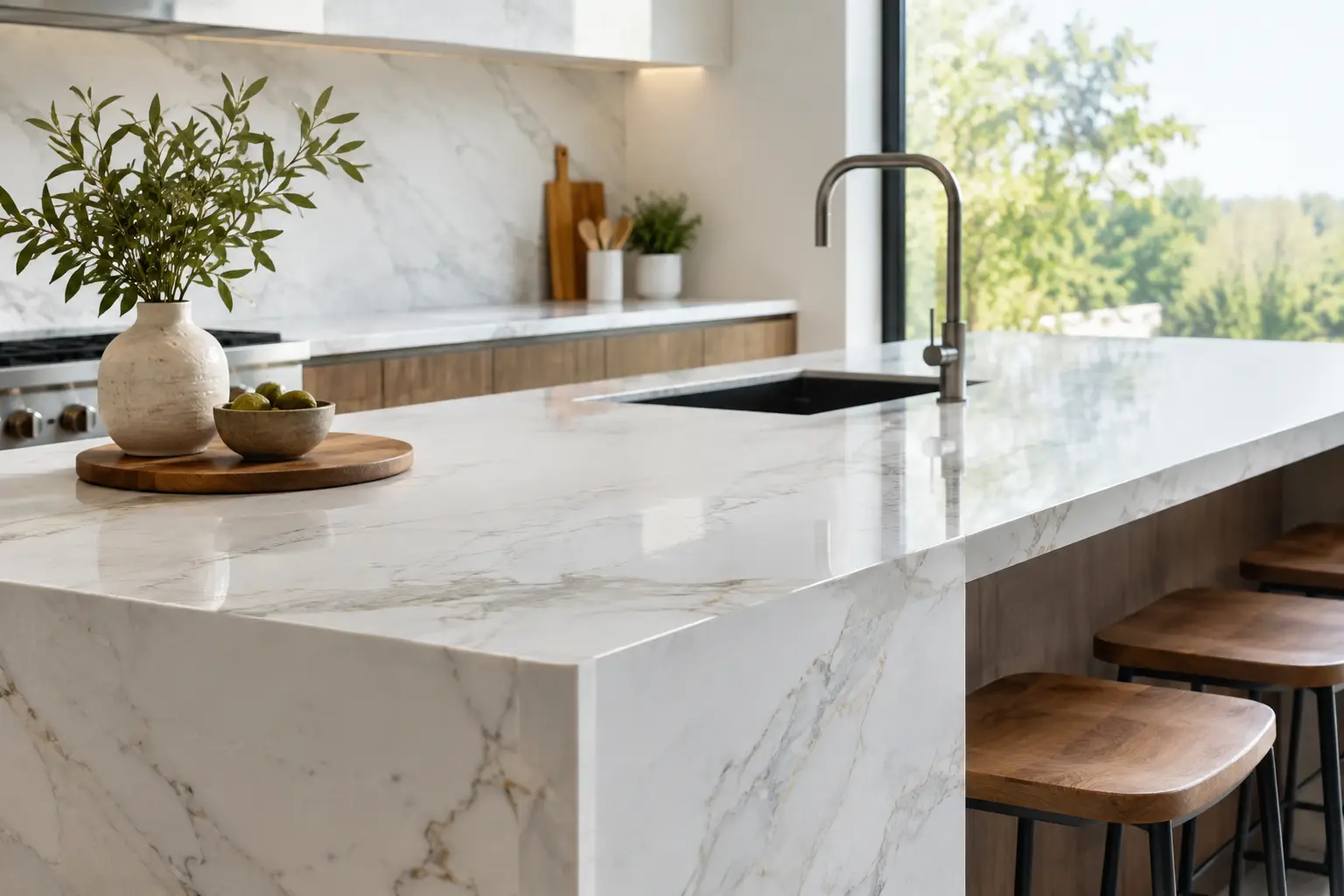
A porcelain slab can give a kitchen the quiet look of natural stone, concrete, or marble while handling everyday spills with relatively little upkeep. But a useful porcelain slab countertops review needs to go beyond the surface. The finished result depends as much on slab layout, fabrication, cabinet preparation, and installation as it does on the material itself.
Porcelain is a strong option for many kitchens, bathrooms, fireplaces, and outdoor counters. It is not, however, a material to choose based only on a small sample. Its thin profile, printed patterns, and fabrication requirements create design opportunities and practical limitations that homeowners should understand before ordering.
Quick Answer: Are Porcelain Slab Countertops Worth It?
Porcelain slab countertops are worth considering if you want a low-porosity, stain-resistant surface with good heat resistance and large-format design options. They generally require little maintenance and can work well indoors or outdoors when the product is approved for the application. Their main drawbacks are the possibility of chipped edges, specialized fabrication requirements, and limitations with certain edge profiles and unsupported spans. Proper slab selection, fabrication, and installation are essential.
What Porcelain Slab Countertops Are
Porcelain countertop slabs are manufactured from mineral materials that are compressed and fired at high temperatures. Many slabs are sold in a large-format, relatively thin format compared with standard 2 cm or 3 cm natural stone and quartz slabs. Exact thicknesses, finishes, and technical properties vary by manufacturer and collection.
The surface design may resemble marble, limestone, soapstone, concrete, metal, or a more uniform contemporary finish. Some patterns are very convincing from a distance, particularly on full-height backsplashes or large islands.
Look closely at the full slab before committing, though. Unlike natural stone, where mineral patterns can extend through the material, many porcelain designs have a decorative surface that differs from the slab body. Some manufacturers offer more coordinated body colours or through-body designs, so the appearance of exposed edges depends on the specific product.
For a broader look at available finishes and applications, explore Stone Valley’s porcelain countertop options.
Porcelain Slab Countertops Review: The Practical Advantages
Porcelain is often considered because it is dense, has very low water absorption, and is generally easy to clean. For a busy kitchen, that means common food and beverage spills are less likely to absorb into the surface than they would with many natural stones.
Routine care is usually straightforward: a soft cloth, water, and a mild cleaner appropriate for the manufacturer’s recommendations.
Good Resistance to Everyday Stains
Porcelain’s low-porosity surface makes it suitable for areas where cooking oils, coffee, sauces, and other household spills are common. Most spills can be removed without specialized stone cleaners when addressed promptly.
However, certain finishes and textured surfaces may require more attention to remove residue. Stain resistance should not be confused with being completely maintenance-free.
Heat Resistance for Kitchen Use
Porcelain performs well around heat in many applications. Its manufacturing process involves very high temperatures, and the finished material generally offers excellent heat resistance compared with some resin-based countertop products.
That does not mean every porcelain countertop should be treated as immune to thermal damage. A hot pan can still create problems if it is dropped, if the countertop experiences sudden temperature changes, or if the particular product has manufacturer-specific restrictions.
Trivets remain a sensible habit, especially near seams, edges, and cutouts.
Large Slabs and Fewer Visible Joints
The large slab format can be a significant visual advantage. A long island, a vanity, or a run of full-height backsplash may require fewer seams than some other materials.
Fewer seams do not always mean no seams. Available slab size, room access, backsplash height, and countertop shape all affect the final layout.
Suitable for Certain Outdoor Applications
For homeowners planning an outdoor kitchen, porcelain is worth discussing because suitable exterior-rated products offer strong resistance to UV exposure and moisture.
The cabinet structure, support system, climate conditions, and specific slab product still need to be reviewed. An outdoor counter has different demands than an indoor kitchen, especially in Ontario’s freeze-thaw conditions.
Confirm that the selected slab and installation system are approved for exterior use rather than assuming every porcelain product is suitable outdoors.
Porcelain Countertops: Pros and Cons at a Glance
The following comparison summarizes the main advantages and limitations homeowners should consider before choosing porcelain.
| Feature | Advantage | Consideration |
|---|---|---|
| Stain resistance | Very low water absorption and easy routine cleaning | Textured finishes may retain surface residue |
| Heat resistance | Handles many normal kitchen heat exposures | Thermal shock and impact remain concerns |
| Scratch resistance | Hard surface resists many everyday scratches | Not completely scratch-proof |
| Edges | Clean, modern profiles and mitered build-ups | Exposed corners can chip under impact |
| Design | Large formats and realistic stone-inspired patterns | Printed veining may not continue through edges |
| Maintenance | Generally does not require sealing | Chips and damaged edges can be difficult to repair invisibly |
Where Porcelain Requires More Planning
Porcelain is hard, but hardness is not the same as being immune to damage. The material can chip if a heavy object strikes an exposed edge or corner.
This matters most on sharp profiles, narrow strips around sinks, and overhang corners that receive regular contact from stools or cookware.
Specialized Fabrication and Cutouts
Fabrication requires specialized tooling, careful handling, and an experienced approach to cutouts and edges.
Sink openings, cooktop cutouts, faucet holes, and inside corners create areas of stress. A fabricator will assess whether the design needs corner radiuses, added support, or adjustments to avoid overly narrow pieces of material.
These decisions should be made before cutting begins. Changes after fabrication can be difficult or impractical, particularly when the slab has a directional pattern or limited replacement availability.
Understanding the stone fabrication process can help homeowners see why accurate templating, cutout planning, and quality checks matter.
Thin Slabs and Mitered Edges
Thin porcelain also changes the edge discussion. Many homeowners want the visual weight of a thicker countertop, such as a 1 1/4-inch profile, while selecting a thinner porcelain slab.
This can often be achieved with a built-up or mitered edge, where pieces are joined to create a thicker appearance.
The detail can look clean and substantial, but the miter line remains a fabricated joint and should be viewed up close before finalizing the design.
Not every countertop edge profile is equally suitable. A simple eased edge is often practical and understated. More decorative profiles may be limited by the slab thickness and the pattern at the edge.
If the chosen design has bold marble-like veins, ask how those veins will continue through a mitered edge or waterfall leg. The answer may affect both appearance and material yield.
Seams, Patterns, and Full-Slab Selection
A seam is a normal part of many countertop projects, including porcelain. The goal is to place it thoughtfully, keep it as unobtrusive as practical, and avoid putting it in a vulnerable area when the layout allows.
A long L-shaped kitchen, oversized island, stair access limitations, or a full-height backsplash can all make a seam necessary.
With porcelain, seam visibility depends on the colour, finish, pattern, lighting, and the direction in which the slabs are laid out.
A quiet solid-look surface may make a seam less noticeable. A dramatic veined pattern can make the seam more visible if the veining does not align, or less noticeable if the layout is planned carefully.
There is no universal answer without looking at the actual slabs and project dimensions. Our guide to what causes countertop seam visibility explains the factors that influence the finished joint.
Why Full-Slab Viewing Matters
Viewing the full slab is particularly valuable with directional patterns. A sample may show one attractive vein, but it cannot show where that vein lands on a 10-foot island, whether it can continue onto a backsplash, or how much material is needed for waterfall panels.
Confirm the direction of the pattern before fabrication and discuss which areas matter most visually.
For some projects, the island face deserves priority. For others, it is the range wall or a bookmatched backsplash.
Before committing to a design, review our guide to choosing a countertop slab for practical considerations beyond the appearance of a small sample.
Sinks, Overhangs, and Support Details
Undermount Sink Installation
An undermount sink can give porcelain a clean, continuous look, but the cutout must be fabricated and supported correctly.
The sink’s mounting method, weight, and cabinet construction all matter. Large single-bowl sinks and heavy accessories should be discussed before fabrication rather than after the countertop arrives.
Depending on the installation, an independent sink support system may be appropriate so the sink’s weight is not carried solely by the porcelain edge or adhesive connection.
Countertop Overhang Support
Overhangs require the same practical thinking. A modest seating overhang may be possible without visible brackets depending on the countertop design, thickness, cabinet construction, and manufacturer’s requirements.
Larger overhangs often need concealed or visible support. Do not assume a thin porcelain slab can simply span farther because the material itself is hard.
The support plan should be settled before installation, with the slab manufacturer’s specifications guiding the allowable design.
Our article on how to measure countertop overhang explains how finished cabinet dimensions, seating clearance, and edge profiles affect the layout.
Waterfall Islands and Vertical Panels
Waterfall countertop designs need careful cabinet alignment and floor conditions.
The countertop and vertical panel must meet cleanly at the miter, and the cabinet base must be level and adequately supported to avoid unnecessary stress on the joint.
These details are not cosmetic afterthoughts. They affect the fit, the joint line, and the long-term performance of the installation.
How Much Do Porcelain Slab Countertops Cost in Ontario?
Porcelain countertop pricing depends on more than the square footage of the finished surface.
Two kitchens with similar countertop dimensions can have different costs because of the slab selected, material thickness, edge construction, number of cutouts, seam layout, and installation conditions.
The main pricing factors include:
- Slab brand and collection: Different manufacturers and finishes have different material costs.
- Slab thickness: Thin slabs and thicker formats may require different fabrication and support methods.
- Mitered edges: Building up a thicker-looking edge adds cutting, finishing, and assembly work.
- Sink and cooktop cutouts: Openings require precise fabrication and may need additional reinforcement or support.
- Pattern matching: Directional veining, waterfall panels, and bookmatching can increase material requirements.
- Installation access: Large pieces, stairs, tight entrances, and difficult handling conditions affect installation planning.
A simple vanity top and a large kitchen island with waterfall legs should not be priced as though they involve the same fabrication work.
For Ontario homeowners, a detailed quote based on the selected slab, final measurements, edge design, and installation requirements is more useful than relying on a generic square-foot price.
Porcelain vs. Quartz and Natural Stone
Porcelain is not automatically better or worse than quartz, granite, marble, or quartzite. Each material has advantages that suit different projects.
| Material | Main Strength | Main Consideration |
|---|---|---|
| Porcelain | Low maintenance, heat resistance, large-format designs | Edge impact and specialized fabrication |
| Quartz | Consistent patterns, low maintenance, versatile fabrication | Heat sensitivity and limitations with prolonged UV exposure |
| Granite | Natural patterns and good heat resistance | Absorbency and sealing needs vary by stone |
| Quartzite | Natural veining and strong scratch resistance in suitable varieties | Variable absorbency and maintenance requirements |
| Marble | Distinctive natural veining and traditional stone appearance | More susceptible to acid etching and visible wear |
Homeowners who want a low-maintenance surface with a marble-inspired design may find porcelain appealing. Those who prefer natural mineral variation, thicker exposed edges, or certain traditional profiles may favour a natural stone.
Compare actual slabs, fabrication requirements, and maintenance expectations before making the final decision.
Maintenance and Everyday Use
Porcelain does not usually need the regular sealing associated with many natural stone surfaces, but it still benefits from normal care.
Wipe spills promptly, avoid abrasive pads unless the manufacturer permits them, and do not use harsh products without checking their suitability for the specific finish.
Simple Daily Cleaning
For routine cleaning, use a soft cloth or non-abrasive sponge with warm water and a mild cleaner approved for the surface.
Remove food residue and grease rather than allowing buildup to collect, particularly on textured finishes.
Follow the manufacturer’s recommendations for removing stubborn marks, mineral deposits, or adhesive residue. Cleaning methods suitable for one finish may not be recommended for another.
Preventing Chips and Impact Damage
The most common risks are impact damage and damage caused by force at vulnerable points.
Avoid standing on the countertop, placing heavy loads on unsupported overhangs, or striking the edge with cast iron cookware.
If a chip occurs, repairs may be possible in some situations, but a repair is rarely invisible. A lighter or busier pattern can sometimes disguise small damage better than a dark, uniform surface.
Is Porcelain Right for Your Project?
Porcelain is a good fit for homeowners who want a low-porosity surface, large-format design possibilities, and a contemporary or natural-stone look without the maintenance routine of some stone materials.
It can work especially well for kitchens with full-height backsplashes, streamlined vanities, fireplace surrounds, and outdoor counter areas where the chosen product is approved for the conditions.
It may be less suitable if you want a deeply carved edge profile, expect a completely through-body marble appearance at every exposed edge, or need a countertop design with long unsupported spans.
Quartz, granite, quartzite, or other materials may better suit some of those priorities. The right choice depends on the slab, the design, the cabinets, and how the space will be used.
Before making a final selection, review the full slab, confirm the edge build-up and seam plan, and discuss sink cutouts, overhang support, and pattern direction with your fabricator.
Those conversations turn a good-looking sample into a countertop that is properly planned for your home.
Frequently Asked Questions About Porcelain Slab Countertops
Are porcelain slab countertops durable?
Yes. Porcelain slabs offer strong resistance to many everyday scratches, stains, and heat exposures. However, edges and corners can chip under impact. Proper fabrication, support, and installation are important for long-term performance.
Do porcelain countertops chip easily?
Porcelain can chip when a hard or heavy object strikes an exposed edge, corner, or vulnerable cutout area. It is a hard material, but that does not make it impact-proof. Edge design and careful everyday use help reduce the risk.
Are porcelain countertops better than quartz?
Neither material is universally better. Porcelain offers excellent heat resistance and can be suitable for exterior applications when approved by the manufacturer. Engineered quartz offers consistent designs and is often more forgiving for certain fabrication and edge details. The better option depends on the kitchen design and intended use.
How much do porcelain slab countertops cost in Ontario?
Porcelain countertop costs vary according to the slab brand, thickness, project size, edge construction, cutouts, pattern matching, and installation access. A detailed quote based on the actual slab and layout is more reliable than a general square-foot estimate.
Can porcelain countertops be used outdoors in Ontario?
Yes, provided the selected porcelain slab is approved for exterior use and the installation system is designed for the conditions. Ontario’s freeze-thaw cycles, moisture exposure, structural support, and movement requirements should all be considered before installation.
Planning a Porcelain Countertop Project in Ontario?
If you are considering porcelain countertops for a kitchen, bathroom, fireplace, or outdoor project, Stone Valley Countertops can help you review slab options, edge details, seams, cutouts, and installation requirements before fabrication.
Visit one of our showrooms in Mississauga, Bowmanville, Welland, or Orillia to explore countertop materials and discuss your project.
For measurements, material questions, or a project-specific quotation, contact Stone Valley Countertops.