kitchen countertops Ontario

Quartz vs Quartzite Countertops Ontario: Key Differences

Quartz vs Quartzite Countertops: What Ontario Homeowners Need to Know

A practical guide to durability, maintenance, appearance, and value before you choose the right countertop for your kitchen or bathroom.

If you are comparing quartz vs quartzite countertops in Ontario, you are not alone. Many homeowners love the soft, elegant look of both materials, especially in popular colours inspired by Taj Mahal-style surfaces. But while they can look similar at first glance, quartz and quartzite are very different in how they are made, how they perform, and how much maintenance they need.

The right choice depends on your priorities. Some homeowners want a surface that is easier to maintain. Others want the natural movement and one-of-a-kind beauty that only real stone can offer. This guide breaks it down in simple terms so you can choose confidently.
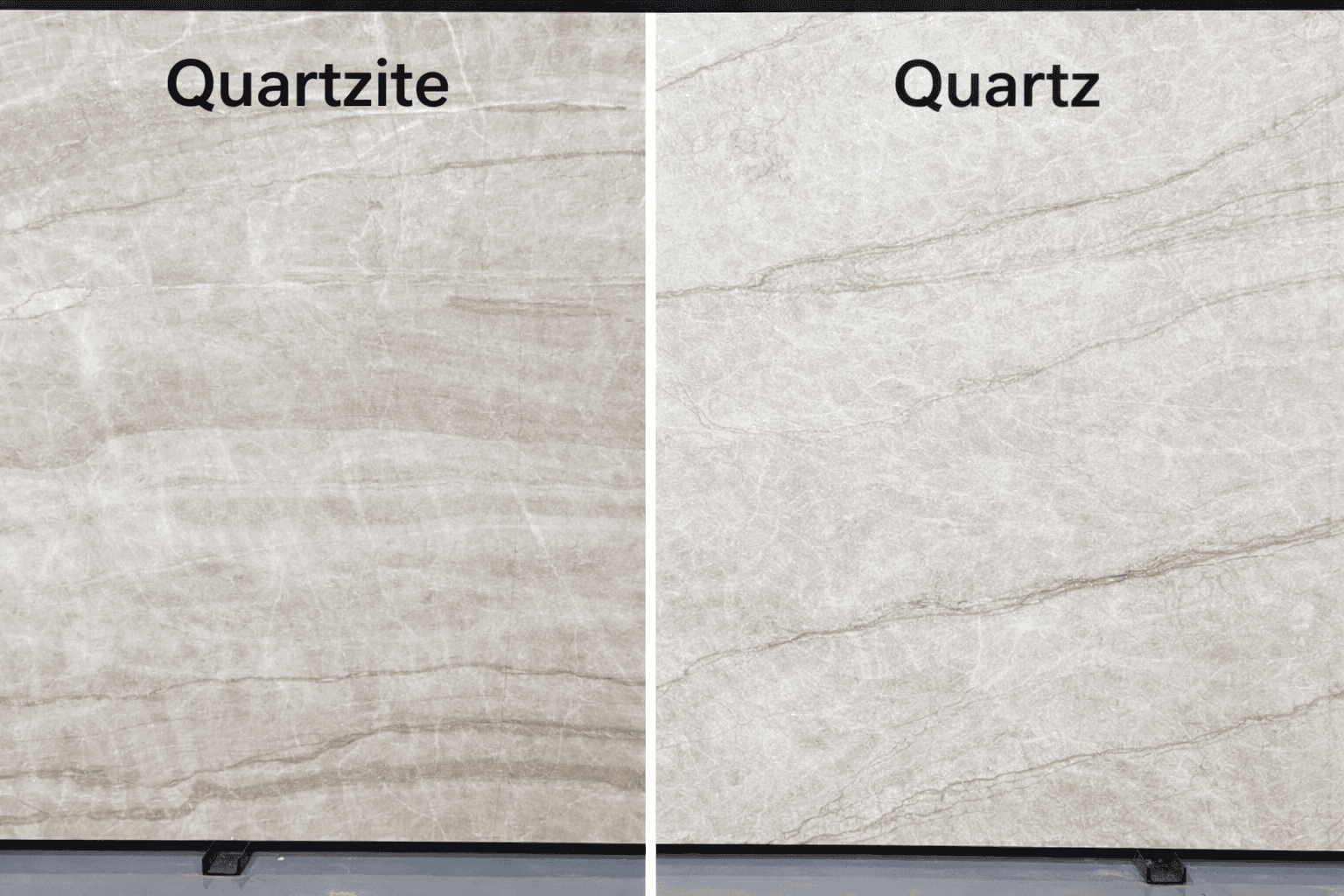
Side-by-side comparison of Taj Mahal quartzite and quartz countertops showing differences in natural veining and uniform pattern in Ontario
Side-by-side comparison showing how quartzite typically has more natural movement, while quartz usually offers a more consistent pattern.

Quick Answer

Quartzite is a natural stone formed by heat and pressure, so every slab is unique and usually has more natural veining and variation. Quartz is an engineered surface made with crushed quartz and resin, so it is more consistent, lower maintenance, and easier for many homeowners to live with day to day.

If you want a more natural and luxurious look, quartzite is often the winner. If you want easier maintenance and a more predictable pattern, quartz is often the better fit.

What Is the Difference Between Quartz and Quartzite?

The biggest difference is simple:

Quartzite is natural stone.
Quartz is engineered stone.

Quartzite

Quartzite starts as sandstone and changes under intense heat and pressure inside the earth. The result is a very hard natural stone with unique veining, colour movement, and character. No two slabs are exactly the same.

Quartz

Quartz countertops are made in a factory using crushed quartz mixed with resins and pigments. That gives manufacturers more control over colour, pattern, and consistency. It also means the finished slab usually looks more uniform from one section to another.

Quartz vs Quartzite Countertops Comparison Table

FeatureQuartzQuartzite
Material TypeEngineered stoneNatural stone
AppearanceMore consistent and controlledMore natural movement and variation
MaintenanceLow maintenanceNeeds sealing and more care
PorosityNon-porousPorous natural stone
Heat ResistanceGood, but direct heat should be avoidedGenerally better heat resistance
Pattern ConsistencyUsually more uniformUsually more unique and unpredictable
Best ForBusy households wanting easier careHomeowners wanting natural stone beauty

Appearance: Which One Looks Better?

This depends on the style you want in your home.

Why homeowners choose quartz

Quartz is popular because it gives a clean, refined, consistent look. If you want your kitchen to feel bright, polished, and controlled, quartz makes that easier. It is also a strong option when you want the island, perimeter, backsplash, or multiple vanities to match closely.

Why homeowners choose quartzite

Quartzite wins when the goal is natural depth and movement. The veining usually feels softer, more organic, and less repeated. Many Ontario homeowners who want a high-end custom look are drawn to quartzite because it feels more like a statement piece than a manufactured surface.

Simple rule: choose quartz if you want consistency. Choose quartzite if you want natural character.

Durability: Which Countertop Performs Better?

Both materials can perform very well when fabricated and installed properly, but they behave differently.

Quartz Strengths

  • Non-porous surface
  • Easy to clean
  • No sealing required
  • Great for everyday family use
  • Consistent finish and colour

Quartzite Strengths

  • Natural stone beauty
  • Very hard material
  • Excellent visual depth
  • Often better resistance to direct heat
  • Unique slab-to-slab variation

That said, durability is not just about hardness. It is also about daily use, maintenance habits, and how the countertop fits your lifestyle.

Maintenance: Which One Is Easier?

If low maintenance matters most to you, quartz usually has the advantage.

Quartz maintenance

Quartz does not need sealing. Since it is non-porous, it is easier to keep clean and less demanding for busy kitchens. For many homeowners, that convenience is a major reason to choose quartz.

Quartzite maintenance

Quartzite is natural stone, so it normally needs sealing to help protect it. It can still be a fantastic countertop material, but it asks for more care. Homeowners who love quartzite usually accept that extra maintenance because they want the natural look.

Best for easy care: quartz.
Best for natural stone lovers: quartzite.

Can Quartz and Quartzite Look Similar?

Yes, absolutely. This is why so many homeowners get confused during the shopping process.

Some quartz colours are designed to imitate natural stones such as Taj Mahal quartzite. From a distance, they can look similar. But when you compare them side by side, quartzite usually shows more natural depth, more irregular veining, and more organic movement. Quartz usually looks more controlled and repeatable.

That does not mean quartz looks bad. In many kitchens, that cleaner and more consistent look is exactly what the homeowner wants.

Which One Is Better for Ontario Kitchens?

For many Ontario kitchens, quartz is the easier choice because it offers a good balance of style, performance, and low maintenance. It works especially well for busy family homes, rentals, and projects where the homeowner wants a bright and consistent design.

Quartzite is often the better choice when the countertop is meant to be the star of the room. If you are investing in a custom kitchen and want a natural slab with real movement and premium character, quartzite can be worth it.

When to Choose Quartz

  1. You want a countertop that is easier to maintain.
  2. You want a more consistent look across the kitchen.
  3. You prefer not to deal with sealing.
  4. You want a practical surface for daily family use.
  5. You like stone-inspired patterns with more predictability.

When to Choose Quartzite

  1. You want real natural stone.
  2. You love unique veining and movement.
  3. You want a more custom, high-end slab look.
  4. You do not mind extra maintenance.
  5. You want your countertop to feel one of a kind.

What About Fabrication and Installation?

No matter which material you choose, the final result depends heavily on fabrication quality, seam planning, edge details, sink cutouts, and installation accuracy. A great slab can still disappoint if it is not measured, fabricated, and installed properly.

At Stone Valley Countertops, we help homeowners, contractors, and designers compare materials based on real project goals, not just showroom samples. We also guide clients through layout, edge profile selection, thickness options, and final installation details.

If you want to understand how the process works from start to finish, read our guide on how countertops are installed in Ontario.

Final Verdict: Quartz vs Quartzite Countertops

There is no one-size-fits-all winner.

Quartz is usually better for homeowners who want easier maintenance, consistency, and day-to-day practicality.

Quartzite is usually better for homeowners who want natural stone beauty, unique movement, and a more luxurious slab appearance.

The best choice comes down to how you want the countertop to look, how much maintenance you are comfortable with, and what matters most in your kitchen or bathroom project.

If you are also deciding on slab thickness, see our guide on 2cm vs 3cm countertops.

Frequently Asked Questions

Is quartz better than quartzite for kitchens?

Quartz is often better for homeowners who want lower maintenance and a more consistent look. Quartzite is often better for homeowners who want natural stone beauty and unique veining.

What is the main difference between quartz and quartzite?

The main difference is that quartz is engineered, while quartzite is a natural stone. That affects maintenance, appearance, and pattern consistency.

Does quartzite need sealing?

Yes, quartzite usually needs sealing because it is a natural stone. Proper sealing helps protect the surface and supports long-term performance.

Does quartz need sealing?

No, quartz does not typically need sealing because it is non-porous.

Which looks more natural, quartz or quartzite?

Quartzite usually looks more natural because each slab has unique movement, variation, and veining created by nature.

Can quartz look like Taj Mahal quartzite?

Yes, some quartz colours are designed to resemble Taj Mahal quartzite. They can be similar in tone, but quartzite usually has more natural depth and less pattern repetition.

Need Help Choosing the Right Countertop?

If you are comparing quartz vs quartzite countertops for your Ontario home, Stone Valley Countertops can help you choose the right material based on style, maintenance, and project goals.

Contact Stone Valley Countertops to discuss your kitchen, vanity, or renovation project.

2cm vs 3cm Countertops: Which Thickness Is Better in Ontario?

2cm vs 3cm Countertops: Which Thickness Is Better in Ontario?

Choosing between 2cm vs 3cm countertops is one of the most important decisions when planning a new kitchen, bathroom vanity, or renovation project. The thickness you choose affects strength, edge style, support requirements, appearance, and overall cost.

Many Ontario homeowners ask the same question: is 2cm enough, or is 3cm the better long-term choice? The answer depends on your design, your budget, the type of installation, and how you want the finished countertop to look.

At Stone Valley Countertops, we fabricate and install quartz, granite, marble, porcelain, and other stone surfaces across Mississauga, Bowmanville, Welland, and surrounding areas. In this guide, we will explain the real difference between 2cm and 3cm countertops in simple terms so you can make the right decision with confidence.

A side-by-side comparison of 2cm and 3cm countertop thickness on a quartz installation by Stone Valley Countertops.
A visual comparison of 2cm and 3cm countertop thickness on a quartz installation.

Quick Answer

In most Ontario kitchens, 3cm countertops are usually the better choice because they are thicker, stronger, and often do not require plywood support underneath. They also create a more solid and premium-looking edge.

2cm countertops can still be an excellent option, especially when paired with the right edge build-up, proper support, and the right design style. They are commonly used for modern looks, vertical applications, and projects where weight or budget matters.

What Does 2cm vs 3cm Countertops Mean?

The terms 2cm and 3cm refer to the thickness of the stone slab.

A 2cm countertop is approximately 20 millimetres thick. A 3cm countertop is approximately 30 millimetres thick. That small difference may not sound like much, but in stone fabrication and installation, it makes a big difference in how the countertop performs and how it looks once installed.

For quartz countertops, granite countertops, and some other natural or engineered stone products, these two thicknesses are among the most common choices.

2cm vs 3cm Countertops Comparison Table

Feature2cm Countertops3cm Countertops
ThicknessApproximately 20mmApproximately 30mm
StrengthStrong, but usually needs more support depending on span and applicationStronger and more rigid for many kitchen layouts
Support RequirementsMay require plywood support or additional reinforcementOften does not require plywood for standard cabinet installations
AppearanceSlimmer, modern, cleaner edge profile unless built upThicker, heavier, more premium appearance
Edge OptionsCan be mitered or laminated to appear thickerNaturally thicker edge without build-up
WeightLighterHeavier
CostCan be lower in some cases, but edge build-up and support may add costOften higher material cost, but may reduce extra support needs
Best ForModern designs, vanities, wall cladding, and selected kitchensBusy kitchens, larger spans, premium kitchen islands, and heavier-use areas

Is 2cm Quartz Strong Enough?

Yes, 2cm quartz is strong enough for many applications when it is fabricated and installed properly. The important part is not just the slab thickness. It is also the cabinet structure, the overhang size, the support underneath, the sink cutout area, and the edge detail.

A well-installed 2cm quartz countertop can perform very well in a kitchen or bathroom. However, it is generally less forgiving than 3cm when it comes to long unsupported spans or areas with more stress, such as around sinks, cooktops, and overhangs.

This is why experienced fabrication matters. The same 2cm slab can perform beautifully in one kitchen and have issues in another if the support or layout is not planned properly.

Installer insight: 2cm is not β€œbad” and 3cm is not automatically β€œrequired” for every project. The right choice depends on the design, edge profile, support plan, and how the countertop will actually be used every day.

Do 2cm Countertops Need Plywood Support?

In many cases, yes. A 2cm countertop may need plywood support under the stone, especially for kitchen applications. This added support helps distribute weight more evenly and reduce stress on the slab.

That said, the answer is not always the same for every project. Some installations depend on the material brand, the cabinet construction, the span, and the edge style. Certain applications may also use steel supports or brackets instead of plywood in specific areas.

If you are planning an overhang, breakfast bar, or island seating area, support becomes even more important. You can also read our full Countertop Overhang Support Guide for more detail on how overhangs should be reinforced properly.

Pros and Cons of 2cm Countertops

Advantages of 2cm Countertops

  • Creates a sleek, modern, minimalist look.
  • Weighs less than 3cm, which can help in some design applications.
  • Works well for bathroom vanities, wall panels, and selected kitchen projects.
  • Can be built up with a mitered or laminated edge to create the look of a thicker slab.
  • May offer cost savings in certain situations depending on fabrication details.

Disadvantages of 2cm Countertops

  • Usually needs more planning for support.
  • May require plywood underneath in many kitchen installations.
  • Can be less forgiving around cutouts and unsupported spans.
  • If you want a thicker visual look, extra fabrication may be needed.
  • Improper installation increases the risk of long-term issues.

Pros and Cons of 3cm Countertops

Advantages of 3cm Countertops

  • Thicker and more rigid for many kitchen applications.
  • Often does not require plywood support on standard cabinet runs.
  • Creates a stronger, more substantial, premium-looking edge.
  • Excellent choice for busy family kitchens and larger islands.
  • Often preferred for straightforward fabrication and installation.

Disadvantages of 3cm Countertops

  • Heavier than 2cm material.
  • May cost more depending on the product and supplier.
  • Not always necessary for every vanity or design style.
  • Some ultra-slim modern looks may be better achieved with 2cm.

Which Thickness Looks Better?

This comes down to design style.

If you want a thin, modern, European-style look, 2cm can look beautiful. It gives the countertop a sharper and lighter appearance. This style is often used in contemporary kitchens, bathroom vanities, and modern renovations.

If you want a fuller, heavier, more luxurious look, 3cm usually wins. It naturally gives the edge more visual presence and often feels more premium in traditional, transitional, and high-end kitchen designs.

There is also a middle ground. With the right fabrication, a 2cm slab can be mitered or built up to visually appear much thicker. This is common when homeowners want the clean performance of engineered stone but also want a bold designer edge profile.

Which Is Better for Kitchens: 2cm or 3cm?

For most kitchens, 3cm is usually the better choice. It gives better rigidity, a stronger look, and fewer support concerns in many standard cabinet installations.

That is especially true for:

Busy family kitchens, large islands, homes with children, projects with sink cutouts near corners, kitchens with more overhang, and homeowners who want a solid premium finish without added build-up details.

However, 2cm can still be the right choice if the kitchen is designed properly and the support is handled correctly. Some premium modern kitchens use 2cm intentionally for the visual style.

Best general recommendation: If a homeowner wants the safest and most commonly recommended option for a kitchen, 3cm is usually the stronger all-around answer. If the homeowner wants a slim designer look and the project is engineered correctly, 2cm can work very well too.

What About Cost in Ontario?

One of the biggest questions homeowners ask is whether 2cm countertops are cheaper than 3cm. In many cases, they can be, but the final answer is not always that simple.

Countertop pricing in Ontario depends on much more than just slab thickness. It also depends on:

The material brand, the colour selection, slab availability, fabrication complexity, edge profile, sink cutouts, backsplash details, overhang support, and whether a 2cm slab needs additional plywood or laminated build-up.

Sometimes a 2cm slab starts with a lower material cost, but once extra edge work and support are added, the total difference becomes smaller. In other cases, 3cm may cost more upfront but simplify the installation and create better long-term value.

If you are still comparing materials, you can also visit our Quartz Countertops page to learn more about one of the most popular countertop options for Ontario homes.

When Stone Valley Countertops Recommends 2cm

At Stone Valley Countertops, we may recommend 2cm when the project calls for a slimmer modern look, when the application is a vanity or decorative surface, when the design includes a mitered edge build-up, or when the support plan has already been designed properly.

We also see 2cm used strategically in certain wall applications, shower areas, fireplace features, and custom projects where the visual result matters just as much as the structural plan.

When Stone Valley Countertops Recommends 3cm

We often recommend 3cm for kitchen countertops, larger islands, family homes, and projects where durability and long-term performance are the main priorities. It is usually the easier recommendation when a homeowner wants strength, simplicity, and a more solid finished look.

For many Ontario kitchens, especially in Mississauga, Bowmanville, Welland, and surrounding service areas, 3cm is the thickness homeowners feel most confident choosing once they understand the difference.

Common Mistakes Homeowners Make When Comparing 2cm vs 3cm

Thinking thinner means weak

2cm is not automatically weak. It simply requires more intentional planning in many applications.

Thinking thicker means always better

3cm is often the safer kitchen choice, but it is not the best fit for every design style or application.

Ignoring support requirements

Overhangs, sink cutouts, and unsupported spans matter just as much as slab thickness.

Choosing based only on price

The cheapest option is not always the best value if it creates extra fabrication or support requirements later.

Not asking the fabricator real installation questions

The right fabricator should explain support, edge treatment, cabinet readiness, overhang limits, and how the thickness choice affects the finished look.

Final Verdict: Should You Choose 2cm or 3cm Countertops?

If you want the simplest answer, here it is:

Choose 3cm countertops if you want the most common, strong, premium-looking kitchen option with fewer support concerns.

Choose 2cm countertops if you want a sleek modern look, lighter visual profile, or a design-specific application that is properly supported and professionally planned.

The best choice is not about following a trend. It is about matching the right thickness to your design, layout, and day-to-day use.

That is where professional fabrication and installation make the real difference.

Frequently Asked Questions About 2cm vs 3cm Countertops

Are 2cm countertops good for kitchens?

Yes, 2cm countertops can be good for kitchens when they are properly supported and professionally installed. They are commonly used in modern designs, but support requirements must be reviewed carefully.

Are 3cm countertops better than 2cm?

For many kitchens, 3cm countertops are often the better all-around choice because they are thicker, more rigid, and usually require less additional support. However, 2cm may be better for certain design styles and applications.

Do 2cm quartz countertops need plywood?

Many 2cm quartz countertops do need plywood or another support method, especially in kitchen installations. The exact requirement depends on the layout, span, material, and fabrication details.

Is 3cm quartz more expensive?

Often yes, but not always by a large amount once fabrication, support, and edge details are considered. Final pricing depends on the full project scope, not just the slab thickness alone.

Which countertop thickness looks more expensive?

3cm usually looks more substantial and premium because of its natural thickness. However, a well-made 2cm countertop with a mitered edge can also create a very high-end custom appearance.

Is 2cm or 3cm better for bathroom vanities?

Both can work well. Many vanities use 2cm successfully because the spans are smaller and the slimmer look suits bathroom design. 3cm can also be used when a thicker, bolder look is preferred.

What is the most popular countertop thickness in Ontario kitchens?

For many kitchens, 3cm is one of the most popular choices because homeowners like the stronger appearance and reduced support concerns. Still, 2cm remains popular in modern and custom applications.

Can 2cm countertops look like 3cm?

Yes. A 2cm countertop can be fabricated with a mitered or laminated edge build-up so it appears thicker and creates a more dramatic finished profile.

Why Homeowners Across Ontario Trust Stone Valley Countertops

Stone Valley Countertops fabricates and installs quartz, granite, marble, porcelain, quartzite, and other stone surfaces for homeowners, builders, designers, and contractors across Ontario. We focus on precise fabrication, clean installation, fast turnaround times, and helping customers choose the right solution for their space.

Whether you are planning a new kitchen in Mississauga, updating a vanity in Bowmanville, or comparing countertop thickness options for a renovation in Welland, our team can help you choose the right material, edge profile, and slab thickness for the best result.

Need Help Choosing 2cm or 3cm Countertops?

If you are planning a kitchen or bathroom renovation and want expert advice on countertop thickness, material selection, pricing, fabrication, and installation, contact Stone Valley Countertops today.

Contact Stone Valley Countertops

This guide was created using practical fabrication and installation insight to help Ontario homeowners make informed countertop decisions.

For additional product information, you can also explore leading quartz manufacturers such as Caesarstone and Cambria.