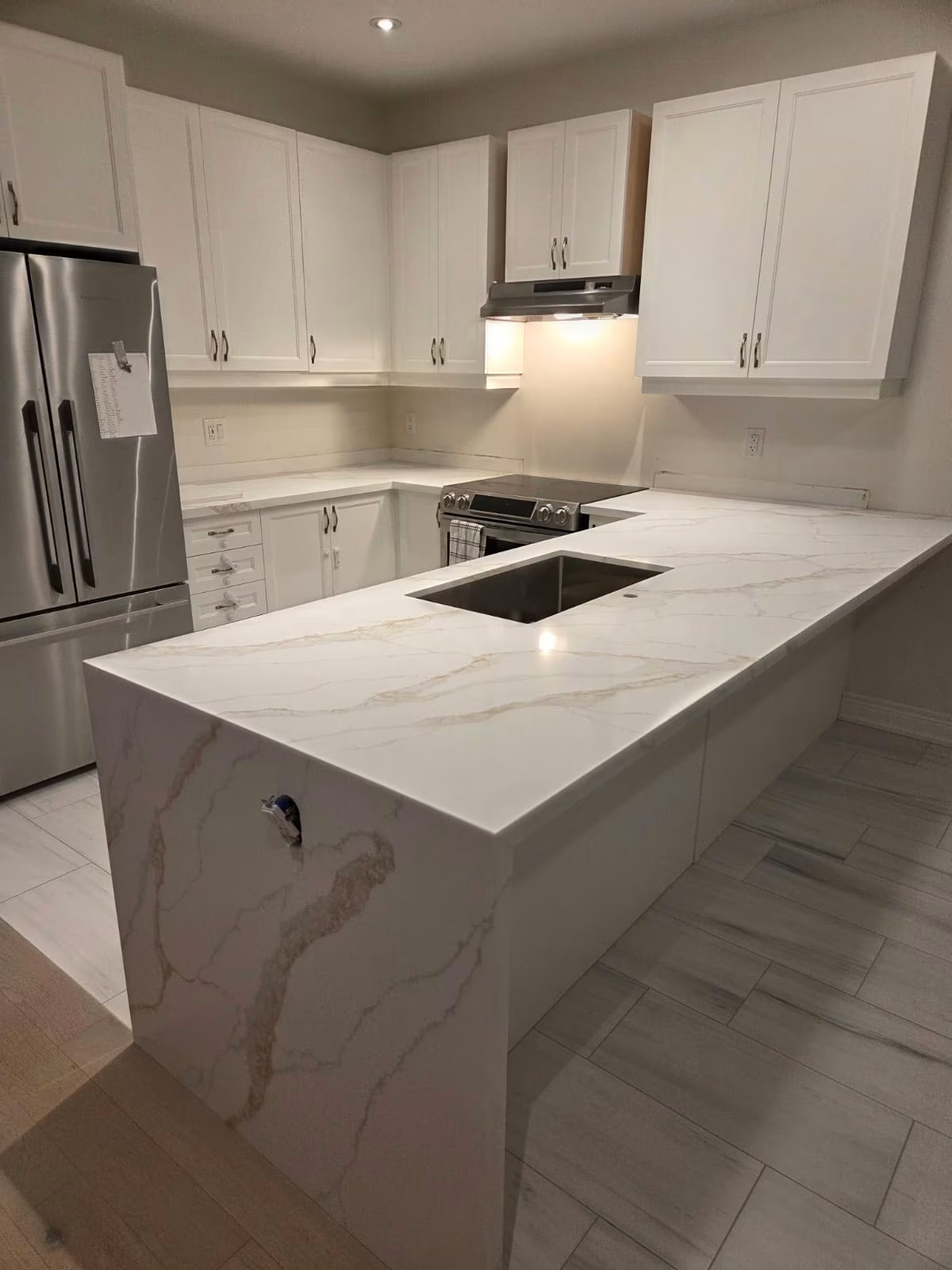
Quartz vs Quartzite Countertops: What Ontario Homeowners Need to Know
A practical guide to durability, maintenance, appearance, and value before you choose the right countertop for your kitchen or bathroom.
If you are comparing quartz vs quartzite countertops in Ontario, you are not alone. Many homeowners love the soft, elegant look of both materials, especially in popular colours inspired by Taj Mahal-style surfaces. But while they can look similar at first glance, quartz and quartzite are very different in how they are made, how they perform, and how much maintenance they need.
The right choice depends on your priorities. Some homeowners want a surface that is easier to maintain. Others want the natural movement and one-of-a-kind beauty that only real stone can offer. This guide breaks it down in simple terms so you can choose confidently.
Quick Answer
Quartzite is a natural stone formed by heat and pressure, so every slab is unique and usually has more natural veining and variation. Quartz is an engineered surface made with crushed quartz and resin, so it is more consistent, lower maintenance, and easier for many homeowners to live with day to day.
If you want a more natural and luxurious look, quartzite is often the winner. If you want easier maintenance and a more predictable pattern, quartz is often the better fit.
What Is the Difference Between Quartz and Quartzite?
The biggest difference is simple:
Quartzite is natural stone.
Quartz is engineered stone.
Quartzite
Quartzite starts as sandstone and changes under intense heat and pressure inside the earth. The result is a very hard natural stone with unique veining, colour movement, and character. No two slabs are exactly the same.
Quartz
Quartz countertops are made in a factory using crushed quartz mixed with resins and pigments. That gives manufacturers more control over colour, pattern, and consistency. It also means the finished slab usually looks more uniform from one section to another.
Quartz vs Quartzite Countertops Comparison Table
| Feature | Quartz | Quartzite |
|---|---|---|
| Material Type | Engineered stone | Natural stone |
| Appearance | More consistent and controlled | More natural movement and variation |
| Maintenance | Low maintenance | Needs sealing and more care |
| Porosity | Non-porous | Porous natural stone |
| Heat Resistance | Good, but direct heat should be avoided | Generally better heat resistance |
| Pattern Consistency | Usually more uniform | Usually more unique and unpredictable |
| Best For | Busy households wanting easier care | Homeowners wanting natural stone beauty |
Appearance: Which One Looks Better?
This depends on the style you want in your home.
Why homeowners choose quartz
Quartz is popular because it gives a clean, refined, consistent look. If you want your kitchen to feel bright, polished, and controlled, quartz makes that easier. It is also a strong option when you want the island, perimeter, backsplash, or multiple vanities to match closely.
Why homeowners choose quartzite
Quartzite wins when the goal is natural depth and movement. The veining usually feels softer, more organic, and less repeated. Many Ontario homeowners who want a high-end custom look are drawn to quartzite because it feels more like a statement piece than a manufactured surface.
Simple rule: choose quartz if you want consistency. Choose quartzite if you want natural character.
Durability: Which Countertop Performs Better?
Both materials can perform very well when fabricated and installed properly, but they behave differently.
Quartz Strengths
- Non-porous surface
- Easy to clean
- No sealing required
- Great for everyday family use
- Consistent finish and colour
Quartzite Strengths
- Natural stone beauty
- Very hard material
- Excellent visual depth
- Often better resistance to direct heat
- Unique slab-to-slab variation
That said, durability is not just about hardness. It is also about daily use, maintenance habits, and how the countertop fits your lifestyle.
Maintenance: Which One Is Easier?
If low maintenance matters most to you, quartz usually has the advantage.
Quartz maintenance
Quartz does not need sealing. Since it is non-porous, it is easier to keep clean and less demanding for busy kitchens. For many homeowners, that convenience is a major reason to choose quartz.
Quartzite maintenance
Quartzite is natural stone, so it normally needs sealing to help protect it. It can still be a fantastic countertop material, but it asks for more care. Homeowners who love quartzite usually accept that extra maintenance because they want the natural look.
Best for easy care: quartz.
Best for natural stone lovers: quartzite.
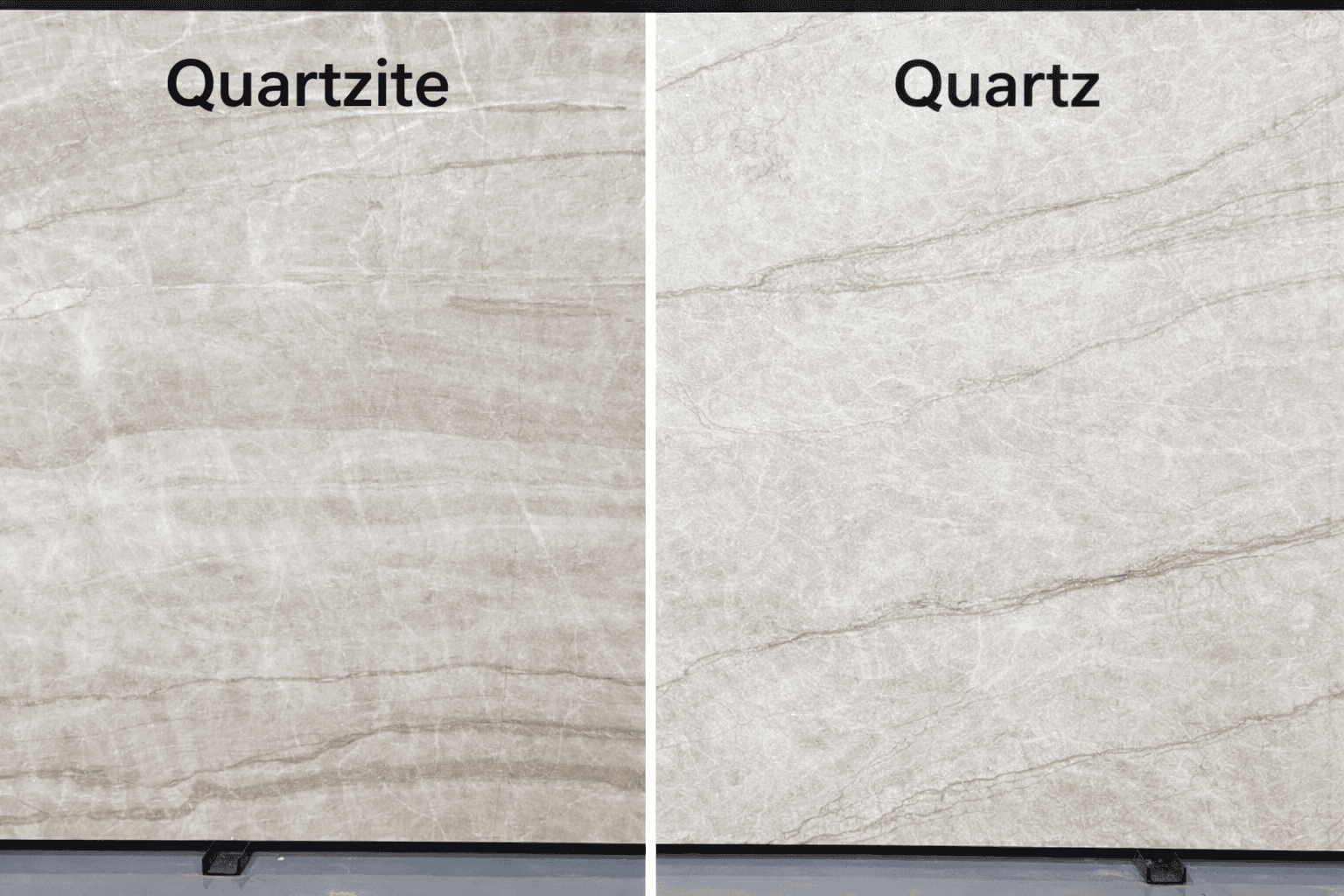
Can Quartz and Quartzite Look Similar?
Yes, absolutely. This is why so many homeowners get confused during the shopping process.
Some quartz colours are designed to imitate natural stones such as Taj Mahal quartzite. From a distance, they can look similar. But when you compare them side by side, quartzite usually shows more natural depth, more irregular veining, and more organic movement. Quartz usually looks more controlled and repeatable.
That does not mean quartz looks bad. In many kitchens, that cleaner and more consistent look is exactly what the homeowner wants.
Which One Is Better for Ontario Kitchens?
For many Ontario kitchens, quartz is the easier choice because it offers a good balance of style, performance, and low maintenance. It works especially well for busy family homes, rentals, and projects where the homeowner wants a bright and consistent design.
Quartzite is often the better choice when the countertop is meant to be the star of the room. If you are investing in a custom kitchen and want a natural slab with real movement and premium character, quartzite can be worth it.
When to Choose Quartz
- You want a countertop that is easier to maintain.
- You want a more consistent look across the kitchen.
- You prefer not to deal with sealing.
- You want a practical surface for daily family use.
- You like stone-inspired patterns with more predictability.
When to Choose Quartzite
- You want real natural stone.
- You love unique veining and movement.
- You want a more custom, high-end slab look.
- You do not mind extra maintenance.
- You want your countertop to feel one of a kind.
What About Fabrication and Installation?
No matter which material you choose, the final result depends heavily on fabrication quality, seam planning, edge details, sink cutouts, and installation accuracy. A great slab can still disappoint if it is not measured, fabricated, and installed properly.
At Stone Valley Countertops, we help homeowners, contractors, and designers compare materials based on real project goals, not just showroom samples. We also guide clients through layout, edge profile selection, thickness options, and final installation details.
If you want to understand how the process works from start to finish, read our guide on how countertops are installed in Ontario.
Final Verdict: Quartz vs Quartzite Countertops
There is no one-size-fits-all winner.
Quartz is usually better for homeowners who want easier maintenance, consistency, and day-to-day practicality.
Quartzite is usually better for homeowners who want natural stone beauty, unique movement, and a more luxurious slab appearance.
The best choice comes down to how you want the countertop to look, how much maintenance you are comfortable with, and what matters most in your kitchen or bathroom project.
If you are also deciding on slab thickness, see our guide on 2cm vs 3cm countertops.
Frequently Asked Questions
Is quartz better than quartzite for kitchens?
Quartz is often better for homeowners who want lower maintenance and a more consistent look. Quartzite is often better for homeowners who want natural stone beauty and unique veining.
What is the main difference between quartz and quartzite?
The main difference is that quartz is engineered, while quartzite is a natural stone. That affects maintenance, appearance, and pattern consistency.
Does quartzite need sealing?
Yes, quartzite usually needs sealing because it is a natural stone. Proper sealing helps protect the surface and supports long-term performance.
Does quartz need sealing?
No, quartz does not typically need sealing because it is non-porous.
Which looks more natural, quartz or quartzite?
Quartzite usually looks more natural because each slab has unique movement, variation, and veining created by nature.
Can quartz look like Taj Mahal quartzite?
Yes, some quartz colours are designed to resemble Taj Mahal quartzite. They can be similar in tone, but quartzite usually has more natural depth and less pattern repetition.
Need Help Choosing the Right Countertop?
If you are comparing quartz vs quartzite countertops for your Ontario home, Stone Valley Countertops can help you choose the right material based on style, maintenance, and project goals.
Contact Stone Valley Countertops to discuss your kitchen, vanity, or renovation project.