Quartz

Quartz Countertop Color Trends for 2025: What’s Hot & What’s Not

Quartz Countertop Color Trends for 2025: What’s Hot & What’s Not

From warm cinnamon veins to bold greens, discover the most popular quartz countertop color trends for 2025. These styles are transforming kitchens and bathrooms across Ontario. Whether you’re renovating or building new, this guide helps you choose the perfect color—and shows how to keep it looking fresh for years to come.

Modern kitchen with quartz countertop color trends for 2025 in warm tones
Modern kitchen featuring quartz countertops in warm tones

Warm Quartz Color Trends 2025: Gold & Cinnamon Veining

One of the biggest 2025 quartz trends is the return of warm tones. Rich white or cream backgrounds with golden or cinnamon veining add subtle luxury and a cozy aesthetic. According to MSI’s 2025 color trend report, homeowners are increasingly opting for these earth-inspired hues to soften modern spaces without losing elegance.

Taj Mahal quartz slab with subtle beige and taupe veining
Taj Mahal quartz slab featuring soft beige and taupe veining

2025 Quartz Color Trends: Greens, Blues & Specialty Shades

Muted greens and deep navy blues are popping up more frequently in quartz slabs this year. These shades work beautifully with matte black fixtures, warm wood cabinetry, and brushed brass hardware. In fact, specialty color quartz offers a dramatic yet balanced contrast in both kitchens and bathrooms. If you want more ways to coordinate countertops and cabinetry, check out our countertop and cabinet pairing guide.

Quartz Color Trends in 2025: Bold Prints & High-Definition Patterns

Thanks to advanced technology, manufacturers are now printing high-definition patterns directly into quartz. These slabs mimic marble, concrete, or even abstract designs—making them perfect for homeowners who want a unique statement without the high maintenance. If you’re exploring style options, don’t miss our article on countertop design trends for 2025.

2025 Quartz Countertop Finishes: Textured and Matte Are In

Glossy surfaces are taking a backseat in 2025. Instead, honed and textured quartz finishes are now in high demand. These surfaces not only reduce glare but also offer a natural, tactile feel that pairs beautifully with minimalist interiors. For help choosing the right edge treatment, be sure to explore our edge profiles guide.

How to Choose the Right Quartz Color in 2025

  • Cabinet Match: Lighter quartz with gold veining complements dark wood cabinets.
  • Lighting: Warm-toned quartz looks best under soft white or daylight LEDs.
  • Design Goal: Choose prints or specialty colors to make a bold design statement.

Need help selecting the right slab? Visit our quartz countertop service page for design support and expert installation.

2025 Quartz Maintenance Tips: Keep Trendy Colors Looking Fresh

Colorful and printed quartz is just as easy to maintain as standard slabs. Simply use warm water and mild soap—no harsh chemicals. Additionally, for in-depth guidance on maintaining beauty and durability, see our complete quartz durability and maintenance guide.

Quartz Countertops in Ontario: Local Trends & Services

We proudly serve multiple locations across Ontario. Below are some of our most popular regional services:

Looking Ahead: Quartz Color Trends Beyond 2025

While 2025 is all about earthy warmth, texture, and print, the next big wave is likely to include bolder marbles and sustainable quartz options. To stay updated, follow our Stone Valley blog for future trend insights and expert advice.

Ready to upgrade your kitchen with a trendy quartz surface? Contact us for a free quote today.

FAQs About Quartz Countertop Color Trends 2025

What are the most popular quartz colors in 2025?

Warm whites with gold or cinnamon veining, muted greens, navy blue, and marble-inspired prints are among the top quartz color trends for 2025.

Are matte quartz finishes better than glossy?

Matte finishes are trending in 2025 because they offer a modern, natural look and resist fingerprints better than polished surfaces.

Do quartz color trends change every year?

Not drastically. Core neutrals like white and beige remain timeless, but accent colors and finishes evolve annually based on design trends.

Is quartz a good long-term investment?

Yes — quartz is durable, low-maintenance, and retains its style appeal for decades, making it one of the best long-term countertop investments.
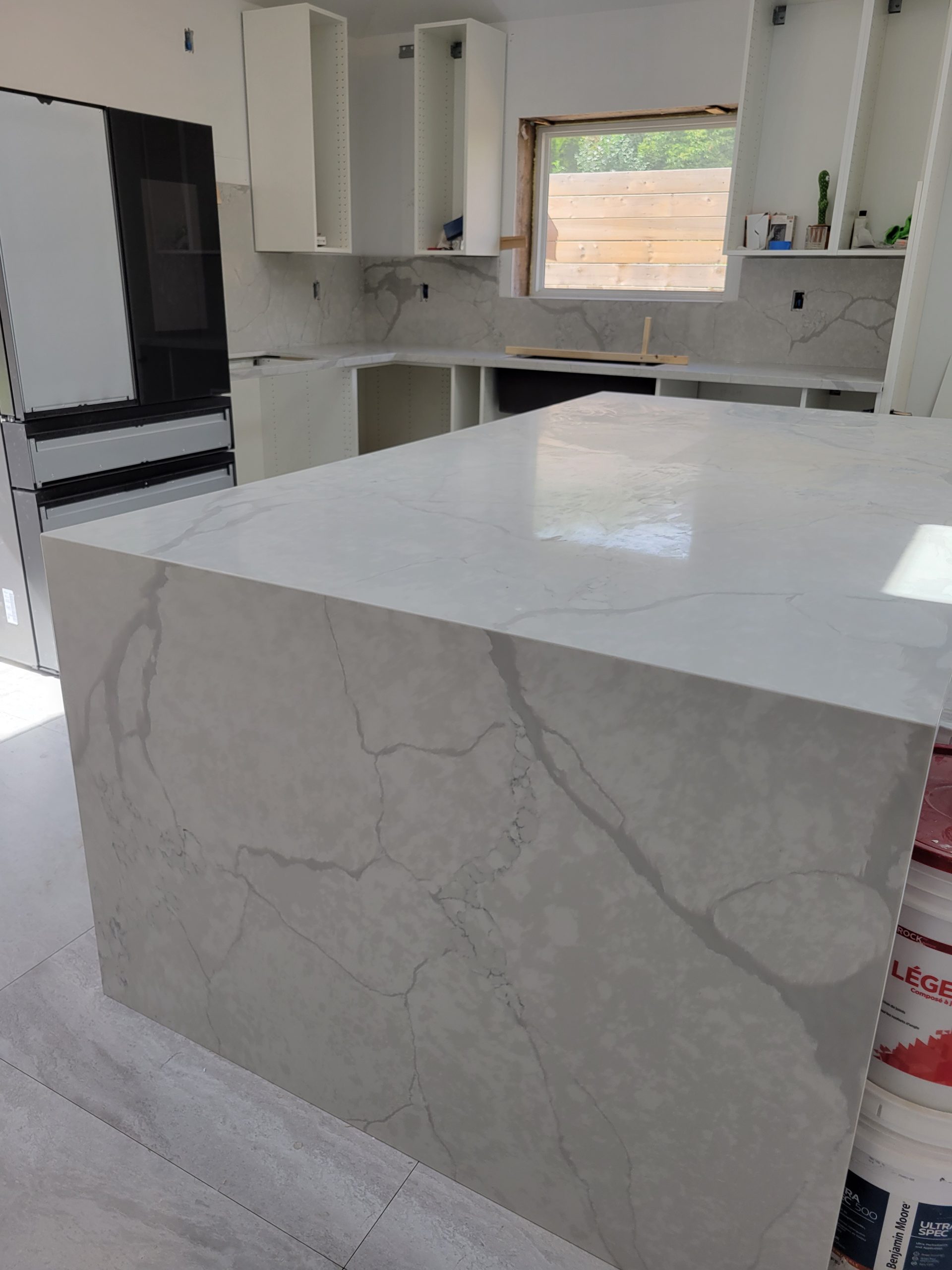
Waterfall Countertops 2025: Bold Designs for Modern Kitchens

Waterfall Countertops: Materials, Design and Installation Guide

A waterfall countertop extends the countertop material vertically down one or both sides of an island, peninsula, vanity, or other cabinet run. The result can be simple and understated or become one of the main visual features of the room.

The finished appearance, however, depends on much more than choosing a dramatic slab. Vein direction, slab size, miter fabrication, cabinet dimensions, floor conditions, seam planning, and installation all affect how convincing the waterfall detail looks.

Quick Answer: Waterfall countertops work particularly well on kitchen islands where the vertical panel can showcase the countertop material and protect the end of the cabinetry. Quartz, granite, quartzite, porcelain, and other slab materials can all be used, but the best choice depends on the design, slab dimensions, fabrication requirements, maintenance expectations, and budget.

White waterfall countertop installed on a modern kitchen island
Waterfall countertop extending from the island surface down the cabinet end.

What Is a Waterfall Countertop?

A traditional countertop usually stops at the outside edge of the cabinet or island. With a waterfall countertop, the same countertop material continues vertically toward the floor.

The vertical section is commonly called a waterfall leg or waterfall panel. Depending on the design, an island may have one waterfall leg or matching panels on both ends.

The transition between the horizontal countertop and vertical panel is especially important. Many waterfall installations use a carefully fabricated mitered joint so the material appears thicker and the pattern can continue around the corner.

If you are planning this detail for an island, our waterfall island planning guide covers several of the decisions worth making before fabrication begins.

Why Homeowners Choose Waterfall Countertops

Waterfall countertops remain popular because they allow the countertop material to become part of the architecture of the kitchen rather than simply sitting on top of the cabinets.

There are several practical and visual reasons to consider one:

  • Showcases the slab: A vertical panel provides another opportunity to display veining, colour, and movement.
  • Creates a finished island end: The countertop material replaces an exposed cabinet panel on one or both sides.
  • Works well with modern designs: Continuous surfaces and clean lines suit contemporary and transitional kitchens.
  • Can protect cabinet ends: The slab creates a durable exterior surface where an exposed cabinet panel would otherwise be located.
  • Creates visual continuity: Thoughtful vein placement can visually connect the horizontal countertop with the vertical leg.

A waterfall is not automatically the right choice for every kitchen. In some rooms, a conventional island with decorative cabinetry, seating, or furniture-style panels may suit the design better.

Best Materials for Waterfall Countertops

Several countertop materials can be fabricated into waterfall designs. There is no single material that is best for every project.

Quartz

Quartz countertops are commonly used for waterfall islands because they are available in a large range of colours and patterns and require relatively little routine maintenance.

Veined quartz can create an especially striking waterfall, but pattern placement should be considered during slab layout. A poorly planned transition can interrupt the movement of the design at the miter.

Quartzite

Quartzite can create a dramatic natural-stone waterfall, particularly when the slab contains strong movement or veining.

Because every natural slab is different, layout becomes extremely important. The fabricator must determine how the available slab will be divided between the island top and waterfall pieces while accounting for cutouts, usable slab dimensions, seams, and the desired pattern direction.

Granite

Granite countertops are another durable natural-stone option. Granite is available in everything from relatively consistent patterns to slabs with significant movement.

As with quartzite, the actual slab should be considered during layout rather than relying only on a small sample.

Marble

Marble can produce a distinctive waterfall design, particularly when the veining is carefully positioned.

Homeowners should understand marble’s maintenance characteristics before selecting it for a busy kitchen. Marble can etch when exposed to acids, and changes in the finish may become part of the stone’s appearance over time.

Our guide explaining why marble etches provides more detail.

Porcelain

Porcelain slabs can create a thin, modern waterfall appearance and are highly resistant to heat, moisture, and many common stains.

Porcelain behaves differently during fabrication and installation than thicker quartz or natural stone. Edge construction, miters, cutouts, handling, and pattern placement should all be planned for the specific product being used.

Why Vein Matching Matters

One of the biggest differences between an average waterfall installation and a carefully planned one is how the pattern transitions from the countertop to the vertical panel.

With directional quartz, marble, quartzite, porcelain, and other strongly patterned slabs, the goal is often to create visual continuity across the corner. This requires planning the cuts before fabrication.

Perfect pattern continuity is not always possible. Slab dimensions, defects, sink and cooktop cutouts, the size of the island, the number of waterfall legs, and the amount of available material all affect layout.

For a deeper explanation, see our guide on how to match countertop veining.

Mitered Edges on Waterfall Countertops

Many waterfall countertops use a mitered edge at the transition between the horizontal top and vertical leg.

Instead of simply placing one square edge against another, the pieces are fabricated so they meet at an angle. When properly executed, this can create the appearance that the countertop material continues around the corner.

Miter quality matters because the joint is highly visible. Accurate fabrication, proper support, careful handling, and precise installation all contribute to the finished result.

Edge thickness can also change the appearance considerably. A thicker-looking miter may create a more substantial island, while a thinner profile can produce a lighter, more minimal design.

Learn more about these options in our countertop edge profiles guide.

One Waterfall Leg or Two?

You do not necessarily need waterfall panels on both ends of an island.

Single Waterfall

A waterfall on one end can work well when the opposite end contains seating, cabinets, an appliance, or another architectural detail. It also uses less slab material than wrapping both ends.

Double Waterfall

Using waterfall panels on both ends creates a more symmetrical, enclosed appearance and can make the countertop material the dominant feature of the island.

The decision should be made as part of the overall island design rather than assuming two waterfall legs are automatically better than one.

Waterfall Countertops With Island Seating

Seating requires additional planning because the waterfall panels can define the width of the seating area.

Consider:

  • available knee and leg room;
  • countertop overhang;
  • stool width and spacing;
  • support requirements;
  • the position of the waterfall panels;
  • walkway clearance around the island.

These decisions should be made before templating whenever possible. Changing the seating configuration after fabrication can affect the dimensions and support requirements of the countertop.

Waterfall Countertop Pros and Cons

Advantages Considerations
Creates a distinctive finished island Requires additional slab material
Shows more of the countertop pattern More fabrication is required
Can protect exposed cabinet ends Miter alignment and installation need precision
Works with many modern and transitional designs Vein matching can affect slab yield and layout
Can create continuity between the top and sides May not suit every cabinet or seating configuration

If you are deciding whether the additional material and fabrication make sense for your project, read our detailed guide: Are Waterfall Countertops Worth It?

How Much Does a Waterfall Countertop Cost?

There is no reliable universal percentage or square-foot price for adding a waterfall because the cost depends heavily on the individual project.

Important cost factors include:

  • the countertop material and slab price;
  • whether one or two waterfall legs are required;
  • island height and depth;
  • additional slab requirements;
  • miter fabrication;
  • vein and pattern matching;
  • material thickness;
  • site access and installation complexity;
  • whether additional seams or reinforcement are required.

A waterfall design can sometimes require an additional slab even when the total square footage does not appear especially large. Slab dimensions and pattern orientation can make the layout just as important as the calculated area.

For that reason, the most useful price is based on your actual island dimensions and selected material rather than a generic online price per square foot.

What Should Be Planned Before Templating?

The best time to resolve waterfall details is before final measurement.

Confirm:

  • whether the island will have one or two waterfall legs;
  • the finished cabinet dimensions;
  • the intended countertop overhang;
  • seating requirements;
  • finished floor conditions;
  • appliance locations;
  • edge thickness;
  • vein direction and preferred slab layout;
  • any outlets or other features located in the island ends.

These details help the fabricator determine how the pieces should be measured, cut, and assembled.

Why the Floor Matters

A waterfall panel extends close to the finished floor, so floor conditions matter more than they do with a conventional countertop.

If the floor is significantly out of level, the bottom relationship between the slab and floor can become more noticeable. Cabinet alignment and the finished dimensions of the island also affect how the waterfall pieces meet the countertop.

This is one reason accurate templating and site preparation are particularly important for waterfall installations.

Where Else Can Waterfall Details Be Used?

Kitchen islands are the most familiar application, but the same design idea can be used elsewhere.

  • Peninsulas: A waterfall can finish an exposed peninsula end.
  • Bathroom vanities: Vertical slab panels can create a furniture-like vanity design.
  • Bars: Waterfall ends can define a bar or entertainment area.
  • Desks and work surfaces: Stone can continue down the side to create a monolithic appearance.

The fabrication approach may vary depending on the material, dimensions, support, and intended use.

How to Care for a Waterfall Countertop

Care depends primarily on the countertop material rather than the fact that it has a waterfall edge.

Quartz should be protected from excessive heat. Natural stones such as granite and quartzite may require sealing depending on the stone. Marble requires additional awareness of etching, while porcelain has its own product-specific care recommendations.

For general guidance, see our countertop maintenance guide.

Waterfall Countertop FAQs

Are waterfall countertops still in style?

Waterfall countertops continue to be used in contemporary and transitional kitchens, but they should be treated as a design choice rather than something every island needs. A well-proportioned waterfall can remain visually relevant even as broader kitchen trends change.

What material is best for a waterfall countertop?

There is no single best material. Quartz offers low maintenance and a wide range of designs. Granite and quartzite provide natural variation. Marble offers distinctive veining but requires more maintenance awareness, while porcelain can create a thin and modern appearance. The right material depends on the project.

Does a waterfall countertop require an extra slab?

Sometimes. It depends on the island dimensions, number of waterfall legs, slab size, pattern direction, cutouts, and how efficiently the pieces can be laid out. Strong veining may also limit how pieces can be positioned.

Can waterfall countertops have seating?

Yes. Seating can be incorporated into a waterfall island, but overhang, support, stool spacing, knee room, and the position of the waterfall panels should be planned together.

Do waterfall countertops need mitered edges?

Many waterfall designs use mitered joints because they can create a cleaner transition between the horizontal top and vertical panel. The appropriate edge construction depends on the material, thickness, design, and fabrication plan.

Can waterfall countertops be installed on existing cabinets?

Potentially, but the existing cabinetry, dimensions, level, floor conditions, support, and overall layout need to be evaluated. A waterfall addition is not simply a vertical piece attached to an existing countertop; the top and side pieces should be planned as a complete fabrication and installation.

Planning a Waterfall Countertop

A successful waterfall countertop comes down to planning. Material selection matters, but so do slab layout, vein direction, cabinet dimensions, miter fabrication, support, floor conditions, and installation.

Before ordering material, determine how the island will be used and which details matter most. Then the slab layout can be planned around the actual dimensions rather than trying to force a waterfall design from whatever material remains.

For another detailed look at the fabrication side of these projects, see our waterfall island project details guide.

Planning a Waterfall Island?

Stone Valley Countertops supplies, fabricates, and installs quartz, granite, quartzite, marble, porcelain, and other stone surfaces for custom countertop projects across Ontario.

Contact Stone Valley Countertops to discuss your island dimensions, material selection, waterfall layout, and fabrication options.

The Ultimate Guide to Quartz Countertops in 2025: Trends, Costs, and Expert Advice

2025 Quartz Countertops: Trends, Costs & Colors Guide

Quartz countertops remain a top choice for homeowners in 2025. With their sleek appearance, resistance to stains and scratches, and low maintenance requirements, quartz surfaces are ideal for kitchens, bathrooms, and even laundry rooms. In this guide, you’ll discover everything you need to know before buying quartz in 2025 — from pricing and trends to pros, cons, and maintenance tips. Most importantly, it will help you make a confident decision for your home renovation.

What Are Quartz Countertops?

Quartz countertops are engineered surfaces made by combining crushed natural quartz (typically 90–95%) with polymer resins and pigments. Unlike natural stone, quartz is non-porous and doesn’t require sealing. Therefore, it’s a favorite for those who want durability with minimal maintenance. In fact, it has become the go-to for homeowners seeking practicality with beauty. If you’re curious how to keep them looking new, check out our countertop maintenance guide.

Top Quartz Countertop Trends in 2025

  • Warm Neutrals: Beige, sand, and taupe tones are replacing cool greys and whites.
  • Bold Marble-Look Veining: Dramatic veining that mimics marble or quartzite is gaining popularity.
  • Textured Finishes: Honed and leathered quartz surfaces are replacing high-gloss finishes.
  • Eco-Conscious Options: Recycled quartz and sustainable production methods are becoming industry standards.

Additionally, color-matching backsplashes and waterfall edges are trending in 2025. For example, many designers are pairing honed quartz with warm wooden cabinetry. Meanwhile, if you want to explore other materials, don’t miss our full roundup of 2025 countertop trends for every style and budget.

Quartz Countertop Pricing in 2025

Quartz countertops in 2025 typically range between $55 and $120 per square foot, including fabrication and installation. However, pricing can vary based on several factors. For instance, choosing premium edges or bookmatched slabs will increase costs. Moreover, location and installer reputation may also influence the total price.

  • Brand (e.g., Cambria, MSI, Silestone)
  • Slab thickness (2cm vs. 3cm)
  • Edge profiles and sink cutouts
  • Installation complexity and project size

Quartz vs Granite: Which Is Better in 2025?

Quartz and granite both offer long-lasting beauty, but they differ significantly in care and consistency. To help you decide, here’s a quick comparison:

Feature Quartz Granite
Porosity Non-porous Porous
Maintenance Low Medium
Heat Resistance Moderate High
Color Consistency Uniform Natural variation

Verdict: Quartz is ideal for those who want a sleek, consistent look with little upkeep. On the other hand, granite is best for those who love natural, one-of-a-kind patterns. Still unsure? See our full Quartzite Countertop Guide for benefits, costs, and care tips.

Pros and Cons of Quartz Countertops

✅ Pros

  • Non-porous and highly hygienic
  • Low maintenance — no sealing needed
  • Scratch and stain resistant
  • Wide variety of colors and finishes
  • Backed by warranties up to 25 years

⚠️ Cons

  • Not ideal for outdoor use (UV-sensitive)
  • Can be more expensive than granite
  • Less heat resistant — use trivets or pads

Nevertheless, the pros outweigh the cons for most homeowners seeking a stylish, easy-to-maintain surface.

Best Quartz Brands in 2025

As you might expect, there are many brands to choose from, each with its own strengths. Below are the top-rated quartz manufacturers for 2025:

  1. Cambria Quartz – Made in the USA with elegant, luxury designs.
  2. Silestone – Offers antimicrobial protection and vivid colors.
  3. MSI Q Quartz – Affordable with diverse colors and patterns.
  4. Caesarstone – Industry innovator known for bold and timeless designs.
  5. Vicostone – Stylish, budget-friendly, and highly durable options.

How to Choose the Right Quartz for Your Home

Choosing quartz may seem overwhelming with so many options available. To simplify the decision, consider the following:

  • Color palette: Match your cabinets, flooring, and walls for a cohesive design.
  • Edge profiles: Eased, beveled, ogee, or waterfall edges add character to your kitchen.
  • Finish: Choose polished, honed, or leathered depending on your desired aesthetic.
  • Brand warranties: Ensure your quartz includes a strong, reliable warranty.

Ultimately, choosing the right quartz comes down to your lifestyle, taste, and budget.

Maintenance Tips for Quartz Countertops

Quartz is loved for its low upkeep. Even so, a few simple care habits can make it last even longer:

  • Clean daily with mild soap and water or a quartz-safe cleaner
  • Avoid harsh abrasives or bleach-based cleaners
  • Use trivets or hot pads to prevent thermal shock
  • Wipe spills promptly to preserve the surface finish

For more details, check out our complete countertop maintenance guide.

Ready to Upgrade Your Home with Quartz?

Quartz countertops are a smart, stylish, and sustainable choice for any home in 2025. Whether you’re remodeling or building new, quartz offers long-lasting beauty, low maintenance, and timeless appeal. Visit Stone Valley Countertops to explore our exclusive quartz collection and get a free quote today.

Countertop Trends 2025: The Hottest Styles, Materials, and Innovations

The 2025 countertop trends are shaping up to be all about innovation, sustainability, and bold aesthetics. Homeowners and designers are looking for materials that are durable, stylish, and eco-friendly, while also integrating cutting-edge technology. Whether you’re planning a kitchen remodel or updating a bathroom vanity, knowing the latest countertop trends can help you make an informed decision. Let’s dive into what’s hot and what’s fading in kitchen and bathroom countertops this year.

1. Popular Colors & Patterns in 2025 Countertop Trends

Color psychology and modern aesthetics are influencing countertop choices. The biggest color and pattern trends for 2025 include:

  • Earthy and warm neutrals – Shades like beige, taupe, greige, and warm grays dominate modern designs.
  • Bold veining and statement slabs – Expect high-contrast marble-inspired patterns that make a dramatic impact.
  • Matte and leathered finishes – Glossy surfaces are fading, while textured and soft-touch finishes are gaining popularity for a more natural feel.

➡️ Trending Countertop Colors & Patterns for Modern Kitchens

2. Material Innovations in 2025 Countertop Trends

Luxury modern kitchen featuring 2025 countertop trends with quartz, sintered stone, and porcelain surfaces in a matte finish and waterfall edge design.

The demand for high-performance and eco-friendly materials is driving exciting innovations:

  • Sintered Stone & Porcelain Countertops – These ultra-durable surfaces offer heat resistance, stain resistance, and scratch-proof performance.
  • Recycled & Sustainable Options – Materials like recycled glass countertops, paper composite surfaces, and reclaimed wood are becoming must-haves for eco-conscious homeowners.
  • Quartzite & Engineered Stone – Offering the look of natural stone but with superior durability, quartzite and engineered quartz remain top choices.

➡️ Eco-Friendly Countertops for Your Home: Best Sustainable Options
➡️ Dekton vs Porcelain: The Ultimate Countertop Showdown – Which One Wins?

3. Edge Profiles & Finishes for 2025 Countertops

The details matter! The hottest edge profile trends are:

  • Mitered edges – Perfect for waterfall kitchen islands, creating a seamless, luxurious look.
  • Eased & beveled edges – Subtle shaping that softens sharp angles and enhances usability.
  • Textured & leathered finishes – Adds depth and warmth while reducing visible fingerprints and smudges.

➡️ Mitered Edge Countertops: Durable Style for Kitchens & Bathrooms

4. Technology in 2025 Countertop Innovations

Smart homes need smart countertops! The latest innovations include:

  • Integrated wireless charging – Charge devices directly on quartz and solid surface countertops.
  • Antimicrobial coatings – Prevent bacteria buildup, making kitchen and bathroom countertops more hygienic.
  • Self-healing surfaces – Some materials now feature heat-sensitive technology that repairs minor scratches.

5. What’s Out of Style in 2025 Countertop Trends?

Some styles are phasing out in favor of more contemporary, minimalist choices:

  • ❌ Busy granite patterns – Homeowners are ditching overly speckled granite for solid or subtly veined slabs.
  • ❌ High-gloss finishes – More people are opting for honed, matte, or leathered surfaces.
  • ❌ Thin countertops – Chunky, thick slabs (1.5″ or more) are making a statement instead of thin, fragile-looking surfaces.

6. Best Countertops for Resale Value in 2025 Trends

If you want to boost your home’s resale value, these are the best countertop investments:

  • Quartz Countertops – The #1 choice for home buyers due to its durability and modern aesthetic.
  • Quartzite Countertops – A luxurious natural stone alternative to marble, with better resistance to etching and staining.
  • Porcelain & Ultra-Compact Surfaces – Long-lasting, heat and scratch-resistant surfaces gaining traction in high-end kitchens.

➡️ Best Kitchen & Bathroom Countertops – Top Choices & Benefits
➡️ Quartzite Countertops: Benefits, Costs, and Maintenance Guide

Conclusion

The 2025 countertop trends focus on durability, sustainability, and modern aesthetics. Whether you’re drawn to eco-friendly countertops, smart surfaces, or bold statement slabs, making the right choice ensures your kitchen and bathroom countertops stay stylish and functional for years to come.

Are you planning a countertop upgrade this year? Check out our in-depth guides for expert advice!

➡️ Most Durable Countertops: What Lasts the Longest?
➡️ How to Maintain Your Countertops for a Lifetime

Most Durable Countertops: What Lasts the Longest?

Most Durable Countertops: What Lasts the Longest?

When choosing the most durable countertops, it is easy to focus on a single question: which material is the toughest? In practice, countertop durability depends on several factors, including resistance to scratches, heat, stains, chips, and everyday wear.

Quartzite, granite, porcelain, and quartz can all be durable countertop materials, but they perform differently. The best choice depends on how you use your kitchen, how much maintenance you are comfortable with, and which types of damage matter most to you.

If you are still comparing your options, our guide to countertop materials provides a broader look at popular surfaces for kitchens and bathrooms.

What Makes a Countertop Durable?

There is no single measurement that determines whether a countertop is durable. A practical comparison should consider several characteristics:

  • Scratch resistance: How well does the surface handle everyday contact with cookware, dishes, and other objects?
  • Heat resistance: How does the material respond to hot cookware and changes in temperature?
  • Stain resistance: How easily can common kitchen spills penetrate or discolor the surface?
  • Impact and chip resistance: How vulnerable are the surface, edges, and cutouts to impact?
  • Maintenance: Does the material require sealing or other routine care?

A material that performs extremely well in one category may have limitations in another. That is why choosing a countertop based only on hardness can be misleading.

Quartzite Countertops

Quartzite is a natural stone known for its hardness and distinctive appearance. Many quartzites offer excellent scratch resistance and can perform well in busy kitchens when properly selected, fabricated, installed, and maintained.

  • Scratch resistance: Generally excellent, although properties vary between stones sold as quartzite.
  • Heat resistance: Natural quartzite generally tolerates heat well, but trivets are still a sensible precaution around hot cookware.
  • Appearance: Available in natural patterns ranging from subtle movement to dramatic veining.
  • Maintenance: Depending on the stone’s porosity and finish, sealing may be recommended to help reduce staining.

Because natural slabs vary, it is important to evaluate the specific stone rather than assuming every slab sold as quartzite will perform identically.

Good fit for: Homeowners who want a durable natural stone and are comfortable with the variation and maintenance that can come with natural materials.

Learn more about quartzite countertops.

Granite Countertops

Granite has a long history as a kitchen countertop material because it combines good scratch and heat resistance with the unique appearance of natural stone.

  • Scratch resistance: Generally very good for normal kitchen use.
  • Heat resistance: Granite handles heat well, although using trivets remains good practice.
  • Appearance: Every natural slab has its own colour, mineral structure, and pattern.
  • Maintenance: Some granites benefit from periodic sealing, while others are relatively dense and may require it less frequently.

The actual performance of granite depends on the specific stone, finish, fabrication details, and how the countertop is used.

Good fit for: Kitchens where natural stone, heat resistance, and long-term durability are priorities.

Learn more about granite countertops or read our guide explaining when granite countertops need sealing.

Porcelain Countertops

Porcelain offers a different combination of durability characteristics. It is highly resistant to heat, moisture, and many common household stains, making it useful for countertops, backsplashes, shower walls, and other applications.

  • Stain resistance: The surface is highly resistant to absorption and generally does not require sealing.
  • Heat resistance: Porcelain performs very well around heat.
  • UV resistance: Many porcelain products can also be suitable for outdoor applications, subject to the manufacturer’s specifications.
  • Fabrication: Slab thickness, edges, cutouts, handling, and installation require careful planning because porcelain behaves differently from thicker stone slabs.

Porcelain can be extremely durable in everyday use, but fabrication quality matters. Edge and cutout design should be considered before the slab is fabricated rather than after installation.

Good fit for: Homeowners looking for a low-maintenance surface with strong heat, stain, and moisture resistance.

Explore our porcelain countertop options or compare sintered stone vs porcelain.

Quartz Countertops

Quartz remains one of the most practical countertop choices for busy kitchens because it combines good durability with low routine maintenance and a large selection of colours and patterns.

  • Stain resistance: Quartz is non-porous and does not normally require sealing.
  • Scratch resistance: It handles normal everyday use well, although it is not scratch-proof.
  • Consistency: Engineered patterns can make colour and design selection more predictable than many natural stones.
  • Heat: Quartz contains resins and should be protected from hot cookware with trivets or heat pads.

Quartz is durable, but it should not be treated as indestructible. Cutting directly on the surface, exposing it to excessive heat, or subjecting edges and cutouts to heavy impact can cause damage.

Good fit for: Busy kitchens where easy cleaning, consistent appearance, and minimal routine maintenance are important.

Explore quartz countertops, learn whether quartz can scratch, or read about quartz heat resistance.

What About Concrete Countertops?

Concrete can create a distinctive custom or industrial appearance, but it is different from the slab materials Stone Valley typically fabricates and installs.

Concrete can be durable when properly designed, poured, reinforced, finished, and sealed, but it may develop stains, small cracks, or changes in appearance over time. For homeowners primarily comparing fabricated slab countertops, quartzite, granite, porcelain, and quartz are generally more relevant options to evaluate.

Comparing Durable Countertop Materials

Material Scratch Resistance Heat Resistance Stain Resistance Routine Sealing
Quartzite Excellent* Excellent Varies by stone Often recommended
Granite Very good Excellent Good to very good Depends on stone
Porcelain Very good Excellent Excellent No
Quartz Very good Moderate Excellent No

*Natural stone characteristics vary by slab and geological composition. Product-specific specifications and manufacturer guidance should always be considered.

Which Durable Countertop Is Right for Your Kitchen?

Instead of looking for one material that wins every durability category, consider which characteristics matter most in your home.

  • If heat resistance is especially important: Granite, quartzite, and porcelain are worth considering.
  • If minimal maintenance is the priority: Quartz and porcelain generally require less routine maintenance than many natural stones.
  • If you want natural stone: Granite and quartzite provide natural variation with strong everyday performance.
  • If consistent colours and patterns matter: Quartz offers a large selection of engineered designs.
  • If the project is outdoors: Material selection should account for UV exposure, temperature changes, moisture, and the manufacturer’s approved applications.

The slab itself is also only part of countertop durability. Proper templating, seam placement, sink support, cutout design, fabrication, and installation can all affect how a finished countertop performs.

See Countertop Materials in Person

Samples and online photos are useful for narrowing down your options, but natural slabs and full-size engineered surfaces can look very different in person. Colour variation, veining, finish, thickness, and edge details are easier to evaluate at full scale.

Stone Valley Countertops supplies, fabricates, and installs stone surfaces for kitchens, bathrooms, islands, backsplashes, and other applications across Ontario.

Visit one of our showrooms or contact Stone Valley Countertops to discuss your project and compare materials based on the way you actually use your space.