luxury countertops

Waterfall Countertops 2025: Bold Designs for Modern Kitchens

Waterfall Countertops: Materials, Design and Installation Guide

A waterfall countertop extends the countertop material vertically down one or both sides of an island, peninsula, vanity, or other cabinet run. The result can be simple and understated or become one of the main visual features of the room.

The finished appearance, however, depends on much more than choosing a dramatic slab. Vein direction, slab size, miter fabrication, cabinet dimensions, floor conditions, seam planning, and installation all affect how convincing the waterfall detail looks.

Quick Answer: Waterfall countertops work particularly well on kitchen islands where the vertical panel can showcase the countertop material and protect the end of the cabinetry. Quartz, granite, quartzite, porcelain, and other slab materials can all be used, but the best choice depends on the design, slab dimensions, fabrication requirements, maintenance expectations, and budget.
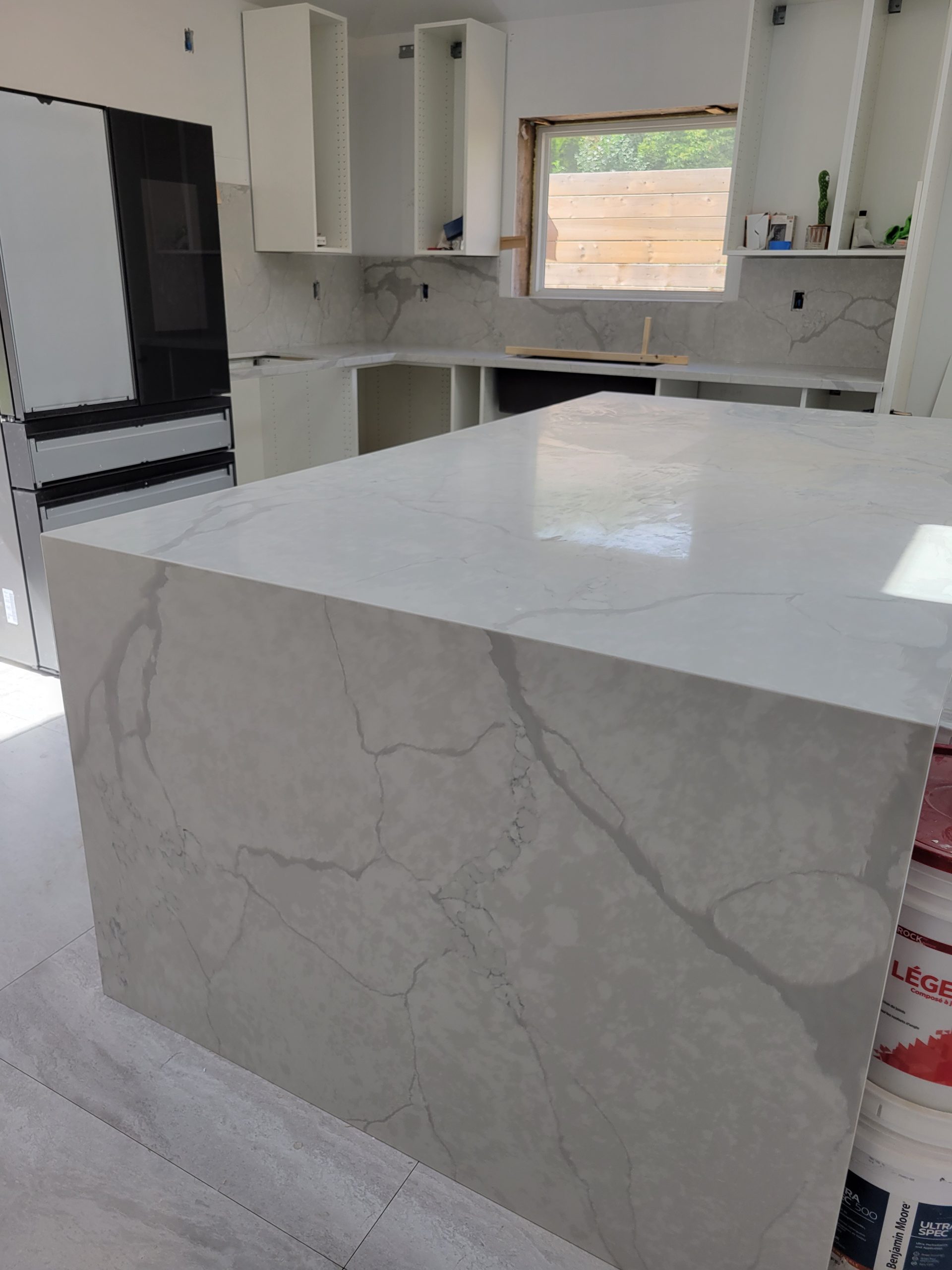
White waterfall countertop installed on a modern kitchen island
Waterfall countertop extending from the island surface down the cabinet end.

What Is a Waterfall Countertop?

A traditional countertop usually stops at the outside edge of the cabinet or island. With a waterfall countertop, the same countertop material continues vertically toward the floor.

The vertical section is commonly called a waterfall leg or waterfall panel. Depending on the design, an island may have one waterfall leg or matching panels on both ends.

The transition between the horizontal countertop and vertical panel is especially important. Many waterfall installations use a carefully fabricated mitered joint so the material appears thicker and the pattern can continue around the corner.

If you are planning this detail for an island, our waterfall island planning guide covers several of the decisions worth making before fabrication begins.

Why Homeowners Choose Waterfall Countertops

Waterfall countertops remain popular because they allow the countertop material to become part of the architecture of the kitchen rather than simply sitting on top of the cabinets.

There are several practical and visual reasons to consider one:

  • Showcases the slab: A vertical panel provides another opportunity to display veining, colour, and movement.
  • Creates a finished island end: The countertop material replaces an exposed cabinet panel on one or both sides.
  • Works well with modern designs: Continuous surfaces and clean lines suit contemporary and transitional kitchens.
  • Can protect cabinet ends: The slab creates a durable exterior surface where an exposed cabinet panel would otherwise be located.
  • Creates visual continuity: Thoughtful vein placement can visually connect the horizontal countertop with the vertical leg.

A waterfall is not automatically the right choice for every kitchen. In some rooms, a conventional island with decorative cabinetry, seating, or furniture-style panels may suit the design better.

Best Materials for Waterfall Countertops

Several countertop materials can be fabricated into waterfall designs. There is no single material that is best for every project.

Quartz

Quartz countertops are commonly used for waterfall islands because they are available in a large range of colours and patterns and require relatively little routine maintenance.

Veined quartz can create an especially striking waterfall, but pattern placement should be considered during slab layout. A poorly planned transition can interrupt the movement of the design at the miter.

Quartzite

Quartzite can create a dramatic natural-stone waterfall, particularly when the slab contains strong movement or veining.

Because every natural slab is different, layout becomes extremely important. The fabricator must determine how the available slab will be divided between the island top and waterfall pieces while accounting for cutouts, usable slab dimensions, seams, and the desired pattern direction.

Granite

Granite countertops are another durable natural-stone option. Granite is available in everything from relatively consistent patterns to slabs with significant movement.

As with quartzite, the actual slab should be considered during layout rather than relying only on a small sample.

Marble

Marble can produce a distinctive waterfall design, particularly when the veining is carefully positioned.

Homeowners should understand marble’s maintenance characteristics before selecting it for a busy kitchen. Marble can etch when exposed to acids, and changes in the finish may become part of the stone’s appearance over time.

Our guide explaining why marble etches provides more detail.

Porcelain

Porcelain slabs can create a thin, modern waterfall appearance and are highly resistant to heat, moisture, and many common stains.

Porcelain behaves differently during fabrication and installation than thicker quartz or natural stone. Edge construction, miters, cutouts, handling, and pattern placement should all be planned for the specific product being used.

Why Vein Matching Matters

One of the biggest differences between an average waterfall installation and a carefully planned one is how the pattern transitions from the countertop to the vertical panel.

With directional quartz, marble, quartzite, porcelain, and other strongly patterned slabs, the goal is often to create visual continuity across the corner. This requires planning the cuts before fabrication.

Perfect pattern continuity is not always possible. Slab dimensions, defects, sink and cooktop cutouts, the size of the island, the number of waterfall legs, and the amount of available material all affect layout.

For a deeper explanation, see our guide on how to match countertop veining.

Mitered Edges on Waterfall Countertops

Many waterfall countertops use a mitered edge at the transition between the horizontal top and vertical leg.

Instead of simply placing one square edge against another, the pieces are fabricated so they meet at an angle. When properly executed, this can create the appearance that the countertop material continues around the corner.

Miter quality matters because the joint is highly visible. Accurate fabrication, proper support, careful handling, and precise installation all contribute to the finished result.

Edge thickness can also change the appearance considerably. A thicker-looking miter may create a more substantial island, while a thinner profile can produce a lighter, more minimal design.

Learn more about these options in our countertop edge profiles guide.

One Waterfall Leg or Two?

You do not necessarily need waterfall panels on both ends of an island.

Single Waterfall

A waterfall on one end can work well when the opposite end contains seating, cabinets, an appliance, or another architectural detail. It also uses less slab material than wrapping both ends.

Double Waterfall

Using waterfall panels on both ends creates a more symmetrical, enclosed appearance and can make the countertop material the dominant feature of the island.

The decision should be made as part of the overall island design rather than assuming two waterfall legs are automatically better than one.

Waterfall Countertops With Island Seating

Seating requires additional planning because the waterfall panels can define the width of the seating area.

Consider:

  • available knee and leg room;
  • countertop overhang;
  • stool width and spacing;
  • support requirements;
  • the position of the waterfall panels;
  • walkway clearance around the island.

These decisions should be made before templating whenever possible. Changing the seating configuration after fabrication can affect the dimensions and support requirements of the countertop.

Waterfall Countertop Pros and Cons

Advantages Considerations
Creates a distinctive finished island Requires additional slab material
Shows more of the countertop pattern More fabrication is required
Can protect exposed cabinet ends Miter alignment and installation need precision
Works with many modern and transitional designs Vein matching can affect slab yield and layout
Can create continuity between the top and sides May not suit every cabinet or seating configuration

If you are deciding whether the additional material and fabrication make sense for your project, read our detailed guide: Are Waterfall Countertops Worth It?

How Much Does a Waterfall Countertop Cost?

There is no reliable universal percentage or square-foot price for adding a waterfall because the cost depends heavily on the individual project.

Important cost factors include:

  • the countertop material and slab price;
  • whether one or two waterfall legs are required;
  • island height and depth;
  • additional slab requirements;
  • miter fabrication;
  • vein and pattern matching;
  • material thickness;
  • site access and installation complexity;
  • whether additional seams or reinforcement are required.

A waterfall design can sometimes require an additional slab even when the total square footage does not appear especially large. Slab dimensions and pattern orientation can make the layout just as important as the calculated area.

For that reason, the most useful price is based on your actual island dimensions and selected material rather than a generic online price per square foot.

What Should Be Planned Before Templating?

The best time to resolve waterfall details is before final measurement.

Confirm:

  • whether the island will have one or two waterfall legs;
  • the finished cabinet dimensions;
  • the intended countertop overhang;
  • seating requirements;
  • finished floor conditions;
  • appliance locations;
  • edge thickness;
  • vein direction and preferred slab layout;
  • any outlets or other features located in the island ends.

These details help the fabricator determine how the pieces should be measured, cut, and assembled.

Why the Floor Matters

A waterfall panel extends close to the finished floor, so floor conditions matter more than they do with a conventional countertop.

If the floor is significantly out of level, the bottom relationship between the slab and floor can become more noticeable. Cabinet alignment and the finished dimensions of the island also affect how the waterfall pieces meet the countertop.

This is one reason accurate templating and site preparation are particularly important for waterfall installations.

Where Else Can Waterfall Details Be Used?

Kitchen islands are the most familiar application, but the same design idea can be used elsewhere.

  • Peninsulas: A waterfall can finish an exposed peninsula end.
  • Bathroom vanities: Vertical slab panels can create a furniture-like vanity design.
  • Bars: Waterfall ends can define a bar or entertainment area.
  • Desks and work surfaces: Stone can continue down the side to create a monolithic appearance.

The fabrication approach may vary depending on the material, dimensions, support, and intended use.

How to Care for a Waterfall Countertop

Care depends primarily on the countertop material rather than the fact that it has a waterfall edge.

Quartz should be protected from excessive heat. Natural stones such as granite and quartzite may require sealing depending on the stone. Marble requires additional awareness of etching, while porcelain has its own product-specific care recommendations.

For general guidance, see our countertop maintenance guide.

Waterfall Countertop FAQs

Are waterfall countertops still in style?

Waterfall countertops continue to be used in contemporary and transitional kitchens, but they should be treated as a design choice rather than something every island needs. A well-proportioned waterfall can remain visually relevant even as broader kitchen trends change.

What material is best for a waterfall countertop?

There is no single best material. Quartz offers low maintenance and a wide range of designs. Granite and quartzite provide natural variation. Marble offers distinctive veining but requires more maintenance awareness, while porcelain can create a thin and modern appearance. The right material depends on the project.

Does a waterfall countertop require an extra slab?

Sometimes. It depends on the island dimensions, number of waterfall legs, slab size, pattern direction, cutouts, and how efficiently the pieces can be laid out. Strong veining may also limit how pieces can be positioned.

Can waterfall countertops have seating?

Yes. Seating can be incorporated into a waterfall island, but overhang, support, stool spacing, knee room, and the position of the waterfall panels should be planned together.

Do waterfall countertops need mitered edges?

Many waterfall designs use mitered joints because they can create a cleaner transition between the horizontal top and vertical panel. The appropriate edge construction depends on the material, thickness, design, and fabrication plan.

Can waterfall countertops be installed on existing cabinets?

Potentially, but the existing cabinetry, dimensions, level, floor conditions, support, and overall layout need to be evaluated. A waterfall addition is not simply a vertical piece attached to an existing countertop; the top and side pieces should be planned as a complete fabrication and installation.

Planning a Waterfall Countertop

A successful waterfall countertop comes down to planning. Material selection matters, but so do slab layout, vein direction, cabinet dimensions, miter fabrication, support, floor conditions, and installation.

Before ordering material, determine how the island will be used and which details matter most. Then the slab layout can be planned around the actual dimensions rather than trying to force a waterfall design from whatever material remains.

For another detailed look at the fabrication side of these projects, see our waterfall island project details guide.

Planning a Waterfall Island?

Stone Valley Countertops supplies, fabricates, and installs quartz, granite, quartzite, marble, porcelain, and other stone surfaces for custom countertop projects across Ontario.

Contact Stone Valley Countertops to discuss your island dimensions, material selection, waterfall layout, and fabrication options.

Marble Countertops: Timeless Beauty & Everything You Need to Know

Why Marble is Still One of the Most Elegant Countertop Choices

Marble countertops have been a symbol of luxury, elegance, and sophistication for centuries. Whether you’re renovating your kitchen, bathroom, or a commercial space, marble offers a unique aesthetic that few materials can match.

But is marble worth the investment? Let’s explore the pros, cons, costs, and maintenance so you can decide if marble is the right choice for your home.


Understanding the Unmatched Appeal of Marble

Marble is a natural stone known for its unique veining and smooth finish. Each slab is one-of-a-kind, making it a preferred choice for high-end kitchen designs.

Some of the most popular marble varieties include:

  • Carrara Marble – Classic soft gray veining, budget-friendly option

  • Calacatta Marble – Bold, dramatic veining with a premium look

  • Statuario Marble – Rare, bright white stone with striking contrast


Pros & Cons of Marble Countertops

Feature Pros 🟢 Cons 🔴
Aesthetic Appeal Timeless, elegant look Requires sealing to maintain appearance
Heat Resistance Naturally cool for baking Can scorch if exposed to extreme heat
Durability Lasts for decades with proper care Softer than granite or quartz
Maintenance Easy to clean Prone to stains from acidic foods
Cost Wide price range to fit different budgets High-end varieties can be expensive

How Much Do Marble Countertops Cost?

Marble countertops can range in price based on the type, thickness, and quality of the slab.

🔹 Carrara Marble – $40 to $100 per sq. ft. (affordable & classic)
🔹 Calacatta Marble – $100 to $250 per sq. ft. (luxury look, premium price)
🔹 Statuario Marble – $150 to $300 per sq. ft. (high-end, rare stone)

💡 Pro Tip: Installation costs vary based on the edge profile, sealing, and customization.


Marble vs. Other Countertops: How Does It Compare?

Feature Marble Granite Quartz
Natural Stone ✅ Yes ✅ Yes ❌ No
Heat Resistance ✅ Yes ✅ Yes 🚫 No
Scratch Resistance 🚫 No ✅ Yes ✅ Yes
Stain Resistance 🚫 No ✅ Yes ✅ Yes
Maintenance Required ✅ Yes (Sealing Needed) ✅ Yes (Less Frequent) 🚫 No

Verdict: If you love the classic, natural beauty of stone and don’t mind some maintenance, marble is a stunning choice.


How to Maintain Marble Countertops

Since marble is a porous stone, it requires some care to keep it looking its best.

Seal Your Countertops – Prevent stains by sealing marble every 6–12 months
Use pH-Neutral Cleaners – Avoid acidic cleaners that can etch the surface
Wipe Spills Immediately – Especially with wine, citrus, and coffee
Use Cutting Boards & Trivets – Protect against scratches and heat damage

Want a full maintenance guide? Check out How to Maintain Your Countertops for a Lifetime.


Is Marble Right for Your Home?

Best for:

  • Homeowners who love luxury and timeless beauty

  • Kitchens where baking is common (naturally cool surface)

  • Elegant bathrooms and high-end designs

Consider Alternatives If:

  • You don’t want to reseal or maintain your countertops

  • You prefer stain and scratch-resistant materials like quartz

  • You have a high-traffic kitchen that needs heavy durability


Final Thoughts on Marble Countertops

Marble countertops are stunning, luxurious, and timeless—but they do require proper care to maintain their beauty.

If you’re considering marble for your kitchen or bathroom, make sure you choose the right type, seal it properly, and clean it regularly for long-lasting beauty.

Thinking about upgrading to marble? Contact us for a consultation!

Best Kitchen & Bathroom Countertops – Top Choices & Benefits

Best Kitchen & Bathroom Countertops – Top Choices & Benefits

Choosing the best kitchen & bathroom countertops is an important decision for any home. The right surface enhances aesthetics, functionality, and durability. However, with so many options available, selecting the perfect material can feel overwhelming.

💡 Not sure where to start? Check out our guide on Types of Countertops: Discover the Best Materials for Your Home.

This guide compares popular countertop materials, highlighting their benefits and drawbacks to help you make the best choice.


Key Factors to Consider

When choosing a countertop, it’s essential to evaluate a few key factors:

Can it withstand daily use? Durability plays a major role in ensuring your countertop lasts for years.

Does it require sealing or special care? Some materials need regular maintenance, while others are hassle-free.

Will it complement your home’s style? The aesthetic appeal of a countertop should match your kitchen or bathroom design.

What is your budget? Prices vary widely, so consider the best option within your price range.

Will it add to your home’s value? Certain materials, like quartzite and granite, can enhance resale value.

Each material offers unique advantages. Therefore, considering these factors will ensure you make an informed decision.


Best Kitchen & Bathroom Countertops – Material Comparison

1. Quartz Countertops

Why Choose Quartz?

  • ✅ Low Maintenance – No sealing required.
  • ✅ Non-Porous – Resistant to stains and bacteria.
  • ✅ Versatile Design Options – Available in various colors and patterns.

⚠ Potential Downsides:

  • Less heat-resistant than natural stone.
  • Prolonged sun exposure may cause discoloration.

💰 Average Cost: $50 – $120 per sq. ft.


2. Granite Countertops

Why Choose Granite?

  • ✅ Highly Durable – Scratch and heat-resistant.
  • ✅ Distinctive Natural Patterns – No two slabs are alike.
  • ✅ Boosts Home Value – A premium choice for resale.

⚠ Potential Downsides:

  • Requires sealing to prevent stains.
  • Fewer color choices compared to engineered options.

💰 Average Cost: $40 – $100 per sq. ft.


3. Quartzite Countertops

Why Choose Quartzite?

  • ✅ Extremely Hard & Scratch-Resistant – Tougher than granite.
  • ✅ Excellent Heat Resistance – Ideal for kitchens.
  • ✅ Natural Marble-Like Appearance – Luxury look with durability.

⚠ Potential Downsides:

  • Requires periodic sealing.
  • More expensive than quartz and granite.

💰 Average Cost: $80 – $200 per sq. ft.


4. Marble Countertops

Why Choose Marble?

  • ✅ Timeless Elegance – Adds a luxurious feel to any space.
  • ✅ Naturally Cool Surface – Ideal for baking and pastry-making.

⚠ Potential Downsides:

  • Prone to scratches and stains.
  • Requires frequent maintenance.

💰 Average Cost: $60 – $180 per sq. ft.


5. Solid Surface Countertops (Corian, etc.)

Why Choose Solid Surface?

  • ✅ Seamless & Repairable – Scratches can be buffed out easily.
  • ✅ Variety of Color Options – Works with modern designs.

⚠ Potential Downsides:

  • Less heat-resistant than stone.
  • Can scratch if not maintained properly.

💰 Average Cost: $40 – $80 per sq. ft.


Best Kitchen & Bathroom Countertops – Cost Comparison

Here’s a general price comparison of countertop materials:

Countertop Material Average Cost (Per Sq. Ft.)
Quartz $50 – $120
Granite $40 – $100
Quartzite $80 – $200
Marble $60 – $180
Solid Surface $40 – $80

Quartzite and marble are premium choices, while granite and solid surface countertops are more budget-friendly.


Which Kitchen & Bathroom Countertop is Right for You?

  • Choose Quartz for a low-maintenance, stain-resistant option.
  • Choose Granite for a natural stone that’s heat- and scratch-resistant.
  • Choose Quartzite for luxury and extreme durability.
  • Choose Marble for elegance with high maintenance requirements.
  • Choose Solid Surface for a budget-friendly, seamless appearance.

Since every home has different needs, selecting the right countertop depends on your lifestyle, budget, and style preference.


Final Thoughts

Selecting the best kitchen & bathroom countertops requires balancing durability, maintenance, cost, and design. Whether you prefer the versatility of quartz, the natural beauty of granite, or the luxury of marble, there’s a perfect option for you.

💡 Still deciding? Check out our guide on Types of Countertops: Discover the Best Materials for Your Home.

Need expert guidance? Fill out our quote request form to get tailored recommendations!


Your Thoughts?

Looking for the perfect countertop? Fill out our quote request form to get a personalized estimate and expert recommendations! 🚀

Need expert advice? Fill out our quote request form to find the perfect countertop for your home!


Your Thoughts?

Looking for the perfect countertop? Fill out our quote request form to get a personalized estimate and expert recommendations! 🚀

Quartzite vs Quartz vs Granite: Which Countertop is Best?

Quartzite vs Quartz vs Granite: Which Countertop is Best?

Choosing a new countertop for your home is a major decision. Many homeowners compare Quartzite vs Quartz vs Granite because each material offers unique benefits. Moreover, understanding the differences in durability, maintenance, cost, and style will help you decide which countertop best suits your needs.


Quartzite vs Quartz vs Granite – Key Differences

To make an informed decision, it is essential to examine the primary differences between these materials.

Quartzite vs Quartz vs Granite – Material Composition

  • Quartzite:
    Quartzite is a natural metamorphic rock formed when sandstone is exposed to extreme heat and pressure. This process produces a hard, attractive stone with a marble-like appearance.

  • Quartz:
    Quartz is an engineered stone created by combining crushed quartz crystals with resin and pigments. Consequently, it offers a consistent look and a variety of colors while requiring less maintenance.

  • Granite:
    Granite is a natural igneous rock that forms from cooled magma. It is renowned for its distinctive patterns and robust durability, making it a popular choice for kitchens and bathrooms.


Quartzite vs Quartz vs Granite – Durability & Scratch Resistance

Feature Quartzite Quartz Granite
Durability Extremely hard and scratch-resistant Durable but can scratch with heavy use Hard and scratch-resistant
Heat Resistance High Moderate High
Porosity Porous (requires sealing) Non-porous Porous (requires periodic sealing)

Quartzite and granite are naturally robust; however, they need regular sealing to protect against stains. In contrast, quartz does not require sealing, yet it is less resistant to high heat.


Pros & Cons of Quartzite vs Quartz vs Granite

Quartzite Countertops

  • Pros:

    • Exhibits natural beauty with elegant, marble-like veining.
    • Extremely durable and highly resistant to heat.
    • Offers excellent scratch resistance.
  • Cons:

    • Requires periodic sealing to prevent stains.
    • Generally more expensive than quartz options.

Quartz Countertops

  • Pros:

    • Low maintenance since it does not need sealing.
    • Customizable colors and patterns to suit any design.
    • Non-porous surface that resists stains.
  • Cons:

    • Less heat-resistant compared to natural stone alternatives.
    • May discolor when exposed to prolonged direct sunlight.

Granite Countertops

  • Pros:

    • Highly durable and resistant to heat.
    • Unique natural patterns add character to any space.
    • Offers strong scratch resistance.
  • Cons:

    • Requires periodic sealing to maintain its appearance.
    • Limited color options relative to quartz.

Cost Comparison

The cost of these countertops varies based on quality, availability, and installation complexity. Here is a general price range per square foot:

  • Quartzite: $80 – $200
  • Quartz: $50 – $120
  • Granite: $40 – $100

Typically, quartzite is the priciest option due to its natural formation and superior durability, whereas granite tends to be more budget-friendly.


Which Countertop Should You Choose?

  • Opt for Quartzite if you desire a natural stone that is both durable and heat-resistant, with a luxurious look that adds value to your home.
  • Select Quartz if you prefer a low-maintenance option that offers versatility in design and color.
  • Choose Granite if you are drawn to a classic, naturally patterned stone that balances durability with affordability.

Final Verdict

Your choice depends on budget, maintenance preference, and style. If you’re looking for a balance of beauty and durability, quartzite is an excellent investment.

💡 Still unsure? Check out our complete countertop material guide for more options


Your Thoughts?

Looking for the perfect countertop for your home? Fill out our quote request form to get a personalized estimate and expert recommendations! 🚀

Quartzite Countertop: Benefits, Costs, and Maintenance Guide

Quartzite Countertops: A Complete Guide for Ontario Homeowners

Choosing a countertop is about more than finding a surface that looks good in a showroom. It needs to stand up to daily cooking, suit your maintenance expectations, and work with the layout of your kitchen or bathroom.

Quartzite countertops have become one of the most requested natural stone options because they combine dramatic movement with excellent durability. Many homeowners are drawn to quartzite because it offers a marble-like appearance while standing up better to scratches, heat, and everyday use.

Before choosing quartzite, it is worth understanding how it performs, what maintenance it requires, and how fabrication affects the finished result.

What Is Quartzite?

Quartzite is a natural stone formed when sandstone is subjected to intense heat and pressure beneath the earth’s surface. During this process, the individual quartz grains fuse together, creating one of the hardest natural stones used for countertops.

Unlike engineered quartz, every slab of quartzite is completely unique. Colour variation, veining, movement, and mineral deposits vary from slab to slab, making each installation one of a kind.

Common quartzite colours include:

  • White
  • Soft grey
  • Cream
  • Beige
  • Gold
  • Blue-grey
  • Green
  • Dramatic exotic patterns

Many homeowners choose materials such as Taj Mahal Quartzite, Perla Venata, or Cristallo because they provide the elegance of marble with greater durability.

Why Homeowners Choose Quartzite Countertops

Quartzite continues to grow in popularity because it offers an excellent balance between natural beauty and everyday performance.

Exceptional durability

Quartzite is one of the hardest countertop materials available. It resists everyday scratching from food preparation and heavy kitchen use better than many other natural stones.

That does not mean it is impossible to damage. Cutting boards are still recommended because they protect the polished finish and help prevent knives from becoming dull.

Excellent heat resistance

Quartzite tolerates heat better than engineered quartz because it does not contain the same resin binders. This makes it suitable for busy kitchens where hot cookware and baking trays are common.

Trivets are still recommended. They protect the stone, the sealer, and the surrounding seams from sudden temperature changes.

Natural beauty

No manufactured surface can perfectly reproduce the depth and movement found in genuine quartzite. Every slab has its own veining, mineral deposits, colour variation, and natural character.

Some slabs are soft and subtle, while others have bold movement that can become the main feature of a kitchen island or full-height backsplash.

Long lifespan

With proper fabrication, installation, and care, quartzite countertops can last for decades while maintaining their appearance.

The material works especially well for homeowners who want a premium natural stone and do not plan to replace their countertops again in a few years.

Suitable for outdoor applications

Quartzite is naturally resistant to UV exposure, making it a possible choice for outdoor kitchens and BBQ areas. Engineered quartz is generally not recommended outdoors because prolonged sunlight can affect its pigments and resins.

Outdoor quartzite still needs proper sealing, support, seam planning, and protection from Ontario’s freeze-thaw conditions.

Things to Consider Before Choosing Quartzite

Quartzite is an outstanding countertop material, but it is not completely maintenance-free. Understanding its limitations before purchasing helps prevent surprises later.

Quartzite needs periodic sealing

Quartzite is a natural stone and can absorb liquid if it is left unsealed. A quality penetrating sealer helps reduce staining from cooking oils, wine, coffee, sauces, and other common spills.

Some quartzite slabs are denser than others, so sealing schedules can vary. Many countertops benefit from resealing every one to three years, but the correct schedule depends on the stone, the sealer, and how heavily the surface is used.

Quartzite is a premium material

Quartzite often costs more than standard quartz or common granite colours. The final project price depends on the slab selected, the number of slabs required, fabrication complexity, edge details, cutouts, seams, and installation conditions.

Rather than comparing price per square foot alone, homeowners should consider the full project, including:

  • Slab selection
  • Templating and measurements
  • Edge profile
  • Sink and cooktop cutouts
  • Backsplash pieces
  • Waterfall panels
  • Seam placement
  • Transportation and installation

Every slab is different

Unlike engineered quartz, quartzite does not offer exact colour or pattern consistency. Two slabs from the same bundle can still have noticeable differences in movement and tone.

This variation is part of the appeal, but it also makes viewing the full slab before fabrication important. Small samples do not always show the amount of veining, colour variation, or natural fissures found in the complete stone.

Stone selection tip: When possible, view the actual slabs that will be used for your project. For kitchens requiring more than one slab, confirm that the slabs work together in colour, movement, and vein direction.

How Much Do Quartzite Countertops Cost in Ontario?

Quartzite is generally considered a premium countertop material. In Ontario, homeowners may see installed quartzite pricing ranging from approximately $80 to more than $200 per square foot, depending on the slab and the complexity of the project.

This range should be used for early budgeting only. Quartzite is normally purchased by the slab, so the final price is not always calculated by multiplying the countertop square footage by a single rate. A kitchen may require two full slabs even when some material is left over after fabrication.

The price of a quartzite countertop project can be affected by:

  • The rarity and origin of the quartzite
  • The number and size of slabs required
  • Slab thickness
  • Kitchen or bathroom layout
  • Number of seams
  • Sink, faucet, and cooktop cutouts
  • Edge profile selection
  • Waterfall panels or mitred edges
  • Full-height quartzite backsplash
  • Vein matching and slab layout
  • Transportation and installation access
  • Removal of existing countertops

Standard and premium quartzite pricing

More readily available quartzite slabs with simpler patterns usually fall toward the lower end of the range. Premium stones with dramatic movement, translucent areas, unusual colours, or limited availability can cost considerably more.

Popular quartzites such as Taj Mahal may also vary significantly in price based on the slab bundle, thickness, supplier, colouring, and overall quality. Two slabs sold under the same stone name may not have the same appearance or cost.

Why square-foot pricing can be misleading

A square-foot price does not always show the complete cost of a quartzite project. Natural stone fabrication involves more than cutting the visible countertop area. The fabricator must also account for slab yield, vein direction, seam locations, cutouts, breakage risk, edge polishing, delivery, and installation.

For example, a kitchen with approximately 55 square feet of countertop may require more material than a larger but simpler layout if it includes a waterfall island, full-height backsplash, oversized pieces, or complicated vein matching.

Budgeting tip: Ask whether a quartzite estimate includes the slabs, templating, fabrication, standard edge finishing, sink and cooktop cutouts, delivery, installation, sealing, and applicable taxes. This makes it easier to compare complete project estimates rather than advertised material rates.

How to get an accurate quartzite estimate

The most reliable estimate is based on a drawing or measurements of the countertop layout and the specific slabs being considered. Photos of the kitchen, sink details, backsplash requirements, edge profile, and island overhangs can also help identify costs that may not be obvious from square footage alone.

Stone Valley can review your measurements and material preferences to provide a project-specific estimate rather than relying on a broad online price range. Contact Stone Valley Countertops with your layout, photos, or countertop measurements.

Quartzite Fabrication Matters More Than Many Homeowners Realize

Choosing a beautiful slab is only the first step. Professional fabrication determines how the finished countertop will look and perform inside the home.

Quartzite is extremely hard, which makes it durable in use but more demanding to cut and finish. Experienced fabrication is especially important around sink cutouts, inside corners, narrow strips, and detailed edge profiles.

Slab layout and vein direction

Before cutting begins, the fabricator should determine which areas of the slab will be used for islands, perimeter countertops, backsplashes, and waterfall panels.

Careful slab layout can help continue the natural movement across connected pieces and keep important veins away from seams, cutouts, or narrow areas where possible.

Seam placement

Most large kitchens require at least one seam. The best seam location depends on slab size, cabinet layout, access to the home, vein movement, and the position of sinks or cooktops.

A good seam plan balances appearance, structural support, and installation practicality. Seams should not be placed based on convenience alone.

Sink and cooktop cutouts

Cutouts remove material from the slab and can create vulnerable areas around corners and narrow rails. Proper measurements, corner radiuses, reinforcement, and support help reduce the risk of cracking during transportation and installation.

Edge profiles

Quartzite can be fabricated with several edge styles, including eased, bevelled, bullnose, ogee, and mitred edges. The right choice depends on the stone, countertop thickness, cabinet style, and desired appearance.

Highly detailed edges may cost more because quartzite takes additional time and tooling to shape and polish.

Overhang support

Islands and peninsulas with seating overhangs may require brackets, steel supports, or other reinforcement. The required support depends on the stone thickness, overhang depth, cabinet construction, and layout.

Support decisions should be made before fabrication and installation, not after the countertop is already in place.

For a closer look at the process, read our guide to countertop fabrication in Ontario.

How to Care for Quartzite Countertops

Quartzite is relatively easy to maintain when a few simple habits are followed.

Clean with gentle products

For everyday cleaning, use warm water, mild dish soap, or a pH-neutral stone cleaner. Wipe the surface with a soft cloth and dry it to prevent streaking.

Avoid vinegar, lemon-based cleaners, abrasive powders, and harsh chemicals that may weaken the sealer or affect the finish.

Wipe spills promptly

Sealing gives homeowners more time to clean a spill, but it does not make the stone completely stain-proof. Oils, wine, coffee, tomato sauce, and strongly coloured liquids should be wiped up promptly.

Test the sealer periodically

A simple water test can help determine whether the surface may need resealing. Place a few drops of water on the countertop and watch how the stone reacts.

If the water darkens the stone or absorbs quickly, it may be time to speak with a stone professional about resealing.

Use cutting boards and trivets

Quartzite is highly resistant to scratches and heat, but cutting boards and trivets are still worthwhile. They help preserve the finish, protect seams and sealers, and reduce the chance of accidental impact damage.

Quartzite vs Quartz

Quartzite and quartz are often confused because of their similar names, but they are completely different materials.

Feature Quartzite Quartz
Material Natural stone Engineered surface made with quartz minerals and resins
Appearance Unique natural veining and movement More consistent colours and patterns
Heat resistance Excellent Heat resistant but not heatproof
UV resistance Excellent Generally not recommended for outdoor use
Maintenance Periodic sealing required No sealing required
Colour consistency Every slab is unique Highly consistent within the same design
Scratch resistance Excellent Very good for everyday use
Typical price range Usually higher Varies widely by brand and design

Quartzite is often the better fit for homeowners who want genuine natural stone, strong heat resistance, and one-of-a-kind movement.

Quartz may be more practical for homeowners who want consistent colours, no sealing, and easier day-to-day maintenance.

For a more detailed comparison, read our guide to quartz vs quartzite countertops.

Quartzite vs Granite

Quartzite and granite are both durable natural stones, but they offer different looks and maintenance considerations.

Granite is available in a wider variety of colours and patterns, including black, brown, red, blue, and speckled designs. Quartzite is more commonly selected for lighter tones and flowing marble-like veining.

Both materials normally require periodic sealing. Quartzite is typically harder, while granite may provide more budget flexibility depending on the colour and availability.

Neither material is automatically better. The right choice depends on the slab appearance, project budget, intended use, and maintenance expectations.

Is Quartzite Right for Your Home?

Quartzite may be a strong choice if you:

  • Want a genuine natural stone surface
  • Prefer dramatic veining and organic movement
  • Cook frequently and value heat resistance
  • Need a durable surface for a busy kitchen
  • Are comfortable with periodic sealing
  • Want to select the exact slabs used for the project
  • Are planning an outdoor countertop or BBQ area

Quartzite may not be the best fit if you want exact pattern consistency, the lowest possible maintenance, or a material that fits within a tighter countertop budget.

Homeowners comparing several options may also find our guide on how to choose kitchen countertops helpful.

Frequently Asked Questions About Quartzite Countertops

Do quartzite countertops stain?

Quartzite can stain if it is unsealed or if spills are left on the surface for an extended period. A quality penetrating sealer and prompt cleaning provide strong protection against most common household spills.

Does quartzite scratch easily?

No. Genuine quartzite is one of the hardest natural countertop stones and is highly resistant to everyday scratching. Cutting boards are still recommended to protect the polished finish and prevent knives from becoming dull.

How often should quartzite be sealed?

Many quartzite countertops benefit from sealing every one to three years. The correct schedule depends on the density of the stone, the type of sealer, and how heavily the countertop is used.

Can quartzite be used outdoors?

Yes. Quartzite is UV resistant and can work well for outdoor kitchens and BBQ countertops. The project still requires proper drainage, support, sealing, seam placement, and fabrication for Ontario weather conditions.

Can quartzite crack or chip?

Quartzite is very hard, but any natural stone can chip from a heavy impact or crack if it is poorly supported. Proper cabinet preparation, cutout reinforcement, overhang support, fabrication, and installation all matter.

Is Taj Mahal a quartzite?

Taj Mahal is commonly sold as quartzite and is known for its soft cream background, warm veining, and marble-like appearance. Because natural stone names can vary between suppliers, homeowners should confirm the slab classification and care requirements before purchasing.

Is quartzite more expensive than quartz?

Quartzite is often more expensive than standard quartz because it is a natural imported stone that can require more labour to cut, polish, transport, and install. Premium quartz designs can also be expensive, so total project pricing should be compared rather than material cost alone.

Final Thoughts

Quartzite countertops combine the beauty of natural stone with impressive durability, making them an excellent option for many Ontario kitchens, bathrooms, and outdoor spaces.

While quartzite requires occasional sealing, it offers excellent heat resistance, strong scratch resistance, and natural movement that cannot be exactly duplicated by a manufactured surface.

The best results come from selecting the actual slabs and planning the fabrication carefully. Seam placement, vein direction, cutouts, overhangs, edge profiles, and installation support all affect how the finished countertop will look and perform.

Planning a Quartzite Countertop Project?

Stone Valley Countertops supplies, fabricates, and installs quartzite countertops for kitchens, bathrooms, islands, fireplaces, and outdoor projects across Toronto, Mississauga, the GTA, Durham Region, Niagara Region, Hamilton, and surrounding Ontario communities.

Contact Stone Valley Countertops to discuss your measurements, slab options, edge profile, and fabrication requirements.