Home Renovation

Waterfall Countertops 2025: Bold Designs for Modern Kitchens

Waterfall Countertops: Materials, Design and Installation Guide

A waterfall countertop extends the countertop material vertically down one or both sides of an island, peninsula, vanity, or other cabinet run. The result can be simple and understated or become one of the main visual features of the room.

The finished appearance, however, depends on much more than choosing a dramatic slab. Vein direction, slab size, miter fabrication, cabinet dimensions, floor conditions, seam planning, and installation all affect how convincing the waterfall detail looks.

Quick Answer: Waterfall countertops work particularly well on kitchen islands where the vertical panel can showcase the countertop material and protect the end of the cabinetry. Quartz, granite, quartzite, porcelain, and other slab materials can all be used, but the best choice depends on the design, slab dimensions, fabrication requirements, maintenance expectations, and budget.
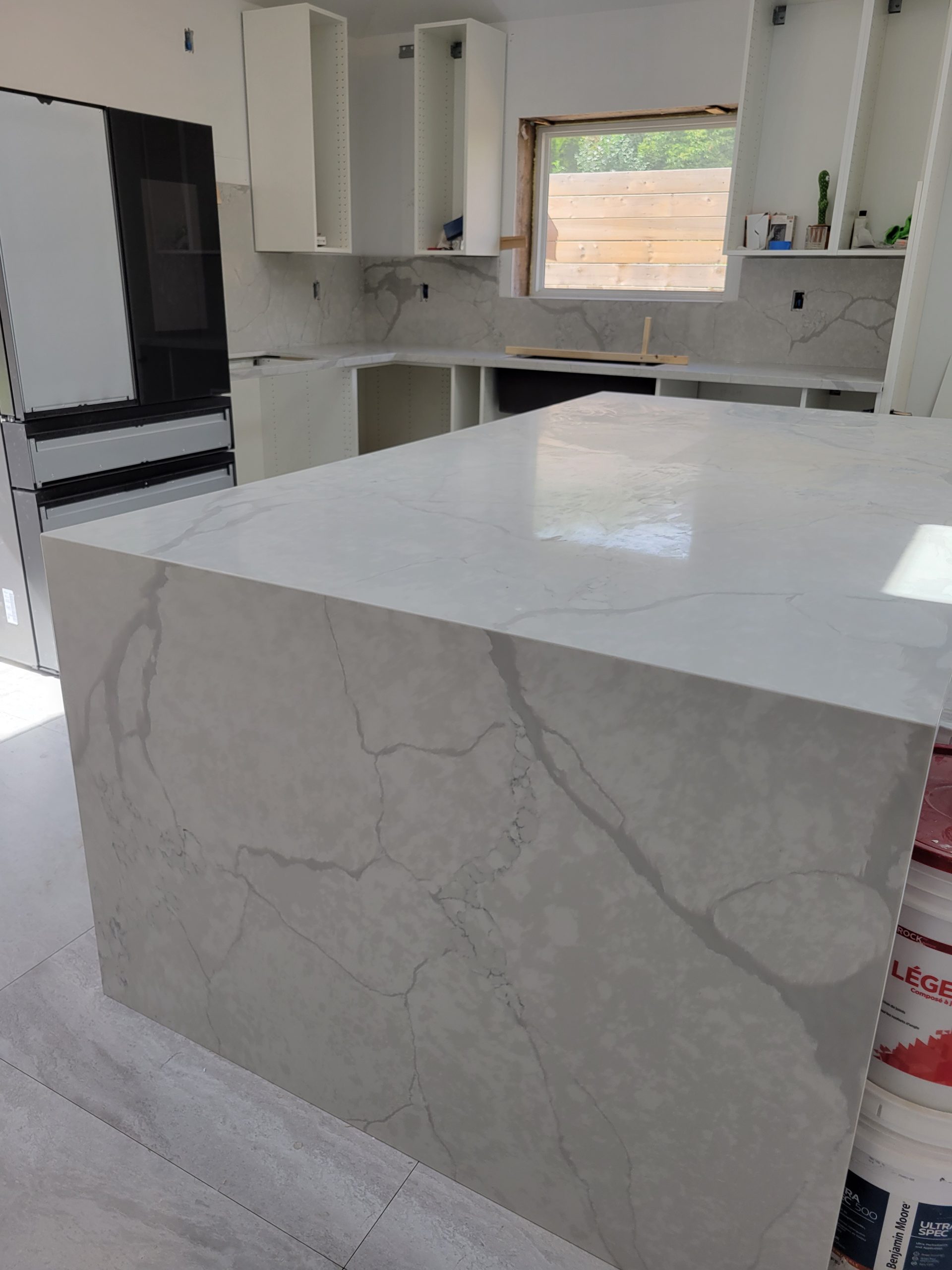
White waterfall countertop installed on a modern kitchen island
Waterfall countertop extending from the island surface down the cabinet end.

What Is a Waterfall Countertop?

A traditional countertop usually stops at the outside edge of the cabinet or island. With a waterfall countertop, the same countertop material continues vertically toward the floor.

The vertical section is commonly called a waterfall leg or waterfall panel. Depending on the design, an island may have one waterfall leg or matching panels on both ends.

The transition between the horizontal countertop and vertical panel is especially important. Many waterfall installations use a carefully fabricated mitered joint so the material appears thicker and the pattern can continue around the corner.

If you are planning this detail for an island, our waterfall island planning guide covers several of the decisions worth making before fabrication begins.

Why Homeowners Choose Waterfall Countertops

Waterfall countertops remain popular because they allow the countertop material to become part of the architecture of the kitchen rather than simply sitting on top of the cabinets.

There are several practical and visual reasons to consider one:

  • Showcases the slab: A vertical panel provides another opportunity to display veining, colour, and movement.
  • Creates a finished island end: The countertop material replaces an exposed cabinet panel on one or both sides.
  • Works well with modern designs: Continuous surfaces and clean lines suit contemporary and transitional kitchens.
  • Can protect cabinet ends: The slab creates a durable exterior surface where an exposed cabinet panel would otherwise be located.
  • Creates visual continuity: Thoughtful vein placement can visually connect the horizontal countertop with the vertical leg.

A waterfall is not automatically the right choice for every kitchen. In some rooms, a conventional island with decorative cabinetry, seating, or furniture-style panels may suit the design better.

Best Materials for Waterfall Countertops

Several countertop materials can be fabricated into waterfall designs. There is no single material that is best for every project.

Quartz

Quartz countertops are commonly used for waterfall islands because they are available in a large range of colours and patterns and require relatively little routine maintenance.

Veined quartz can create an especially striking waterfall, but pattern placement should be considered during slab layout. A poorly planned transition can interrupt the movement of the design at the miter.

Quartzite

Quartzite can create a dramatic natural-stone waterfall, particularly when the slab contains strong movement or veining.

Because every natural slab is different, layout becomes extremely important. The fabricator must determine how the available slab will be divided between the island top and waterfall pieces while accounting for cutouts, usable slab dimensions, seams, and the desired pattern direction.

Granite

Granite countertops are another durable natural-stone option. Granite is available in everything from relatively consistent patterns to slabs with significant movement.

As with quartzite, the actual slab should be considered during layout rather than relying only on a small sample.

Marble

Marble can produce a distinctive waterfall design, particularly when the veining is carefully positioned.

Homeowners should understand marble’s maintenance characteristics before selecting it for a busy kitchen. Marble can etch when exposed to acids, and changes in the finish may become part of the stone’s appearance over time.

Our guide explaining why marble etches provides more detail.

Porcelain

Porcelain slabs can create a thin, modern waterfall appearance and are highly resistant to heat, moisture, and many common stains.

Porcelain behaves differently during fabrication and installation than thicker quartz or natural stone. Edge construction, miters, cutouts, handling, and pattern placement should all be planned for the specific product being used.

Why Vein Matching Matters

One of the biggest differences between an average waterfall installation and a carefully planned one is how the pattern transitions from the countertop to the vertical panel.

With directional quartz, marble, quartzite, porcelain, and other strongly patterned slabs, the goal is often to create visual continuity across the corner. This requires planning the cuts before fabrication.

Perfect pattern continuity is not always possible. Slab dimensions, defects, sink and cooktop cutouts, the size of the island, the number of waterfall legs, and the amount of available material all affect layout.

For a deeper explanation, see our guide on how to match countertop veining.

Mitered Edges on Waterfall Countertops

Many waterfall countertops use a mitered edge at the transition between the horizontal top and vertical leg.

Instead of simply placing one square edge against another, the pieces are fabricated so they meet at an angle. When properly executed, this can create the appearance that the countertop material continues around the corner.

Miter quality matters because the joint is highly visible. Accurate fabrication, proper support, careful handling, and precise installation all contribute to the finished result.

Edge thickness can also change the appearance considerably. A thicker-looking miter may create a more substantial island, while a thinner profile can produce a lighter, more minimal design.

Learn more about these options in our countertop edge profiles guide.

One Waterfall Leg or Two?

You do not necessarily need waterfall panels on both ends of an island.

Single Waterfall

A waterfall on one end can work well when the opposite end contains seating, cabinets, an appliance, or another architectural detail. It also uses less slab material than wrapping both ends.

Double Waterfall

Using waterfall panels on both ends creates a more symmetrical, enclosed appearance and can make the countertop material the dominant feature of the island.

The decision should be made as part of the overall island design rather than assuming two waterfall legs are automatically better than one.

Waterfall Countertops With Island Seating

Seating requires additional planning because the waterfall panels can define the width of the seating area.

Consider:

  • available knee and leg room;
  • countertop overhang;
  • stool width and spacing;
  • support requirements;
  • the position of the waterfall panels;
  • walkway clearance around the island.

These decisions should be made before templating whenever possible. Changing the seating configuration after fabrication can affect the dimensions and support requirements of the countertop.

Waterfall Countertop Pros and Cons

Advantages Considerations
Creates a distinctive finished island Requires additional slab material
Shows more of the countertop pattern More fabrication is required
Can protect exposed cabinet ends Miter alignment and installation need precision
Works with many modern and transitional designs Vein matching can affect slab yield and layout
Can create continuity between the top and sides May not suit every cabinet or seating configuration

If you are deciding whether the additional material and fabrication make sense for your project, read our detailed guide: Are Waterfall Countertops Worth It?

How Much Does a Waterfall Countertop Cost?

There is no reliable universal percentage or square-foot price for adding a waterfall because the cost depends heavily on the individual project.

Important cost factors include:

  • the countertop material and slab price;
  • whether one or two waterfall legs are required;
  • island height and depth;
  • additional slab requirements;
  • miter fabrication;
  • vein and pattern matching;
  • material thickness;
  • site access and installation complexity;
  • whether additional seams or reinforcement are required.

A waterfall design can sometimes require an additional slab even when the total square footage does not appear especially large. Slab dimensions and pattern orientation can make the layout just as important as the calculated area.

For that reason, the most useful price is based on your actual island dimensions and selected material rather than a generic online price per square foot.

What Should Be Planned Before Templating?

The best time to resolve waterfall details is before final measurement.

Confirm:

  • whether the island will have one or two waterfall legs;
  • the finished cabinet dimensions;
  • the intended countertop overhang;
  • seating requirements;
  • finished floor conditions;
  • appliance locations;
  • edge thickness;
  • vein direction and preferred slab layout;
  • any outlets or other features located in the island ends.

These details help the fabricator determine how the pieces should be measured, cut, and assembled.

Why the Floor Matters

A waterfall panel extends close to the finished floor, so floor conditions matter more than they do with a conventional countertop.

If the floor is significantly out of level, the bottom relationship between the slab and floor can become more noticeable. Cabinet alignment and the finished dimensions of the island also affect how the waterfall pieces meet the countertop.

This is one reason accurate templating and site preparation are particularly important for waterfall installations.

Where Else Can Waterfall Details Be Used?

Kitchen islands are the most familiar application, but the same design idea can be used elsewhere.

  • Peninsulas: A waterfall can finish an exposed peninsula end.
  • Bathroom vanities: Vertical slab panels can create a furniture-like vanity design.
  • Bars: Waterfall ends can define a bar or entertainment area.
  • Desks and work surfaces: Stone can continue down the side to create a monolithic appearance.

The fabrication approach may vary depending on the material, dimensions, support, and intended use.

How to Care for a Waterfall Countertop

Care depends primarily on the countertop material rather than the fact that it has a waterfall edge.

Quartz should be protected from excessive heat. Natural stones such as granite and quartzite may require sealing depending on the stone. Marble requires additional awareness of etching, while porcelain has its own product-specific care recommendations.

For general guidance, see our countertop maintenance guide.

Waterfall Countertop FAQs

Are waterfall countertops still in style?

Waterfall countertops continue to be used in contemporary and transitional kitchens, but they should be treated as a design choice rather than something every island needs. A well-proportioned waterfall can remain visually relevant even as broader kitchen trends change.

What material is best for a waterfall countertop?

There is no single best material. Quartz offers low maintenance and a wide range of designs. Granite and quartzite provide natural variation. Marble offers distinctive veining but requires more maintenance awareness, while porcelain can create a thin and modern appearance. The right material depends on the project.

Does a waterfall countertop require an extra slab?

Sometimes. It depends on the island dimensions, number of waterfall legs, slab size, pattern direction, cutouts, and how efficiently the pieces can be laid out. Strong veining may also limit how pieces can be positioned.

Can waterfall countertops have seating?

Yes. Seating can be incorporated into a waterfall island, but overhang, support, stool spacing, knee room, and the position of the waterfall panels should be planned together.

Do waterfall countertops need mitered edges?

Many waterfall designs use mitered joints because they can create a cleaner transition between the horizontal top and vertical panel. The appropriate edge construction depends on the material, thickness, design, and fabrication plan.

Can waterfall countertops be installed on existing cabinets?

Potentially, but the existing cabinetry, dimensions, level, floor conditions, support, and overall layout need to be evaluated. A waterfall addition is not simply a vertical piece attached to an existing countertop; the top and side pieces should be planned as a complete fabrication and installation.

Planning a Waterfall Countertop

A successful waterfall countertop comes down to planning. Material selection matters, but so do slab layout, vein direction, cabinet dimensions, miter fabrication, support, floor conditions, and installation.

Before ordering material, determine how the island will be used and which details matter most. Then the slab layout can be planned around the actual dimensions rather than trying to force a waterfall design from whatever material remains.

For another detailed look at the fabrication side of these projects, see our waterfall island project details guide.

Planning a Waterfall Island?

Stone Valley Countertops supplies, fabricates, and installs quartz, granite, quartzite, marble, porcelain, and other stone surfaces for custom countertop projects across Ontario.

Contact Stone Valley Countertops to discuss your island dimensions, material selection, waterfall layout, and fabrication options.

How to Pair Countertops with Cabinets for a Cohesive Look

Learning how to pair countertops with cabinets is essential for creating a harmonious and stylish kitchen. Whether you’re remodeling or designing from scratch, pairing countertops with cabinets the right way ensures a balanced and aesthetically pleasing design.

💡 Need help selecting the best countertop material? Check out our guide on Types of Countertops: Discover the Best Materials for Your Home.

In this guide, we’ll cover expert tips on how to match colors, materials, and finishes to create a seamless kitchen design.


1. Understanding Color Theory in Kitchen Design

The color combination of cabinets and countertops can define the overall feel of your kitchen. Here’s how different color pairings affect the space:

  • Light Cabinets + Dark Countertops → Creates contrast and adds depth.
  • Dark Cabinets + Light Countertops → A balanced and timeless look.
  • Monochromatic (Similar Tones) → A sleek, modern aesthetic.
  • Bold Cabinets + Neutral Countertops → A statement look without overwhelming the space.

💡 Tip: Use a color wheel to find complementary shades that naturally work together!


2. Best Ways to Pair Countertops with Cabinets for a Cohesive Look

Here are some of the most popular countertop and cabinet combinations that work beautifully in modern kitchens:

Classic White Cabinets

Best Countertop Matches:

  • Marble or Quartz (White with Veining) → Elegant and timeless.
  • Dark Granite or Quartzite → Creates contrast and depth.
  • Warm Wood-Toned Butcher Block → Adds natural warmth.

🔥 Best For: Traditional, farmhouse, and coastal kitchens.


Dark Wood Cabinets

Best Countertop Matches:

  • White or Light Beige Quartz/Granite → Provides contrast and brightens the space.
  • Matte Black or Soapstone → Creates a moody, high-end look.
  • Gray or Taupe Quartz → A modern and neutral balance.

🔥 Best For: Classic, contemporary, and rustic kitchens.


Modern Two-Tone Cabinets

Best Countertop Matches:

  • Neutral Quartzite or Granite → Works with multiple tones.
  • Honed Black or Concrete → Adds texture and industrial style.
  • Soft Green or Blue Quartz → A trendy, nature-inspired choice.

🔥 Best For: Sleek, contemporary, and bold kitchen designs.


3. Choosing the Right Countertop Finish

The finish of your countertops plays a major role in the overall aesthetic:

Polished Finish → Reflects light, making the kitchen feel bright and clean.
Honed (Matte) Finish → A soft, modern look with no glare.
Leathered Finish → Adds texture and character, great for rustic spaces.

💡 Tip: If your cabinets have a glossy finish, consider a matte countertop for balance (and vice versa).


4. Matching Countertop Patterns with Cabinet Styles

If your cabinets have intricate detailing, it’s best to keep the countertops simple. On the other hand, if your cabinets are sleek and minimalist, you can go bold with a high-veining or patterned countertop.

Bold Veining + Simple Cabinets → Adds character to a minimalist kitchen.
Subtle Countertops + Detailed Cabinets → Creates balance without overwhelming the space.

🔥 Tip: Always order countertop samples before finalizing your choice!


5. Creating a Cohesive Look with Backsplashes & Hardware

Don’t forget about backsplashes and hardware—they act as the finishing touches to tie your design together.

Modern Kitchens: Sleek, seamless backsplashes with minimal grout lines.
Traditional Kitchens: Subway tiles or patterned ceramic backsplashes.
Bold Kitchens: Statement backsplashes with geometric designs or metallic accents.

💡 Tip: Match your cabinet handles and faucet finishes to your countertop veining or undertones for a polished look.


Which Countertop & Cabinet Combo is Right for You?

  • Love classic designs? Go for white cabinets + marble countertops.
  • Want high contrast? Try dark cabinets + light quartz countertops.
  • Prefer a modern look? Opt for honed black quartz + wood cabinets.
  • Looking for something bold? Experiment with colored cabinets + neutral countertops.

Final Thoughts

Pairing the right countertops with cabinets is the key to achieving a harmonious and stylish kitchen. Whether you prefer classic contrast, modern minimalism, or bold statement designs, the perfect combination will enhance your space and increase home value.

💡 Need more countertop inspiration? Check out our guide on Types of Countertops: Discover the Best Materials for Your Home.

Need expert design advice? Fill out our quote request form for personalized recommendations!

Dekton vs Porcelain: The Ultimate Countertop Showdown – Which One Wins?

Introduction: The Great Countertop Debate

If you’re planning a home renovation, selecting the right countertop material is crucial. Among the top contenders are Dekton and Porcelain, both known for their durability, style, and practicality. But which one is better for your home? This article will break down the key differences between Dekton vs Porcelain, so you can make an informed choice. Whether you’re remodeling a kitchen, upgrading your bathroom, or looking for outdoor surfaces, we’ve got you covered.


Dekton vs Porcelain: A Quick Overview

Before diving into the details, let’s quickly compare the two materials:

Feature Dekton Porcelain
Composition Blend of porcelain, glass, and quartz Hard-glazed ceramic material
Porosity Extremely low (Non-porous) Low (Comparable to quartz)
Scratch Resistance High (Mohs scale 7/10) Good, but slightly less resistant than Dekton
Heat Resistance Withstands up to 300°C Withstands up to 150°C
UV Resistance Excellent for outdoor applications Also UV resistant but may discolor over time
Stain Resistance Highly resistant Highly resistant
Thickness Options Available in various thicknesses Comes in larger sheet sizes
Warranty 25 years Lifetime warranty (varies by brand)
Price More expensive More cost-effective
Installation Complexity More labor-intensive Easier to fabricate and install

Now, let’s break these factors down in detail.


Durability: Which One Lasts Longer?

Both Dekton and Porcelain are extremely durable, but there are some notable differences.

  • Dekton is engineered using an ultra-compaction process, making it nearly indestructible. It is highly resistant to scratches, stains, heat, and UV rays.
  • Porcelain, on the other hand, is still very durable but slightly more prone to chipping and cracking under heavy impact compared to Dekton.

If longevity and resilience are your top concerns, Dekton has the upper hand.


Heat and Scratch Resistance: Can They Handle the Pressure?

  • Dekton is virtually impervious to heat, handling temperatures up to 300°C without damage. You can place hot pots and pans directly on the surface without worrying about burn marks.
  • Porcelain is also heat-resistant, but its tolerance is lower, around 150°C. Using trivets is recommended to prevent damage.

For scratch resistance, both materials perform well, but Dekton is slightly stronger, scoring 7/10 on the Mohs scale, making it harder to scratch than porcelain.

Winner: Dekton for superior heat and scratch resistance.


Water and Stain Resistance: How Do They Compare?

Both Dekton and Porcelain are non-porous, meaning they resist water absorption and stains exceptionally well.

  • Dekton has almost zero porosity, making it ideal for outdoor use and areas with high moisture levels.
  • Porcelain is also non-porous, but since it has some degree of porosity, certain liquids may leave marks if not cleaned immediately.

Both materials are ideal for kitchen and bathroom countertops, offering effortless cleaning and maintenance.

Winner: Dekton for ultra-low porosity.


Design and Aesthetic Appeal: Which One Looks Better?

When it comes to design versatility, both Dekton and Porcelain offer stunning options:

Dekton comes in a variety of textures and finishes, mimicking natural stone, concrete, and wood grains. Its sleek and modern appearance makes it a favorite for luxury homes.

Porcelain has nearly unlimited design options, including marble, granite, and even metallic or fabric-like finishes. It can be printed with high-definition images for a realistic look.

Winner: Tie! Both materials provide incredible design flexibility.


Installation and Fabrication: Which One is Easier?

  • Porcelain is easier to cut and install, as it comes in larger slab sizes with thinner profiles.
  • Dekton is extremely hard and dense, making fabrication more challenging. It requires special tools and professional installation.

If you’re looking for a hassle-free installation, porcelain is the better choice.

Winner: Porcelain for easier installation.


Cost: Which One Fits Your Budget?

Price is often a deciding factor when choosing a countertop material:

  • Dekton is more expensive due to its advanced engineering and superior durability.
  • Porcelain is generally more affordable, with larger sheet sizes allowing for fewer seams and less waste.

If you’re working on a budget-friendly project, porcelain may be the better option.

Winner: Porcelain for affordability.


Best Uses for Dekton and Porcelain

Application Dekton Porcelain
Kitchen Countertops Perfect for high-traffic use Durable and easy to clean
Bathroom Countertops Highly resistant to moisture Great for humid environments
Outdoor Kitchens Best choice for UV and heat resistance Works well but may fade over time
Flooring Suitable for heavy use Lightweight and easy to install
Wall Cladding Modern and sleek Available in large panels for seamless designs
Furniture Used in high-end designs Lightweight and flexible options

Final Verdict: Choose Dekton if you want extreme durability, and Porcelain if you prefer affordability and ease of installation.


Frequently Asked Questions

Is Dekton better than porcelain?

Dekton offers superior durability, heat resistance, and scratch resistance. However, porcelain is more affordable, easier to install, and comes in larger sheets.

Can Dekton and porcelain be used outdoors?

Yes! Dekton is UV-resistant and highly recommended for outdoor use, while porcelain is also UV-resistant but may show signs of fading over time.

Which is easier to maintain?

Both materials are low-maintenance, requiring only regular cleaning with mild soap and water.

Is Dekton more expensive than porcelain?

Yes, Dekton is generally more expensive due to its advanced manufacturing process and superior durability.

Can you cut directly on Dekton or porcelain countertops?

It’s always best to use cutting boards, even though both materials are scratch-resistant.


Final Thoughts: Which One Should You Choose?

Choosing between Dekton vs Porcelain depends on your needs, budget, and aesthetic preferences.

🔹 If extreme durability, heat resistance, and outdoor usability are priorities, go for Dekton.
🔹 If you prefer a budget-friendly, stylish, and easy-to-install option, porcelain is the better choice.

Both materials are excellent choices for modern, stylish, and long-lasting countertops. The decision ultimately comes down to what works best for your home!

Looking for More Countertop Options?

Still unsure about Dekton vs Porcelain? Explore other countertop materials in our guide to different types of countertops.

For more details on Dekton’s unique features and color options, visit the official Cosentino Dekton page.

Ready for a quote? Fill out the form below to get expert advice and pricing for your countertop project. Let’s bring your vision to life!

Best Kitchen & Bathroom Countertops – Top Choices & Benefits

Best Kitchen & Bathroom Countertops – Top Choices & Benefits

Choosing the best kitchen & bathroom countertops is an important decision for any home. The right surface enhances aesthetics, functionality, and durability. However, with so many options available, selecting the perfect material can feel overwhelming.

💡 Not sure where to start? Check out our guide on Types of Countertops: Discover the Best Materials for Your Home.

This guide compares popular countertop materials, highlighting their benefits and drawbacks to help you make the best choice.


Key Factors to Consider

When choosing a countertop, it’s essential to evaluate a few key factors:

Can it withstand daily use? Durability plays a major role in ensuring your countertop lasts for years.

Does it require sealing or special care? Some materials need regular maintenance, while others are hassle-free.

Will it complement your home’s style? The aesthetic appeal of a countertop should match your kitchen or bathroom design.

What is your budget? Prices vary widely, so consider the best option within your price range.

Will it add to your home’s value? Certain materials, like quartzite and granite, can enhance resale value.

Each material offers unique advantages. Therefore, considering these factors will ensure you make an informed decision.


Best Kitchen & Bathroom Countertops – Material Comparison

1. Quartz Countertops

Why Choose Quartz?

  • ✅ Low Maintenance – No sealing required.
  • ✅ Non-Porous – Resistant to stains and bacteria.
  • ✅ Versatile Design Options – Available in various colors and patterns.

⚠ Potential Downsides:

  • Less heat-resistant than natural stone.
  • Prolonged sun exposure may cause discoloration.

💰 Average Cost: $50 – $120 per sq. ft.


2. Granite Countertops

Why Choose Granite?

  • ✅ Highly Durable – Scratch and heat-resistant.
  • ✅ Distinctive Natural Patterns – No two slabs are alike.
  • ✅ Boosts Home Value – A premium choice for resale.

⚠ Potential Downsides:

  • Requires sealing to prevent stains.
  • Fewer color choices compared to engineered options.

💰 Average Cost: $40 – $100 per sq. ft.


3. Quartzite Countertops

Why Choose Quartzite?

  • ✅ Extremely Hard & Scratch-Resistant – Tougher than granite.
  • ✅ Excellent Heat Resistance – Ideal for kitchens.
  • ✅ Natural Marble-Like Appearance – Luxury look with durability.

⚠ Potential Downsides:

  • Requires periodic sealing.
  • More expensive than quartz and granite.

💰 Average Cost: $80 – $200 per sq. ft.


4. Marble Countertops

Why Choose Marble?

  • ✅ Timeless Elegance – Adds a luxurious feel to any space.
  • ✅ Naturally Cool Surface – Ideal for baking and pastry-making.

⚠ Potential Downsides:

  • Prone to scratches and stains.
  • Requires frequent maintenance.

💰 Average Cost: $60 – $180 per sq. ft.


5. Solid Surface Countertops (Corian, etc.)

Why Choose Solid Surface?

  • ✅ Seamless & Repairable – Scratches can be buffed out easily.
  • ✅ Variety of Color Options – Works with modern designs.

⚠ Potential Downsides:

  • Less heat-resistant than stone.
  • Can scratch if not maintained properly.

💰 Average Cost: $40 – $80 per sq. ft.


Best Kitchen & Bathroom Countertops – Cost Comparison

Here’s a general price comparison of countertop materials:

Countertop Material Average Cost (Per Sq. Ft.)
Quartz $50 – $120
Granite $40 – $100
Quartzite $80 – $200
Marble $60 – $180
Solid Surface $40 – $80

Quartzite and marble are premium choices, while granite and solid surface countertops are more budget-friendly.


Which Kitchen & Bathroom Countertop is Right for You?

  • Choose Quartz for a low-maintenance, stain-resistant option.
  • Choose Granite for a natural stone that’s heat- and scratch-resistant.
  • Choose Quartzite for luxury and extreme durability.
  • Choose Marble for elegance with high maintenance requirements.
  • Choose Solid Surface for a budget-friendly, seamless appearance.

Since every home has different needs, selecting the right countertop depends on your lifestyle, budget, and style preference.


Final Thoughts

Selecting the best kitchen & bathroom countertops requires balancing durability, maintenance, cost, and design. Whether you prefer the versatility of quartz, the natural beauty of granite, or the luxury of marble, there’s a perfect option for you.

💡 Still deciding? Check out our guide on Types of Countertops: Discover the Best Materials for Your Home.

Need expert guidance? Fill out our quote request form to get tailored recommendations!


Your Thoughts?

Looking for the perfect countertop? Fill out our quote request form to get a personalized estimate and expert recommendations! 🚀

Need expert advice? Fill out our quote request form to find the perfect countertop for your home!


Your Thoughts?

Looking for the perfect countertop? Fill out our quote request form to get a personalized estimate and expert recommendations! 🚀

Granite Countertops: Top Benefits for Your Home

Granite countertops remain a popular choice for homeowners due to their combination of elegance and resilience. When you choose granite, you benefit from a surface that enhances both the beauty and functionality of your kitchen or bathroom. At Stone Valley Countertops, we deliver expertly installed granite that transforms your space.

Durability and Strength

Granite is one of the most durable natural stones available, which is why it’s perfect for busy kitchens. It withstands heat and scratches, keeping its pristine look over time. Therefore, you can confidently place hot cookware directly on the surface without worry. Unlike synthetic options, granite maintains its strength and appearance for decades.

Unique Beauty and Variety

Each slab of granite has unique patterns, so no two countertops are exactly alike. This distinctive quality adds visual interest and makes your home stand out. Additionally, granite comes in a range of colors, from deep blues and blacks to warm neutrals, allowing you to find the perfect fit for your décor.

Low Maintenance and Easy Care

Granite is easy to maintain with periodic sealing. With proper care, cleaning is simple—just use warm water and mild soap. By resealing the surface every year or as needed, you ensure its stain resistance and shine remain intact.

Added Value to Your Home

Installing granite countertops doesn’t just beautify your space; it also adds significant value. Potential buyers often seek homes with granite surfaces, so this choice can enhance your home’s marketability.

Explore More Countertop Options

While granite offers many benefits, other materials may align with your needs. For more insights, check out our guide on countertop materials.

Why Choose Stone Valley Countertops?

Our team at Stone Valley Countertops guarantees precision and quality, ensuring every installation showcases the elegance of granite. We prioritize attention to detail and customer satisfaction, so your project is completed with care.

Get Started Today

Enhance your kitchen or bathroom with the timeless appeal of granite. Visit Stone Valley Countertops or request a free quote today.